Emily Rose Martin
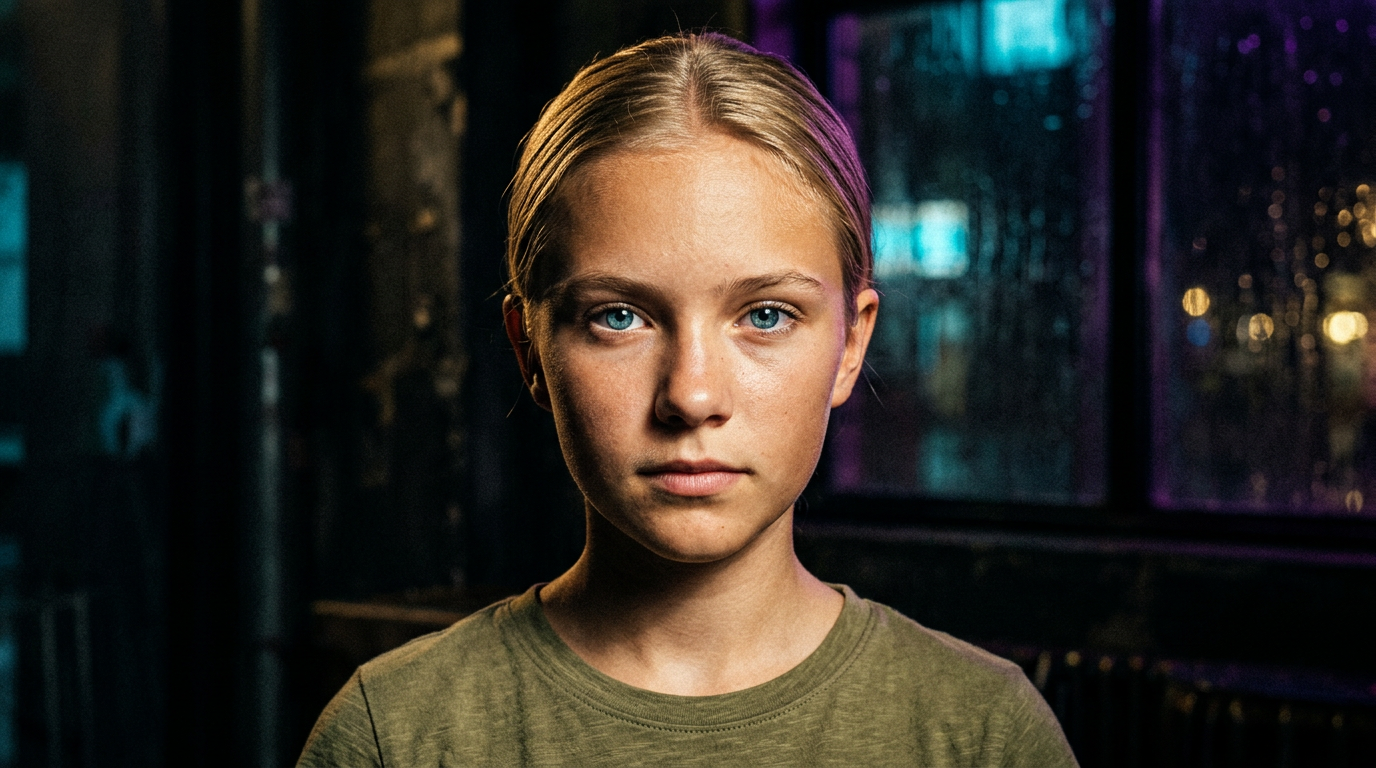
Emily Rose Martin, born on 28 June 2010 in Townsville, was the first child of Corporal David Martin, Australian Army, and Hannah Martin, a yoga instructor. Raised across three cities by the age of eight, Emily developed the particular observational skills of a child who was perpetually new — watching systems, reading dynamics, adapting to unfamiliar environments with practised efficiency. She was eight when the school bus passed through a Portal into Clivilius on 5 August 2018. Her capacity for systems thinking made her an ecological observer across Bixbus's interconnected operations.
The New Kid
Emily Rose Martin was born on 28 June 2010 at the Townsville University Hospital, the first child of Corporal David Richard Martin, Australian Army, then posted to Lavarack Barracks, and Hannah Claire Martin (née Fitzgerald), a part-time yoga instructor who had followed her husband north from Sydney the year before and had not yet decided whether she considered Townsville a temporary assignment or a life sentence. The question would resolve itself within two years, when David's next posting moved them south again, but Hannah did not know that at the time and the uncertainty gave the first months of Emily's life a provisional quality — as though the family were camping in their own house, waiting for orders that would tell them where they actually lived.
David was a signals technician who had enlisted at nineteen, straight out of a state school in Wagga Wagga where his father, Colin James Martin, worked as a mechanic and his mother, Judith Anne Martin (née Reilly), taught Year 4 at the local Catholic primary. He was the eldest of two — his brother, Steven Michael Martin, was three years younger and had stayed in Wagga, working at the same garage as their father. David had joined the Army because it offered a trade, a wage, and a direction, and because Wagga Wagga in 2001 was a town where the options for an eighteen-year-old without a university ambition were limited to the Army, the land, or the pub, and David did not drink.
Hannah was from Cronulla, in Sydney's south, the only daughter of Patrick and Marie Fitzgerald — Patrick a retired customs officer, Marie a piano teacher. Hannah had studied a diploma in health sciences and drifted into yoga instruction with the unplanned momentum of a person whose talents were real but whose career ambitions were vague. She met David at a barbecue in Holsworthy when he was posted to the base there in 2007, and they married in 2009, six months before his transfer to Townsville.
She was warm, adaptable, and possessed of a patience that military spouses either developed or did not survive without. She had developed it — though not without cost, and not without the occasional evening when she sat on the back step after Emily was in bed and wondered what her life would have looked like if she had married someone whose employer did not move her every two years.
Emily's younger brother, James David Martin, was born on 12 September 2013, also in Townsville. By then, the family had already moved once — from the base housing at Lavarack to a rented house in Aitkenvale that Hannah had chosen because it had a garden and because the kitchen window faced west, which meant she could watch the sunset while cooking dinner, a small luxury she considered non-negotiable. James was a cheerful, uncomplicated baby whose primary contribution to the household was an ability to sleep through any noise, a talent that would prove useful in a home where David's phone could ring at three in the morning with instructions to report to base.
In 2015, David was posted to Holsworthy in Sydney. The family moved south. Emily, at five, started school in Moorebank, made friends, lost them three months later when the family moved from base housing to a rental in Liverpool, made new friends, and began developing the particular skill set of a child who changes environments frequently: she watched. She assessed. She learned, before introducing herself to a new group, to observe its dynamics — who was the leader, who was the outsider, who would welcome a newcomer and who would not — with the analytical patience of a field researcher studying an unfamiliar species.
She was not shy. She was strategic, in the way that children who have been the new kid three times by the age of six become strategic, because the alternative was to walk into every new room blind and hope for the best, and Emily had learned that hope was less reliable than information.
In 2017, David was posted to Gallipoli Barracks in Enoggera, Brisbane. The family rented a house in Ashgrove — a fibro cottage with a corrugated iron roof and a mango tree in the back yard that dropped fruit onto the lawn in January with an abundance that attracted fruit bats and delighted James, who was three and considered the bats a personal entertainment service. Emily started at Brisbane Grammar School in Year 3, the same year as the field trip to D'Aguilar. It was her third school in four years.
She adapted. She always adapted. The Grammar uniform was different, the building was older, the children were louder, and the playground was smaller than Liverpool, but the underlying architecture of a school — its hierarchies, its alliances, its rules spoken and unspoken — was the same everywhere, and Emily read it within a week. She identified the girls who would accept her, the boys who would ignore her, the teachers who rewarded quiet compliance and the one who preferred enthusiasm. She calibrated her behaviour accordingly, not because she was manipulative but because she had learned, through repetition, that belonging was a skill and not a birthright, and that the children who belonged most naturally were usually the ones who had never had to learn how.
Her interest in the natural world predated Brisbane but deepened there. In Townsville, she had watched geckos on the ceiling and learned their habits — which corners they preferred, what time they emerged, how they communicated through clicks and postures. In Sydney, she had spent weekends at the Royal National Park with Hannah, walking trails and asking questions that Hannah could answer about plants and could not answer about the complex relationships between them. Emily's curiosity was not taxonomic — she did not care what things were called. She cared how they connected. Why did this bird eat that insect? Why did this plant grow beside that tree and not another? Why did the garden at the Ashgrove house support different creatures than the garden in Liverpool, even though both had the same lawn and the same fence?
She thought in systems, though she did not know the word, and the habit of seeing connections where other people saw individual things was so instinctive that she did not realise it was unusual until a teacher at Grammar mentioned it in a parent-teacher interview and Hannah, surprised, said she had not noticed.
The Neck That Remembered
The overnight field trip to D'Aguilar National Park departed from Brisbane Grammar School on the morning of Saturday, 4 August 2018. Emily packed her bag with the military precision she had absorbed from watching her father prepare for exercises — everything in its designated pocket, the spare clothes in a compression sack, the water bottle accessible without opening the main compartment. David, who was on base that weekend, had checked her bag the night before and added a head torch that Emily did not think she needed and would later be grateful for. Hannah drove her to the school in the early morning darkness and watched the bus pull away with the particular composure of a woman who had watched her husband leave on deployments and who had learned that goodbyes were better conducted quickly and without fuss.
At D'Aguilar, Emily walked the guided trail with an attention that Susan Clarke noticed and appreciated. Most children looked where Clarke pointed. Emily looked at what Clarke was not pointing at — the undergrowth beneath the featured tree, the insect activity on the bark, the moss patterns that indicated moisture levels and shade duration. She asked questions that required Clarke to think before answering, which was unusual in an eight-year-old and which Clarke later recalled as the thing she remembered most clearly about the girl with the blonde pigtails and the blue eyes that moved constantly, cataloguing everything.
The bus departed D'Aguilar on the morning of 5 August for the return to Brisbane. Emily was seated in the middle section, her backpack on the floor, her head turned toward the window.
The bus passed through a Portal opened across a road in the Brisbane suburbs and collided with vehicles on the far side, in the landscape of Clivilius. The impact threw Emily forward into the seat in front. Her face struck the headrest and her neck snapped backward with the whiplash motion of an unbraced collision — the cervical muscles and ligaments wrenching beyond their range, the soft tissue damage instant and invisible. Bruising bloomed across her left cheekbone and the bridge of her nose where her face had connected with the seat. She did not lose consciousness. The pain in her neck was not sharp like a break but deep and spreading, a wrongness that radiated from the base of her skull down through her shoulders and settled into her upper back like something that had moved in and intended to stay.
Raj Patel assessed her on the bus. He checked her cervical spine for fracture — manipulating her head gently through its range of motion while Emily held very still and did not cry, not because she was brave but because she had learned from watching David that pain was information and that the person assessing you needed information more than they needed your tears. The spine was intact. The damage was muscular and ligamentous — whiplash that would cause headaches, stiffness, and restricted movement for weeks. Patel fashioned a soft collar from folded fabric and told her to keep her head still. Emily complied with the discipline of a child raised in a household where instructions from authority were followed first and questioned later.
She did not panic. The other children cried. Emily sat with her improvised collar and her bruised face and her throbbing neck and watched. She watched the adults organise the evacuation. She watched the older children help the younger ones. She watched the landscape through the shattered windows — the wrong sky, the sparse terrain, the absence of everything familiar — and she catalogued it the way she had catalogued every new environment she had entered since she was five years old. This was a new place. She did not understand it. But she had been the new kid before, and the first thing the new kid did was watch.
The Girl Who Mapped the Edges
The whiplash took longer to heal than anyone expected. Six weeks after the collision, Emily could turn her head without pain. Three months later, she could look up at the sky without a pulling sensation in her upper back. But the neck retained a sensitivity that flared in cold weather and after long periods of stillness, and the headaches — a dull, persistent pressure behind her eyes that arrived without warning and left on its own schedule — continued intermittently for the better part of a year. She learned to live with them the way she had learned to live with everything: by adapting, by adjusting, by never mentioning them unless asked.
She attended the Learning Grove from its earliest weeks, the fabric collar still around her neck, her observation notebook — a small exercise book she had salvaged from the bus wreckage — open on whatever surface was available. Jenny Triffett placed her in an ability group with children of similar academic strength, and Emily's performance was quietly strong across all areas: her reading was advanced for her age, her writing was clear and descriptive, her numeracy was competent. She was not the kind of student who demanded attention. She was the kind who earned it gradually, through the consistent quality of work that appeared on her desk each morning, completed without fuss and without error and without the drama that other children required to produce the same output.
The afternoon practical sessions revealed something that the classroom could not. At the Verdant Nursery, Emily noticed that the plants nearest the irrigation line were growing differently from those ten metres away — not just in size but in leaf colour, root spread, and susceptibility to a fungal infection that was bothering the nursery staff. She mentioned it to an adult. The adult looked. Emily was right. The observation was not remarkable in itself — an experienced gardener would have seen it — but it was remarkable in an eight-year-old, because Emily had not just noticed the difference; she had noticed the pattern, the connection between water availability and disease resistance, the system that linked one variable to another in a way that the adults who tended each plant individually had not stepped back far enough to see.
This became her defining quality at Bixbus: she saw systems. Where other children gravitated toward a single site and a single skill — Mason Clarke to geology, Lucas White to animals, Jacob Thomas to plants — Emily moved between sites and saw how they connected. The nursery grew seedlings that were transplanted to the orchard. The orchard produced food that generated organic waste. The waste composted into soil amendments that returned to the nursery. The Haven of Wilds managed fauna whose grazing patterns affected the vegetation that the nursery staff were trying to cultivate. These connections were obvious in retrospect and invisible in practice, because the people managing each site were focused on their own domain and did not always look sideways.
Emily looked sideways. She had been looking sideways since she was five years old and learning to read the dynamics of a new classroom, and the habit, applied to an ecosystem rather than a social group, proved unexpectedly valuable.
The transition to Bixbus School in late 2019 gave her work a structure. Her mornings were spent in academic classes where she was consistently near the top of her cohort — not through brilliance but through the disciplined application of attention that was, by now, so habitual she did not recognise it as effort. Her afternoons, under the community mentorship programme, did not settle into a single placement the way other students' did. She rotated between the nursery, the orchard, and the Haven of Wilds, and the rotation was deliberate — she had asked for it, and the staff had agreed because Emily's observations, delivered in her quiet, precise way, were useful to all three operations. She kept a journal that recorded not what she did but what she saw — interactions between species, effects of weather on growth, changes in animal behaviour that preceded changes in vegetation.
By twelve, the journal ran to several volumes, cross-referenced by date and location, written in handwriting that was small and neat and relentlessly factual.
She was not, despite appearances, a natural scientist. She had no interest in theory for its own sake. She could not have explained the nitrogen cycle or described the mechanics of photosynthesis, and her understanding of ecology was observational rather than conceptual — rooted in what she had seen, not what she had read. She was an observer. She had been an observer since birth, trained by circumstance and temperament to watch how things worked before she attempted to participate in them, and the training had produced a person who could sit at the edge of a system — social, ecological, mechanical — and understand its dynamics with a clarity that the people inside it could not achieve.
Her social life reflected the same quality. She had friends — a stable, small group that had formed in the Learning Grove years and persisted through adolescence. She was liked but not widely known, respected but not popular in the way that Lucas White or Oliver Smith were popular, because Emily did not perform sociability. She was present, she was warm when warmth was needed, and she disappeared without notice when she wanted to be alone, which was more often than people expected.
She had grown up moving between cities and schools, and the experience had given her a self-sufficiency that was functional and isolating in equal measure. She could enter any group and find her place within it. She could also leave any group without attachment, and the ease with which she detached — from conversations, from routines, from people — was something she had never examined closely enough to recognise as a scar.
The military childhood had prepared her for Clivilius in ways that were useful and ways that were damaging, and the two were difficult to separate. She adapted faster than most children. She did not cling to routines that had been lost. She accepted new authority structures without resistance. These were strengths, and the adults around her praised them, and the praise reinforced the behaviour, and nobody paused to consider that a child who adapts to catastrophe without visible distress is not necessarily a child who has processed it.
Emily had not processed it. She had filed it. She had placed the loss of her family — David, Hannah, James, the house in Ashgrove with the mango tree, the sound of fruit bats at dusk — in the same mental compartment where she stored every previous departure, every previous school, every previous set of friends she had left behind. The compartment was full. It had been full for years. But Emily had never learned any other way to manage loss, because the Army had taught her family that departure was not a crisis but a rotation, and she had internalised the lesson so completely that she applied it even when it did not apply.
She was sixteen, and she lived in the shared quarters at Bixbus with the quiet self-possession of someone who had never expected any place to be permanent. Her mornings were spent at Bixbus School, where her academic work was strong and her teachers had learned to value the observations she offered — infrequently, precisely, and usually about something nobody else had noticed. Her afternoons were spent between sites, her journal open, her eyes moving across the settlement's interconnected operations with the same watchful attention she had once given to playground hierarchies in Moorebank and geckos on the ceiling in Townsville.
She missed her father's steadiness. She missed her mother's patience. She missed James, who had been four when the bus left for D'Aguilar and who would be twelve now, and she wondered sometimes what kind of boy he had become and whether he remembered her at all. She did not dwell on these thoughts. She noted them, the way she noted everything, and moved on — because Emily had learned, long before the Portal, that the new kid could not afford to look backward for too long. There was always another room to read, another system to understand, another place to learn to belong to without ever quite believing it was hers.







