Emily Louise Jeffries
Emily Louise Jeffries (1992-2018) embodied the pursuit of scientific truth against the backdrop of ancestral darkness. Born into Tasmania's enigmatic Jeffries dynasty, she transformed her analytical brilliance into biochemical research, seeking to unlock life's molecular mysteries whilst navigating profound personal loss. Her promising career in molecular biology ended tragically at twenty-five during the Jeffries Manor Massacre, leaving the scientific community bereft of a mind destined for discovery and the family mourning a daughter whose curiosity illuminated their shadowed halls.
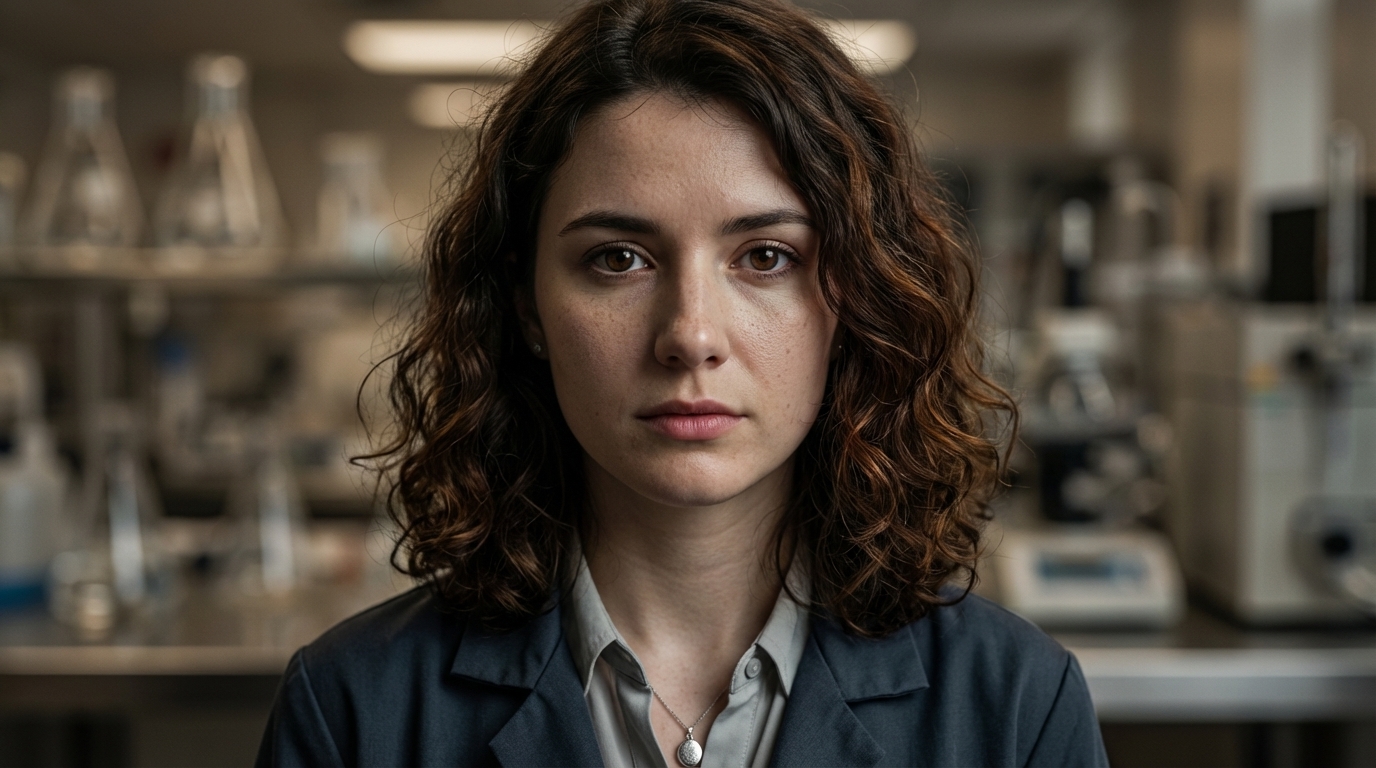
Childhood in the Shadow of the Manor
Emily Louise Jeffries arrived on a summer morning, 13 December 1992, at the Royal Hobart Hospital, the second daughter born to Thomas Charles Jeffries and Louise Elizabeth Greyson. Her birth came during a period of cautious stability for the young family—Thomas had completed his Bachelor of Commerce the previous year and was beginning his apprenticeship at Jeffries Industries under his father Charles's exacting tutelage, whilst Louise balanced motherhood with the final year of her Bachelor of Business degree. Unlike her elder sister Rebecca, whose arrival in September 1990 had shocked both families with its prematurity, Emily's birth was planned, expected, and welcomed as confirmation that Thomas and Louise had indeed created something lasting from their unconventional beginning.
The Jeffries Manor of Emily's earliest years existed in a peculiar state of transition. Her parents lived there unmarried, raising two daughters in the grand Georgian sandstone house whilst navigating the social complexities that Tasmania's established families found deeply uncomfortable. Emily's first two and a half years were spent in this ambiguous space—neither quite legitimate nor entirely scandalous, with great-grandfather James III and great-grandmother Thelma Rose maintaining the emotional distance that suggested disapproval too polite to voice directly.
The summer wedding of 1995, when Emily was nearly three, transformed that ambiguity into official recognition. She and Rebecca served as flower girls, their white dresses and scattered rose petals marking not just their parents' union but their own transition from questionable additions to acknowledged heirs. Emily, too young to understand the significance consciously, absorbed the unspoken message that formal structures mattered in the Jeffries world, that legitimacy came through proper channels rather than merely lived reality.
The arrival of her younger brother Kain in 1995, shortly after the wedding, and sister Katie in October 1996, completed the family constellation that would shape Emily's childhood. At three and then four years old, Emily occupied the middle ground between Rebecca's eldest responsibilities and the younger siblings' demands for attention. This position suited her emerging personality—she possessed neither Rebecca's natural leadership nor Katie's creative expressiveness, but rather a quiet intensity that manifested as sustained focus on whatever captured her interest.
The manor's vast grounds became Emily's first laboratory. Whilst Rebecca organised elaborate games and Katie spun stories about the estate's hidden corners, Emily conducted her own investigations. She collected insects with systematic thoroughness, categorising them by observable characteristics years before she encountered formal taxonomy. She watched the seasonal cycles of the manor's gardens with focused attention, noting which plants flowered when, how different species responded to Tasmania's temperamental weather, the patterns that underlay apparent chaos.
Louise recognised these tendencies early, seeing in her second daughter echoes of her own mathematical aptitude channelled into different domains. Where Louise's mind had organised numbers and financial patterns, Emily's sought to understand living systems—more complex, more resistant to simple categorisation, but governed by principles that careful observation might reveal. Thomas, increasingly consumed by the demands of Jeffries Industries and the weight of family expectations, had less time for individual attention to his children's developing personalities, but he noted approvingly that Emily seemed to inherit the Jeffries tendency towards intellectual pursuits rather than mere social charm.
The family dynamics of Emily's childhood were marked by careful navigation of Thomas's moods and increasing paranoia. Charles Jeffries' mysterious disappearance in 2008, when Emily was fifteen, fundamentally altered the household. Thomas's assumption of control over Jeffries Industries came with mounting pressure and escalating security concerns. The manor, already imposing, became fortified—additional surveillance cameras, private security staff, protocols for entry and exit that transformed the family home into something approaching a compound.
For Emily, these changes reinforced a sense that the world beyond the manor's walls posed threats that vigilance might mitigate. Where Rebecca increasingly questioned their father's behaviour and Katie withdrew into imagination, Emily internalised the message that danger lurked in unexpected places, that careful observation and systematic preparation might prevent catastrophe. These childhood lessons would shape her approach to both scientific inquiry and personal relationships, instilling habits of caution that served her research whilst sometimes isolating her socially.
Academic Excellence and Theatrical Escape
Emily's enrolment at St. Michael's Collegiate School in 1999, aged six, marked her entry into Hobart's elite educational system. The prestigious institution, where her elder sister Rebecca had already established herself as academically exceptional, initially seemed to position Emily as merely following in established footsteps. But whilst Rebecca's brilliance manifested across subjects with particular strength in law and ethics, Emily's gifts concentrated more narrowly in the sciences and mathematics, displaying from her earliest years a facility with systematic thinking that her teachers found remarkable.
Primary school revealed Emily's pattern of approaching problems methodically. Whilst other children guessed at answers or relied on intuition, Emily worked through logical progressions, testing hypotheses, adjusting based on results. Her Year 3 teacher, Mrs. Patricia Hendricks, later recalled: "Emily approached a simple addition problem like a scientist conducting an experiment. She'd show her working, explain her reasoning, and if she got the wrong answer, she'd retrace her steps to find where the error occurred. At eight years old, she possessed more intellectual rigour than some adults I've known."
But Emily wasn't merely an isolated prodigy lost in abstractions. The discovery of drama club in Year 5 revealed an unexpected dimension to her personality. On stage, freed from the self-consciousness that sometimes marked her social interactions, Emily found a space where intellectual control gave way to emotional expression. She excelled at character study, approaching roles with the same systematic analysis she brought to scientific problems—reading the text carefully, identifying the motivations, constructing coherent interpretations of behaviour and emotion.
Her performance as Scout Finch in St. Michael's Year 8 production of To Kill a Mockingbird demonstrated the synthesis of Emily's analytical and creative capacities. She didn't merely recite lines but inhabited the character, capturing Scout's fierce intelligence and moral clarity with a conviction that moved the audience. Rebecca, watching from the seats with their parents, recognised in Emily's performance something of her own struggle to reconcile privilege with justice, though Emily approached these questions through imagination rather than activism.
The teenage years brought increasing academic sophistication alongside the emotional turbulence common to adolescence. Emily's science teachers, recognising her exceptional aptitude, provided opportunities for advanced study. She completed chemistry and biology curricula ahead of her year level, spent lunch hours in the laboratories conducting independent experiments under teacher supervision, participated in state-level science competitions where she consistently placed amongst the top performers.
Yet this academic success came with social costs. Emily's intensity, combined with the Jeffries family's growing reputation for eccentricity following Charles's disappearance and Thomas's increasingly paranoid behaviour, created isolation amongst her peers. She had friends—girls from established Hobart families who shared classes and activities—but these relationships remained somewhat superficial. The deepest connection remained with Rebecca, two years older and navigating her own complicated relationship with the Jeffries legacy, who served as confidante and source of emotional support when the weight of family expectations and social awkwardness threatened to overwhelm.
The theatrical productions continued throughout secondary school, providing Emily with the creative outlet that balanced scientific rigour. She played Juliet in Year 10's Romeo and Juliet, brought surprising depth to Lady Macbeth in Year 11, and delivered a memorable Hermia in the Year 12 production of A Midsummer Night's Dream. These performances revealed Emily's capacity for emotional connection when protected by the structure of scripted roles—on stage, she could express vulnerabilities and passions that remained more guarded in daily life.
Her final years at St. Michael's saw Emily emerge as not merely academically gifted but intellectually formidable. She graduated in 2010 with exceptional results across all subjects, particular distinction in chemistry, biology, mathematics, and physics. The valedictory address that year was delivered by Rebecca as school captain, but Emily's academic achievements earned her recognition as science student of the year—an honour that carried particular weight at an institution that prided itself on producing distinguished scientists.
The decision to pursue university study seemed inevitable to everyone who knew Emily. The only questions involved which field would claim her attention and whether she would remain in Tasmania or seek opportunities elsewhere. Louise, understanding her daughter's need for both challenge and stability, encouraged Emily to begin at the University of Tasmania whilst remaining open to future possibilities. Thomas, increasingly absorbed by Jeffries Industries' demands and his mounting paranoia, expressed approval of Emily's academic pursuits whilst seeming not quite to see her as an individual rather than another Jeffries heir fulfilling expected obligations.
University Years and the Discovery of Biochemistry
Emily's enrolment at the University of Tasmania in 2011 to pursue a Bachelor of Science marked the beginning of her transformation from talented student to dedicated researcher. The decision to remain in Tasmania rather than pursuing opportunities in Melbourne or Sydney reflected both practical considerations and emotional attachments—she could live at Jeffries Manor, maintaining connections with family whilst exploring intellectual independence in an environment familiar enough to feel manageable.
The first-year science curriculum, with its breadth across disciplines, allowed Emily to explore different fields before settling on specialisation. She excelled across subjects—physics, chemistry, biology, mathematics—but found herself increasingly drawn to biochemistry, fascinated by the intersection of chemical principles and living systems. The revelation that life's complexity emerged from molecular interactions governable by physical and chemical laws captured Emily's imagination in ways that pure physics or traditional biology could not.
Professor Michael MacKenzie, who taught Emily's second-year biochemistry course, later described her as "the student who asked questions that revealed she'd already been thinking beyond the material covered in lectures. She didn't just want to know what happened in cellular metabolism—she wanted to understand why those particular pathways had evolved, what constraints shaped their development, how variations in molecular structure might alter function. She thought like a researcher before she'd ever entered a research laboratory."
The theatre troupe that Emily joined during her first year provided welcome balance to scientific intensity. The Hobart Community Players, a local company that produced several shows annually, attracted amateur actors from across the city—university students, professionals seeking creative outlets, retirees rediscovering passions set aside for careers. Emily found amongst this eclectic group an acceptance that sometimes eluded her in other social contexts. On stage, her intensity became asset rather than liability, her careful analysis of character translating into nuanced performances.
It was through the Community Players that Emily met Liam O'Connor, a fellow actor three years her senior who worked as a carpenter whilst pursuing theatrical ambitions in his spare time. Their romance developed over rehearsals for a production of The Crucible in late 2011, Emily playing Abigail Williams to Liam's John Proctor. The intensity required by those roles, combined with the hours spent together exploring character and motivation, created intimacy that extended beyond the stage.
Liam represented everything that Emily's carefully controlled academic life was not—spontaneous, emotionally expressive, comfortable with uncertainty. Where Emily approached problems systematically, Liam trusted intuition. Where she planned meticulously, he improvised. Yet these differences created complement rather than conflict. Liam encouraged Emily to trust her instincts more, to allow space for emotion alongside analysis. Emily helped Liam think more strategically about his carpentry business and theatrical career, bringing organisational skills to the creative chaos.
Their relationship, Emily's first serious romance, opened dimensions of experience that intellectual pursuits alone could never provide. The physical intimacy was novel and occasionally overwhelming for someone whose default mode involved analysis rather than sensation. The emotional vulnerability required by genuine partnership challenged Emily's carefully maintained control. But the rewards—the sense of being fully known and accepted, the joy of sharing interests across their different domains, the simple pleasure of companionship—made the challenges worthwhile.
Louise watched Emily's relationship with Liam with mixed feelings. She recognised that Liam was fundamentally decent, genuinely cared for Emily, and brought lightness into her daughter's sometimes overly serious existence. But Louise also worried about the practical realities—Liam's limited earning potential, his lack of university education, the cultural gaps between a tradesman and the daughter of Tasmania's wealthiest family. She kept these concerns largely private, determined not to repeat the pattern where external disapproval had complicated her own relationship with Thomas during their university years.
The tragedy came with devastating suddenness in March 2012. Liam, driving home after a carpentry job in Launceston, lost control of his vehicle on the Bass Highway during heavy rain. The crash killed him instantly. Emily, then nineteen and in her second year of university, received the phone call from Liam's sister whilst studying in the campus library. The transition from absorbed concentration in biochemistry to the incomprehensible reality of Liam's death occurred in the space of minutes—no preparation, no possibility of farewell, nothing but the sudden absence where a person had been.
The grief that followed was complicated by Emily's analytical nature. She couldn't simply mourn—she had to understand. She researched traffic accident statistics, highway safety standards, the physics of vehicular crashes. She obtained the official report, reading with detached horror the technical description of the collision, the medical examiner's clinical account of the injuries that had killed her boyfriend. The effort to impose intellectual order on emotional chaos provided temporary relief from the raw pain but ultimately only delayed the necessary work of genuine mourning.
Melbourne and Molecular Mysteries
Emily's graduation from the University of Tasmania in 2014 with first-class honours in biochemistry represented both significant achievement and bitter milestone. The years between Liam's death in 2012 and this moment had been marked by fierce devotion to studies, as if accumulating knowledge might fill the void his absence created. Her honours thesis, examining the role of specific proteins in cellular metabolism, demonstrated research capabilities that impressed her supervisors and suggested genuine potential for original contributions to the field.
The offer of a place in the University of Melbourne's prestigious graduate programme in molecular biology arrived in late 2014, accompanied by a research scholarship that would fully fund her studies. The opportunity represented everything Emily had worked towards—access to cutting-edge facilities, supervision by leading researchers in the field, participation in projects pushing the boundaries of human understanding about genetic mechanisms and disease processes.
Yet accepting meant leaving Tasmania, abandoning the family and familiar surroundings that had provided stability through the grief and ongoing challenges. Rebecca had already left for Harvard in 2012, pursuing her legal studies in Cambridge, Massachusetts. If Emily also departed, only Kain and Katie would remain with their parents at an increasingly tense Jeffries Manor. Louise expressed support whilst privately worrying about the mounting family pressures that Emily's departure would exacerbate. Thomas, absorbed in his paranoid management of Jeffries Industries, barely seemed to register the decision beyond perfunctory approval.
Emily's relocation to Melbourne in early 2015 marked the most significant geographical and emotional distance she'd ever established from home. The city, vastly larger than Hobart, initially overwhelmed her. The University of Melbourne, with its Gothic Revival architecture and international student population, represented academic prestige on a scale Tasmania couldn't match. The molecular biology programme demanded capabilities that even Emily's strong undergraduate preparation had only partially developed.
The first months involved exhausting adjustment—learning new laboratory techniques, absorbing the theoretical frameworks that extended far beyond her previous knowledge, navigating the social dynamics of a research group where personalities and politics mattered as much as scientific ability. Emily's tendency towards intense focus served her well in the laboratory but sometimes created difficulties with colleagues who valued collaboration and casual interaction alongside rigorous methodology.
Her research, conducted under Professor Sarah Lin's supervision, examined the role of genetic variations in metabolic diseases. The work involved intricate laboratory techniques—genetic sequencing, protein analysis, cellular studies—combined with computational modelling to understand how specific mutations affected molecular function. Emily found in this research a kind of peace that had eluded her since Liam's death. The problems were intellectually demanding but ultimately soluble through careful application of method. The patterns that emerged from data suggested underlying order to life's complexity.
Professor Lin later described Emily as "exceptional in her technical capabilities and theoretical understanding, though sometimes so absorbed in her immediate research questions that she lost sight of broader implications. She could spend hours optimising a single experimental protocol, pursuing incremental improvements with determination that bordered on obsession. That intensity produced rigorous results but occasionally came at the cost of perspective."
The graduate student community in Melbourne provided social connections that Emily navigated with mixed success. She attended the departmental gatherings, participated in the journal clubs where students discussed recent papers, joined colleagues for occasional evenings at the campus pubs. But these interactions remained somewhat superficial. Emily's grief over Liam, never fully processed, created emotional barriers that prevented deeper friendship. Her family background, which she rarely discussed, added another layer of separation from peers whose circumstances bore little resemblance to growing up as a Jeffries.
The phone calls home revealed the accumulating tensions that Emily's distance made more bearable but couldn't entirely escape. Rebecca had returned from Harvard in 2015, choosing legal aid work in Hobart that put her at odds with Thomas's values. The Christmas gathering of 2017, which Emily attended with both anticipation and dread, featured the explosive confrontation between Rebecca and Thomas about the ethics of Jeffries Industries' operations. Emily, watching her brilliant elder sister challenge their father's fundamental assumptions whilst their mother tried desperately to mediate, felt the familiar guilt of having chosen distance over engagement.
Yet even as family tensions mounted, Emily's research progressed impressively. She published her first peer-reviewed paper in 2016, contributed significantly to a collaborative study examining genetic factors in diabetes that appeared in a prominent journal in 2017. Her supervisors expressed confidence that she would complete her doctoral work by 2020 or 2021, positioning her for postdoctoral opportunities at leading research institutions worldwide.
The irony would later seem almost unbearable—Emily was on the cusp of fully establishing herself in the career she'd worked towards since childhood, finally moving beyond the shadow of tragedy and family complications, when the events of 2018 would draw her back into the very darkness she'd tried to escape through scientific pursuit.
Family Crisis and the Final Return
The phone call that changed everything came on 27 July 2018. Louise's voice, usually so controlled even in difficult circumstances, betrayed the panic that Emily had never heard from her mother before. Kain had disappeared. He'd gone to check on Uncle Jamie at Louise's request the previous day and simply never returned. No contact, no explanation, nothing but the silence where her brother should have been. And Jamie himself had been missing for several days before that, his absence triggering Louise's concerns that had prompted Kain's welfare check.
Emily, sitting in the University of Melbourne library when the call came through, felt the familiar sensation of the world becoming unreal, the intellectual order she'd constructed through years of scientific study suddenly revealed as fragile construct over chaos. Her immediate response combined her mother's analytical precision with barely controlled terror—gathering information, establishing timelines, asking practical questions about what steps the police were taking, whether there were any leads.
But underneath the practical discussion ran the current of dread that both women recognised without fully acknowledging. The Jeffries family's history of mysterious disappearances stretched back generations—William Jeffries Sr. vanishing in 1821 under circumstances never explained, Charles Jeffries disappearing in 2008 just as Thomas assumed control of the family business, and now Kain and Jamie simultaneously gone without trace. The pattern suggested something more than coincidence, though neither Emily nor Louise could articulate what that something might be.
Emily's decision to suspend her doctoral research and return to Tasmania came without real deliberation. Whatever progress she'd made in establishing distance from family obligations collapsed immediately in the face of genuine crisis. Her supervisors, whilst disappointed, understood that family emergencies sometimes superseded academic commitments. They assured her that she could resume her work whenever circumstances permitted, that her research position would remain open, that they expected to see her back in Melbourne once the immediate situation resolved.
The return to Jeffries Manor in early August 2018 revealed the extent of deterioration in the five months since Emily's last visit. Thomas had installed additional security measures that transformed the estate into something approaching a fortress—motion sensors, expanded camera coverage, protocols for entry and exit that would have seemed ridiculous if they weren't so clearly born of genuine paranoia. The private security staff moved through the grounds with military efficiency, their presence making the family home feel like an occupied territory.
The household's emotional atmosphere was even more disturbing than the physical changes. Louise existed in a state of barely controlled panic, maintaining surface functionality whilst drowning in anxiety about her missing son and brother. Rebecca, who'd been present throughout the unfolding crisis, moved through the manor with tense wariness, her legal training making her hyperconscious of the increasingly bizarre circumstances. Katie, then twenty-one, oscillated between helping their great-grandmother Thelma and withdrawing into creative work that provided temporary escape from mounting dread. Thomas spent hours in his study, monitoring security feeds and making phone calls to contacts whose purposes he didn't explain.
Emily found herself simultaneously trying to support her mother, maintain connection with her sisters, and navigate her father's paranoia. The scientific training that had served her well in controlled laboratory environments provided little guidance for the psychological dynamics now dominating Jeffries Manor. She applied what analytical capacity she could muster—helping Louise organise the information for police, reviewing the missing persons reports with the systematic attention to detail that characterised her research, attempting to identify patterns or inconsistencies that might suggest leads.
But the essential mystery remained opaque. Two adult men had disappeared from separate locations without apparent connection beyond family relationship. The police investigation, led by Detective Karl Jenkins, proceeded with professional thoroughness but produced no significant leads. Jamie's partner Luke Smith, whom Louise insisted held answers despite lack of concrete evidence, remained elusive and uncooperative.
The events of 2 August 2018 transformed already tense circumstances into open crisis. When Louise, driven beyond endurance by the accumulating disappearances and convinced that Luke Smith held crucial information, somehow managed to trap him in the manor's shed and called the police for assistance, Emily watched her mother's desperation cross the line into actions that Rebecca's legal training immediately identified as potentially criminal. The arrival of Detectives Jenkins and Lahey should have brought resolution or at least clarity. Instead, their inspection of the shed resulted in both Jenkins and Luke Smith vanishing without explanation—two more impossible disappearances added to a situation already beyond rational comprehension.
The nine days between that incident and 11 August existed in a state of suspended reality. The family continued their daily routines—meals prepared and eaten, conversations conducted, activities pursued—but everyone recognised these as performances of normality over the void. Emily, trained in rigorous observation and systematic analysis, found herself unable to apply those skills to circumstances that seemed to violate every principle of causation she'd spent years studying. People didn't simply vanish. Effects required causes. Yet here, repeatedly, were effects without discernible causes, disappearances without explanations.
The Final Hours
The evening of 11 August 2018 began with an ordinariness that would later seem obscene. Emily spent the early hours after dinner in the conservatory that had become her favourite reading space in the manor—a glass-roofed addition to the main house where natural light streamed in during the day and stars became visible at night. She was reviewing a recent paper in molecular genetics that her supervisor had sent, maintaining connection with the research that represented the future she still hoped to return to once this nightmare resolved.
The paper discussed new findings about genetic markers for hereditary diseases, work that intersected with her own research interests. Under normal circumstances, Emily would have found the material absorbing, making notes about methodological approaches and considering implications for her own experiments. But concentration proved impossible. Every few minutes, her attention drifted from the technical material to the larger questions that science couldn't answer—where was her brother? What had happened to Uncle Jamie? How did people simply vanish from locked sheds whilst police officers investigated?
Louise had made tea around nine o'clock, her habitual evening ritual that she'd maintained throughout the crisis as an anchor to normality. Rebecca remained in the library, reviewing legal documents related to her clients' cases, attempting to fulfil professional obligations despite the personal circumstances that made such work feel both essential and absurd. Katie was upstairs with great-grandmother Thelma, the two of them presumably talking or reading or simply keeping each other company in the face of accumulating dread.
What happened next remains obscured by official reticence and the simple fact that no one survived to provide firsthand account. The police reports, kept from public release out of respect for the victims, documented the physical evidence—the locations where bodies were found, the apparent sequence of events as reconstructed from forensic analysis—but could not explain the fundamental mystery of how or why the massacre occurred.
Emily was found in the conservatory where she'd been reading, the molecular genetics paper still open beside her, her careful notes abandoned mid-thought. The specifics of her death were not publicly released, though the official determination that violence rather than any medical cause had claimed her life answered the questions about mechanism whilst raising infinitely more troubling questions about motive and perpetrator.
She was twenty-five years old, eight months away from the birthday that would have marked twenty-six years of life, five or six years from completing the doctoral research that would have launched a promising career in molecular biology. She died in the place where she'd been born, surrounded by the family legacy she'd tried to escape through scientific pursuit, her brilliant mind silenced before it could contribute the discoveries that her education and talents suggested were possible.
Scientific Promise Interrupted
The aftermath of the Jeffries Manor Massacre brought forth the eulogies from Emily's academic community that illuminated the professional future now lost. Professor Sarah Lin, her doctoral supervisor at the University of Melbourne, spoke at a memorial service about Emily's exceptional potential. "She possessed that rare combination of technical skill and creative thinking necessary for genuinely original research. Her work on genetic variations in metabolic diseases was already producing insights that would have contributed significantly to our understanding of hereditary conditions. But beyond the specific results, Emily demonstrated a capacity for asking profound questions about biological systems—the kind of questions that reshape entire fields of inquiry."
Her undergraduate mentors from the University of Tasmania expressed similar sentiments, whilst noting the tragedy that Emily's death came just as she was fully coming into her own as a researcher. The honours thesis she'd completed in 2014, examining protein function in cellular metabolism, had been excellent student work. The research she was conducting in Melbourne by 2018 had evolved beyond student exercises into genuine contributions to scientific knowledge.
The particular cruelty of Emily's death lay not just in its violence but in its timing. Had she died during her undergraduate years, whilst still developing capabilities, one might at least have said she'd accomplished what was possible given limited time. Had she died as an established researcher after years of discoveries and publications, one might at least have pointed to achievements that justified the education and opportunity she'd received. Instead, Emily died at the moment of transition—past the apprenticeship stage but before fully establishing independent research identity, all that training and promise culminating in nothing.
Yet perhaps Emily's legacy resides not in the research papers never written or discoveries never made, but in what her life illuminated about the tension between scientific rationality and lived experience. She'd pursued biochemistry with the conviction that understanding molecular mechanisms might reveal the deeper order underlying apparent chaos. She'd chosen to study genetics and disease because she believed that knowledge might prevent suffering—that careful analysis of biological systems could lead to interventions that improved human life.
But Emily's own existence repeatedly demonstrated that knowledge and control existed in far more complicated relationship than scientific training acknowledged. She couldn't prevent Liam's death through understanding traffic accident statistics. She couldn't protect her family by analysing the patterns in their history of mysterious disappearances. She couldn't escape the legacy of Jeffries Manor by pursuing molecular biology in Melbourne. The rational inquiry she'd dedicated her life to proved powerless against the irrational circumstances that ultimately claimed her.
The memorial established by the University of Tasmania in Emily's honour—a scholarship supporting undergraduate women pursuing biochemistry—represented acknowledgement that her loss diminished not just her family but the broader community that had invested in her education. Tasmania produced relatively few students who progressed to doctoral-level research in competitive scientific fields. Emily had been among that select group, representing both individual achievement and collective hope that the smaller state might contribute to larger scientific endeavours. Her death robbed Tasmania of a scientist who might have brought distinction to the place that had shaped her.







