
Emily Jane Rogers
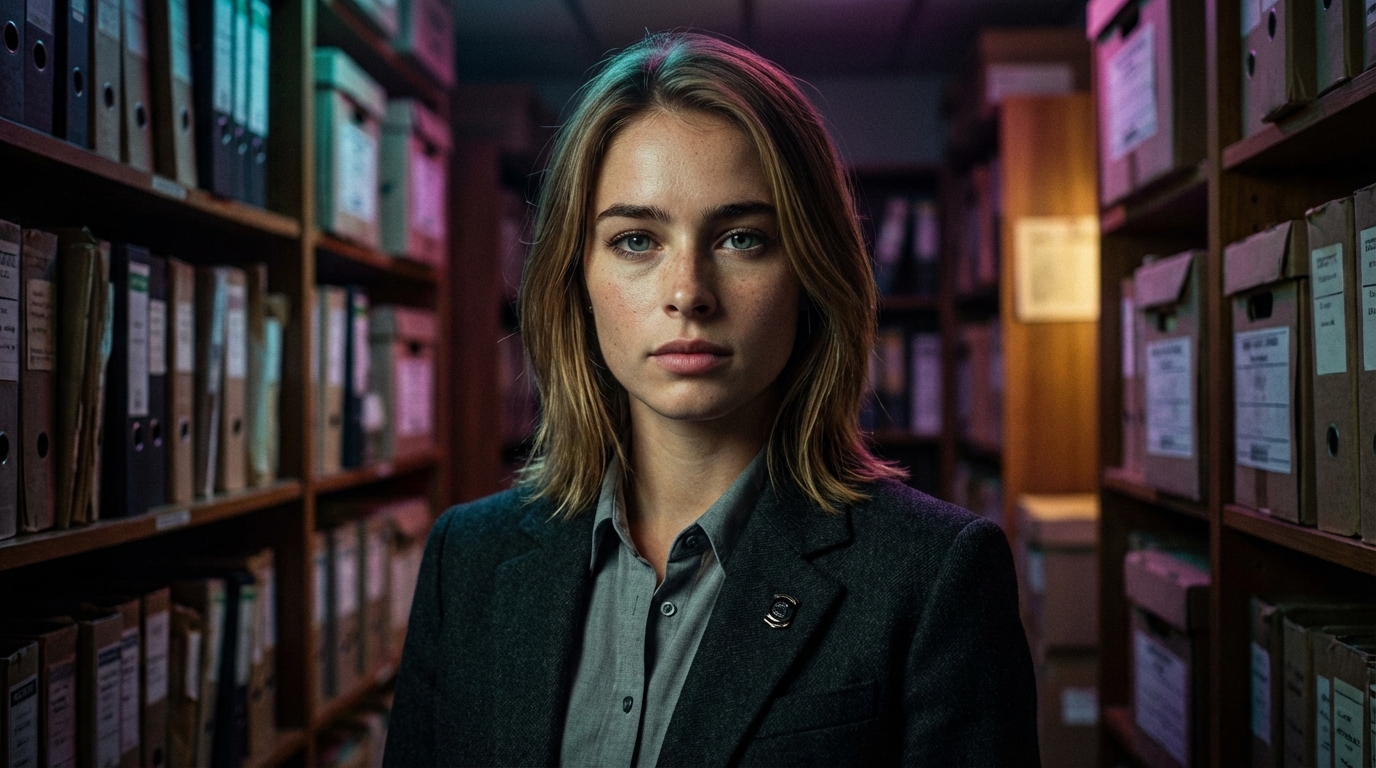
Born in Launceston in 1990, Emily Jane Rogers grew up in a close-knit Tasmanian family before pursuing a career in law enforcement that would carry her from community policing through to detective work with the Criminal Investigation Branch. Her early years in the force were shaped indelibly by the events of August 2018, when the disappearance of Detective Karl Jenkins and the death of Detective Sarah Lahey tested every officer at Hobart Police Station — none more so than the young constable who helped secure the scene where a colleague died.
Early Life in Launceston
Emily Jane Rogers was born on 15 April 1990 at the Launceston General Hospital in Launceston, Tasmania, the second child of Michael David Rogers, a civil engineer with the Launceston City Council, and Sarah Anne Rogers (née Whitfield), who worked as an administration officer at the Launceston Aquatic Centre. The family lived in a weatherboard house on Cypress Street in the suburb of Newstead, a quiet residential pocket within easy reach of the city centre and the green corridors that followed the North Esk River towards the Gorge.
Emily arrived between her older brother Gerald Thomas Rogers, born in 1987, and her younger sister Sophia Grace Rogers, who followed in 1993. The three-year gaps between siblings created a household defined by overlapping phases of childhood — Gerald's rugby boots drying on the back porch whilst Emily practised piano in the front room, Sophia's toys accumulating in corners that Emily had recently vacated. Michael Rogers was a practical, even-tempered man whose engineering background expressed itself domestically through an insistence on planning, punctuality, and the belief that most problems yielded to careful thought. Sarah provided the emotional texture — she was affectionate, talkative, and possessed the social instinct of someone who remembered every neighbour's name and every colleague's birthday.
Emily inherited elements of both parents without becoming a copy of either. She had her mother's ease with people — a natural warmth that made her popular at school without the brittleness that sometimes accompanied popularity — and her father's capacity for focused attention, the ability to sit with a problem until it gave up its solution. She was the kind of child who read widely and indiscriminately, consuming crime novels alongside fantasy series, and who spent as much time analysing why characters behaved as they did as she did following the plot.
At Launceston Church Grammar School, where she enrolled in 2002, Emily found an environment that rewarded her particular blend of academic diligence and social engagement. She performed well across the humanities — English, history, and legal studies became her strongest subjects — whilst maintaining respectable results in mathematics and science without ever excelling in them. Her involvement in the debate team sharpened the argumentative precision she would later bring to interviews and courtroom testimony, whilst her participation in the drama club revealed a talent for inhabiting perspectives other than her own — understanding why people did things, even when those things were harmful or irrational.
Gerald, three years ahead at the same school, cast a long enough shadow to be occasionally irritating but not so long as to be suffocating. He was louder, more physically confident, and more conventionally ambitious; Emily operated with a quieter determination that teachers sometimes mistook for passivity until her exam results arrived. Sophia, the youngest, looked to Emily with the particular admiration that younger sisters reserve for the sibling who seems to navigate the world with the least visible effort. The bond between the two sisters deepened as they grew, built on shared confidences, borrowed clothes, and the unspoken understanding that they occupied different positions in the family architecture but neither was more valued than the other.
Hobart College and the University of Tasmania
Emily completed her secondary education at Launceston Church Grammar School in 2007 and, following the path of several classmates, relocated to Hobart the following year to continue her studies. She enrolled at Hobart College for her final pre-tertiary year, using the transition as both an academic bridge and a chance to establish independence away from her family for the first time. The move south was less traumatic than she had anticipated — Hobart's smaller scale compared to mainland cities made it navigable, and the proximity of the university campus to the waterfront gave her the sense of space and light she had grown up with in Launceston.
In 2009, Emily began a Bachelor of Arts in Criminal Justice at the University of Tasmania, minoring in Psychology. The combination reflected a developing conviction that effective law enforcement required understanding not just the mechanics of crime but the human behaviour that produced it — why people offended, why victims responded as they did, and how the systems designed to address crime sometimes perpetuated the conditions that created it. She was not the most naturally gifted student in her cohort, but she was among the most disciplined, approaching her studies with the methodical focus her father had modelled and the genuine curiosity her mother had encouraged.
Her Honours thesis, which examined the psychological impacts of police-community engagement programmes on both officers and residents, earned First Class Honours upon her graduation in 2012. The research drew on volunteer work Emily had undertaken throughout her university years at youth centres in Hobart's southern suburbs and community safety initiatives in Glenorchy, where she encountered the intersection of poverty, disconnection, and offending behaviour that her coursework had described in theoretical terms. The practical experience confirmed what she had suspected since her school debate days — that she wanted to work with people directly, in situations where the stakes were real, rather than analyse those situations from an academic remove.
The Police Academy and Early Career
Emily entered the Tasmania Police Academy at Rokeby in late 2012. The physical demands of the training programme tested her more than the academic components — she had never been a natural athlete in the mould of her brother Gerald, who had played representative rugby league — but she approached the fitness requirements with a stubborn determination that impressed instructors accustomed to candidates who excelled physically but struggled intellectually, or vice versa. She performed with particular distinction in crisis intervention and de-escalation scenarios, where her psychology background and her instinct for reading people's emotional states provided advantages that raw physical capability could not replicate. Her outstanding performance in these areas earned her special recognition upon graduation in 2013.
Emily began her career as a Probationary Constable in the Hobart Division, conducting foot and vehicle patrols, responding to emergency calls, and managing the unpredictable daily rhythm of frontline policing. The transition from academy training to operational reality was, as it was for every new officer, a process of rapid and sometimes uncomfortable learning. She discovered that domestic disputes rarely resembled the controlled scenarios of training exercises, that the people she encountered were frequently more complicated and more vulnerable than any textbook had described, and that the emotional residue of difficult shifts did not simply dissipate when the uniform came off.
She completed her probationary period in 2015 with commendations for her communication skills and her ability to build rapport across the diverse communities of greater Hobart. Her promotion to Constable brought broader responsibilities — evidence gathering, witness interviewing, report preparation — and a growing reputation as someone whose presence calmed situations that might otherwise have escalated. She participated in community outreach programmes with genuine enthusiasm rather than institutional obligation, building relationships with local residents who came to know her by name.
The promotion to Senior Constable in 2017 recognised her performance and her emerging leadership potential. She took on mentoring responsibilities for junior officers, providing guidance in complex cases with the same patient attention she brought to her own work. The role also brought closer collaboration with the station's detectives, and Emily found herself increasingly drawn to investigative work — the sustained analytical engagement, the construction of cases from fragmentary evidence, the challenge of understanding not just what had happened but why.
The Events of August 2018
On the afternoon of 2 August 2018, Emily was among the constables dispatched as backup to Jeffries Manor in Granton, where Detective Karl Jenkins had vanished during a confrontation with suspect Luke Smith. She arrived to find Sergeant Charlie Claiborne deploying teams across the estate's grounds and Detective Sarah Lahey standing amidst the unfolding chaos with an expression that Emily — trained in reading emotional states — recognised as something beyond ordinary distress.
Emily led one of the search teams that swept the manor's grounds alongside Constables Mackenzie, Edwards, and David O'Neil, combing through manicured lawns, outbuildings, and the bushland that bordered the property. The search yielded nothing. As evening fell and Claiborne departed to brief senior officers, Constable O'Neil assumed temporary coordination of the remaining team. Emily stayed through the night shift, helping to secure the perimeter for the following morning's expanded search, standing in the cold Tasmanian darkness with the knowledge that a colleague had simply disappeared from a place that offered no explanation for how.
The days that followed drew Emily into the deepening investigation. On 4 August, she formed part of Detective Sergeant Alexander Stout's team executing a search warrant on Karl Jenkins' residence, where the accumulating strangeness of the case became impossible to ignore — the untouched newspaper, the anxious dog, the cryptic notes about hidden secrets.
On 7 August, Emily was selected as part of the covert surveillance team assigned to monitor Detective Sarah Lahey under the authorisation of Detective Inspector Sienna Blackwood. The seventy-two-hour operation, led by Detective Sergeant Stout and designated Operation Shadow Watch, required Emily to watch a senior colleague whose guilt had not yet been established but whose behaviour had placed her at the centre of an investigation that now encompassed a detective's disappearance, a murder, and the theft of a body from the morgue. For an officer still relatively early in her career, the assignment represented an extraordinary test — of professional discipline, of emotional compartmentalisation, and of the capacity to follow evidence wherever it led, even when it led towards people she had worked alongside.
Myrtle Forest
The evening of 8 August 2018 became the event around which Emily Rogers' career would pivot. Positioned in Myrtle Forest with Constable David O'Neil as part of the covert apprehension team, she witnessed the confrontation between Sarah Lahey and Gladys Cramer that no contingency plan had anticipated. When the situation deteriorated catastrophically and Sarah sustained fatal injuries, Emily and O'Neil were the first officers to respond — securing the scene, calling for additional backup and medical assistance, performing the procedural duties that training had encoded into muscle memory whilst the reality of what had happened worked its way past the professional armour into something more personal.
Emily stood in that forest as paramedics Scott Fleming and Kristy McIntyre attempted to save Sarah Lahey's life, and she remained when Fleming pronounced Sarah dead at approximately 4:50 PM. She was twenty-eight years old. Nothing in her academy training, her psychology minor, her crisis intervention commendations, or her five years of operational policing had prepared her for the particular weight of watching a colleague die during an operation she had been part of. The institutional response — debriefings, counselling referrals, welfare checks — addressed the procedural requirements of post-incident care. The emotional processing took longer and followed no prescribed timeline.
The Move to Detective Work
In the aftermath of August 2018, Emily completed the detective training course and was promoted to Detective Constable, assigned to the Criminal Investigation Branch with a focus on serious and organised crime. The transition from uniformed policing to investigative work represented a professional evolution she had been moving towards throughout her career, though the circumstances that accelerated it cast a shadow over the achievement. She had demonstrated, during the most intense week of the station's modern history, the composure, judgement, and analytical capability that detective work demanded. The cost of that demonstration was an understanding of what policing could take from the people who practised it.
Within the CIB, Emily developed expertise in advanced interviewing techniques and forensic analysis, bringing to complex cases the psychological insight her university training had provided and the interpersonal sensitivity her community policing years had sharpened. She worked high-profile investigations — serious assaults, organised criminal networks, fraud operations that exploited vulnerable Tasmanians — building a reputation as a detective who prepared meticulously, interviewed with patience rather than pressure, and constructed cases that held together under the scrutiny of defence barristers and magistrates alike.
She continued to pursue professional development with the same quiet determination that had characterised her academy years, attending courses in digital forensics, financial crime investigation, and advanced crime scene management. The breadth of her training reflected both institutional investment in a promising officer and Emily's own recognition that the investigative landscape shifted constantly, demanding skills that her initial training could not have anticipated.
Personal Life and Character
Emily maintained close ties to her family throughout her career. She returned to Launceston for holidays and gatherings with a regularity that her roster permitted, and the relationship with her sister Sophia — who pursued a career in graphic design and settled in Melbourne — endured across distance through the persistent, affectionate communication that had defined their bond since childhood. Gerald, who followed their father into engineering and took a position with a mining company in Queensland, remained the louder, more outwardly confident sibling; Emily remained the one the family turned to when situations required calm.
Her personal life outside policing centred on the Tasmanian landscape that had shaped her since childhood. She became an avid bushwalker, exploring the island's wilderness with a thoroughness that reflected her professional temperament — she planned routes carefully, carried proper equipment, and found in the sustained physical effort and the silence of remote places a necessary counterweight to the demands of investigative work. She adopted a German Shepherd named Max from a police dog training programme — a washout who lacked the aggression required for operational deployment but possessed the loyalty and intelligence that made him an ideal companion for long walks and quiet evenings at home.
Photography became another outlet — Emily carried a camera on bushwalks and developed a genuine eye for composition, capturing the island's landscapes with a patience and attention to light that colleagues who saw her work found unexpectedly accomplished. The hobby satisfied the same analytical instincts that drove her detective work — framing, perspective, the careful selection of what to include and what to leave out — whilst providing something her professional life could not: the creation of beauty rather than the documentation of its absence.
Emily did not discuss the events of Myrtle Forest with people outside the force, and rarely within it. The experience existed as a contained fact within her professional history — acknowledged, processed through the mandated channels, and integrated into the understanding she carried of what policing was and what it could cost. It did not define her, but it informed everything that followed — a baseline awareness that the institutional structures officers operated within could fail, that colleagues could betray, and that the controlled scenarios of training bore only partial resemblance to the moments that actually mattered.
Colleagues who worked with Emily Rogers in the years following 2018 described a detective whose warmth coexisted with precision, whose empathy never compromised her analytical rigour, and whose composure under pressure carried the particular steadiness of someone who had already encountered the worst the job could deliver and chosen to remain. She was not the most senior detective in the CIB, nor the most decorated, but she possessed something that experience alone could not produce — the ability to sit with uncertainty, with ambiguity, with the incomplete answers that most investigations ultimately provided, and to keep working regardless.







