Emily Eleanor Blackwood (née Harrington)
Emily Eleanor Harrington Blackwood (1818–1876) was a philanthropist, cultural advocate, and watercolour painter whose influence shaped the intellectual and social landscape of colonial New South Wales. Born in Bath, Somerset, to a physician father and an artist mother, she married Thomas Erasmus Blackwood and emigrated to Sydney in 1841, transforming Rosebank Estate in Parramatta into a centre of reform and ideas. She co-founded the Sydney Women's Relief Society and championed practical aid without religious stipulation.
Early Life and Family
Emily Eleanor Harrington was born on 22 June 1818 at 13 Lansdown Crescent, Bath, Somerset, into a household that combined scientific rigour with artistic sensitivity. She was the third of five children born to Dr Charles Edward Harrington, a respected physician and lecturer in anatomical sciences at the Bath Royal Mineral Water Hospital, and Lydia Eleanor Harrington, née Talbot, an accomplished landscape painter and former student of the noted artist Francis Towne. The Harringtons belonged to Bath's cultured professional class — literate, civic-minded, and intellectually engaged, their home a gathering place for clergymen, poets, surgeons, and visiting naturalists whose presence gave the children early exposure to a breadth of ideas and disciplines unusual for the period.
Charles Harrington had been born on 12 March 1779 in Bristol and trained in medicine in both London and Edinburgh before returning to Somerset to practise. He was known for his precision and his measured advocacy for hygienic reform, contributing regularly to the medical journals of the day and promoting evidence-based treatment at a time when much of provincial medicine remained rooted in tradition rather than empirical observation. Lydia, born on 17 August 1784 in Wells, had exhibited at the Bath Society of Artists and was known for her oils and watercolours of the Mendip Hills and the Somerset Levels — a talent that she passed directly to her third daughter.
Emily's four siblings each pursued vocations that reflected the family's breadth of interest. Her eldest brother, Edward James Harrington, born on 9 May 1812, studied theology at Magdalen College, Oxford, and became an Anglican clergyman and author of treatises on Christian ethics; it was he who would officiate at Emily's wedding. Her elder sister, Caroline Frances Harrington, born on 3 January 1815, remained unmarried and dedicated her life to teaching music and drawing at a girls' seminary in Gloucestershire — a quiet vocation whose influence was felt through the hundreds of young women she instructed. Her younger brother, George Talbot Harrington, born on 6 December 1821, joined the East India Company as a civil servant in the Bengal Presidency and died of cholera near Calcutta on 2 May 1854, at the age of thirty-two. Her youngest sister, Henrietta Louisa Harrington, born on 28 March 1824, married Dr Alfred Wentworth Marlow, a retired Royal Navy surgeon, and became a matron at a convalescent house for naval widows in Brighton, where she died on 19 November 1901.
Emily was particularly close to Caroline and Henrietta, but the formative bond of her childhood was with her father. Charles took a special interest in nurturing her intellectual curiosity, often bringing her along to his hospital lectures and granting her access to his personal library of scientific volumes and medical diagrams. It was not uncommon for the young Emily to spend hours sketching anatomical plates or transcribing her father's notes — an unconventional education for a girl of her class, and one that instilled the empirical habits of mind she would carry into adulthood. From her mother she inherited a different kind of discipline: the patience required to observe landscape, to render light and form on paper, and to find in the natural world a source of meaning that the social world did not always provide.
Education
Emily's early education was conducted at home under the guidance of private tutors, as was customary for girls of her social standing in early nineteenth-century England. Her governess, Miss Annabel Reeves, a former schoolmistress from Winchester with a particular interest in Enlightenment philosophy, oversaw instruction in English literature, classical history, moral philosophy, and natural science. By the age of ten, Emily was reading Plutarch and Milton, and had begun keeping a commonplace book filled with observations, moral reflections, and botanical sketches that demonstrated the interweaving of her parents' respective influences.
Her scientific education was personally overseen by her father, who taught her the fundamentals of anatomy, human physiology, and medicinal botany. Emily often accompanied Charles on visits to the Bath Royal Mineral Water Hospital, where she witnessed firsthand the treatment of the city's poor — encounters with suffering and resilience that instilled in her a deep sense of compassion and a nascent calling toward the philanthropic work that would define her colonial years.
In 1832, at the age of fourteen, Emily enrolled at Miss Haversham's Academy for Young Ladies, situated at Camden Crescent, Bath. The academy, founded by Miss Judith Haversham, a progressive headmistress with reformist Anglican leanings, catered to daughters of the professional and landed classes and was reputed for combining traditional refinement with academic substance. Emily studied French and Italian under Madame Adèle Moreau, a Napoleonic émigrée; watercolour and oil painting with Mr Thomas Ashbury, a local landscape artist and Royal Academy exhibitor; music, with a focus on piano and voice; and moral philosophy consistent with contemporary expectations of genteel femininity. She excelled particularly in French, quickly gaining fluency and reading Rousseau and Madame de Staël in the original.
Her teachers frequently noted her critical thinking, artistic sensitivity, and calm authority in discussion. In her final year at the academy, she delivered a lecture to her peers on the moral duties of the cultivated woman — an early sign of the conviction that privilege ought to be coupled with service, a principle that would govern her public life. She completed her formal education in 1835, at the age of seventeen, having acquired not only the social polish expected of a young woman of her class but a formidable intellectual and moral foundation that distinguished her from most of her contemporaries.
Return to Bath and Courtship
Following the completion of her education, Emily returned to Bath in 1836, where she emerged as a notable figure within the city's cultured social circles. Admired for her intelligence, poise, and artistic accomplishment, she became a frequent guest at civic events, charity committees, and literary salons hosted in the drawing rooms of Bath's Georgian townhouses. Her watercolours of the Somerset landscape attracted favourable comment, and her conversation — informed by the unusual breadth of her education — earned her invitations that her family's professional standing alone might not have commanded.
It was at one such event that Emily's life changed irrevocably. On the evening of 17 December 1838, at a charity ball held in the Assembly Rooms in Bath, she encountered Thomas Erasmus Blackwood, a colonial barrister of Anglo-Australian lineage who had recently returned to England to conclude legal business and visit family. Thomas, educated at Winchester College and Balliol College, Oxford, combined colonial ambition with English polish — a combination that intrigued Emily immediately. He was twenty-six years old, she twenty; their conversation that evening revealed shared convictions regarding public service, the moral obligations of privilege, and the possibilities that colonial society offered for social experimentation that England's more settled structures foreclosed.
The courtship that followed was conducted through correspondence and carefully chaperoned visits between Bath and London, its formality belying the intellectual intensity of their exchanges. Emily recognised in Thomas a mind that complemented her own — analytical where she was intuitive, commercially pragmatic where she was philosophically inclined, yet sharing the conviction that wealth and education imposed duties upon those who possessed them. Thomas, for his part, recognised in Emily a partner whose capacities extended far beyond the decorative expectations that colonial society would impose upon a wife. Their letters from this period, several of which survive in private family collections, reveal a relationship built on mutual intellectual respect — a quality rarer in Victorian marriages than romantic convention might suggest.
Marriage and Emigration
Emily Eleanor Harrington and Thomas Erasmus Blackwood were married on 12 October 1840 in a formal Anglican ceremony at Bath Abbey, with Emily's eldest brother, the Reverend Edward James Harrington, officiating and both families in attendance. She was twenty-two years old. The ceremony marked not merely a personal union but the beginning of a partnership whose effects would be felt across colonial New South Wales for decades.
Shortly after the wedding, Emily made the decision to leave England and accompany her husband to Sydney. The merchant vessel Catherine Roy departed Portsmouth on 24 November 1840, carrying eighty-one passengers and forty-one crew on a voyage that would cover fifteen thousand miles of ocean across one hundred and four days. Emily's letters from the passage detail her mixture of anticipation and trepidation, her philosophical reflections on empire and migration, and the practical adjustments required by months of confinement aboard a vessel whose accommodation, whilst adequate for passengers of her class, bore no resemblance to the comforts of Lansdown Crescent.
The Catherine Roy anchored in Port Jackson on 9 March 1841. Thomas met Emily on the docks, and later that same day she arrived at Rosebank Estate in Parramatta — the Georgian homestead overlooking the Parramatta River floodplain that Thomas had acquired in 1839 and that would serve as her home, her salon, and the stage upon which her most significant public contributions would unfold. The woman who crossed Rosebank's threshold that evening carried with her an education in science and art, a temperament shaped by Bath's intellectual culture, and a determination that colonial life would be embraced rather than merely endured.
Rosebank and the Drawing-Room Salons
Emily approached her new life with characteristic resolve. Where many Englishwomen of her background might have recoiled from the roughness and social limitations of New South Wales society, she recognised opportunity where others saw deficiency. Within weeks of her arrival, she had begun to assess the household's needs and the community's gaps, her physician father's empirical habits manifesting in a systematic approach to understanding the colonial world into which she had been transplanted.
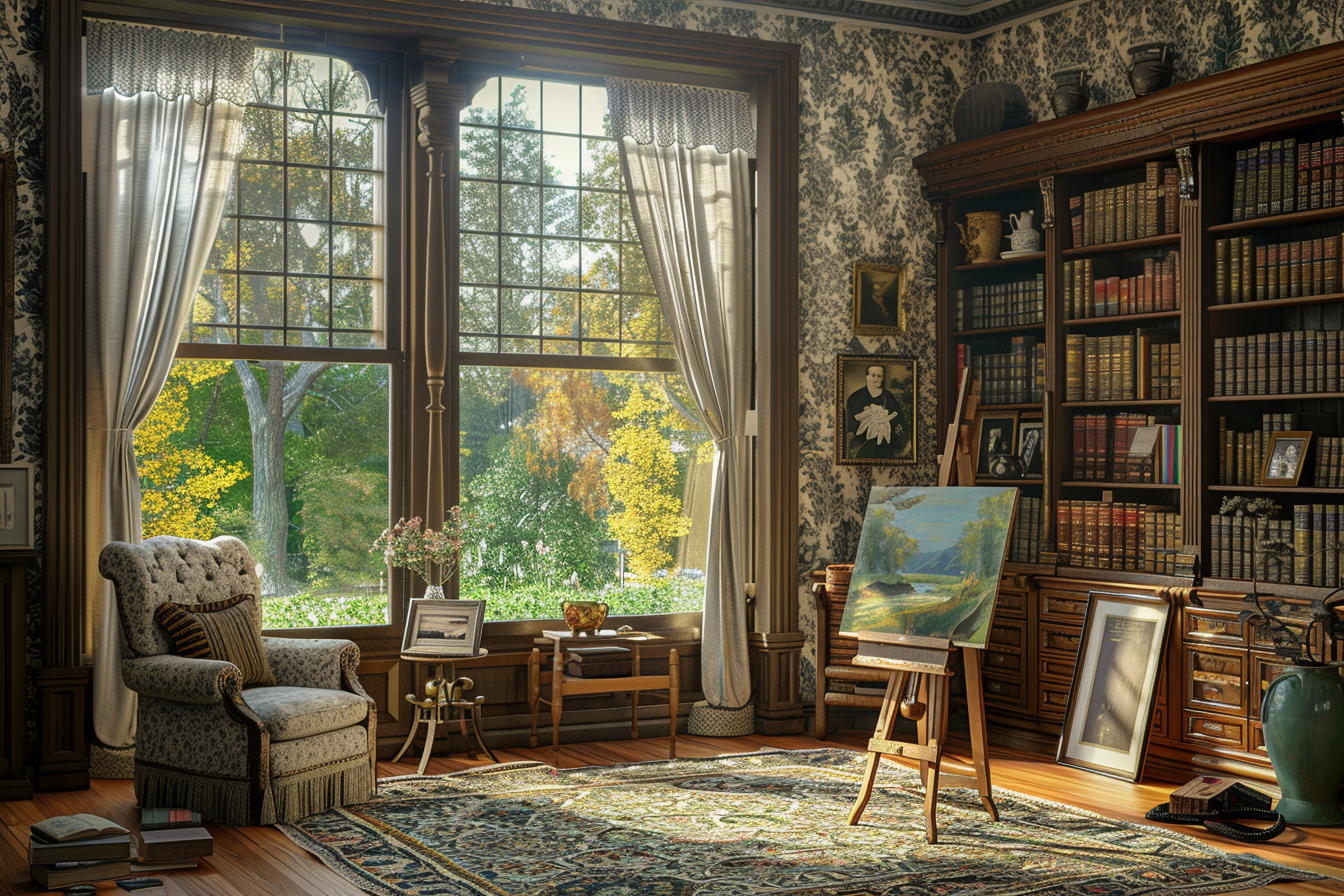
The drawing room at Rosebank, previously utilised for little more than after-dinner conversation during Thomas's years as a bachelor, became under Emily's direction a space of purpose. She established fortnightly salons that drew together the colony's most engaged minds — poets, surgeons, botanists, and social reformers who gathered over preserved fruits and strong Darjeeling, the hospitality deliberately understated so that conversation rather than display remained the evening's purpose. Among the regular attendees was Robert Atwood of the Australian Herbarium Society, a naturalist whose unpublished letters describe Emily's "sharp eye for flora and female injustice alike." Visiting clergy, colonial administrators, and newly arrived professionals sought invitations to evenings that offered something rare in the colony — sustained intellectual exchange conducted in an atmosphere of genuine inquiry rather than social performance.
These gatherings became the intellectual engine of Rosebank's significance. Ideas that originated in the drawing room found their way into civic discourse, charitable initiatives, and the policy conversations that colonial governance conducted at one remove from public scrutiny. Emily's role was not merely as hostess but as facilitator and provocateur — a woman whose questions were often more consequential than the answers they provoked, and whose ability to connect disparate fields of knowledge created syntheses that no single discipline could have produced alone.
Philanthropy and Social Reform
Emily's philanthropic career began almost immediately upon her arrival in the colony. On 7 July 1841, barely four months after stepping ashore, she formally joined the Sydney Ladies' Benevolent Society, becoming one of its most active and reform-minded members. The Society's existing work — distributing clothing and provisions to the deserving poor — struck Emily as necessary but insufficient, its methods shaped by assumptions about moral worthiness that her medical father's pragmatism had taught her to question. She pressed for expanded services, for less judgemental criteria in determining eligibility, and for approaches that addressed the structural conditions of poverty rather than merely its visible symptoms.
It was from the fireside discussions at Rosebank that Emily's most significant institutional contribution emerged. Conversations regarding the rising number of widowed or abandoned women in the colony — women whose circumstances left them without either means or support — crystallised into action. In 1842, Emily co-founded the Sydney Women's Relief Society, an organisation reportedly conceptualised in the parlour at Rosebank during a series of autumn evenings. Her approach was considered audacious by the standards of colonial philanthropy: the Society offered practical aid — accommodation, employment referrals, basic education — without requiring religious affiliation or attendance at services. This deliberate separation of charitable assistance from denominational obligation challenged the assumption, deeply embedded in colonial welfare practice, that material aid and spiritual improvement were inseparable. Some churchmen regarded the innovation with suspicion; the women whom the Society served regarded it as liberation.
Emily's philanthropic work extended beyond the Relief Society. She advocated for improvements in women's education, supported initiatives to provide healthcare to underserved communities, and used her social position and the platform that Rosebank's salons provided to advance causes that colonial society's more conservative elements would have preferred to ignore. Her methods were pragmatic rather than confrontational — she worked within existing structures wherever possible, cultivating allies among officials and clergy whose support could translate reforming impulses into institutional change. The results were incremental but genuine, each small advance creating precedent for the next.
Motherhood and Domestic Life
Emily and Thomas's four children were born during the 1840s and 1850s, their arrivals punctuating a domestic life that balanced intellectual ambition with the practical demands of raising a family in colonial circumstances. Robert Cornelius Blackwood was born on 10 March 1845 — the event summary in family records locates his birth in Hobart, Tasmania, suggesting that Emily may have travelled south for the confinement during a period when Thomas's business increasingly drew him toward the Tasmanian colony. Eliza Margaret followed on 5 February 1848, Henry Jonathan on 15 July 1852, and Miriam, the youngest, completed the family.
Emily took an active role in the children's upbringing, ensuring that each received education reflecting both the intellectual standards she had inherited from her own parents and the practical demands of colonial life. Private tutors were engaged for subjects ranging from Latin and mathematics to natural history and drawing, the curriculum deliberately broader than what convention would have prescribed for children of their class. She was determined that her daughters should receive education of equal substance to that provided for her sons — a conviction rooted in her own experience of the transformative power of rigorous instruction, and in the observation that colonial society offered women fewer opportunities than their capabilities warranted.
The household that Emily managed at Rosebank operated within the structures of class and race that characterised colonial society, and she was not immune to the contradictions these structures imposed. Records from 1845 list six full-time staff: a coachman, two maids, a cook, a gardener, and a nursemaid. The nursemaid, Alice Wintle, was a mixed-race girl of just fourteen, assigned to tend the Blackwood children. Alice's name appears once more in the surviving records — in a letter from Thomas to his brother in London, describing her "difficult temperament" and subsequent relocation to a cousin's estate near Camden. Her fate thereafter went unrecorded, a silence that speaks to the limits of even the most reform-minded colonial household's capacity for self-examination.
The Artist at Rosebank
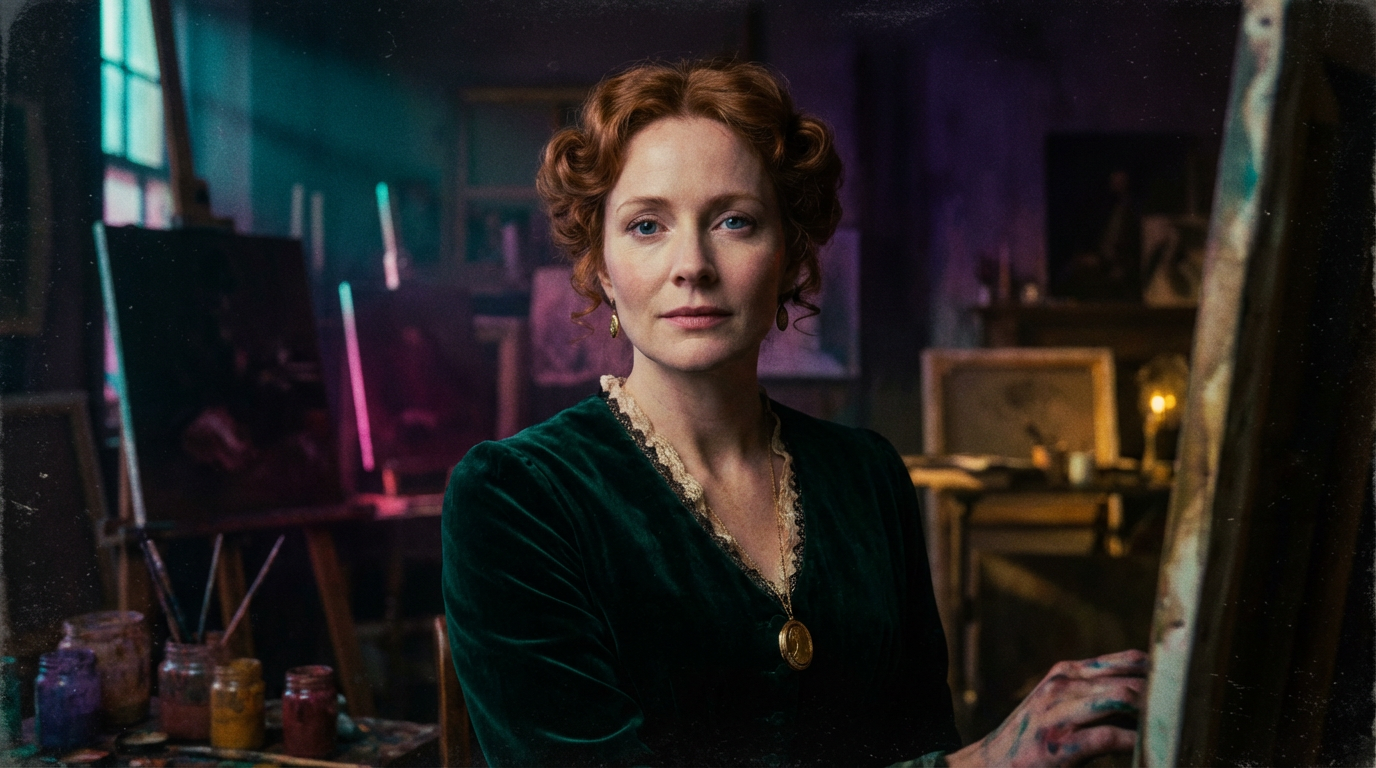
Throughout her years in the colony, Emily maintained the commitment to visual art that her mother's example and her own education had instilled. Her watercolours, executed in a style that combined the topographical precision of her father's anatomical training with the atmospheric sensibility of her mother's landscape tradition, depicted the Australian bush with an attention to light, colour, and botanical detail that distinguished her work from the more conventional picturesque views that colonial artists typically produced. She painted the country surrounding Parramatta and the broader Sydney basin — the eucalypt forests, the sandstone escarpments, the river flats that shifted character with each season — and her works were exhibited in local galleries throughout the 1850s and 1860s.
Emily also produced at least one portrait of significant historical interest. She sketched an elderly Aboriginal woman named Binda, possibly a survivor of earlier frontier violence, whose presence near the estate spoke to the persistence of Indigenous connection to country even after dispossession. The watercolour hung in Rosebank's drawing room for years — a quiet acknowledgment, in a space otherwise dedicated to English culture and colonial aspiration, that the land upon which the Blackwoods had built their lives held meanings and memories that preceded their arrival by millennia. Following Emily's death, the portrait was removed from the drawing room. Its subsequent fate remains unknown.
The Weight of Absence
Thomas's expanding professional commitments — his growing involvement with Blackwood Enterprises, his legal studies at the University of Sydney, his eventual founding of Blackwood and Associates in Hobart in 1866 — meant that Emily bore an increasing share of responsibility for both the household and the estate's social functions. She managed these demands with the same methodical competence she brought to her philanthropic work, maintaining the salon calendar, overseeing the children's education, and attending to the property's domestic affairs with an efficiency that visitors frequently remarked upon.
Yet the cost of Thomas's absences was felt in ways that efficiency could not address. Emily's letters from the 1860s, those fragments that survive, suggest a woman whose intellectual vitality remained undiminished but whose domestic circumstances had grown lonelier than she had anticipated when she first crossed Rosebank's threshold in 1841. The partnership that had drawn her to Thomas — the meeting of complementary minds, the shared conviction that colonial life offered possibilities for meaningful work — remained intact in its professional dimensions but had thinned in its personal ones. Thomas's attention was increasingly absorbed by the Hobart practice and the commercial interests that demanded his presence in Tasmania for months at a time. Rosebank, during these years, was effectively Emily's domain — animated by her energy, shaped by her tastes, sustained by her determination that the house should serve purposes greater than mere habitation. The drawing-room salons continued; the philanthropic work expanded; the children grew under her guidance. But the collaborative marriage that had brought her to the colony had evolved into something more like parallel endeavour, each partner pursuing their work in separate spheres connected more by institutional partnership than by the daily intimacy of shared domestic life.
Death
Emily Eleanor Blackwood died on 14 January 1876 in Sydney, at the age of fifty-seven. She was survived by Thomas and their four children — Robert, Eliza, Henry, and Miriam — each of whom would carry forward aspects of the legacy their mother had built. The cause of her death is not recorded in surviving family documents, though the cumulative toll of decades of colonial life, the emotional demands of philanthropic work conducted without adequate institutional support, and the particular loneliness of a woman whose intellectual capacities had always exceeded the scope that her circumstances permitted may all have contributed to a constitution that failed earlier than it should.
Her death diminished Rosebank in ways that the physical structure could not express. The salons ceased. The intellectual energy that had animated the drawing room dissipated. The portrait of Binda was removed from the wall. Thomas, whose professional life had by then centred firmly on Hobart, visited the estate with decreasing frequency, and the house settled into a quieter existence that reflected the absence of the woman who had given it purpose. The Sydney Women's Relief Society continued its work, as did the charitable networks that Emily had cultivated across three decades of engagement, but the animating intelligence behind these initiatives was gone — replaced by institutional momentum that carried forward the forms of her philanthropy without quite replicating its spirit.
Emily Harrington Blackwood had been a woman of formidable ability, genuine compassion, and quiet determination, whose life illustrated both the possibilities and the constraints that colonial society imposed upon women of her class. She had used the tools available to her — hospitality, conversation, art, charitable organisation — to expand the boundaries of what was considered appropriate for a colonial wife, creating spaces in which ideas could be examined, injustices acknowledged, and practical responses devised. That these contributions required her to operate within structures whose limitations she clearly perceived, and that the personal costs of her public engagement were borne largely in private, does not diminish their significance. It merely reminds us that the most consequential work is often accomplished by those whose names appear in the margins of history rather than at its centre.







