Elizabeth Woolley (née Johnson)
Elizabeth Johnson spent eighty-three years quietly revolutionising the possibilities available to colonial women through education, transforming from a schoolmaster's daughter into the intellectual force behind a shopkeeper's family whose youngest daughter would marry into Tasmania's elite, all whilst maintaining the fiction that her husband made the decisions and her influence extended no further than domestic management. Born into New Norfolk's small educated class, she understood that intelligence in women was tolerated only when disguised as practical competence, building behind this facade a lending library, informal school, and network of educated women that would subtly reshape the town's cultural landscape.
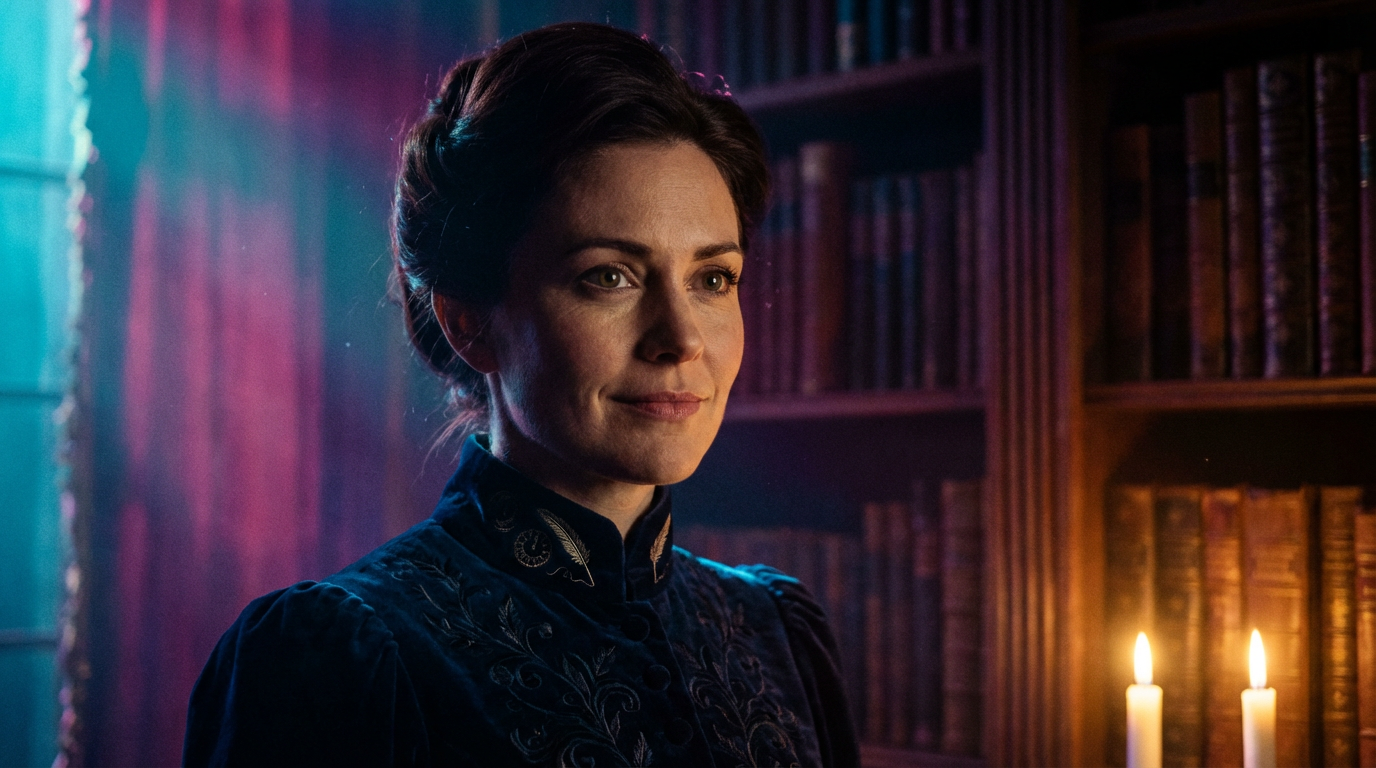
Birth and Scholarly Childhood (1850–1860)
Elizabeth Johnson arrived on 19th February 1850 in the schoolmaster's cottage attached to New Norfolk's parish school, the third child and first daughter of Richard Johnson and his wife Margaret, née Davies. Her birth came after two sons — William in 1845 and Robert in 1847 — whose arrivals had been celebrated with appropriate relief that the family name would continue. Elizabeth's arrival prompted no such celebration, merely resignation that girls required dowries rather than generating income.
The cottage, though modest, contained more books than most houses in Tasmania. Richard Johnson had arrived from Wales in 1840 with a classical education and crates of texts he had accumulated through years of careful saving. These books lined every wall, stacked on floors, tucked under beds — creating an environment where Elizabeth learned to read by absorption, surrounded by words before she understood their meaning. By four, she was deciphering Latin primers her brothers had abandoned, finding in ancient languages a logic absent from daily life.
Her mother Margaret, daughter of Welsh farmers, had married above her station and never quite recovered from the elevation. She compensated through obsessive domesticity, maintaining the cottage with exhausting perfection that suggested intellectual life was somehow dirty. Elizabeth learned early to hide her reading, pretending interest in needlework whilst secretly memorising poetry, developing the split existence that would define her entire life — surface compliance concealing intellectual rebellion.
The death of her younger sister Catherine in 1854, aged only two, from scarlet fever that swept through New Norfolk, marked Elizabeth's first encounter with the arbitrariness that governed life. She watched her mother collapse into grief that no amount of education could prevent, her father retreat into his books as escape, her brothers continue their lives largely unaffected. The lesson — that loss was both inevitable and unequally distributed — shaped her pragmatic approach to emotion.
Education and Intellectual Formation (1860–1868)
At ten, Elizabeth had exhausted the parish school's curriculum, knowing more than her father taught to boys years older. Richard Johnson faced a dilemma — his daughter's intelligence demanded cultivation, but educating girls beyond basic literacy risked making them unmarriageable. His solution was typically academic: he taught her secretly, after regular school hours, maintaining the fiction that she was helping him prepare lessons whilst actually receiving education equivalent to university preparation.
These evening sessions from 1860 to 1868 covered Latin, Greek, mathematics, natural philosophy, and political economy. Elizabeth proved particularly gifted at mathematics, understanding calculus concepts that her brothers found incomprehensible. Her father, initially pleased, gradually became uncomfortable with her facility, particularly when she corrected errors in his own calculations. He began limiting her access to advanced texts, claiming they would "overheat the feminine brain," though Elizabeth suspected he feared being intellectually surpassed.
Her friendship with Catherine Blackwood, daughter of New Norfolk's doctor, provided crucial outlet for intellectual discussion. Catherine, equally constrained by gender expectations, shared Elizabeth's hunger for knowledge. They created a secret reading society, meeting in the Blackwood garden shed to discuss texts that would have scandalised their parents — not salacious material but political philosophy, economic theory, scientific papers that suggested women's intellectual capacity equalled men's. Catherine would later leave New Norfolk to work as a governess, beginning a journey through reduced circumstances that would eventually bring her back to the town's parish school as its teacher — a position from which she would recognise and nurture the same intellectual gifts in Elizabeth's youngest daughter that she had once shared with Elizabeth herself.
William's departure for Hobart in 1863 to clerk in a law firm created unexpected opportunity. As the eldest remaining child, Elizabeth assumed responsibility for helping her father with school administration. She discovered she could teach younger students more effectively than the approved methods allowed, and began subtly expanding lessons, introducing concepts through games and stories that would not appear threatening to observing parents.
The Courtship Question (1868–1874)
At eighteen, Elizabeth faced the marriage pressure that dominated young women's lives. Her intelligence, rather than being an asset, was actively problematic. Several potential suitors, sons of New Norfolk's prosperous farmers and merchants, approached her father, but conversations with Elizabeth inevitably revealed an education that made them uncomfortable. One, James Mitchell, explicitly told Richard Johnson that his daughter "knew too much for a wife," a phrase that became family legend.
Her mother's response was to intensify domestic training, as if sufficient expertise in household management might compensate for excessive education. Elizabeth learned to cook, clean, sew, and manage household accounts with mechanical precision, all while secretly reading her father's new acquisitions — Darwin's theories, Mill's political economy, contemporary novels that arrived hidden in crates of approved educational texts. She became expert at appearing absorbed in needlework whilst actually solving mathematical problems in her head.
The arrival of Thomas Woolley Jr in her life came through her brother William, now returned from Hobart and practising law in New Norfolk. Thomas, managing his family's shop whilst his older brothers pursued their own ventures, impressed William with his quiet reliability and hidden intelligence. The introduction at Christmas dinner 1869 was carefully orchestrated — William invited Thomas, knowing Elizabeth would be present, creating circumstances for interaction that appeared accidental.
Thomas's appeal lay precisely in his unassuming nature. Unlike other suitors who felt threatened by Elizabeth's intelligence, he seemed genuinely interested in her thoughts. Their early conversations, conducted whilst walking after church or during chance encounters at the lending library, revealed his own self-education — limited by circumstance but genuine in desire. He didn't understand all her references but asked questions that showed he wanted to learn rather than wanting her to know less. The engagement, announced in 1873, surprised New Norfolk society — the shopkeeper's assistant and the schoolmaster's daughter seemed mismatched socially, though those who knew them recognised deeper compatibility.
The wedding on 12th April 1874 was modest by choice rather than necessity. Elizabeth insisted on simplicity that wouldn't embarrass Thomas's working-class siblings or her own academic father. She brought a dowry of books — her father's gift of an entire library that would become the foundation of their children's education. Thomas's brother James attended with his wife Emma, offering awkward congratulations. Charles arrived late, having forgotten the date whilst working on an invention.
Marriage and the Shop (1874–1890)
Their first home, the rooms above Thomas's shop on New Norfolk's main street, required significant adjustment for Elizabeth. After years in a cottage surrounded by books and intellectual conversation, she found herself in spaces that smelled of flour and lamp oil, where customers' voices replaced scholarly discussion. She responded by systematically organising both living and commercial spaces, creating efficiency that allowed time for her own pursuits whilst managing household duties.
The transformation of the shop's back room into an unofficial lending library occurred gradually. Elizabeth began by organising Thomas's scattered agricultural manuals, then added her own books brought from her father's house. When customers noticed and expressed interest, she offered to lend volumes with purchases, creating what amounted to Tasmania's first commercial lending library operating alongside regular trade. The innovation attracted customers who might have shopped elsewhere, building loyalty through literature.
George Alfred's arrival on 11th January 1875 came after a relatively easy pregnancy. She had studied midwifery texts in preparation, understanding the process scientifically even as she experienced it physically. Her detailed notes on the birth, discovered years later, revealed clinical observation of her own labour — timing contractions, noting symptoms, maintaining intellectual distance from physical pain through documentation.
Harriet Louisa's birth on 6th March 1878 came during a particularly difficult economic period. The Tasmanian economy had contracted, credit extended to struggling families went unpaid, and competitors undercut prices. Elizabeth instituted accounting systems that tracked every penny, identified which products generated actual profit versus mere turnover, and gradually shifted inventory towards higher-margin items. Her innovation of accepting goods in trade — eggs, butter, preserved foods — when cash was unavailable created an informal economy that benefited everyone, and the shop became a community centre where economic exchange merged with social support.
The births of Thomas Richard in 1881, Frederick James in 1884, and Charlotte May in 1887 established a pattern of pregnancy, recovery, and immediate return to work that exhausted her physically whilst she maintained intellectual activity through correspondence with Catherine Blackwood, who by then had left New Norfolk for governess positions elsewhere. These letters, preserved by Catherine, reveal a woman struggling to balance maternal duties with mental stimulation, finding in her children both purpose and imprisonment.
The death of her mother Margaret in 1889 brought unexpected relief mixed with guilt. Margaret's final years had been marked by criticism of Elizabeth's unconventional approach to marriage and motherhood — the lending library was "putting on airs," allowing children in the shop was "common," educating daughters equally with sons was "dangerous." Elizabeth's grief was complicated by freedom from constant disapproval, though she maintained appropriate mourning observances. Thomas's mother Anne died the following March, in 1890, drawing the two households together in shared mourning and leaving Elizabeth, at forty, as the senior woman in the broader Woolley family.
Grace's Arrival and the Complete Family (1890–1900)
Grace's birth on 3rd November 1890, when Elizabeth was forty, was unexpected and initially unwelcome. After three years since Charlotte, she had assumed her childbearing years were finished. The pregnancy was difficult, with complications that confined her to bed for the final months, forcing her to rely on twelve-year-old Harriet for household management. The experience of dependency — being cared for rather than caring — proved more challenging than physical discomfort.
Yet Grace proved different from her siblings from the earliest days. Where others had been content with basic stimulation, Grace demanded constant intellectual engagement. Elizabeth found herself reading to an infant who seemed to listen, explaining concepts to a toddler who appeared to understand, answering questions from a child whose curiosity matched her own at that age. This unexpected intellectual companionship partially compensated for the physical exhaustion of late motherhood.
The subsequent births of Albert Henry in 1893, Eleanor Rose in 1896, and Joseph Edward in 1899 pushed Elizabeth to her physical limits. At forty-nine, managing an infant whilst running a household and business tested even her formidable organisational abilities. She developed systems that delegated age-appropriate responsibilities to older children, creating a functional hierarchy that maintained operations whilst she recovered from each birth.
The shop's evolution during the 1890s reflected Elizabeth's growing influence on New Norfolk's cultural life. The lending library had expanded to include current periodicals and newspapers from Hobart and Melbourne. She organised reading groups that met monthly, carefully structured to appear as social gatherings whilst actually discussing contemporary literature and political developments. These groups, attended primarily by women, created an educated female network that quietly influenced the town's development.
Managing Prosperity and Letting Go (1900–1910)
The new century brought relative prosperity that allowed Elizabeth to pursue long-deferred ambitions. With older children managing shop duties, she established informal classes for working-class children whose parents couldn't afford proper schooling. Operating from the shop's back room on Sunday afternoons, she taught reading, writing, and arithmetic to children who would otherwise remain illiterate, understanding from experience how education could transform lives.
Her father Richard's death in 1902 at seventy-eight marked the end of an era. The funeral drew New Norfolk's entire educated class, acknowledging his fifty years of teaching their children. Elizabeth delivered a eulogy that carefully balanced filial devotion with subtle criticism of the educational limitations he had imposed on girls. Her inheritance of his library — over two thousand volumes — transformed the shop's lending operation into a significant cultural institution.
Catherine Blackwood's return to New Norfolk during this period, now in reduced circumstances after refusing a former employer's advances, brought Elizabeth's oldest intellectual companion back into her orbit. Catherine's appointment as teacher at the parish school, where she had once been a student alongside Elizabeth's father's other charges, closed a circle that neither woman could have anticipated. Elizabeth watched with quiet satisfaction as Catherine recognised in young Grace the same exceptional intelligence they had once shared between themselves, and she said nothing when Catherine began lending the girl books from her personal library and teaching her French during lunch breaks — the same clandestine education Elizabeth had once received from her own father.
The marriages of George in 1900, Harriet in 1902, and Dick in 1905 brought both relief and new responsibilities. As a mother-in-law, Elizabeth had to navigate relationships with women who hadn't expected a shopkeeper's mother to be so well-read. She managed these interactions with characteristic diplomacy, offering advice when asked, maintaining distance when appropriate, never quite fitting the expected role of either intellectual equal or social inferior.
Grace's emerging brilliance created particular challenges. By 1908, the seventeen-year-old had exhausted New Norfolk's educational resources and Elizabeth's ability to teach her. The girl's questions about economic theory and political philosophy required texts Elizabeth couldn't access, knowledge she didn't possess. The frustration of seeing her daughter's potential constrained by the same limitations that had restricted her own development was sharp enough to taste.
Grace's Marriage and Social Transformation (1910–1924)
William Jeffries IV's appearance in the shop in February 1910 initially seemed routine — another wealthy customer whose estate workers required supplies. Elizabeth observed his repeated returns, his increasingly specific requests that required Grace's assistance, his questions that tested her daughter's knowledge rather than seeking information. She recognised courtship disguised as commerce but said nothing, understanding that interference might destroy possibilities.
The engagement announcement in May created crisis within the family. Thomas worried about social humiliation, about Grace entering a world she wasn't prepared for. Elizabeth, better understanding what her daughter was attempting, provided practical preparation — lessons in managing servants, navigating formal dinners, maintaining composure under social scrutiny. She drew on her own experience of marrying across class boundaries, though Grace's leap was far greater than her own had been.
The wedding on 12th June at Jeffries Manor tested Elizabeth's composure more than any previous challenge. Surrounded by Tasmania's elite, wearing her best dress that still marked her as provincial, watching her youngest daughter marry into a dynasty built on convict transportation and banking fortunes, she maintained perfect dignity whilst weeping throughout the ceremony — tears that guests interpreted as maternal sentiment but which contained calculations far more complex than anyone suspected.
The elevation of the family's status through Grace's marriage created unexpected complications. Customers who had previously treated Elizabeth as an equal now showed deference that felt false. Others stayed away, uncomfortable with the connection to Jeffries power. The lending library, once Elizabeth's pride, seemed suddenly quaint compared to the Jeffries Manor library Grace now accessed. Yet Elizabeth continued as she always had, finding that books remained the same regardless of who owned the shelves they occupied.
Grace's daughters provided Elizabeth with a particular form of vindication she never articulated aloud. Eleanor Jane, born in 1911, and Amelia Catherine, born in 1913, and Charlotte Grace, born in 1916, were Jeffries children raised with Woolley intelligence — girls whose education would never be hidden or apologised for, whose grandmother's struggle for intellectual recognition had been rendered invisible by a single generation's elevation. Elizabeth held each granddaughter with the quiet ferocity of a woman who understood exactly what their existence represented.
Albert's marriage in 1915, Eleanor's in 1920, Frederick's in 1910, Charlotte's in 1912 — the decade scattered her children across Tasmania whilst the Great War consumed the world beyond it. Elizabeth organised care packages for soldiers through the shop, maintaining community function whilst her own household contracted. Thomas, increasingly frail at seventy-four, relied on her more heavily with each passing year, their roles gradually reversing until she was managing both him and the remaining business with the same quiet competence she had brought to everything.
Thomas's death on 23rd June 1924 ended fifty years of marriage that had evolved from pragmatic arrangement to genuine partnership. Elizabeth accepted condolences with composed efficiency at a funeral attended by hundreds who remembered the quiet shopkeeper. She wore widow's weeds that would define her remaining years and felt unmoored without the routine responsibilities that had structured her existence.
The shop's sale six months later marked the end of an era. Without Thomas's patient presence and with children scattered to their own lives, maintaining the business seemed pointless. Joseph initially attempted to manage operations but lacked his father's patience for small transactions and careful credit, and within months the property was sold to a syndicate that would demolish it for a modern department store. Elizabeth moved to a cottage near the church, taking her father's library and her own accumulated books, creating a private sanctuary where she could finally read without interruption or guilt. The freedom, so long desired, proved surprisingly empty.
Widowhood and Final Years (1924–1933)
The nine years of widowhood brought Elizabeth a solitude she had theoretically craved her entire life and found, in practice, disorienting. She maintained correspondence with all nine children, her letters combining practical advice with the literary references she could finally indulge without pretence. Grace visited weekly from Jeffries Manor, bringing whichever children could be spared — the daughters growing into young women of startling capability, William V developing his father's imperious manner, and eventually James III, born in November 1925, and Florence Mary, born in 1928, completing a set of grandchildren that spanned the social spectrum from shopkeepers' offspring to banking dynasty.
Her relationship with Grace during these final years was complex. The daughter who had achieved everything Elizabeth might have dreamed — education, influence, intellectual engagement — was trapped in her own gilded cage, managing William IV's deteriorating mind and the tensions between children their father valued and children he overlooked. Their correspondence revealed parallel frustrations across different social strata, both women constrained by structures that granted them intelligence but limited its application. Elizabeth's replies to Grace's letters, full of practical advice disguised as gossip, provided crucial emotional support that Grace would later acknowledge as having sustained her through the worst years of her marriage.
The onset of dementia in 1931 was particularly cruel for someone whose identity centred on intellectual capacity. Elizabeth initially hid her confusion, developing elaborate systems to compensate for failing memory. She would write detailed notes about conversations immediately after they occurred, create maps of familiar places she could no longer navigate instinctively, maintain lists of her children's names and accomplishments to avoid revealing she had forgotten. The woman who had spent her life pretending to know less than she did now spent her final years pretending to know more.
By 1932, the deterioration was undeniable. She would read the same page for hours, unable to remember she had already read it. She confused her children with her siblings, believed her long-dead parents were waiting for her at home, asked repeatedly when Thomas would return from the shop. Grace arranged for professional nursing care, understanding that her mother's greatest fear had always been becoming a burden. The occasional moments of lucidity were perhaps worse than the confusion — Elizabeth would suddenly recognise her situation, understand what she had lost, and rage against the betrayal of a mind she had cultivated so carefully.
Death came on 18th August 1933, peaceful in its finality if not its progression. Elizabeth simply failed to wake from an afternoon nap, her face showing none of the confusion that had marked recent years. Beside her bed was found a letter to Grace, written during a lucid moment weeks earlier: "I gave you the education I couldn't use. You used it to enter a world I couldn't imagine. Perhaps your daughter will live in a world that doesn't require such complicated translations between intelligence and acceptability."
The funeral on 21st August drew unexpected crowds. Former students from her informal classes, now adults with their own children, came to honour the shopkeeper's wife who had taught them to read. Members of her reading groups, now elderly themselves, remembered discussions that had quietly shaped their thinking. Grace delivered a eulogy that acknowledged her mother's hidden intellectual life, revealing the full extent of Elizabeth's self-education and influence. Grace's daughters — Eleanor Jane at twenty-two, Amelia Catherine at twenty, and Charlotte Grace at seventeen — sat in the front pew alongside their brothers and Woolley cousins, embodying the very future Elizabeth's deathbed letter had imagined.
The discovery of Elizabeth's journals after her death revealed the full scope of her intellectual activity. Thousands of pages documented not just family life but observations on colonial development, critiques of educational policy, analyses of economic patterns observed through shop transactions. These documents, donated by Grace to the State Library of Tasmania, provided historians with invaluable perspective on colonial women's hidden intellectual lives, though Elizabeth would likely have been mortified by such public exposure of her private thoughts.







