Eliza Margaret Harris (née Blackwood)
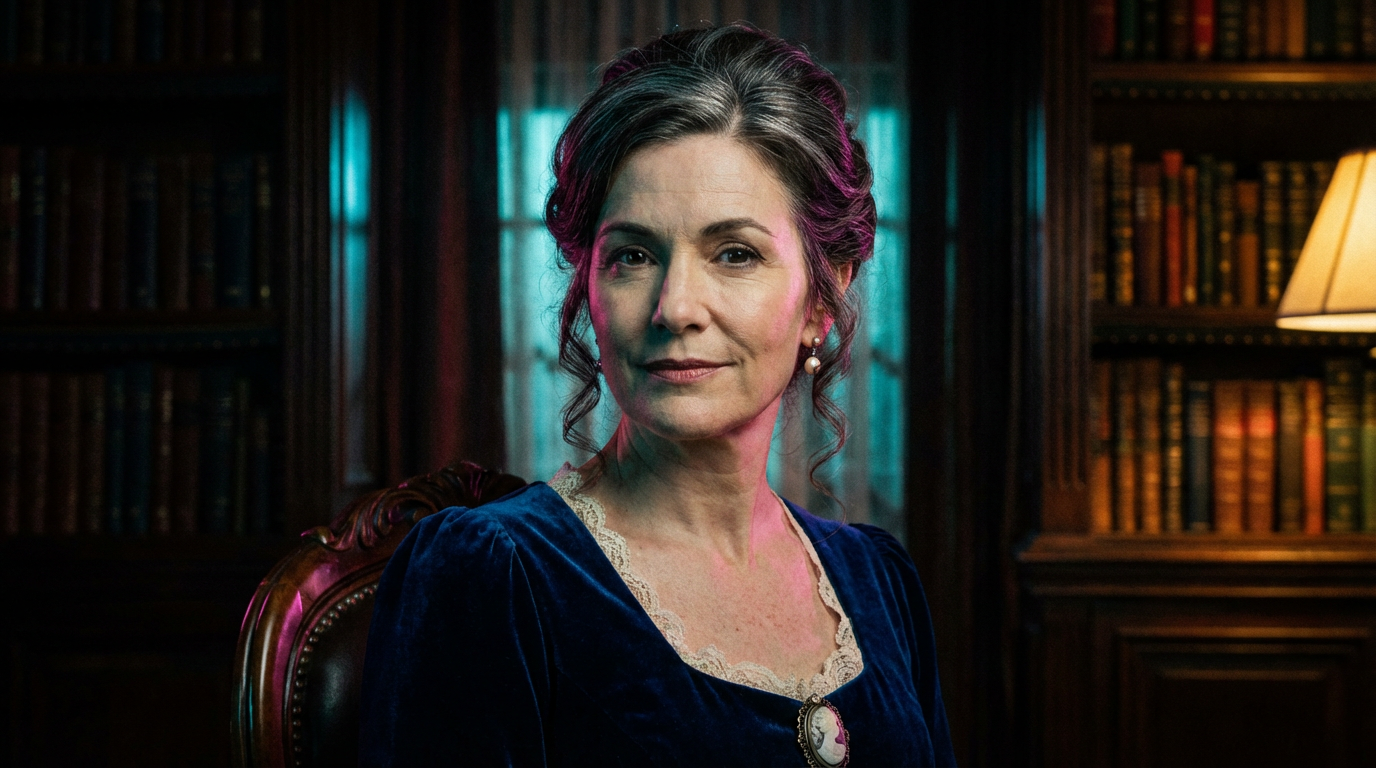
Eliza Margaret Harris, née Blackwood (1848–1905), was a philanthropist and social reformer who continued and expanded the charitable legacy established by her mother, Emily Eleanor Blackwood. Born in Hobart, Tasmania, and raised at Rosebank Estate in Parramatta, she married Sydney merchant Charles William Harris in 1875 and dedicated her adult life to the Sydney Women's Relief Society, women's education, and the welfare of impoverished mothers and children across New South Wales.
Early Life and Family
Eliza Margaret Blackwood was born on 5 February 1848 in Hobart, Tasmania, the second child and eldest daughter of Thomas Erasmus Blackwood, a colonial lawyer and commercial strategist, and Emily Eleanor Blackwood, née Harrington, a philanthropist, cultural advocate, and watercolour painter. Her birth in Hobart rather than at the family seat of Rosebank Estate in Parramatta reflected the increasingly peripatetic nature of her father's professional life — Thomas's business interests drew him frequently to Tasmania, where the Blackwood name carried associations dating back to his own father's early colonial ventures, and Emily had evidently travelled south for the confinement during one such period of family relocation.
Eliza was the second of four children. Her elder brother, Robert Cornelius Blackwood, had been born on 10 March 1845 and would go on to assume leadership of the family's legal firm, Blackwood and Associates, in Hobart. Her younger brother, Henry Jonathan Blackwood, arrived on 15 July 1852, and her younger sister, Miriam, completed the family. The Blackwood household into which Eliza was born combined her father's analytical rigour and professional ambition with her mother's artistic sensibility and reforming energy — a domestic atmosphere that shaped all four children but found perhaps its most direct expression in Eliza's adult commitments.
Though born in Hobart, Eliza spent most of her childhood at Rosebank Estate, the Georgian homestead overlooking the Parramatta River floodplain that her father had acquired in 1839 and that her mother had transformed into a centre of intellectual and philanthropic life. The house that Eliza knew as a child was Emily's creation — its drawing room animated by fortnightly salons that brought together poets, surgeons, botanists, and reformers, its walls hung with her mother's watercolours of the Australian landscape, its routines shaped by the conviction that privilege imposed obligations upon those who enjoyed it.
Education and Formative Influences
Eliza's education reflected the breadth of her mother's ambitions for her children. Emily Blackwood was determined that her daughters should receive instruction of equal substance to that provided for her sons, and the curriculum she arranged for Eliza extended well beyond the conventional expectations for girls of her class. Private tutors engaged for the Blackwood children covered Latin, mathematics, natural history, and drawing, but Emily supplemented this formal instruction with her own teaching — in watercolour technique, in the observation of the natural world, and in the moral reasoning that she regarded as inseparable from intellectual development.
Eliza showed particular aptitude for literature and history, disciplines whose narrative dimensions appealed to a temperament that was more expressive than her father's and more practically inclined than her mother's. She read widely from the library at Rosebank, which contained not only the legal and commercial texts that served Thomas's professional needs but also the novels, poetry, and philosophical works that Emily had accumulated since her arrival in the colony. The habit of reading for both pleasure and instruction, established in childhood, remained with Eliza throughout her life and informed the clarity of expression that would later distinguish her advocacy work.
More formative than any textbook was Eliza's early exposure to her mother's charitable activities. From the age of eight or nine, she accompanied Emily on visits connected to the Sydney Women's Relief Society, the organisation that Emily had co-founded in 1842 to provide practical aid to impoverished women without religious stipulation. These experiences — observing the circumstances of women whose lives bore no resemblance to the comfort of Rosebank, watching her mother navigate the institutional politics that charitable work inevitably entailed, absorbing the principle that assistance should address need rather than reward moral conformity — planted convictions that would define Eliza's adult vocation. She later recalled that it was not any single encounter that determined her path, but the cumulative effect of witnessing, week after week and year after year, the gap between what colonial society proclaimed about female welfare and what it actually provided.
Young Womanhood and the Loss of Her Mother
Eliza's transition from sheltered childhood to engaged adulthood coincided with the gradual transformation of the Blackwood household during the 1860s. Her father's professional commitments drew him increasingly toward Tasmania, where the founding of Blackwood and Associates in Hobart in 1866 demanded sustained attention, and his absences from Rosebank placed greater responsibility upon Emily and, by extension, upon Eliza as the eldest daughter still resident in the household. Robert had by then begun his own career in the law, and the domestic management of Rosebank — its social functions, its staff, its relationship to the Parramatta community — fell increasingly to the women of the family.
Eliza proved capable of bearing this responsibility with a competence that her mother recognised and valued. She assisted with the organisation of the salon evenings, managed correspondence on her mother's behalf when Emily's health or other commitments prevented her from attending to it personally, and took on supervisory roles within the Relief Society that prepared her for the independent leadership she would eventually assume. The relationship between mother and daughter during these years was one of partnership as much as dependence — Emily treating Eliza not merely as an assistant but as a collaborator whose judgement she trusted and whose capabilities she sought to develop.
The death of Emily Eleanor Blackwood on 14 January 1876, at the age of fifty-seven, represented the most significant loss of Eliza's life. She was twenty-seven years old, recently married, and still deeply entwined with the institutional and personal networks that her mother had built over three decades of colonial engagement. Emily's passing removed the animating intelligence behind Rosebank's intellectual life and left the organisations she had founded or supported without the leadership that had sustained them. Eliza experienced her mother's death not merely as personal grief but as a call to continuation — a recognition that the work Emily had begun would falter unless someone with both the commitment and the practical ability to carry it forward stepped into the breach.
Marriage to Charles William Harris
In 1875, approximately a year before her mother's death, Eliza had married Charles William Harris, a successful merchant based in Sydney. The precise circumstances of their courtship are not preserved in surviving family records, though the couple's shared commitment to social causes and their complementary temperaments suggest a union grounded in mutual respect and common purpose rather than romantic impulse alone. Charles, whose mercantile business provided the financial stability that philanthropic work required but could not itself generate, proved a supportive partner whose own civic sensibilities aligned with the values that Eliza had absorbed at Rosebank.
The couple settled in Sydney, establishing a household that consciously echoed the principles Eliza had inherited from her parents. Their home, whilst more modest than Rosebank, served as a gathering place for reformers, educators, and charitable workers whose interests intersected with Eliza's expanding philanthropic commitments. Charles's commercial connections provided access to donors and institutional supporters whose resources Eliza directed toward causes that the colony's official welfare structures inadequately addressed. The marriage functioned as a genuine partnership — not the intellectual collaboration that had characterised Thomas and Emily's relationship, but a practical alliance in which each partner contributed distinct capacities toward shared objectives.
Eliza and Charles had two children. Their daughter, Emily Rose Harris, was born on 15 May 1878 in Sydney — named for Eliza's mother, the choice carrying the weight of both tribute and aspiration. Their son, William Charles Harris, followed in 1880. Eliza was a conscientious mother who balanced the demands of family with the charitable commitments that consumed an increasing proportion of her time and energy. She ensured that both children were raised with the values of compassion, education, and public service that she had inherited from her parents, though the particular intensity of her dedication to the Relief Society sometimes placed strains upon the domestic arrangements that Charles was left to manage in her absence.
The Sydney Women's Relief Society
Eliza's most significant public contribution lay in her stewardship and expansion of the Sydney Women's Relief Society, the organisation that her mother had co-founded in 1842. Following Emily's death, the Society faced a period of uncertainty — its programmes dependent upon networks of personal connection that Emily had cultivated over decades and that no institutional structure could entirely replace. Eliza stepped into this gap with a combination of her mother's reforming principles and her own more pragmatic temperament, providing the organisational leadership that sustained the Society through the transition and redirecting its efforts toward the changing needs of the colonial population.
Under Eliza's guidance, the Relief Society expanded its reach beyond the provision of immediate material aid to encompass educational programmes aimed at equipping women with skills that might enable lasting independence. She recognised — as her mother had before her — that charity alone could not address the structural conditions that produced female poverty, and she advocated for approaches that combined short-term assistance with longer-term capacity building. Sewing workshops, basic literacy instruction, and employment placement services were added to the Society's programmes during the 1880s and 1890s, reflecting Eliza's conviction that practical utility ought to complement compassionate intent.
Eliza also worked to broaden the Society's constituency, extending its services to women whom earlier, more restrictive criteria might have excluded. Immigrant women, women of mixed heritage, women whose circumstances involved domestic violence or abandonment — populations that colonial charity organisations frequently overlooked or actively shunned — found in the Relief Society under Eliza's leadership a willingness to engage with the full complexity of their situations. This expansion was not universally welcomed. Some of the Society's longer-standing supporters regarded Eliza's broadened approach as a dilution of the organisation's original mission, and the tensions that resulted required diplomatic skills that Eliza developed through practice rather than natural inclination.
Her eloquence in advocacy — inherited from a household where articulate argument was valued above all other social accomplishments — made her a respected figure in Sydney's reform circles. She spoke at public meetings, wrote letters to newspapers, and maintained correspondence with reformers in other colonies and in Britain whose work informed and reinforced her own. Her methods were direct, sometimes blunt, and occasionally contentious; she possessed neither her mother's social grace nor her father's diplomatic instinct, and she was not above making enemies in the pursuit of objectives she considered morally non-negotiable. This combativeness earned her critics as well as admirers, but it also ensured that the causes she championed received attention that more temperate advocacy might not have commanded.
Grief and Perseverance
The years following her mother's death in 1876 were compounded by the loss of her father, Thomas Erasmus Blackwood, who died in Hobart on 10 October 1880 at the age of sixty-eight. Eliza was thirty-two years old when both parents had passed, her son William barely an infant. The double bereavement left her as the family member most visibly carrying forward the Blackwood legacy of public service — Robert had by then assumed leadership of Blackwood and Associates in Hobart and was absorbed in the firm's expansion, whilst Henry pursued his political career and Miriam had retreated into the private world she would maintain at Rosebank for the remainder of her life.
Eliza processed grief through work, a habit she had observed in her father and that she adopted with the same mixture of effectiveness and emotional cost. The Relief Society's programmes expanded during the 1880s in ways that reflected not only genuine need but also the particular energy of a woman who could not afford to pause. She took on additional responsibilities within the broader network of charitable organisations that served Sydney's growing population, sitting on committees, advising newer organisations on governance and fundraising, and mentoring younger women whose interest in reform work she recognised and sought to develop.
The cost of this sustained engagement was borne privately. Eliza's health, never robust, showed signs of strain from the mid-1890s onwards, and the demands of charitable work conducted without adequate institutional support — the endless meetings, the fundraising appeals, the emotional toll of sustained engagement with poverty and suffering — accumulated in ways that her determination could not indefinitely override. Charles's steady presence and practical support provided the domestic stability that made Eliza's public commitments possible, though friends and colleagues observed that the balance between her charitable obligations and her family life tilted increasingly toward the former as the years progressed.
Cultural and Educational Advocacy
Alongside her charitable work, Eliza maintained the commitment to cultural institutions and educational initiatives that her mother's example had instilled. She supported the establishment of reading rooms and lending libraries in working-class districts of Sydney, contributed to campaigns for improved access to public education for girls, and advocated for the inclusion of practical subjects — domestic science, commercial arithmetic, basic hygiene — in the curriculum of schools serving populations whose daughters were more likely to enter the workforce than the drawing room.
Her approach to education, like her approach to charity, was characterised by practical intent rather than abstract idealism. She valued learning for its capacity to improve material circumstances, to expand the range of choices available to women whose lives were constrained by poverty and convention, and to equip the next generation with capabilities that their mothers' circumstances had denied them. This pragmatism distinguished her from reformers whose educational advocacy was shaped primarily by religious conviction or by the desire to reproduce middle-class values in working-class settings. Eliza wanted women to be able to support themselves and their children; the philosophical framework within which they did so was, in her view, their own concern.
Death
Eliza Margaret Harris died on 22 July 1905 in Sydney, at the age of fifty-seven — the same age at which her mother had died twenty-nine years earlier. She was survived by her husband Charles, her daughter Emily Rose, and her son William Charles. The coincidence of age at death between mother and daughter was noted by those who had known both women, though whether it reflected shared constitutional vulnerability or mere chance, none could determine.
She left behind a philanthropic infrastructure that bore her mother's name but carried her own distinctive imprint. The Sydney Women's Relief Society continued its work under the leadership of her daughter Emily Rose, who inherited both her mother's commitment and her grandmother's name, creating a chain of female dedication to women's welfare that spanned three generations of a single family. The educational programmes Eliza had established served thousands of women during the decades that followed her death, their practical orientation ensuring that her legacy manifested in improved circumstances rather than in monuments or memorials.
Eliza Margaret Harris had been neither as intellectually brilliant as her mother nor as professionally accomplished as her father, and she would have been the first to acknowledge both limitations. What she possessed instead was tenacity — the determination to continue work that others had begun, to sustain institutions through periods when attention and resources flagged, and to insist that the obligations of compassion did not diminish simply because the first generation of reformers had passed from the scene. Her contribution lay not in originality but in persistence, not in vision but in execution — qualities less celebrated than genius but no less essential to the slow, cumulative work of making society marginally more just than it would otherwise have been.







