Eldrik Magnus Drikarsus
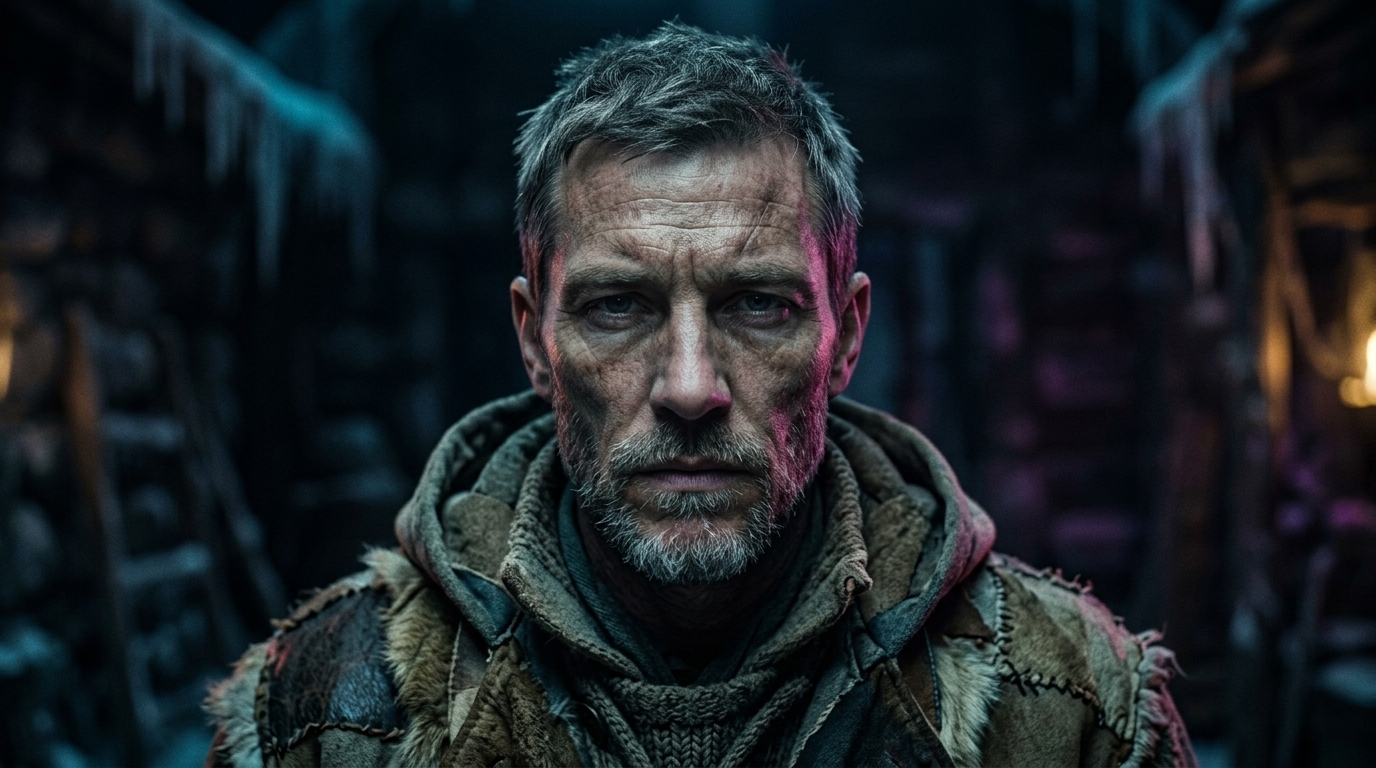
Eldrik Magnus Drikarsus (1955–2010) was a Whitby-born marine biologist who abandoned a disillusioned conservation career on Earth to help found Belkeep in 1988, only to watch the frozen settlement render his science useless. He became its hunter instead, feeding the community for more than two decades and hardening, year by year, into a severe and undemonstrative man. The coldness he passed to his son Lewyyd outlived him. He died out on the ice in 2010, aged fifty-five.
A Whitby Childhood
Eldrik Magnus Drikarsus was born on 7 April 1955 in Whitby, the old whaling and fishing town on the Yorkshire coast, and the sea was the first fact of his life. His father, Alistair Drikarsus, worked the North Sea in the hard, unromantic way the trade demanded, and taught his son early that the water was neither friend nor enemy but simply a force—one that fed you if you respected it and drowned you if you did not. His mother, Moira, born a Fairfax, was a schoolteacher, and from her Eldrik took the other half of what he would become: a habit of study, a respect for knowledge, a conviction that the world could be understood if one were patient and exact enough with it.
Whitby shaped him more than he ever acknowledged. He grew up between his father's harbour and his mother's books, between the brutal practicality of men who wrested a living from cold water and the quieter belief that understanding a thing was its own form of mastery. He was not a warm child. He was watchful and self-contained, more at ease with tide tables than with other children, and the reserve that others would one day read as coldness was fixed in him long before he left Yorkshire. What affection he had, he showed in competence rather than words—a trait his own son would inherit and be marked by.
The Marine Biologist
Eldrik was the first of his family to leave the coast for a lecture hall. He read Marine Biology at the University of Hull, drawn less by ambition than by the same pull that had held him at the harbour wall as a boy—a need to understand the water that had shaped everyone he came from. At university that need acquired a purpose. This was the 1970s, when the damage industrial humanity was doing to the oceans was becoming impossible to ignore, and Eldrik found in marine conservation a cause that fitted his temperament exactly: patient, evidence-bound, and quietly furious on behalf of something that could not speak for itself.
He met Aeliana Prescott through the environmental movement of those years—a student of environmental science at Bristol, with a warmth and openness he conspicuously lacked. What she saw in the severe, exacting young man from Whitby was never obvious to anyone else, but it held. They married in 1978 and spent the years that followed as a working partnership as much as a marriage, moving between conservation projects wherever the work took them, she softening his edges in company and he lending her cause a rigour it might otherwise have wanted. He believed, in those years, that knowledge could save things—that if you studied the world carefully enough and argued for it well enough, you could protect it. Belkeep would take that belief from him more completely than it took anything else.
A Door Out of the World
By the mid-1980s something in Eldrik had begun to sour. The work of those years had taken the shape of small, unwinnable battles—surveys of declining fish stocks that governments filed and ignored, campaigns against pollutants banned only after the damage was already done, seasons spent counting the dwindling of things he had loved since boyhood. He was good at it and grew slowly certain that being good at it changed nothing; the evidence accumulated on one side and the will to act failed, year after year, to appear on the other. The idealism that had carried him through university thinned into a weary, disillusioned competence, and he drew the private, corrosive conclusion that the world he had trained to protect was not going to be saved by careful men with data, or by anyone at all.
It was into this disenchantment that Cody Jennings arrived with a proposition that should have sounded like madness and instead sounded, to Eldrik, like an answer. Cody, the Guardian who had opened a Portal to another world in 1987, was recruiting settlers for a community he was founding in a place called Clivilius. To a disillusioned scientist who had lost faith in the world he knew, the offer of an untouched one carried an almost unbearable appeal: a chance to begin again somewhere that human carelessness had not yet ruined, somewhere knowledge might still count for something.
Eldrik and Aeliana talked it over in the private, undramatic way they decided everything, and chose to go. On 12 September 1988 they stepped through the Portal and left Earth behind. Whether either of them fully grasped that the crossing was one-way—that no ordinary settler could ever use the Portal to return—is impossible to know. If Eldrik understood it, he did what he always did with hard facts, and said nothing.
What they carried through the Portal on that September day was almost nothing—what a settler could take was little, and what a settler could keep of an old life was less. Eldrik left behind the grey harbour of his childhood, the graves of his parents, the discipline that had been his identity for twenty years, and a world that, for all its failures, he understood. He was thirty-three. He would spend the rest of his life—another twenty-two years—in a valley that never once thawed, and he would never see the sea he was born beside again. He did not speak of what he had surrendered. Speaking of it would not bring it back, and Eldrik had no use for words that changed nothing.
The End of the Science
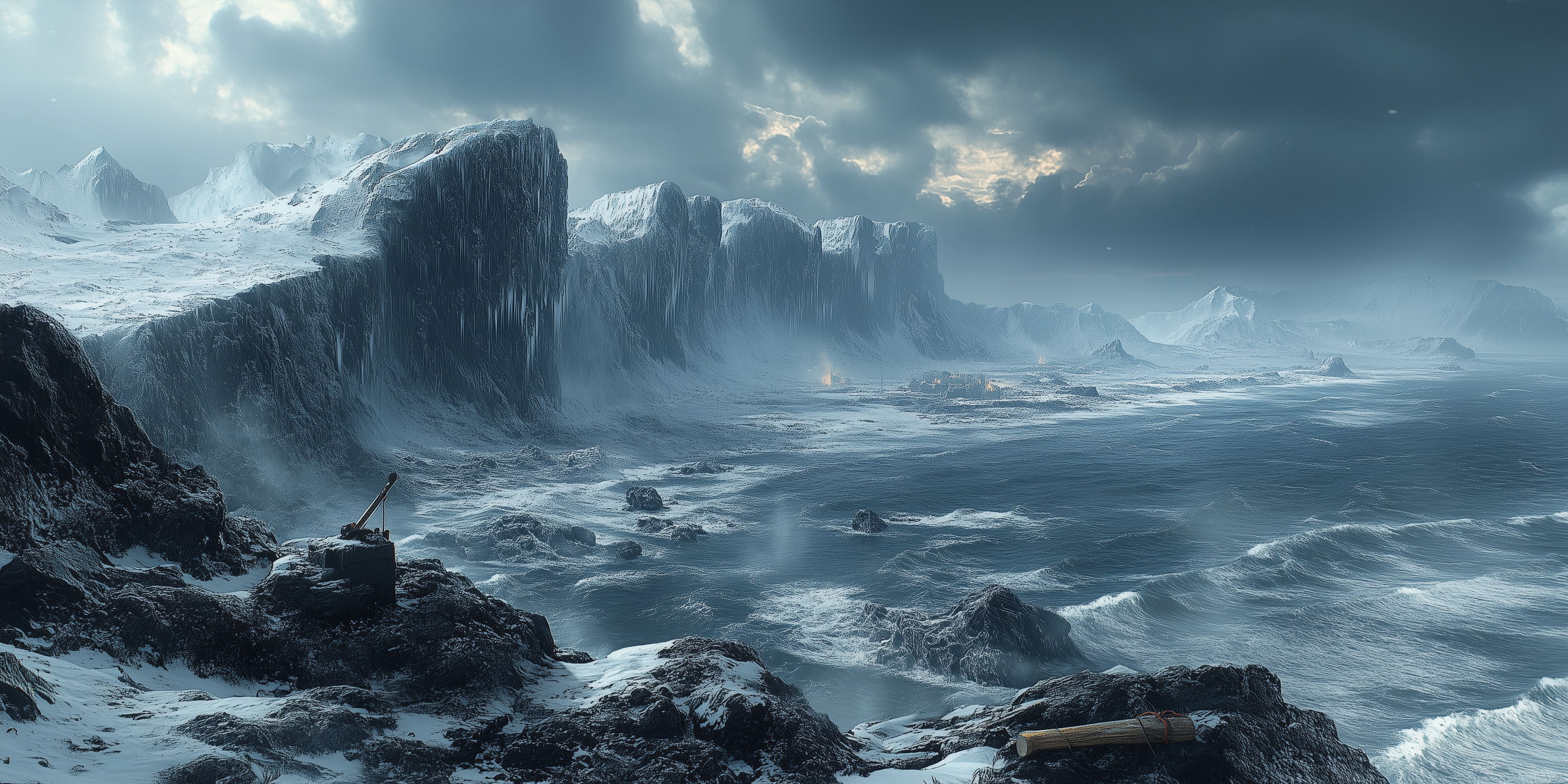
Belkeep was not the untouched Eden of a disillusioned man's imagination. It was a frozen valley locked in perpetual winter, a place where survival consumed every waking hour and the natural world Eldrik had trained his life to understand behaved according to no rule he recognised. His marine biology, the discipline that had defined him, proved almost useless. The lake would not be read like an ocean; the sparse, alien life beneath its ice answered to none of his models; the sea beyond the valley was a killer that offered nothing to study and everything to fear. The scientist who had crossed worlds to understand a new one found instead that his expertise had been left on the far side of the Portal with everything else he could not carry.
What survived the crossing was not the science but the man underneath it—the fisherman's son who had learned before he could read that the water fed you or drowned you and asked nothing in between. Belkeep did not need a marine biologist. It needed someone who could keep a starving community fed, and Eldrik, stripped of the profession he had built, became that instead. The transformation was not a triumph, whatever the settlement's later fondness for the story made of it. It was a demotion he accepted because the alternative was watching people starve, and he was too practical a man to indulge in grieving the loss of a self that could no longer be afforded.
His first winter in Belkeep taught him the scale of his miscalculation. He had come expecting a frontier and found a slow catastrophe—settlers dead of cold and hunger and worse, the lake taking the careless and the sea taking the desperate, none of it yielding to the patient observation that had been his whole method. An early attempt to turn his training to use, sounding the lake and sampling its water for anything the community might eat, cost the settlement equipment it could not spare and returned almost nothing. He did not try again. He put the scientist away, as he put away everything he could not use, and went to learn what could be killed.
The Hunter
For more than two decades Eldrik was Belkeep's hunter. He learned the valley the way his father had learned the North Sea—by patient, dangerous, unglamorous attention, reading the sea ice and the movements of what little game the frozen land offered, marking the routes that could be walked and the ones that killed. In the years before the settlement's systems formalised, it was very often his skill alone that stood between the community and starvation, and even after the Council of Stewards took over the counting and the rationing, it was Eldrik and the few he trained who went out into the cold to bring back what there was to be counted.
The hunts themselves were long, cold and frequently fruitless. Game in the valley was scarce and growing scarcer, and Eldrik came to measure a good season not by abundance but by the absence of empty-handed returns. He carried back from the ice frostbite that never fully healed, joints that stiffened early, and a stillness that deepened year on year, as though each expedition left a little more of him out on the frozen ground. He asked for no relief from it. As long as he could walk the ice he intended to, because the day he could not was the day he became, in a settlement that could carry no passengers, a cost rather than a provider.
The work was brutal and it hardened him. There was a bitter symmetry in it that he never spoke of: he had studied the sea to protect its life, and now he killed to preserve his own kind, in a place where mercy toward the hunted was mercy the settlement could not afford. He grew leaner and quieter with the years, his conversation reduced to what needed saying, his patience with softness worn down to almost nothing. The men who went out with him respected him without ever quite warming to him, and he seemed to prefer it that way. He was easiest, always, when he was alone on the ice with a task in front of him and no one to answer to but the land, which at least was honest about wanting him dead.
He trained the hunters who came after him, though training was a generous word for what he did—he took the young and the willing onto the ice, showed them once how a thing was done, and expected it learned. Several of the men who kept Belkeep fed in later years owed their lives to that grudging apprenticeship, and not one of them would have called him kind. With Cody Jennings he shared something closer to understanding. The founder carried his own version of Eldrik's disenchantment—guilt where Eldrik had only weariness, but the same buried knowledge that the new world had not been the deliverance either man had promised himself. They were not friends. They were two Earth-born men who had staked everything on Belkeep and watched it fail to become what they needed it to be, and there was a silent company in that which neither had to explain.
The Cold Father
Aeliana was the warmth in the household, as she had always been the warmth between them. She became one of Belkeep's early teachers, carrying into the settlement's makeshift schooling the same openness that had drawn her to a severe man twenty years before, and it was largely she who held the family together while Eldrik was out on the ice or turned inward at the hearth. Their two children, Lewyyd and Lyra, were both born in Belkeep, into a world their parents had chosen and they had not.
The marriage that had begun as a meeting of opposites held, but Belkeep changed its shape. On Earth Aeliana had softened him in company and lent her warmth to his rigour; in the settlement there was less and less company to soften him for, and the rigour hardened past the reach of her softening. She did not stop loving him and he did not stop needing her, but the easy partnership of their conservation years narrowed, under the constant pressure of survival, into something more like two people holding the same line from opposite ends. That she kept any warmth alive in the household at all, beside a man the ice was steadily cooling, was its own quiet achievement.
Eldrik loved his children in the only way he knew, which was by preparing them to survive. He was not cruel, but he was hard—teaching by expectation and correction rather than encouragement, withholding praise as though it were a resource to be rationed, treating competence as the only affection worth offering and the only kind worth earning. On Lyra, quick and open like her mother, the severity glanced off. On Lewyyd it landed and stayed. The boy absorbed his father's lesson so completely—that feelings were managed privately if at all, that the world rewarded steadiness and punished softness—that he carried it into the office of Chief and into every relationship of his short life. Whatever coldness would later define Belkeep's last Chief was, in its origin, his father's, passed down not through instruction but through example, from a man who did not know any other way to be.
What the Ice Left Him
The idealist who had crossed worlds to begin again did not survive the crossing by much. Somewhere in the early years of hunger and burial and grinding cold, the conviction that knowledge could save things quietly died in Eldrik, and he did not replace it with despair so much as with duty—the narrow, sustaining certainty that the day's work had to be done regardless of whether any of it meant anything. If he ever regretted bringing his family into a place that would consume them, he never said so, but the possibility sat in him, unspoken, in the way he watched his children grow up knowing nothing but ice.
His one indulgence was the coast. When the office of survival loosened its grip, Eldrik walked the rugged shoreline of the valley's sea alone, as he had walked Whitby's harbour as a boy, and it was the single thread of continuity between the world he had left and the one that had claimed him. He never explained the pull of the water to anyone, and he did not need to; it was the oldest thing in him. His son Lewyyd would later feel the same pull toward the same cruel sea and be equally unable to account for it, never knowing that he had inherited it, like so much else, from the father who had carried it across a Portal from a harbour on the other side of everything.
The Land Takes Him
Eldrik Magnus Drikarsus died on 22 October 2010, at the age of fifty-five, out on the ice he had read for twenty-two years. The land that had made him useful finally took him in the plain, unsentimental way it took everyone in Belkeep—a hunter who did not come back, claimed by cold or by a misjudged step on a surface that forgave nothing and had never pretended otherwise. There was a grim fitness to it that no one in the family could bring themselves to say aloud: the man who had spent his life reading the indifferent world was killed by the one thing about it he had always understood best.
His son recorded the death in the settlement's ledger. Lewyyd was twenty, and five years into the chieftainship his father had lived just long enough to see him carry, and he entered the loss the way Eldrik had taught him to enter everything—without display, and alone. The fisherman's son from Whitby, who had crossed worlds in search of somewhere knowledge might still matter and found instead a place that asked only whether you could survive it, was buried in the frozen valley he had helped drag a community out of, a long way from the grey Yorkshire sea that had been the first fact of his life.







