Edward James Schofield
Edward James Schofield (1923–2003) was a biology teacher in the Adelaide Hills who served as an army medical orderly in New Guinea and came home carrying what he had seen in silence rather than speech. He taught at Heathfield High School for thirty-seven years, married Marion Carrington, and raised three children in a house governed by his restraint. A steady provider and a distant man, he gave his family everything but the part of himself the war taught him to withhold — and chose, in time, to keep it.
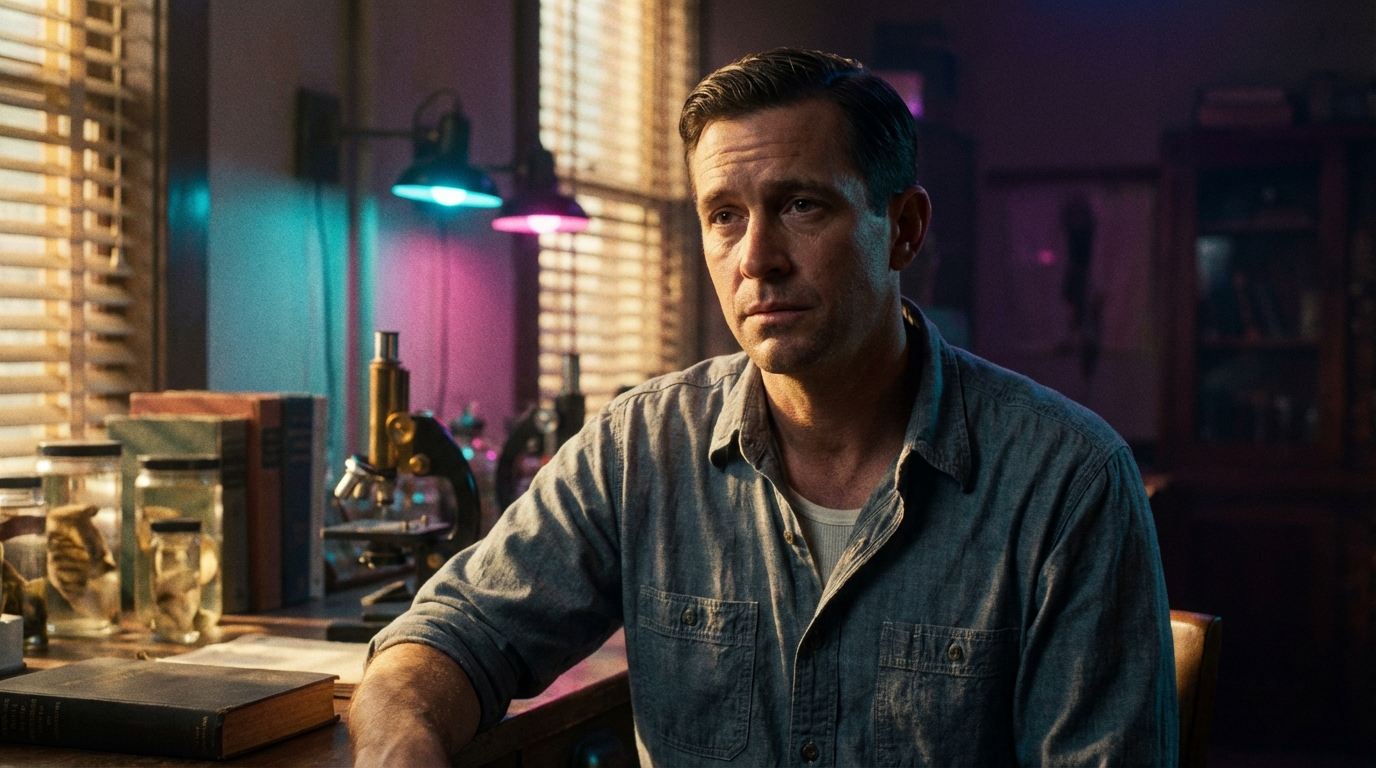
A Carpenter's Second Son
Edward James Schofield was born on 3 September 1923 in Lobethal, a German-heritage township in the Adelaide Hills, the second of four children of Albert Henry Schofield, a carpenter who built farmhouses and sheds across the district, and Edna May Schofield, née Brinkworth, whose world was the Methodist church, her vegetable garden, and the daily arithmetic of feeding a family on too little. The home was a weatherboard cottage on the edge of town, near enough to walk to school, far enough that the seasons set the rhythm of their days.
He had an older brother, Walter, born in 1921, and two younger sisters — Dorothy in 1926 and Irene in 1930, who arrived just as the Depression closed its hand on the Hills. Edward's childhood was marked by its scarcity: patched clothes, meals stretched thin, his mother's silence when the work dried up and his father went looking for it as far as the Barossa and the Mallee. Albert was a taciturn man, easier with timber than with people, and the household ran on his wages, Edna's thrift, and the assumption that children worked as soon as they were able.
Edna had left school at twelve and believed in education with the ferocity of someone who had been denied it. Edward repaid her: a quiet, diligent boy who liked to know how things worked — engines, the crops his father planted, the chemistry of his mother's bread — and who took care never to draw a teacher's eye. The family's Methodism gave the week its shape, Sunday services and Wednesday prayer meetings and the moral certainties of small-town Protestant life. He kept the outward practice of it long after the war had emptied it of meaning.
Family Tree
The Clerk's Desk
He finished at Oakbank Area School in 1940, cycling the hilly roads in all weathers, and went to work as a junior clerk at a stock and station agent in Mount Barker — a job that bored him to the marrow and a wage he handed to his mother each Friday. His evenings belonged to borrowed books on natural history and dog-eared National Geographics, and to a half-formed dream of becoming a veterinarian or an agricultural scientist, which sat at an impossible distance from his desk and his family's means.
Then Pearl Harbor, Singapore, the bombing of Darwin, and a war that had been Europe's became, almost overnight, a threat at the door. Edward enlisted in March 1942, eighteen years old, moved by a mixture of duty, the example of every other young man in the queue, and the plain wish to be anywhere but the clerk's desk. He could not have imagined where the wish would take him.
What the Jungle Took
The army made him a medical orderly, his clerk's steadiness and tidy hand marking him for the methodical work of the Australian Army Medical Corps rather than the infantry. After training at Woodside, close enough to home that he could see familiar ridgelines on the horizon, he was sent to New Guinea late in 1942, into the casualty clearing stations and field hospitals behind a campaign fought in mud and rain across country that killed men on its own account.
His war was carrying stretchers through that mud, holding men still while surgeons worked without enough anaesthetic, cleaning wounds that crawled with infection, writing letters home for soldiers who could no longer hold a pen. Malaria moved through the units like weather; he caught it three times and would carry its recurrences for years. Dysentery, scrub typhus and tropical ulcers killed almost as efficiently as the Japanese. He learned to function without sleep, to eat whatever there was, and to put down the ordinary human response to horror, because there was always another stretcher coming.
The part that never left him was not the dying but the choosing — the mornings when there were more wounded than hands, and a sergeant's nod decided which men were carried first and which were laid against the tent wall to see whether they would last. Edward did the carrying. He did not make the choices, and he was grateful, for the rest of his life, that he had not been asked to.
He almost never spoke of any of it afterward, but it surfaced in dreams that woke him gasping for decades — a boy calling for his mother as he died of a stomach wound, rain drumming on canvas, the smell of gangrene no disinfectant could lift. He had tended men in the morning who were dead by the afternoon, and he had learned that skill counts for very little against blood loss and infection and supplies that do not come.
He came home physically whole, which was more than many managed. His brother Walter, who had gone into the infantry, was taken at the fall of Singapore and spent three years on the Thai–Burma Railway; he returned in 1945 weighing barely forty kilograms and never recovered, dying of it in 1957 and leaving a widow and two small children behind.
Walter's slow dying sat strangely in Edward. He had spent his war among the broken and come home sound; his brother had carried a rifle and come home ruined, and the arithmetic of it — who was spared, who was not, and on what principle — was exactly the kind of question the jungle had taught him had no answer. He went to the funeral in 1957, helped carry the coffin, said almost nothing, and did not speak of Walter again.
The Two Years He Never Described
Edward was demobilised early in 1946 and came back to Lobethal to find a place that had gone on without him — his father aged, his mother's heart failing, his sisters grown into women he hardly knew. The clerk's job was gone, and the restless hunger that had once pointed him toward science had been replaced by an exhaustion nothing reached.
The next two years were the worst of his life, though he never once called them that. He worked in bursts — labouring jobs that asked for his body and not his mind, held for a few weeks until something turned him out of them. He drank more than he should have, not spectacularly, just steadily, to quiet a mind that would not settle. He sat through church beside his family and felt nothing at all, the minister's talk of providence landing like mockery on a man who had heard others pray, uselessly, as they died.
There was a night, in the worst of it, when his father found him sitting in the dark of the workshop among the tools, not drunk, just unable to account for how he had come to be there or how long he had sat. Albert, who had no words for any of it, sat down on the bench beside his son and stayed there, saying nothing, until the light came up.
What pulled him out was the Commonwealth Reconstruction Training Scheme. He enrolled in 1948 and began the teacher training that would shape the rest of his life. The structure suited him — clear tasks, defined expectations, knowledge gathered in a subject that did not ask him to think about what he had seen. He took biology, and found in the study of living systems the framework religion could no longer give him: a way of understanding life that did not depend on a God he had stopped being able to believe in.
He qualified in 1951 and took a science post at a high school in Murray Bridge, far enough from the Hills to feel like a clean page. He was competent, conscientious and entirely unremarkable, which was exactly what he wished to be. The nightmares went on, but he learned to work around them, and if colleagues noticed that he sometimes went distant, they put it down to the reserve of a returned man and asked him nothing.
The House on the Edge of Stirling
He met Marion Ruth Carrington in 1953 at a church social in Mount Barker, where he had gone to visit his ageing parents. She was twenty-four, library work and a widowed mother's boarding house behind her, and she understood without being told that the war had marked him. She did not press. For a man worn down by years of carrying it alone, her acceptance was something close to relief. They married in April 1955 at the Stirling Methodist Church, and bought a modest brick house on the edge of Stirling, where the bushland met the backyards of working families.
Douglas Edward was born on 14 February 1956, and fatherhood moved something in Edward the war had not closed — not healing, exactly, but a new capacity opening beside the old damage. Felicity Marion followed in 1958, and James Albert in 1961, and the family found its shape: Edward teaching through the week, the Anglican church on Sundays, summers at Victor Harbor where his children could play in the ocean he had once crossed to go to war.
His own parents fell away in those years. Edna, whose heart had been failing since the war, died in 1954, and Albert followed in 1961, the carpenter's hands at last still. Edward drove up to Lobethal for each of them, stood at the graveside in the contained silence he brought to everything, and came home and said little. He grieved them the way he grieved all things — thoroughly, privately, and where no one could see.
He was, by every visible measure, a good father — present, providing, genuinely interested in what his children learned. But the house ran on his restraint, and his restraint asked the same of everyone in it. Feeling was not done at Edward's table; it was managed, lowered, kept. His children learned to bring him the contained version of themselves, and the one who could not — Felicity, all noise and colour and performance — felt his coolness without ever being able to name it. He did not dislike his daughter. He simply could not warm to the very thing that made her herself, and he gave the easy, watchful Douglas a quiet preference he would have denied if asked.
It would have been kind to lay all of it at the war's door, and Edward, who never spoke of the war, let everyone do exactly that. But not all of the distance was the wound. Some of it was only easier than the alternative, and a man can hide a long time behind an explanation everyone is too tactful to question. He had reasons no one would challenge, and he used them, and the using was his own.
James asked of him what he found hardest to give. From infancy the boy was different — slow to reach his milestones, easily overwhelmed, struggling at what his brother and sister managed without thought — and the medicine of the day had little to offer but patience. Edward provided for him without fail and made sure he had what services existed, and could not, for all his trying, reach a child whose inner world stayed closed to him. He met James's difficulty the way he met most difficulty: by doing the practical thing impeccably, and feeling it from a distance.
Mr Schofield
He taught at Heathfield High School for more than three decades and eventually ran its science department. His manner was understated and effective — he rarely raised his voice, holding a room instead through the plain depth of what he knew. Students remembered the dissections done with a surgeon's neatness, the nature walks where he named plants and birds with quiet authority, the way he could make cellular respiration or natural selection feel suddenly obvious.
One year a boy who had failed at everything else discovered, under Edward's hand, that he could understand genetics. Edward kept him back week after week and never once mentioned his other marks, and the boy left school for a veterinary course owing him a debt Edward would have been embarrassed to have named aloud.
There was a gravity to him his students felt without being able to source it. Something in the way he spoke of resilience, of organisms enduring hostile conditions, of the body's stubborn capacity to mend, suggested knowledge gained outside any textbook. He never mentioned the war in class and never traded on it, but the perceptive ones understood that Mr Schofield had seen things that informed his biology in ways the purely academic had not.
His colleagues respected him without ever knowing him. He came to staff functions when required, spoke in meetings without dominating them, marked with the same conscientiousness he brought to everything, and formed almost no friendships. He was, as one of them put it, always pleasant and never personal — a man who had perfected the trick of being present without being known. His care for his students was real but expressed in deeds rather than warmth: the detailed references, the after-school hours given to a struggling pupil, the science clubs and excursions reliably supervised. More than a few of them went on to medicine and research, and credited him with the start of it.
The Quiet After
He retired in 1988, at sixty-five, after thirty-seven years at the school, and asked for no fuss — a short speech, a bookshop voucher, the applause of students who knew him only as the quiet older man in the science block. Retirement went harder than he had expected. The structure that work had given him fell away, and into the space it left, memory expanded. His silences lengthened. His sleep worsened. The activities he and Marion had planned were slow to interest him.
He found some peace in his garden, putting his biology to the cultivation of the native plants that drew birds to the Stirling block, and in long walks through the Cleland Conservation Park, the same bushland that had shaped his childhood and would one day steady his eldest son. He read widely — history, natural science, biography — and sat beside Marion in church each Sunday with the patient endurance of a man for whom faith had long since become a habit rather than a belief.
His health gave way through the 1990s. The malaria had left his liver weakened, and decades of held tension had worn at his heart. A mild stroke in 1998 took some strength from his left side and, when he was tired, his words. Marion nursed him with the steady competence she had brought to the whole of their marriage, and the children came when they could — Douglas from the hospital, Felicity from her Adelaide classroom, James from the supported accommodation where he had lived since his twenties.
Edward James Schofield died on 17 March 2003, aged seventy-nine, after a second stroke he did not survive. They buried him from the Stirling Anglican Church, and the mourners included more former students than anyone had expected — people who had read the notice and felt they owed something to the teacher who had quietly handed them the living world. Marion took the condolences with her usual composure. A little apart from her stood Douglas, his face unreadable, holding the same contained silence his father had modelled for him across a lifetime, and had passed down as surely as the colour of his eyes.







