Devon, England
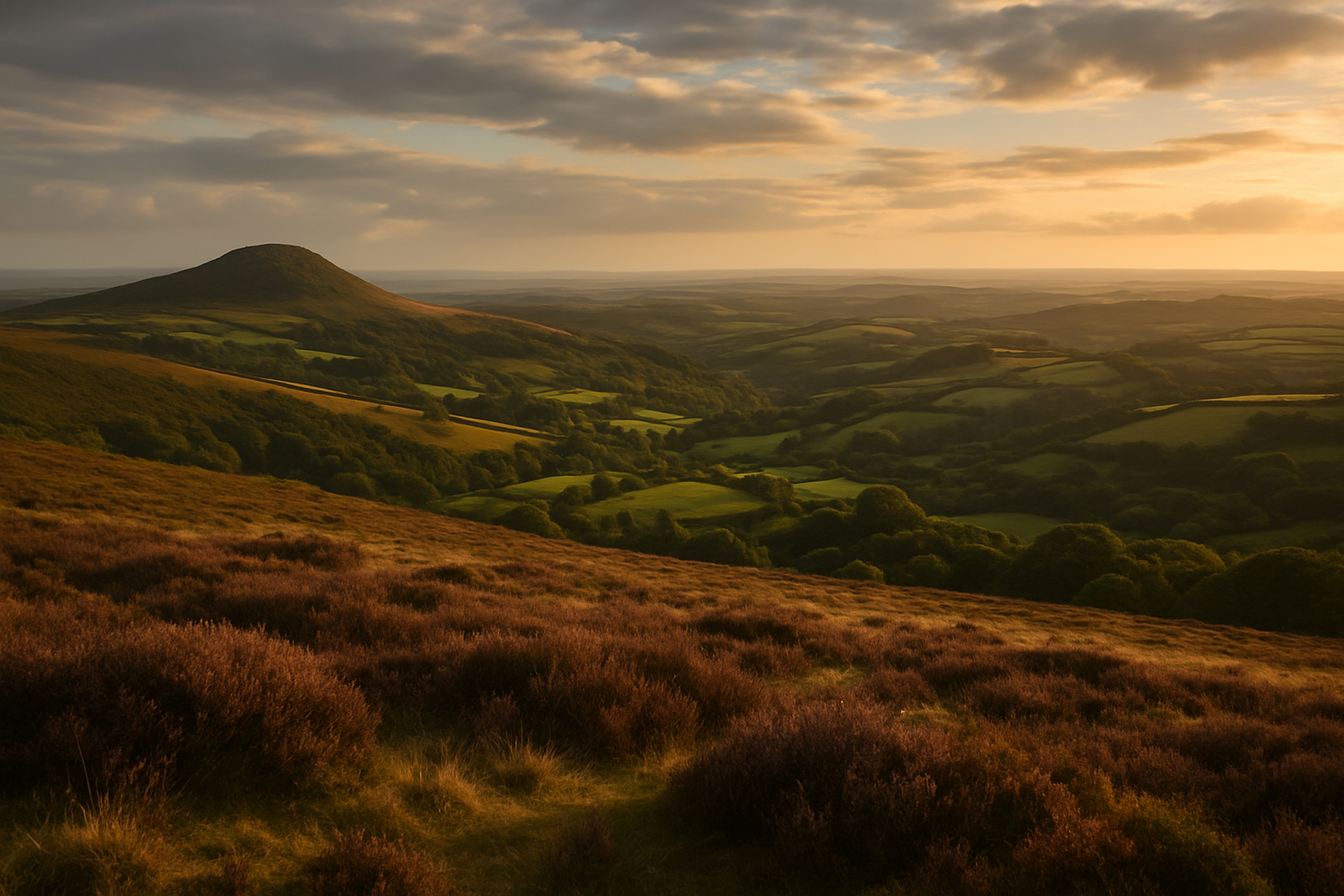
Devon is a ceremonial county in south-west England, occupying the broad peninsula between the Bristol Channel to the north and the English Channel to the south, with Cornwall beyond the River Tamar to the west. England's third-largest county by area, it encompasses two national parks, two coastlines, and a landscape shaped by the Dumnonii Celts, Saxon expansion, medieval wool wealth, Elizabethan exploration, and centuries of agriculture and seafaring. Its settlements range from the naval city of Plymouth to hamlets of barely two hundred souls.
Land and Landscape
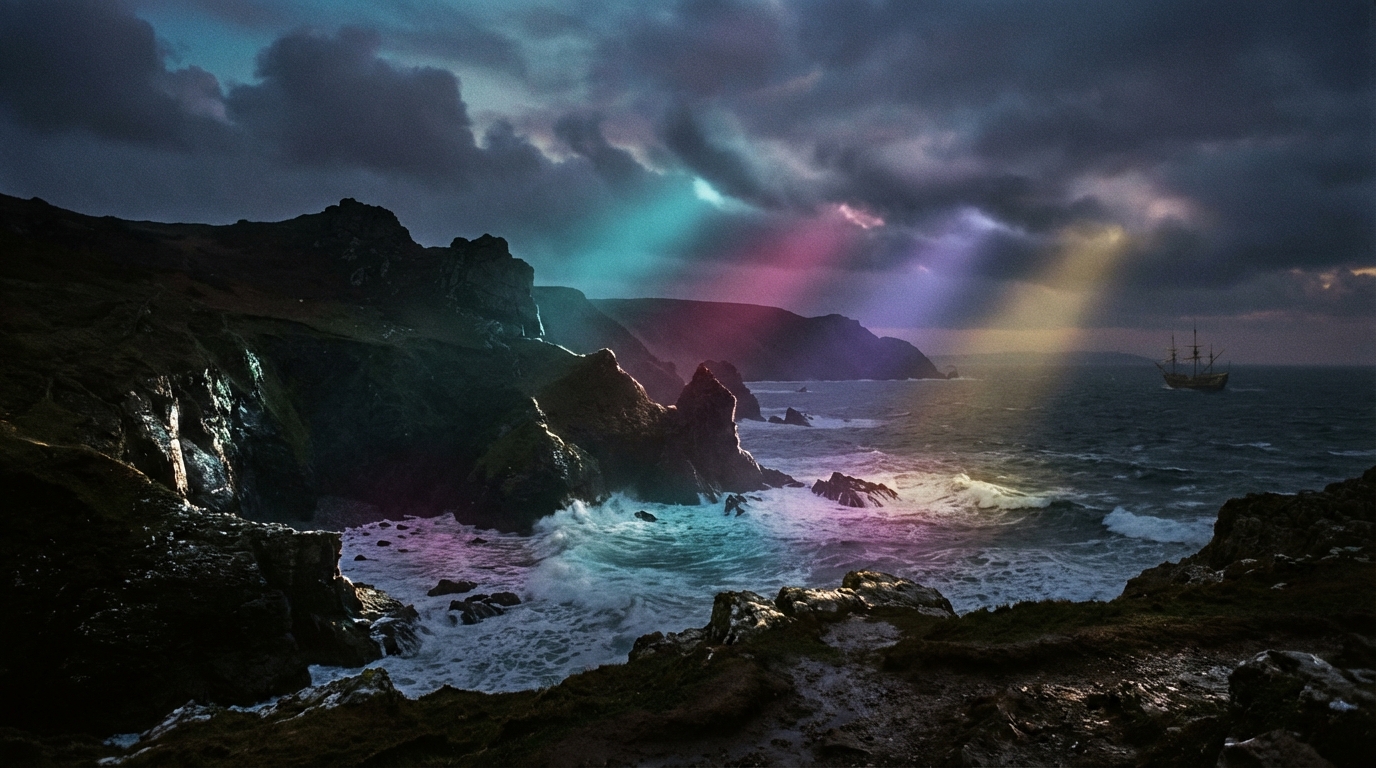
Devon covers approximately 2,590 square miles — the third-largest county in England — and is unique among English counties in having two separate coastlines: the north coast facing the Bristol Channel and Celtic Sea, the south coast facing the English Channel. Between them lies some of the most varied terrain in Britain. The granite uplands of Dartmoor, rising to 2,037 feet at High Willhays, dominate the south-west, while the northern fringe of Exmoor stretches into the county from Somerset. Both have been designated national parks. Inland, the landscape is a patchwork of red-soiled farmland, wooded valleys, and orchards, drained by rivers that include the Exe, the Dart, the Tamar, the Taw, and the Torridge. The south-east coast forms part of the Jurassic Coast World Heritage Site, where cliffs of Triassic, Jurassic, and Cretaceous rock expose 185 million years of geological history. It was from Devon's own slates and sandstones that the Devonian geological period — spanning roughly 420 to 360 million years ago — took its name.
Ancient Origins
Human presence in Devon extends deep into prehistory. Kents Cavern in Torquay has yielded Palaeolithic hand axes and a jawbone fragment that may represent the oldest modern human remains in Europe, dated to between 37,000 and 40,000 years ago. Dartmoor was settled by Mesolithic hunter-gatherers from about 6000 BC, and Neolithic and Bronze Age communities left a rich legacy of stone rows, standing stones, hut circles, and burial mounds across the moorland. In the Iron Age and Roman periods, Devon was the homeland of the Dumnonii, a Celtic Brythonic tribe whose name — thought to mean "deep valley dwellers" — survives in the modern county name, filtered through the Welsh Dyfnaint and the Old English Defenas. The Romans established the legionary fortress of Isca Dumnoniorum at Exeter around AD 55, but Devon remained on the fringe of Romanised Britain, and the countryside beyond the Exe valley shows comparatively little evidence of Roman settlement.
Dumnonia and the Saxon Advance
Following the Roman withdrawal in the early fifth century, the Dumnonii maintained a sub-Roman kingdom known as Dumnonia, encompassing modern Devon, Cornwall, and part of Somerset. For some two centuries this Brythonic kingdom persisted, its kings itinerant, its church following Celtic Christian practice, its links with Wales and Brittany sustained by sea. The gradual westward expansion of the Anglo-Saxon kingdom of Wessex changed everything. By the 680s, the West Saxons controlled Exeter, where St Boniface received his education at an Anglo-Saxon monastery. The historian Henry Loyn judged the conquest of Devon "probably swift, set in motion about 660, and virtually complete by the death of King Ine in 725." The final separation came in 936, when King Athelstan expelled the remaining Britons from Exeter and fixed the western boundary of Devon at the River Tamar — a border that has endured for over a thousand years.
Under Saxon rule, Devon was organised as a shire, with fortified towns — or burhs — established at Exeter, Totnes, Lydford, Barnstaple, and elsewhere to defend against Viking raids. A bishopric was established at Crediton around 910 (birthplace of St Boniface), before Bishop Leofric moved the see to Exeter in 1050 under Edward the Confessor, uniting the dioceses of Devon and Cornwall.
Norman Devon and the Medieval Wool Trade
The Norman Conquest brought castles, feudal estates, and the great "honours" of Plympton, Okehampton, Barnstaple, Totnes, and Harberton. Exeter withstood an eighteen-day siege before William the Conqueror was admitted on honourable terms. The Domesday Book of 1086 recorded a predominantly agricultural county — ninety-nine mills and thirteen fisheries — already supporting a significant wool trade. Through the twelfth to fourteenth centuries, Devon prospered. Towns such as Totnes grew wealthy from wool and tin exports to the Continent. Dartmouth served as an assembly point for Crusader fleets in 1147 and 1190 and developed into a major port for the wine and cloth trades. The Black Death of 1348 devastated the population and emptied many villages and hamlets, but the resulting labour shortage allowed tenant farmers to prosper, and Devon's agricultural economy eventually recovered on the back of large flocks of sheep and cattle.
Tin mining, centred on the granite heights of Dartmoor, had been practised since pre-Roman times. Devon's tin miners enjoyed remarkable independence through the Stannary Parliament, which dates from the twelfth century. Meeting in the open air at Crockern Tor on Dartmoor, with stannators appointed from the four stannary towns of Ashburton, Chagford, Plympton, and Tavistock, the parliament exercised authority that exceeded ordinary English law and maintained its own gaol at Lydford — a place whose reputation for rough justice became proverbial. Until about 1300, Devon produced more tin than Cornwall; thereafter, production shifted westward as deeper Cornish mines opened.
Rebellion and Reformation
Devon featured in nearly every civil conflict of the late medieval and early modern periods. In 1497, Perkin Warbeck besieged Exeter during his failed bid for the English throne; Henry VII himself travelled to Devon to thank the citizens for their resistance. The most violent upheaval came in 1549, when the imposition of Edward VI's Book of Common Prayer — replacing the Latin mass with an English-language service — provoked the Prayer Book Rebellion. Starting at Sampford Courtenay, where a priest was forced by his parishioners to revert to the old rites on Whit Monday, the rising spread across Devon and Cornwall. Thousands of rebels besieged Exeter for over a month before being defeated by government forces; the subsequent reprisals killed thousands more. The rebellion exposed deep religious and cultural fissures that would widen during the English Reformation and persist into the Civil War.
Elizabethan Exploration and Maritime Power
The sixteenth and seventeenth centuries brought Devon's maritime identity to its zenith. Plymouth and Dartmouth — along with Bideford on the north coast — launched the fleets that carried English ambition across the world. The Hawkins family pioneered voyages to West Africa and the Americas. Sir Francis Drake, born at Tavistock, circumnavigated the globe between 1577 and 1580, played bowls on Plymouth Hoe as the Spanish Armada approached in 1588 (or so the legend insists), and served as mayor of Plymouth. Sir Walter Raleigh, born at East Budleigh, pursued colonisation in Virginia. The Mayflower departed Plymouth for the New World on 6 September 1620. The wool trade continued to underpin rural prosperity, while Devon's ports handled fish, tin, and an increasing volume of colonial goods.
Civil War and Glorious Revolution
The English Civil War divided Devon along lines of religion, culture, and geography. The county's cities — Exeter, Plymouth, and to some extent Dartmouth — largely favoured Parliament, while much of the rural hinterland supported the King. Plymouth endured a Royalist siege lasting nearly four years, from 1642 to 1646. Exeter changed hands repeatedly before Sir Thomas Fairfax captured it in 1646, along with Tiverton and Dartmouth; the last Royalist stronghold in Devon, Charles Fort at Salcombe, fell shortly after. The Monmouth Rebellion of 1685 brought Judge Jeffreys's Bloody Assizes to Exeter. Three years later, on 5 November 1688, William of Orange landed at Brixham to launch the Glorious Revolution, passing through Exeter on his march to London to claim the English throne.
Agriculture, Industry, and the Nineteenth Century
Devon's economy has been overwhelmingly agricultural for most of its recorded history, and the nineteenth century confirmed this character even as industrialisation transformed other parts of England. Mixed farming — cattle, sheep, cider orchards, and arable crops on the rich red soils of East Devon and the South Hams — sustained the majority of the population. The Domesday pattern of dispersed rural settlement persisted, with hundreds of small villages and hamlets linked by deep lanes and parish churches. The county's industrial output, though never negligible, remained localised: tin and copper mining on Dartmoor, with Devon Great Consols near Tavistock believed at its peak to be the largest copper mine in the world; kaolin (china clay) extraction following William Cookworthy's discovery near Plymouth in 1746; lace-making at Honiton; carpet-weaving at Axminster; and the vast naval dockyard complex at Devonport, which by the nineteenth century was the largest employer in the south-west.
The railways arrived in stages: the South Devon Railway, engineered by Isambard Kingdom Brunel, connected Exeter to Plymouth via Newton Abbot and Totnes, with branch lines reaching Torquay in 1848, Dartmouth (via Kingswear) in 1864, and Barnstaple in the north. The railway transformed Devon's seaside towns — Torquay, Sidmouth, Dawlish, Ilfracombe — into fashionable resorts, while simultaneously drawing population and prosperity away from the market towns that the trains passed without stopping.
The Twentieth Century
Both world wars left deep marks on Devon. During the First World War, military hospitals were established at Torquay and elsewhere for the treatment of wounded servicemen, including survivors of Gallipoli. Plymouth's dockyard and naval base made the city a target during the Second World War; the Plymouth Blitz of 1941 killed over 1,170 civilians and left vast areas of the city in ruins. Exeter was badly damaged in the Baedeker Blitz of May 1942. South Devon served as a major training and assembly area for the D-Day landings in 1944, most notably at Slapton Sands, where a disastrous rehearsal — Exercise Tiger — killed an estimated 749 American servicemen. Both Plymouth and Exeter required extensive post-war reconstruction.
The collapse of domestic seaside tourism from the 1960s onward, driven by the rise of cheap Mediterranean package holidays, struck Devon's resort towns hard. Agriculture faced its own crises, culminating in the devastating foot-and-mouth outbreak of 2001. The county's economy shifted gradually toward services, education, and heritage tourism, aided by the designation of Dartmoor and Exmoor as national parks, the Jurassic Coast and Cornwall and West Devon Mining Landscape as World Heritage Sites, and the English Riviera UNESCO Global Geopark at Torbay.
Devon's Storiverse Settlements
The range of Devon's communities — in scale, character, and fortune — is reflected in the settlements recorded within this Atlas. Plymouth, the county's largest city, carries in its dockyards and bomb-scarred streets the full weight of England's naval history and the birthplaces of Samuel John Brooks, Elias Harcourt, and Elijah James Goodwin, all men whose lives led eventually to the southern oceans. Exeter, the ancient county town, houses the cathedral, the university, and the Royal Devon and Exeter Hospital, one of England's oldest medical institutions. Dartmouth, on the deep-water estuary of the Dart, has served as port, privateering base, and naval training ground since the twelfth century. Torquay, the self-styled "English Riviera," grew from a Saxon fishing hamlet to a Victorian resort of international reputation and is the birthplace of both Agatha Christie and Daniel Arthur Brohm. Clovelly, clinging to the cliffs of North Devon, gave rise to Elizabeth Mary Harrington, whose emigration to Van Diemen's Land entwined the village's story with colonial Tasmania. Holcombe Regis, perched on the red sandstone coast between Teignmouth and Dawlish, embodies the quiet persistence of Devon's smallest coastal parishes. And Whitford, a hamlet of barely two hundred in the Axe valley, shaped the early life of Artair Steffen before his skills carried him to an altogether different landscape.
The County Today
The 2021 census recorded a usual resident population of 1,215,661 for the ceremonial county of Devon — comprising 811,642 in the administrative county, 264,695 in the unitary authority of Plymouth, and 139,324 in the unitary authority of Torbay. Devon remains one of the most rural counties in England, with a population density of approximately 126 people per square kilometre compared with a national average more than three times that figure. Its demographic profile skews older than the English average, reflecting the county's longstanding appeal to retirees and the persistent challenge of retaining younger residents in an economy where agriculture, tourism, and seasonal employment still predominate. The tensions are familiar and enduring: affordable housing against second-home ownership, coastal erosion against the heritage that tourism demands, the needs of working communities against the expectations of those who come to Devon seeking something gentler. The county absorbs these contradictions as it has always done — not through grand transformation, but through the quiet, stubborn, incremental adjustment that has characterised Devon since the deep valley dwellers first cleared the moor and set their stones against the sky.







