Craigmore Animal Care Centre
The Craigmore Animal Care Centre was a suburban veterinary practice operating out of a mid-strip shopfront at Craigmore Village, in South Australia's northern growth corridor. Founded in 1995 by Dr Harold Bennett and run from 2014 by Dr Ethan Turner, it served the working-class families, retirees, and peri-urban small-holders of the surrounding suburbs with the unglamorous competence of a clinic that had long since stopped trying to be anything other than what it was — a small, busy, fluorescent-lit practice behind a glass door, with a biscuit tin behind the counter and the steady inward drift of the neighbourhood's animals.
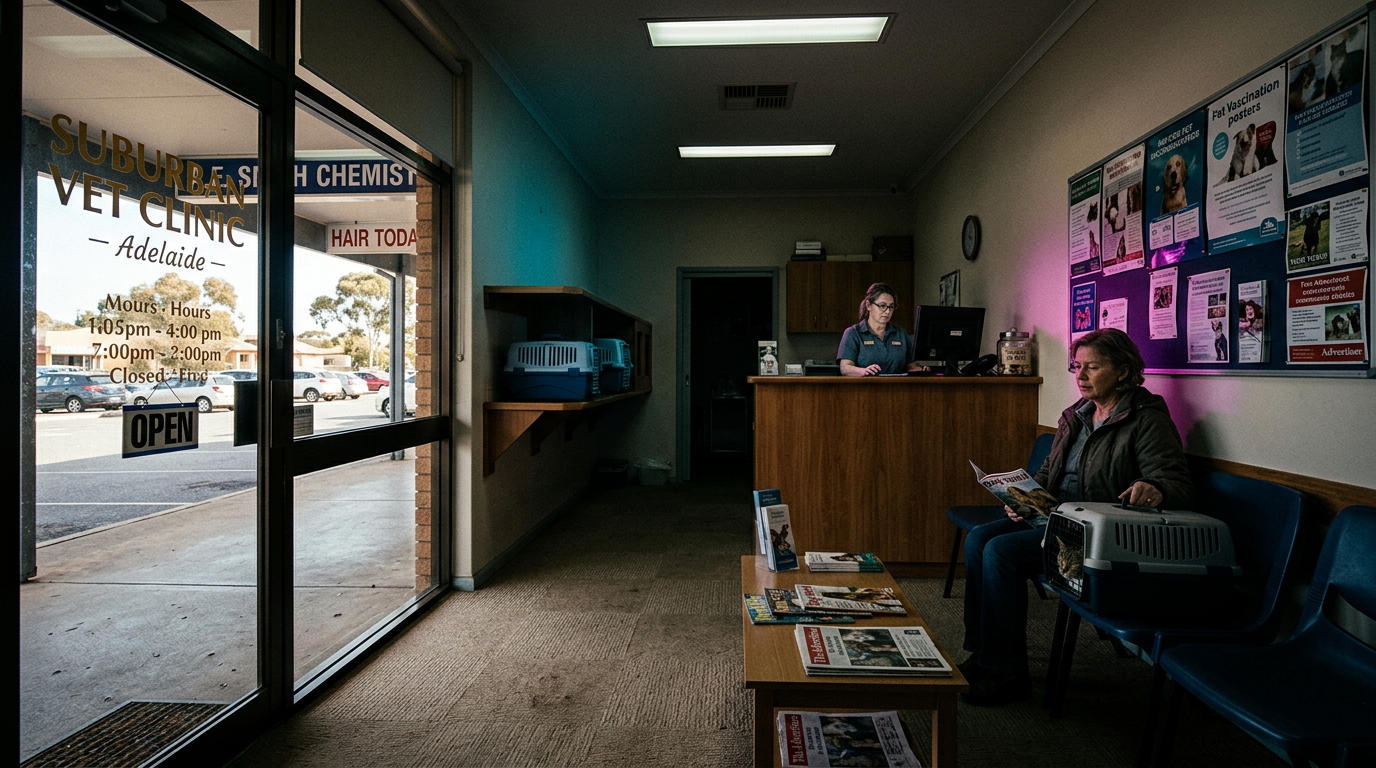
The Shopfront
The Craigmore Animal Care Centre occupied one of the mid-strip shopfronts at Craigmore Village, wedged between a discount chemist on one side and a hairdresser on the other, a few doors down from the Foodland. From the outside it was unassuming — a glass door, a sun-faded vinyl sign bearing the clinic name in blue sans-serif, and a modest window display of pet food brochures and vaccination reminders taped to the inside of the glass. Nothing about it announced ambition. It was what it was: a suburban vet clinic servicing the northern Adelaide growth corridor.
Inside, the waiting room opened directly off the entrance, carpet-tiled in a colour once called oatmeal and now called scuffed, with a reception counter at the far end behind which the receptionist worked. Plastic chairs lined two walls — the kind that stacked, with the slight wobble that suggested they had been stacking for years — and a low coffee table held a rotation of gardening magazines that had not been current in any useful sense since roughly 2014. A faintly discoloured aquarium bubbled in one corner, maintained more from habit than because anyone particularly enjoyed it.
Along one wall, raised on a waist-high counter, was the cat shelf — a designated zone where carriers could be placed so that the inmates did not have to spend their waiting time at dog-eye level. It had been Harold Bennett's idea in the early years, one of the first modifications he had made to the space after watching a terrier reduce a Persian to hysterics within ninety seconds of them both arriving for their shots.
Beyond the counter lay the working parts of the clinic: three consult rooms running along one side of a narrow corridor, a surgical suite at the rear, a small kennelling area for overnight and day patients, and a back room with an X-ray unit and a preparation bench that doubled as the lunch spot when nobody remembered to book the room. The building smelled — pervasively, inescapably — of disinfectant and wet dog, overlaid at different hours with coffee, printer toner, and whatever one of the nurses had warmed up in the microwave.
Bennett's Clinic
The clinic had been founded in 1995 by Dr Harold Bennett, then forty-eight and coming off a twelve-year stint at a general practice in Elizabeth. Bennett had grown up in the outer northern suburbs when they had still been mostly paddock, and he had watched the subdivisions creep north through the 1980s and early 1990s with the mixed feelings of someone whose childhood playgrounds were being converted to estate lots. When the new developments around Craigmore finally outgrew the capacity of the nearest vet in Salisbury, he saw the gap and took out a lease before anyone else did.
The first year was lean. Bennett ran the clinic with his wife Diana doing the books and a single part-time nurse, Julie Weatherall, who drove down from Two Wells three days a week. The caseload in those early months was thin enough that Bennett spent more time doing home calls to the acreage properties on the fringe of Craigmore than he did in his own examination rooms, fitting vaccinations around calving cows and budgerigar check-ups around the occasional colic.
By the late 1990s the practice had stabilised. Word travelled — Bennett's manner, which was neither unctuous nor especially warm but reliably practical, suited the suburb. He kept a biscuit tin behind the counter for the children of nervous clients, and he had a way of delivering difficult news without making it feel performed. Two more nurses joined across the next decade. A second vet, Dr Peter Hindmarsh, worked alongside Bennett for six years in the mid-2000s before taking a role with a university clinic in Adelaide. For a brief period in 2009 the clinic had three vets on its books; then one left for Queensland, and Bennett, in his early sixties, did not rush to replace him.
The shopping centre around the clinic shifted and reshifted across those years. The florist that had been next door through the clinic's first decade closed in 2006 and was replaced by a Vietnamese bakery that became, within months, the place where every staff member bought their lunch on the three days a week it was open. The bank branch at the end of the strip had closed and become a discount variety store, then briefly a vape shop, then finally the hairdresser that now sat next to the clinic. Only the chemist, anchored at the clinic's other side since 1994, had remained constant through the decades.
The Handover
By 2012 Bennett had begun talking about retirement with more seriousness than he had previously shown. His back, never entirely reliable after decades of wrestling large animals in his early career, had begun to protest more loudly. Diana had retired from the books the year before. His own pets — a series of variably well-behaved kelpies — had thinned to one, and the notion of slowing down had stopped feeling like an abstraction.
He met Ethan Turner through a shared colleague at a professional development day in Adelaide in early 2013. Turner was then working at the Glenelg Veterinary Centre and, at thirty-nine, was beginning to find the commute across town punishing. They had two further conversations across that year, one at a pub in Norwood and one at the clinic itself, and by late 2013 a handover arrangement had been drafted. Turner would join in February 2014 as associate; Bennett would remain on three days a week for the first six months, reducing through the second half of the year, and would formally retire at the end of 2014.
The transition was mostly smooth and occasionally clumsy. Some of Bennett's longer-standing clients — the sort who had come in during the 1990s and had now been through three dogs each — found Turner slower in his manner, more careful in his examinations, less inclined to the brisk diagnoses Bennett had favoured. A few of them took their custom elsewhere. Most did not. By the end of 2014, when Bennett handed over the last of the keys and went home to Diana and the garden, the clinic had steadied under its new arrangement.
Bennett himself retired not to leisure but to a quieter version of purpose. He continued to do occasional locum relief days at clinics in the northern suburbs for another four years before finally stopping altogether in 2018, and he remained a faintly judgmental presence at Turner's shoulder for several years after that, dropping into the clinic to pick up something for Diana's cockatiel and staying long enough to offer observations about the vaccine cold chain that were, as often as not, correct.
Under Turner
Turner's tenure was defined by unshowy continuity rather than reinvention. He made few structural changes in his first three years, preferring to understand what the clinic already did well before deciding what it should do differently. By 2017 he had brought in a part-time associate, Dr Hannah Maitland — a vet then in her early thirties who worked three days a week around her own young children — and had upgraded the X-ray unit to a digital system, which the existing staff pretended to find straightforward for several weeks before admitting they did not.
The clinic's core nursing team through the late 2010s comprised Karen Dobson, who had started under Bennett in 2005 and carried the institutional memory of everyone who had ever passed through the door, and Sophie Rennell, who had joined in 2016 and was still, three years later, addressed by Karen as "the new girl." The reception desk saw more turnover than the clinical staff did. Turner had inherited a competent woman named Janet Ruddick who retired in late 2017, and after a brief interregnum during which Turner answered the phones himself and discovered that he was no good at it, the position was filled in early 2018 by Ava Martin.
The working week settled into a rhythm Turner had inherited from Bennett and not seen reason to alter. Mondays were heavy with walk-ins from the weekend's damage — dogs who had eaten things, cats who had fought things, the occasional bird or lizard whose owner had meant to come in on Saturday and had not managed it. Tuesdays were surgery days. Wednesdays were the weekly nadir and the day Turner used for his longer consults. Thursdays rebuilt toward the weekend, and Fridays ran late — the six o'clock appointment routinely finishing closer to seven — as owners tried to clear things before their weekends. Saturday mornings were puppy preschool and the clinic's busiest scheduled window.
Turner's particular interest in neurological cases meant that over the years a soft referral pattern had established itself: other local clinics, knowing he had seen more epileptic dogs than they had and was willing to give the time these cases required, would occasionally send their trickier patients his way. He did not advertise the interest. It simply accumulated, one dog at a time, until the clinic had a modest reputation for being the place you went in the northern suburbs if your kelpie had started seizing and the first set of medications wasn't holding.
The Clientele
The people who brought their animals through the clinic's doors represented, in aggregate, a reasonable cross-section of the northern Adelaide suburbs — working families, retirees, shift-workers from the Salisbury transport depots, teachers and trades and the particular category of small-acreage owner who had moved just beyond the metropolitan fringe and kept a single house-cow alongside the dog. The caseload skewed heavily toward dogs. The second-largest category was cats, the third was budgerigars, and the long tail included the occasional rabbit, guinea pig, lizard, and — under Turner at least twice a year — a chicken whose owner had decided it was worth the twenty-dollar consult to see whether the respiratory problem could be resolved.
The economic texture of the clientele was not wealthy. Craigmore's median income sat below the state average through most of the clinic's years, and many of the homes it served operated on single incomes or on the tight juggle of mortgage, school fees, and whatever the cost of veterinary care happened to be that month. Bennett had been sensitive to this during his years and had quietly written off more bills than Diana had ever fully accounted for. Turner had inherited the disposition and extended it. Dorothy Pender, the accountant who had handled the clinic's books since the Bennett era, disapproved annually.
Long-standing clients were the clinic's quiet backbone. The Murchison family, for instance, had brought in four successive Labradors across three decades — the original Bailey who had come in during Bennett's first year, then Harvey who had overlapped with Bailey's decline in 2004, then Piper who had lived from 2009 to 2023, and finally the current Bailey the Second, acquired in 2024 and named with an apology to the original. Three generations of that family had come through the door at various points. The Sandersons, who lived on a five-acre block on the northern edge of Craigmore, had been bringing a rotating cast of kelpies, goats, and backyard chooks through since 1997. The clinic had treated four generations of some families' dogs.
The Pandemic Years
The first pandemic lockdown in March 2020 cut the clinic's caseload by roughly forty percent in a fortnight. Turner restructured the workflow within a week: appointments moved to kerbside drop-off, owners waited in their cars while he and Hannah worked animals through the building, and everything that could be deferred was. Karen, in her late fifties and with her sister's asthma history weighing on her, considered retiring early and decided against it. Sophie's partner lost his job in events management. Ava's then-boyfriend, whose warehousing work had been declared essential, continued to leave for full shifts while Ava was told to hot-desk the reception phone from the clinic with surgical gloves on.
What followed over the next two years was what the wider profession came to call, without much humour, the Puppy Boom. Demand rose sharply as people locked down with newfound time and bought or adopted dogs in numbers the industry had not previously seen. By late 2020 the clinic was running at capacity. By 2021 it had a four-week wait for routine consultations, which Turner found demoralising for reasons he had trouble articulating — he had come to suburban practice partly because he disliked the high-throughput feeling of larger operations, and the pandemic had made his own clinic feel, briefly, like a larger operation despite his best efforts.
The emotional ballast of those years came from the clientele. People who ordinarily saw their vet twice a year were in the clinic fortnightly during some stretches, processing the losses and adjustments of the broader moment through the health of their animals. Turner, who had always preferred concrete tasks to emotional labour, found himself delivering more difficult news more often than at any other point in his career. By the time restrictions eased in the middle of 2022, both he and Hannah had developed visible exhaustion in their faces. Karen had put on weight. Sophie had, at some point in early 2022, quietly started a course in animal physiotherapy.
After the Boom
The years after 2022 brought a slower recovery than many in the profession had expected. The pandemic pets grew up. A non-trivial proportion were surrendered as their owners returned to offices and struggled to manage the animals they had acquired in the isolation. Turner saw more behavioural cases than he ever had, more aggression assessments, more euthanasia requests for young dogs whose owners had run out of solutions. The mood in the clinic shifted in ways that were hard to name but impossible to miss.
Hannah Maitland, by then in her early forties and with her own children edging into teenage years, reduced her hours further in 2023. Sophie qualified as an animal physiotherapist in early 2024 and began splitting her time between the clinic and a mobile rehab service she had set up. Turner, rather than seeing the arrangement as a loss, made space for it and began referring his orthopaedic and post-surgical cases to her. Karen Dobson remained immovable at the front of the nursing team, and had started threatening retirement with the kind of frequency that suggested she would not retire at all.
By 2025 the clinic had settled into what looked, to anyone stepping in from the outside, like a fundamentally ordinary suburban practice. The scuffed chairs had finally been replaced with a set donated by a long-term client whose sister had redone her real estate office. The aquarium had been retired, not without sentiment. The biscuit tin remained. Turner, in his early fifties, had reduced himself to four days a week. His accountant had won, eventually, a long-running argument about fees, and the clinic's prices were at last close to what the work was worth.
Into 2026 the clinic remained what it had always been under Turner: a small, competent, slightly over-committed community practice in a shopfront in Craigmore, carrying the steady low-grade weight of treating the animals of people who had known each other's dogs for thirty years. The fluorescent lighting still buzzed faintly in the consult rooms. The disinfectant smell still found its way into the corridor. The magazines on the coffee table were slightly more current than they had ever been, though not much.







