4134.318 · November 14, 1814 AD
Confessions in the Counting Room
Eliza Donnelly returned to Campbell Cove four days after her initial encounter with William Jeffries, ostensibly to review her father's accounts. In the privacy of the warehouse counting room, Jeffries revealed the circumstances of his conviction—his innocence of the theft itself and the betrayal by a man named Jack Hawley that had resulted in his transportation. Miss Donnelly offered to assist him in building a future beyond his convict past.
The black lacquer carriage with its polished brass fittings returned to Campbell Cove on the morning of the fourteenth of November, drawing up near Warehouse Three with the quiet authority of regular custom. Eliza Donnelly descended and made her way along the dock with the same purposeful bearing she had displayed during her previous visit, her gaze sweeping the waterfront before settling upon the checker who had caught her attention four days earlier.
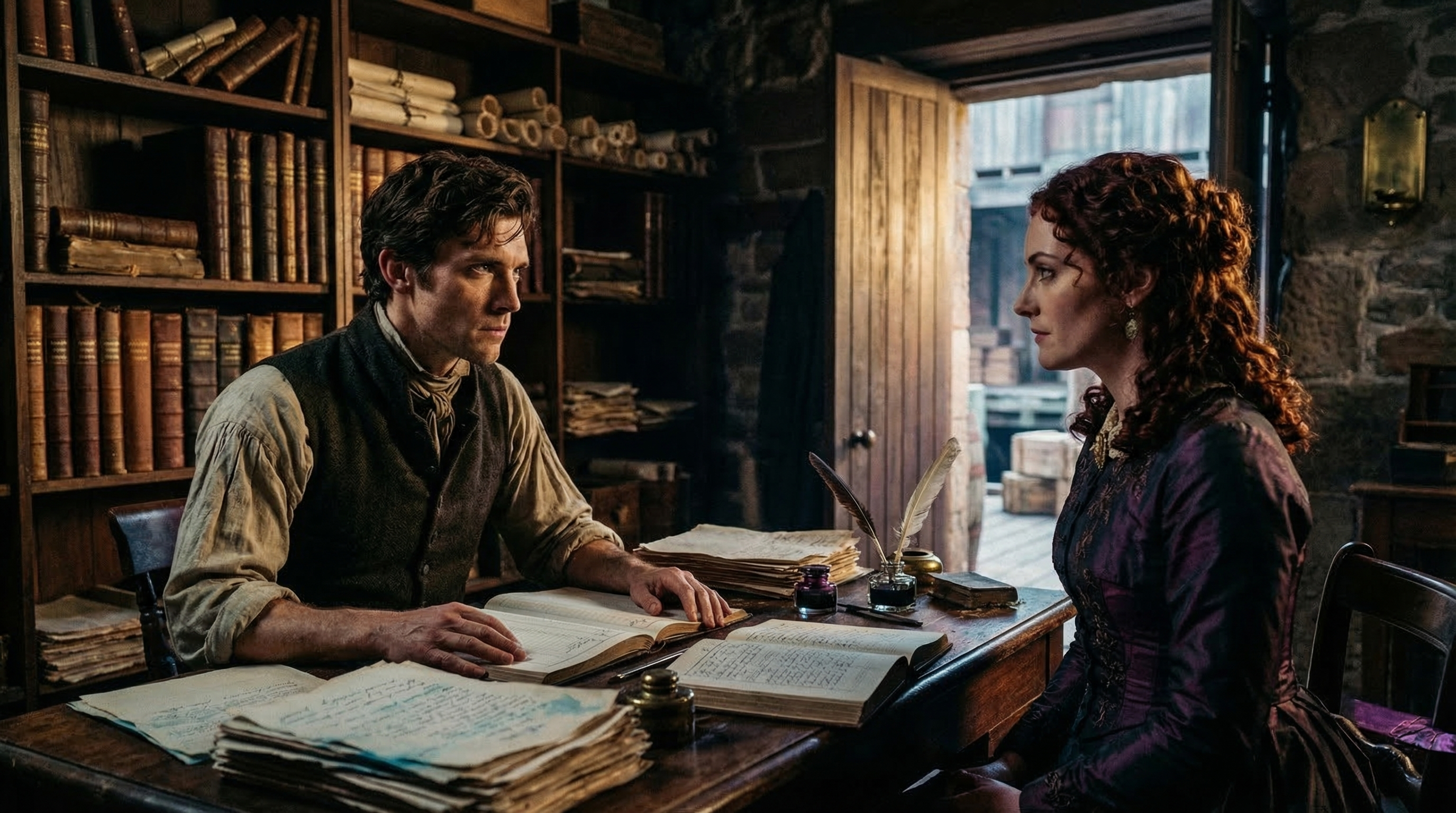
William Jeffries maintained his focus on the manifest before him as she approached, though those who observed him closely might have noted a stillness in his manner that suggested awareness of her presence. When she requested his assistance in reviewing certain discrepancies in her father's accounts, he led her to the counting room at the rear of Warehouse Three—a small chamber furnished with a battered desk and shelves of ledgers that offered a degree of seclusion from the bustle of the docks.
What transpired within that room was not witnessed by any third party. The door remained open throughout, preserving the appearance of propriety, and any clerk passing in the corridor would have seen only a merchant's daughter consulting records with a checker—an unremarkable scene repeated countless times across the colony's commercial establishments. Yet the conversation that unfolded between Eliza Donnelly and William Jeffries bore no resemblance to ordinary business discourse.
Jeffries spoke of Portsmouth and the events that had led to his transportation. He described a man named Jack Hawley, once believed to be a friend, who had placed a stolen pocket watch among his possessions without his knowledge. When constables came searching for the item, they had found it exactly where Hawley had secreted it. The watch's owner was a man of influence; the magistrate had not been inclined to credit the word of a dockworker over that of a gentleman. Hawley himself had attended the trial and walked free whilst Jeffries was led away in chains.
The admission was remarkable for its candour. Convicts who maintained their innocence were common enough—the gaols and work gangs of New South Wales held no shortage of men who claimed to have been wrongly convicted—but few spoke of their circumstances with the controlled precision that Jeffries displayed. He did not plead or protest; he simply stated the facts as he understood them, leaving his listener to draw her own conclusions.
Miss Donnelly's response was equally notable. She did not recoil from the revelation, did not treat his claims with the scepticism that most free colonists would have considered appropriate when confronted with a convict's protestations of innocence. Instead, she listened with the same attentiveness she brought to matters of commerce, weighing his words against whatever assessment she had already formed of his character.
The conversation turned to philosophy—to questions of worth and judgement, of how men should be measured and by whom. Reginald Donnelly's views on the matter were discussed; the merchant apparently held that transportation was a punishment rather than a permanent damnation, and that men who had served their sentences and demonstrated good character deserved consideration equal to any other. It was a position that placed him at odds with much of Sydney society, though Miss Donnelly spoke of it with evident pride.
Before they parted, Miss Donnelly made an offer whose precise terms were not recorded but whose general nature could be inferred from subsequent events. She expressed interest in assisting Jeffries—in helping him build a future that might transcend the limitations his conviction had imposed. Whether this assistance was to take the form of commercial education, social introduction, or something less easily defined remained to be determined.
The counting room meeting concluded with the afternoon's business still requiring attention. Miss Donnelly departed to conduct her inspection of the Donnelly warehouses; Jeffries returned to his ledgers and his duties. The harbour master, whose informants had doubtless reported the extended consultation, made no immediate comment, though his manner toward the checker in subsequent days suggested that the encounter had not escaped his notice.
Something had shifted in the relationship between the merchant's daughter and the ticket-of-leave man. What had begun as a chance encounter over cargo discrepancies had become something more deliberate, more intentional, more fraught with implications that neither party could have failed to recognise. The path they had begun to walk together led toward territory that colonial society had marked with clear warnings against trespass.
They walked it nonetheless.







