Collinsvale, Tasmania, Australia
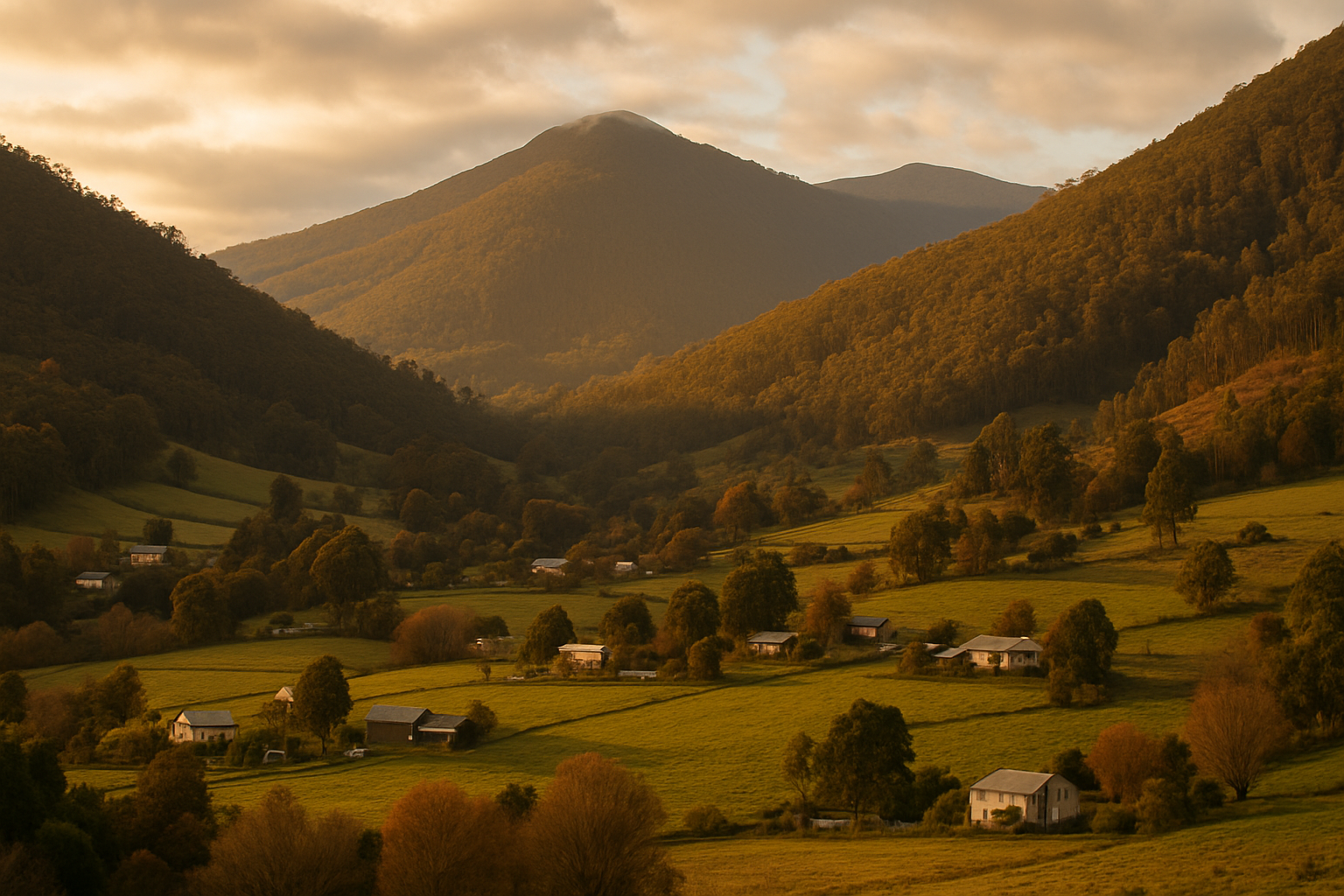
Collinsvale is a rural suburb nestled in the foothills of kunanyi/Mount Wellington, approximately twenty-five kilometres northwest of Hobart. Established in 1840 by settler James Collins, it evolved from a farming community into an agricultural hub renowned for its apple orchards. The suburb gained unexpected notoriety in July 2018 when the disappearance of residents Karen and Chris Owen sparked a police investigation that culminated in a dramatic high-speed pursuit through its winding roads.
Location and Geography
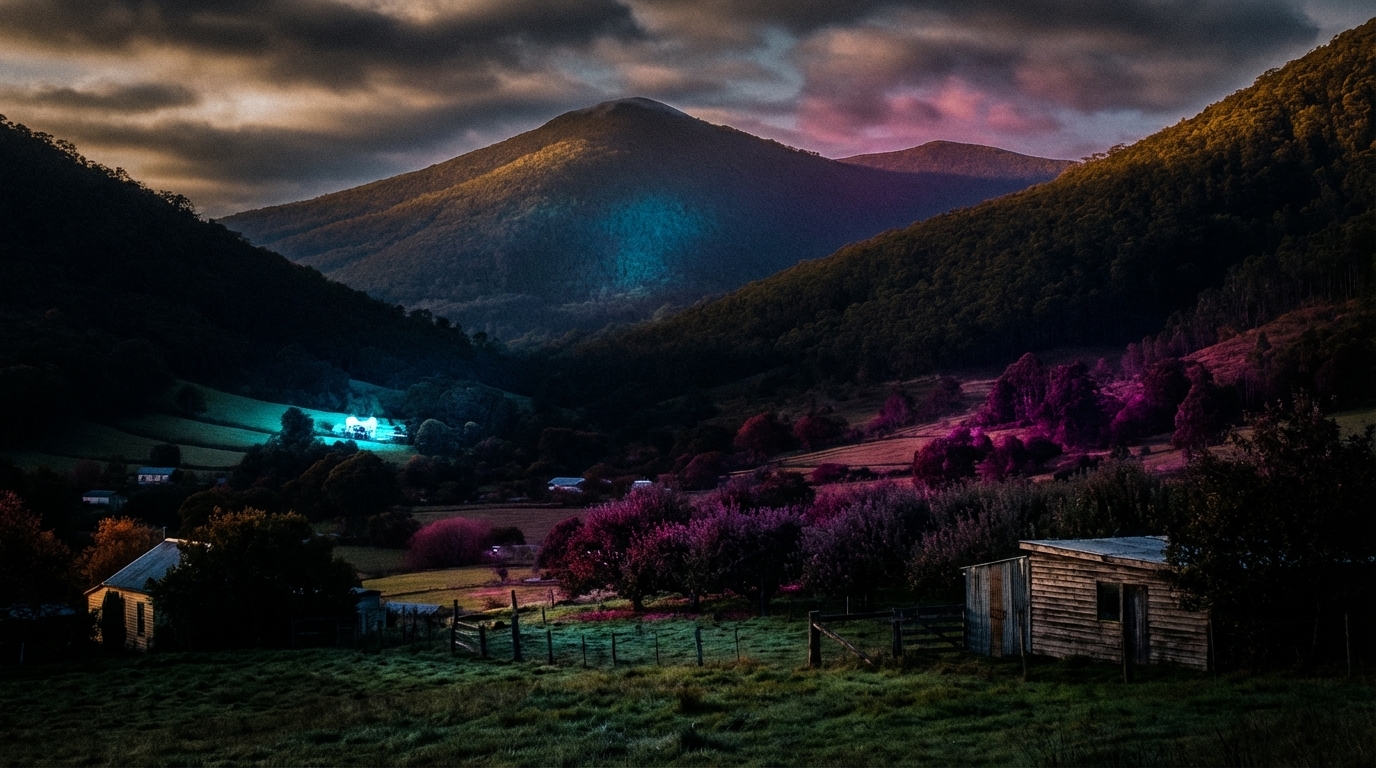
Collinsvale occupies a distinctive position within Tasmania's southeastern landscape, situated in the foothills that rise towards the imposing presence of kunanyi/Mount Wellington. The suburb lies approximately twenty-five kilometres northwest of Hobart's central business district, accessible via Collinsvale Road, which winds through the undulating terrain that characterises this region of the Derwent Valley. The area's elevation provides residents with expansive views across the surrounding countryside whilst maintaining proximity to the state capital.
The geography of Collinsvale is defined by its transitional position between the fertile lowlands of the Derwent Valley and the rugged slopes of the Wellington Range. The terrain rises and falls in gentle undulations, creating a patchwork of small valleys and ridges that have historically determined patterns of settlement and agriculture. Creeks and seasonal watercourses thread through the landscape, feeding into the broader Derwent River catchment and supporting the lush vegetation that characterises much of the area.
The natural environment surrounding Collinsvale encompasses a mixture of cleared agricultural land and remnant native bushland. Eucalyptus forests dominate the higher slopes, whilst the lower areas support grasslands and orchards that reflect centuries of European land management. The proximity to Wellington Park, which encompasses the mountain's protected wilderness areas, ensures that wildlife corridors connect Collinsvale to broader ecological systems, allowing native species to move between habitats despite the presence of human settlement.
Historical Origins
The suburb takes its name from James Collins, an early settler who established the first European presence in the area in 1840. Collins recognised the agricultural potential of the fertile valleys and well-watered slopes, claiming land that would eventually form the nucleus of the community that bears his name. Like many Tasmanian settlements of this era, Collinsvale emerged from the colonial project of transforming wilderness into productive farmland, a process that displaced the Palawa peoples who had occupied these lands for tens of thousands of years.
The decades following Collins's arrival saw gradual expansion of the settlement as additional farming families claimed adjacent properties. The area's reliable rainfall and temperate climate proved conducive to mixed agriculture, with settlers establishing vegetable gardens, grain crops, and livestock operations. The community that developed was characterised by the self-reliance typical of rural Tasmania, with families producing much of what they needed whilst trading surplus produce with Hobart's growing urban population.
The construction of Collinsvale Road in 1885 represented a significant milestone in the suburb's development, providing a formal connection to Hobart that facilitated the transport of agricultural products to market. Prior to the road's completion, farmers had relied on rough tracks that became treacherous during winter rains, limiting their ability to participate in the colonial economy. The new road opened possibilities for commercial agriculture whilst also enabling greater social connection between Collinsvale's residents and the broader Tasmanian community.
Agricultural Heritage
The late nineteenth and early twentieth centuries witnessed Collinsvale's transformation into an agricultural hub renowned particularly for its apple orchards. The area's climate proved ideal for pome fruit cultivation, with cool winters providing necessary chilling hours whilst mild summers allowed fruit to develop slowly, concentrating flavours and sugars. Orchardists planted extensive stands of heritage varieties, many of which have since disappeared from commercial production elsewhere but which occasionally persist in Collinsvale's older properties.
Beyond apples, Collinsvale's farmers diversified into various agricultural enterprises suited to the local conditions. Dairy farming found a foothold on properties with reliable water supplies and lush pastures, whilst market gardens supplied Hobart's tables with fresh vegetables. The keeping of poultry became widespread, with chickens providing eggs and meat for both domestic consumption and sale. These birds, descendants of flocks established generations ago, continue to roam freely on many properties, occasionally causing minor disruptions to traffic along the suburb's roads.
The agricultural character of Collinsvale persists into the present day, though the scale and nature of farming has evolved considerably. Large commercial orchards have given way to smaller holdings where hobby farmers and those seeking rural lifestyles cultivate gardens, keep animals, and maintain connections to the land. Environmental consciousness has become increasingly prominent, with some properties adopting permaculture principles and sustainable practices that seek to work with rather than against natural systems.
Community Character
Collinsvale has maintained a distinctly rural character despite its relative proximity to Hobart. The suburb lacks the commercial development and population density found in Tasmania's urban centres, instead offering residents a quieter existence marked by space between properties, minimal street lighting, and the sounds of nature rather than traffic. This isolation, whilst attractive to those seeking escape from urban pressures, also means that neighbours may live considerable distances from one another, their properties separated by paddocks, orchards, and remnant bushland.
The community that has developed in Collinsvale over generations reflects a mixture of long-established farming families and more recent arrivals drawn by the area's natural beauty and peaceful atmosphere. Artists, conservationists, and those working in environmental sciences have found the suburb congenial, its landscape providing both inspiration and opportunity for practical engagement with ecological systems. The resulting social fabric combines traditional rural values with contemporary environmental consciousness, creating a community that respects both heritage and sustainability.
Properties in Collinsvale range from modest cottages dating to the colonial era to more substantial modern homes designed to take advantage of the area's views and natural setting. Many residents have invested considerable effort in their gardens and grounds, creating private landscapes that blend productive elements with ornamental plantings. These individual efforts collectively contribute to Collinsvale's character as a place where human presence coexists with, rather than dominates, the natural environment.
The Owen Residence
Among the properties that exemplify Collinsvale's blend of heritage and environmental consciousness, the residence of Karen and Chris Owen stands as a particularly notable example. Located on a secluded parcel of land accessible via a private drive, the Owen property encompasses a colonial-era cottage that the couple thoughtfully renovated in the early 2000s, blending nineteenth-century Tasmanian architecture with modern ecological sensibilities. The home featured three bedrooms, an original stone hearth, and cedar cladding handpicked by Chris from nearby forests.
The Owens, both committed environmentalists, designed their property to reflect their values. A passive solar design maximised natural heating and cooling, whilst a greywater wetland system processed household waste. The gardens incorporated permaculture principles, with vegetable beds, fruit trees, and a wild pollinator refuge supporting native bees and other beneficial insects. Karen, an entomologist by training, maintained a collection of Tasmania's rarest insect species, specimens pinned near the kitchen window where she could observe them whilst working.
The property also included a Tasmanian oak barn dating from the previous century, which served as storage for tools and equipment whilst also providing refuge for injured wildlife that the couple rehabilitated. Domestic ducks and geese roamed the grounds, serving both practical purposes in land maintenance and providing companionship. A black cat patrolled the property, keeping pest populations in check. This carefully curated environment reflected lives devoted to conservation and sustainable living, making the events of July 2018 all the more unexpected.
The Disappearance
On the morning of 27 July 2018, Karen and Chris Owen were engaged in their usual routines, repairing a section of retaining wall damaged by recent weather whilst awaiting the arrival of a visitor named Luke Smith. The day began unremarkably, with breakfast prepared in their familiar kitchen and conversation about the work ahead. Neither could have anticipated that by the day's end, they would have vanished completely from their beloved property, leaving behind a mystery that would consume police resources and haunt those who knew them.
The circumstances of their disappearance defied conventional explanation. Luke Smith arrived at the property as expected, but what transpired within the cottage's walls bore no resemblance to an ordinary social visit. In the living room, a door transformed into something impossible, a kaleidoscopic gateway that pulled Karen through before she could resist. Chris, witnessing his wife's inexplicable departure, followed immediately, refusing to let her face whatever lay beyond alone. Within moments, both had crossed a threshold that no longer existed by conventional measures.
The property they left behind showed subtle signs of abandonment that would later trouble investigators. Fresh daisies, freshly picked, sat on the verandah, their presence suggesting a life interrupted rather than concluded. The couple's dark green Land Cruiser remained parked in its usual spot. The geese, normally vocal guardians of the property, fell strangely silent. These details, insignificant individually, would collectively suggest to those who came looking that something deeply wrong had occurred.
The Investigation Begins
The police investigation into the Owen disappearance began on 30 July 2018, triggered by an emergency call from Meredith Clarke, a neighbour whose property lay over a kilometre away across a wooded ridge. Clarke reported that she had not seen Karen or Chris for several days, that their usual patterns had been disrupted, and that she had observed unusual activity at the property. Her account, whilst seemingly straightforward, contained inconsistencies that investigating officers would later note with interest.
Clarke described witnessing a white unmarked truck making repeated deliveries at odd hours, cargo being unloaded via the eastern entrance, and other specific details that seemed remarkably precise for observations made from such a distance through dense forest. When questioned about her vantage point, her explanations grew defensive, shifting from claims of direct observation to reliance on sounds and dust clouds. The investigating officer documented these discrepancies, sensing that Clarke's relationship to the events was perhaps more complicated than her role as concerned neighbour suggested.
Senior Detective Karl Jenkins and Detective Sarah Lahey of Tasmania Police Southern Division were assigned to the case. Their journey to Collinsvale proved eventful even before they reached the Owen property, as a flock of stubborn chickens brought their vehicle to a halt on one of the suburb's narrow roads. The birds, seemingly oblivious to the urgency of police business, required patient herding before the detectives could continue. This brief, absurd delay provided a moment of levity before the grimmer discoveries that awaited them.
The Crime Scene
When Jenkins and Lahey arrived at the Owen property, they encountered a scene that unsettled their professional instincts. The cottage's front door stood open, an invitation to entry that seemed wrong given the owners' absence. Fresh daisies on the verandah suggested recent activity, yet an oppressive silence hung over the grounds. The geese, which neighbours had described as reliably noisy guardians, offered no challenge to the approaching strangers. Every surface within the house had been wiped clean, carrying the distinctive scent of disinfectant.
Inside, Jenkins discovered a blood trail leading from the dining room to a coffee table, evidence that something violent had occurred despite the obvious attempt to sanitise the scene. A journal lay open, its pages bearing a smear of fresh blood that transferred to the detective's hand when he touched it. The discovery transformed a missing persons enquiry into something more sinister, raising questions about whether the Owens had left voluntarily or met with foul play.
While Jenkins examined the interior, Lahey investigated the outbuildings. The locked barn resisted easy entry, and her attempts to gain access resulted in a series of mishaps that compounded injuries she had already sustained. Her exploration was interrupted by a sudden, unexpected encounter with one of the property's geese, resulting in a gunshot that echoed across the quiet property. The bird's death, though accidental, added another layer of complexity to an already troubled investigation.
The High-Speed Pursuit
The investigation at the Owen property was interrupted by a radio call reporting two vehicles travelling at dangerous speeds near Collinsvale. The timing seemed too coincidental to ignore, and Lahey, seeking perhaps an escape from the emotional complexity of the scene, urged Jenkins to pursue. What followed became one of the most dramatic incidents in recent Tasmanian police history, a chase that would leave its participants changed and its conclusion shrouded in mystery.
The pursuit led through Collinsvale's winding roads as a violent storm broke over the hills, rain reducing visibility and making the asphalt treacherous. Jenkins demonstrated expert driving skills, closing the distance on the fleeing vehicles despite conditions that would have deterred less determined officers. The patrol car went airborne over a rise at one point, giving Lahey just enough time to catch a registration plate before they lost control momentarily. The chase continued through flooded sections where hydroplaning became a constant danger.
The vehicles being pursued included a ute carrying Luke Smith and another man, Adrian Pafistis, as well as a vehicle driven by Gladys Cramer, a woman whose involvement in the broader conspiracy would only become clear later. The pursuit ended at Myrtle Forest, where the suspects' vehicles were discovered abandoned near the walking trail. Fresh tyre tracks and footprints led into the forest, but the suspects themselves had vanished as completely as the Owens, leaving behind only a silver bracelet bearing the initials 'G.C.' as evidence of their presence.
Connection to Myrtle Forest
The events in Collinsvale proved inextricably linked to the nearby Myrtle Forest, a temperate rainforest within Wellington Park renowned for its majestic myrtle beech trees. The forest, which had served as a peaceful sanctuary for bushwalkers and nature enthusiasts, became the destination for those fleeing the Owen property investigation. Unknown to the pursuing officers, a wooden toilet block within the forest served a purpose far stranger than its mundane appearance suggested.
The connection between Collinsvale and Myrtle Forest would deepen tragically in the days that followed. Detective Karl Jenkins himself would disappear during a subsequent investigation at Jeffries Manor, his fate becoming yet another unsolved mystery. On 8 August 2018, Detective Sarah Lahey met her death in Myrtle Forest during a covert operation that spiralled into violence. Gladys Cramer was arrested at the scene, charged with manslaughter and other offences, though she would later vanish before serving any sentence.
The geographic proximity of Collinsvale and Myrtle Forest, connected by roads that wind through the foothills of kunanyi, meant that the events of July and August 2018 affected both locations in ways that continue to resonate. What began at the Owen property in Collinsvale led directly to the forest's transformation from peaceful wilderness to crime scene, linking the two places in a narrative of disappearance, pursuit, and death that defies complete explanation.
Aftermath and Legacy
The events of 2018 left Collinsvale changed in ways both subtle and profound. The Owen property, once a model of sustainable living and environmental consciousness, stands as a reminder of lives interrupted and mysteries unsolved. Local residents, particularly those who knew Karen and Chris, continue to grapple with the couple's unexplained disappearance, some finding comfort in the belief that the pair simply chose to start new lives elsewhere, others harbouring darker suspicions about their fate.
The police investigation remains officially active, though progress has stalled in the absence of new evidence. The case files document a conspiracy of unusual scope, connecting the Owen disappearance to other missing persons, to deaths both explained and unexplained, and to individuals whose movements between Tasmania and elsewhere suggest operations beyond ordinary criminal enterprise. Karl Jenkins remains listed as a missing person, his disappearance at Jeffries Manor adding another layer to an already complex investigation.
For Collinsvale itself, life continues much as it has for generations. Farmers tend their properties, chickens wander across roads to the occasional frustration of motorists, and the suburb's distance from Hobart continues to attract those seeking quieter lives. Yet beneath the surface tranquillity, an awareness persists that this seemingly unremarkable place witnessed events that challenge conventional understanding. The foothills of kunanyi keep their secrets, and Collinsvale, for all its pastoral charm, remains a place where the ordinary and the inexplicable proved capable of intersection.


