4338.208 · July 27, 2018 AD
Chewbathian Tension
When Chris reveals a set of ancient coins, Glenda is drawn into a confrontation that fractures alliances and awakens something older than any of them understand. As truths are fought for and secrets clawed back from the firelight, she begins to realise: this isn’t just a discovery—it’s an invitation. And someone, somewhere, may already be listening.
“You never think history’s watching until you feel it breathing down your neck.”
The sudden change in Karen’s demeanour broke through the intensity of our discussion like a blast of icy air, severing the thread of our exchange with unsettling precision. Her voice, edged in irritation, rose above the low murmur of the camp, cutting through the ambient crackle of the fire like the snap of dry twigs underfoot. She wasn’t speaking to me.
She was speaking to Chris.
A sharp question—pointed, personal.
It landed hard.
Until that moment, I’d barely registered Chris’s agitation. His pacing had been background noise, an unconscious tick lost in the tapestry of our surroundings. But now, as Karen turned her full attention to him, her words hung heavy in the air, crystallising something I hadn’t fully seen until now. Chris wasn’t just restless—he was unravelling.
I took a half-step back, not out of fear but reflex, as if giving the scene room to breathe. My own irritation—the tension from earlier—seeped away before a more pressing energy. My fingers rose to my forehead, a familiar gesture of containment, of trying to smooth away the fatigue that had set up residence just behind my eyes. The fire’s glow caught the faint sheen of sweat on Chris’s brow, highlighting a tautness in his features that hadn’t been there before.
He looked… off.
"It's nothing," he muttered, the words limp and unconvincing, barely audible above the subtle movement of bodies around the fire.
But it was something.
His voice betrayed him, tight and fragile. And the way his hands trembled—barely perceptible unless you were looking—set something alight at the base of my spine. Instinct, honed over years in medicine, stirred. A whisper. Something’s wrong.
Karen’s patience evaporated like moisture on a hot skillet.
"Just spit it out, would you!" she snapped. Her voice cracked with more than frustration—it carried a tremor of fear. Her anger was a mask. I saw it now. Beneath the sharp words, her eyes betrayed her. She was scared.
That admission, unspoken but clear, made the air feel tighter.
A ripple of unease passed through me—not from Karen, and not from Chris, but from something older. Something more primal. The kind of atmospheric shift I had felt in trauma bays when things were about to spiral. A pressure, invisible but there, making it harder to think in straight lines.
Around us, the camp pulsed on, oblivious. Figures huddled in small groups at the edges of the firelight, their laughter dimming as the cold deepened. A breeze stirred the sand, dragging a low hiss across the packed earth.
And in the middle of it all: Karen, rigid with tension; Chris, on the verge of something he wasn’t ready to admit; and me—unexpectedly calm.
I hadn’t intended to gain the upper hand, but there it was, handed to me by the chaos of human emotion. Karen, who had been sharp and unrelenting moments earlier, now floundered—her thoughts pulled in two directions. Her eyes darted between me and her husband, her authority fraying.
In that breath of hesitation, I recalibrated.
Not out of malice. Not to win. But because something else was beginning to stir, and I needed to be steady when it broke.
And it would break. Of that, I was suddenly certain.
I studied Chris. The shadows under his eyes. The way his posture faltered. Whatever he was hiding—whether it was guilt, illness, fear, or something stranger—it wasn’t just affecting him. It was affecting her. And that meant it would affect all of us, eventually.
I inhaled slowly through my nose, steadying myself.
If the harmony of earlier had lulled us into a sense of ease, it was time now to awaken.
This wasn’t a song anymore.
It was a countdown.
The tension in the air was almost tangible—like static before a storm—as we instinctively drew nearer to the fire, the warmth offering little comfort against the chill that had begun to settle between us. The flames crackled and spit, casting long, wavering shadows across our faces, rendering expressions difficult to read and lending the moment an eerie, theatrical intimacy.
Chris’s movements were slow, deliberate, too measured for someone simply reaching into a pocket. His hand moved as though burdened by more than just the weight of the objects it carried—there was meaning there, hesitation, even fear. He pressed his top teeth hard into his lower lip, a tell of nervous restraint I’d seen countless times in trauma patients about to confess what they’d hidden from doctors—or from themselves.
Then, he withdrew his hand.
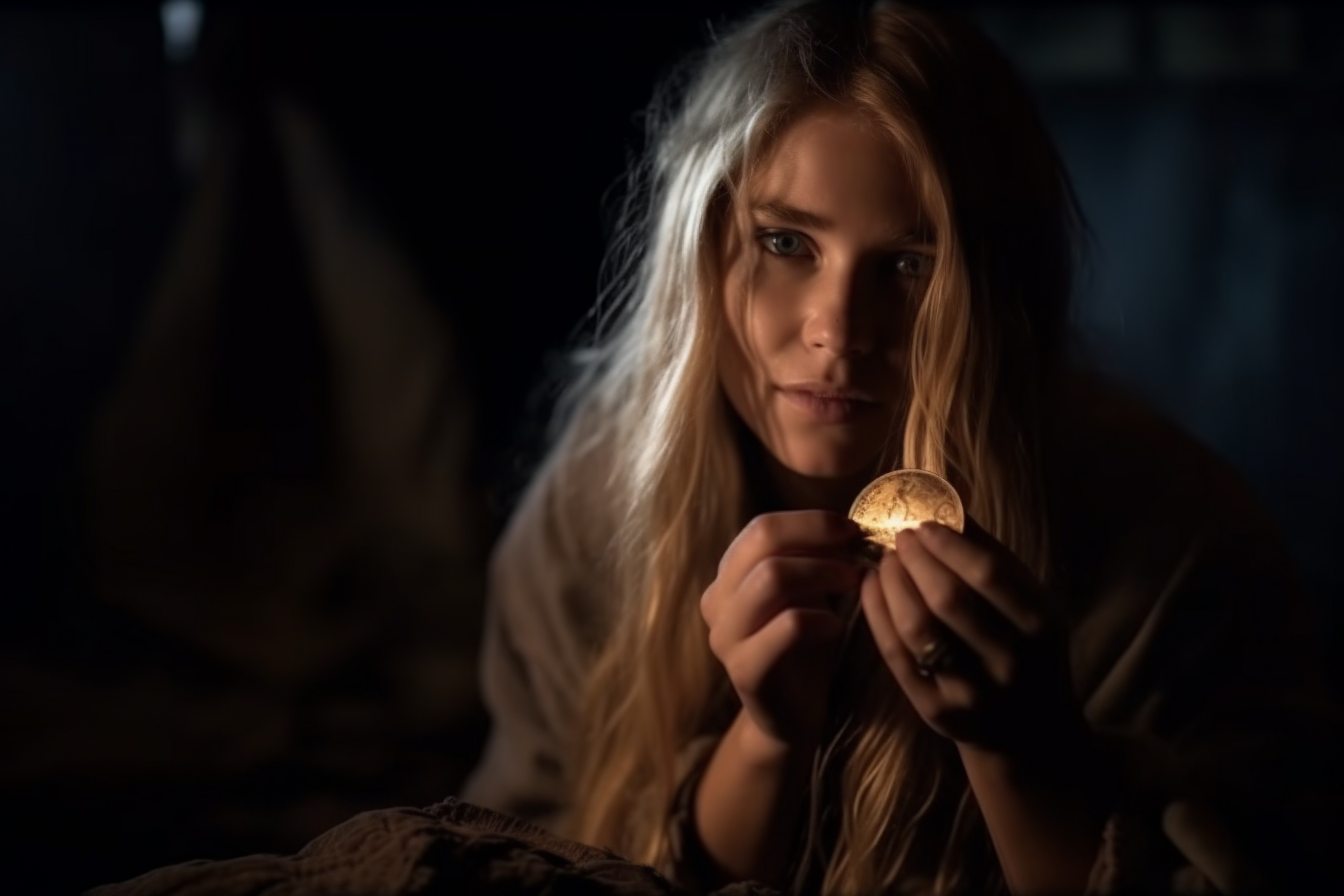
His fingers uncurled, palm trembling slightly, revealing several small metallic items. Their surfaces caught the firelight with brief flashes of dull silver, muted and ancient-looking, like lost trinkets unearthed from deep time. There was no announcement, no declaration—just the offering, and the silent gravity of a secret finally exposed.
I gasped before I could catch myself. The sound escaped me, unfiltered, and hung in the air like a fragile thread. My hand reached forward, guided more by instinct than intention, and I plucked one of the strange objects from his palm. Its coolness against my skin was sharp and unexpected, sending a small thrill through my fingers.
"Fascinating," I breathed, more to myself than anyone else, my voice thin and awed. The object—no, the coin—was small, but its presence was enormous. Holding it barely an inch from my face, I turned it in the firelight, trying to parse the etchings along its edge. The symbols were unfamiliar yet meticulously formed, whispering of a language I didn’t recognise, but somehow felt I should.
Karen's voice snapped through the quiet like a whip. "What are they?" she asked, grabbing one from Chris’s open hand with none of the reverence I felt. Her voice was laced with a kind of tension I couldn’t yet place—part suspicion, part fear, part something else altogether.
Chris swiped the back of his hand across his brow, wiping at the sweat that had pooled there. The firelight caught in the glistening smear across his skin. "I think they might be coins of some sort," he murmured, though there was uncertainty in his tone. "But I’m not really sure."
My thumb traced the ridged edge of the object as I brought it closer to my eyes. The letters were old-fashioned, their forms almost ceremonial. "Chewbathia," I read aloud, each syllable landing like something half-remembered. The name didn’t register in any logical catalogue, yet it stirred something—an echo from stories once told beneath the hush of night. My father’s voice, ghostlike, brushing against memory.
My gaze lifted sharply to Chris. "Yes, it’s a coin," I said with quiet certainty, surprised by the firmness in my own tone. There was no room for doubt. Whatever this thing was, it had meaning. Deep, buried meaning.
Karen’s eyes narrowed. "How do you know for certain?" Her tone carried challenge, but underneath it, I heard something else—unease. The need to push back when the ground begins to feel unstable beneath your feet.
I didn’t answer her.
Couldn’t, really.
Because even as she spoke, I was no longer fully with them—I was spiralling inward, searching my memory for breadcrumbs. Chewbathia. My father had never said it directly, I was sure of that. But he had spoken in riddles, in fragments, in allusions to lands and currencies and powers that weren’t of our world. Back then, I’d taken them as metaphors, or perhaps the storytelling eccentricities of a brilliant man grown strange in grief.
Now I wasn’t so sure.
The coin was heavier than it looked. Its very presence whispered of something beyond our comprehension. A relic. A key.
"I think the markings of the twenty cliv make it rather obvious," Chris added, his voice clearer now, his composure slowly returning—as if, having unburdened himself, he was beginning to reassemble.
My eyes darted to the numbers—stylised, subtle, but undeniably there. Twenty cliv.
What was a "cliv," exactly?
I didn’t know.
But my gut told me this wasn’t currency from anywhere on Earth. And if it wasn’t… what, precisely, was it?
The campfire crackled beside us, sending a thin stream of sparks spiralling into the blackness above like a warning signal—fleeting and beautiful, yet undeniably urgent. The fire's light glinted across the metallic surface of the coin in my hand, turning it briefly into something precious, something dangerous. It lay in my palm like a forgotten truth begging to be remembered, its weight pressing down not just on my skin but on my thoughts.
"It means we're not alone," I found myself responding, the words leaping from my lips before my sense of caution could catch them. The surge of exhilaration left no room for restraint. The idea of another civilisation—one hidden, perhaps even watching—spilled into my consciousness like water breaching a dam.
But even as the statement hovered in the air, something inside me recoiled.
Say no more. The warning came unbidden, like a cold hand resting against the back of my neck. It wasn’t fear, exactly—but a primal urge for silence. As if the air itself had thinned. As if something—someone—might be listening.
Karen’s voice cut through the charged moment, the sharp edge of her scepticism grounding us like a sudden gust of wind extinguishing a candle. "We don't know that," she said coolly, examining the coin with narrowed eyes, its shine catching briefly in her gaze. "This looks quite dated."
Her practicality grated against my wonder, but it was necessary—an anchor in a moment when I might otherwise have floated too far into imagination.
Her words echoed in the hollow of my chest. Dated. Ancient, even.
It is, my mind whispered. My father's voice stirred behind the thought, cloaked in memory and layered meaning. It is.
Karen turned the object over in her hand, oblivious to the whirlpool tightening in me. Her brow furrowed, her lips pressed into a thoughtful line—but I could feel her slipping away from curiosity into doubt.
The fire popped, startling me, and I realised my knuckles had gone white around the edge of the coin. I loosened my grip, staring down at it again. The ancient symbols, the unfamiliar name, the eerie sense of familiarity… It all culminated into a deep, unspoken dread. Not everything about discovery was enlightenment. Some things, once uncovered, brought only questions—and danger.
The excitement that had surged through me moments earlier soured with an undercurrent of apprehension. It was subtle at first—a whisper at the edges of my consciousness—but it grew steadily, insidiously. A dark fog was creeping in, quietly but undeniably, tainting the thrill with something else. Something older. Heavier. More unknowable.
The coin, small as it was, had cracked open a door. And behind that door, shadows stirred.
Chris's assertion sliced through the silence that had momentarily enveloped us, his excitement barely contained, lending his words an urgency that seemed to mirror my own inner turmoil. "But it must mean that people have been here before us," he declared, the pitch of his voice rising with the weight of realisation. "We're not the first."
The implication echoed like a struck bell. Indeed we're not, I thought, the idea reverberating through the very core of me. I stared at the coin again, my thumb tracing its ancient edge, suddenly aware of how out of place—how impossibly intentional—its presence here was.
This was no accidental drop. No weather-worn relic cast off by time. These coins, and whatever they pointed to, had been waiting. For us? Or simply for someone?
What are the coins doing out here?
My mind spiralled with possibilities—each more alarming than the last. Were we wandering into territory already staked and guarded? Was Chewbathia not just real, but close? And if it was, had we already crossed some invisible line?
Are we being watched?
The thought chilled me more than the night air. I shifted my stance, suddenly hyper-aware of the darkness beyond the firelight—of the deep silence between the wind’s gentle laps at the tents. Every rustle of cloth, every stray crackle from the fire now felt like a footstep, a breath, a gaze from something hidden.
Karen’s voice cut through the rising unease. Pragmatic. Measured. Still moored to practicality, thank God. "We should tell Paul," she said, reaching out her hand, palm open in quiet expectation. She wanted the second coin back—wanted to escalate. Document. Inform.
But her suggestion, though sensible, landed wrong in my gut.
Too soon. Too many unknowns.
"I don't think that is wise," I said, the words sliding out before I had fully formed them. My fingers curled tighter around the coin, the metal cold against my skin. Its presence felt more precious now—like a key I wasn’t ready to hand over.
There was a fine line between protecting the camp and protecting knowledge. I wasn’t ready to let Paul’s heavy-handed caution snuff out the fragile flame of possibility this discovery had lit.
There are too many unknowns.
Paul meant well. I had no doubt he would act with the best of intentions. But good intentions didn’t always yield the right outcomes. Especially not with things like this—things that trembled on the edge of myth and danger.
I need to find Chewbathia. The thought burned inside me like a beacon, bright and unwavering. It wasn’t a whim—it was a calling.
Karen’s lips thinned, her displeasure evident. She didn’t like being shut out, and she certainly didn’t like secrets. "Why not?" she challenged, the words laced with frustration, her brows drawn tight.
I met her stare evenly. "He is too busy," I replied. It was the simplest version of the truth I could offer. A veil. A half-answer.
Karen’s look was sceptical—she wasn’t buying it, not completely—but she didn’t press further. Not yet. My mind circled back to her earlier cryptic allusions, the things she had kept to herself. If she was guarding secrets of her own, then surely she could understand my caution now.
If Karen’s doing the same, then it’s only fair.
The thought didn’t make me proud, but it steadied me. We were all choosing our silences. Some, like mine, were fuelled by wonder. Others, perhaps, by fear.
And in Clivilius, both were dangerous in equal measure.
Chris’s voice broke the tension, hesitant yet deliberate, offering a sliver of validation I hadn’t dared to hope for. "Perhaps Glenda is right," he said, reaching out to retrieve the coin from Karen, but failing as she pulled it out of reach. The gesture was small, almost offhand, but it landed with the force of agreement. His shrug seemed casual, but I could see the calculation behind it—a choice made, even if reluctantly. "Until we know more about them, there’s probably no point saying anything to Paul."
"Yes," I said quickly, seizing the opening. My voice was calmer than I felt, the words tumbling out with practised steadiness. "Paul has enough on his mind with trying to get the settlement up and running." It was true. Every day brought new demands, new crises. The last thing we needed was to throw a potentially paradigm-shifting discovery into the mix—especially one we didn’t even understand yet.
"And dealing with Luke," Chris added, his tone dipping slightly as the unspoken strain of that dynamic hung between us. Paul was a man fraying at the edges, and Luke, with all his complexities, was a thread that could unravel the whole thing.
But Karen wasn’t budging. Her jaw was set, her eyes locked on mine with the stubborn steel of someone who wouldn’t be dissuaded by pragmatism or caution. "As our delegated leader, I still think Paul should know," she said, each word landing like a stubborn stone.
There it was: her blind spot. Her allegiance to hierarchy, to protocol, even in a world that no longer followed any familiar rules.
And suddenly, I snapped.
"No." The word sliced out of me, sharp and final. Karen flinched—not dramatically, but enough. In that moment of hesitation, I seized the second coin from her grasp, my fingers closing around it with the urgency of someone pulling a child from oncoming traffic. I didn’t think—I acted, and the act felt like crossing a line I couldn’t uncross.
Karen’s face lit with fury. "Give that back!" she snapped, her arm darting towards me with alarming boldness.
The threat of her fingers anywhere near my chest ignited something primal in me. "Fuck off, Karen!" I growled, twisting away and pulling back with a fierce protectiveness. My voice rose—too loud, too raw—but it didn’t matter. The line had already been crossed, and there was no going back. "I said no."
Her hand froze mid-air, and then she dropped it, her chest heaving with unspoken rage. Arms folded tightly across her front, she backed down—but her silence was venomous. The firelight flickered across her clenched jaw, casting her features in stark relief, making her look carved from stone.
I didn’t wait for her next move. I turned and walked away, each step thudding with purpose, the coins tucked close against me like a secret I could no longer afford to share. The fire crackled behind me, each pop and hiss feeling like a warning—a reminder of how fragile things really were.
"I don’t care," I muttered under my breath, though even as I said it, the words felt hollow. My gaze followed Karen as she turned towards her tent, her shoulders still rigid, her posture radiating outrage.
That woman needs to learn her place. The thought came unbidden—not with malice, but with the exasperated clarity of someone pushed past their threshold. We were not equals in this—not in instinct, not in judgement. Our visions for this community, for how to navigate the unknown, were too far apart.
The air between us now was scorched. And as I retreated into the deepening night, the memory of our musical unity from just hours ago felt like a distant dream—something impossibly naïve in the face of what had just been set into motion.
The tent flap announced my entrance with a loud, unsettling rustle, tearing the fragile quiet like a warning. I flinched, my nerves already taut from the earlier confrontation. "For fuck’s sake!" The curse slipped from me in a hissed breath as my foot caught on the uneven lining beneath. The world pitched sideways. In one ridiculous, slow-motion sprawl, I lunged forward, arms flailing—my instinct to brace myself overriding the fierce grip I’d had on my chest.
And then—cold absence.
The coins.
That fleeting moment of airborne helplessness was eclipsed by a jarring thud as I hit the ground, palms skidding across the tent’s coarse floor. My body sprawled awkwardly in the dark, heart hammering as a fresh, pulsing pain radiated from my elbow. But pain was secondary.
My hands, now freed from reason, began their frantic, spidering search, sweeping through sleeping bags and loose fibres, brushing past bits of clothing and dirt in their desperate quest.
And through it all, Joel’s voice echoed through my mind like a ghost.
"Let us celebrate our story
The words we've yet to write."
The melody was haunting, a whisper of hope threading its way through the thicket of my frustration and disarray. That simple stanza floated over me with a cruel contrast—as though the song mocked the sight of me, crawling on hands and knees in the dark, clutching at scattered symbols of a history I barely understood.
Fingertips met the edge of one coin—cool, familiar—and relief surged through me like breath after drowning. Then the second, resting perilously close to the tent’s edge, where one more inch might have consigned it to the outside world forever. I pressed them both against my chest, drawing in a sharp breath, as if the touch alone could slow the thrum of adrenaline.
"How we all wound up with glory
In the world we fought to right."
I remained still for a long moment, cross-legged in the blackness, cocooned in silence save for the rise and fall of my own breathing. A quiet settled within me—not peace, but something closer to reckoning. The firelight from outside seeped faintly through the canvas walls, casting a dull orange blur like blood against gauze.
I whispered the final line aloud, more for myself than anyone else: "In the world we fought to right."
And then—softly, thoughtfully—"But which world?"
The question lodged in my throat as if spoken by someone else. It wasn’t rhetorical. It was real. Were we fighting to reclaim the world we’d lost—the fractured Earth left behind? Or was our battle now tethered to this new, strange realm where the rules had shifted and the past felt like a distant myth?
In that quiet, breath-held moment, I felt the boundary between the two blur. Not just physically—but in my identity, my purpose. I had crossed into a place where history was unwritten and belonging came with a price.
The coins pressed into my skin like a pact.
And outside, beyond the thin wall of canvas, I sensed the weight of something turning—slow, inevitable.
The lull was over.
