Callum George Baird
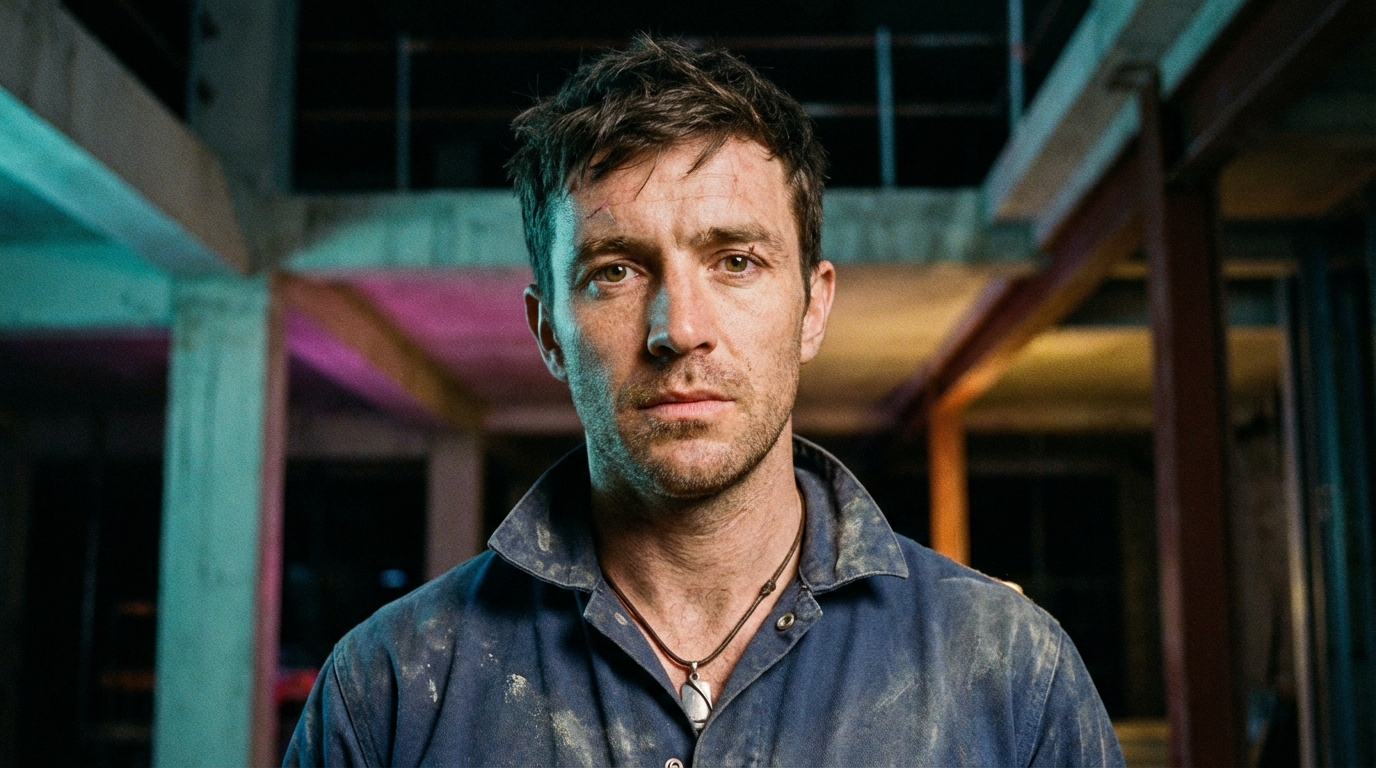
Callum George Baird, born in Chewbathia, Stewartshire, Caledonia, served as a Chewbathian Hunter before his reassignment to a New Edinburgh construction crew dispatched to the fledgling Bixbus settlement in August 2018. The youngest member of the five-man detachment led by Alastair James Drummond, Callum arrived as a labourer with limited building experience but remained in Bixbus permanently, developing over the following years into a competent builder and construction foreman in his own right.
Early Life and the Plateau
In 2021, he began a relationship with a woman named Petra Gallagher, an Irish-born logistics coordinator who had arrived in Bixbus through the portal network in late 2019. Petra was two years older than Callum, sharp-tongued and organised in ways that amused him, and unimpressed by physical strength in a settlement full of builders and labourers. The relationship progressed without haste. They moved into shared accommodation in early 2022, a transition that Petra orchestrated and Callum agreed to with the compliant bewilderment of a man who had spent his adult life in military barracks and construction dormitories and was not entirely sure what domesticity involved.
Callum George Baird was born on 5 November 1995 in Chewbathia, the military burgh that had defended Stewartshire from its commanding plateau since 1765. He was the third child and only son of Sergeant Dougal Baird and Margaret Baird (née Hendrie), a family that had produced Hunters for three generations. His grandfather, George Euan Baird, had served in the regular garrison for twenty-eight years before retiring to New Edinburgh with a damaged knee and a collection of stories he embellished freely. His father Dougal had joined the Hunters at nineteen and remained with them for the duration of his career, eventually reaching the rank of patrol sergeant in the frontier reconnaissance division.
Callum's sisters, Isla and Kirsty, were born in 1990 and 1992 respectively. Isla, the eldest, trained as a medic within Chewbathia's field hospital and married a garrison quartermaster named Alec Beattie in 2014. Kirsty left Chewbathia at seventeen for New Edinburgh, where she apprenticed to a dressmaker — a decision that Dougal treated as a mild betrayal and Margaret defended with the observation that not every Baird needed to spend their life on a rock. The remark became a household reference point, deployed with varying degrees of affection whenever the question of Chewbathian insularity arose.
Life on the plateau shaped Callum in ways he would only recognise after leaving it. Chewbathia was not a large settlement — several thousand military personnel and their dependents spread across two square kilometres of windswept stone. Everyone knew everyone. Privacy was a courtesy rather than a right. The rhythms of daily life were structured around garrison routines: morning drills, patrols, training exercises, the sound of pipes at dusk carrying across the plateau as they had for over 250 years. Children grew up watching soldiers and were watched in turn — assessed, often unconsciously, for the qualities that might one day make them useful.
Callum was a physical child in a community that valued physicality. He was broad-shouldered by twelve, strong enough by fourteen to carry supply crates that gave older boys difficulty, and possessed of an energy that teachers at the garrison school found easier to direct than to contain. He was not stupid — he could read and write adequately, handled arithmetic well enough, and had a reasonable memory for facts when he could be persuaded to care about them. But he was restless in classrooms and attentive on the training ground, and no one in Chewbathia pretended that these two observations were unrelated.
His father was proud of him in the uncomplicated way that military fathers are proud of sons who resemble them. Dougal Baird was not a reflective man. He had served the Hunters loyally, performed his duties competently, and expected the same of his children. He and Callum communicated well in contexts that involved doing things — hunting, climbing, maintaining equipment — and poorly in contexts that required discussing feelings, motivations, or doubts. Margaret provided what emotional nuance the household possessed, though she was herself a practical woman who had spent two decades managing a military household and had limited patience for introspection.
Hunter Training
Callum entered the Chewbathian Hunters' recruitment programme at sixteen, in late 2011. The selection process was demanding by design — physical endurance assessments, weapons proficiency tests, navigation exercises conducted across unfamiliar terrain with minimal equipment, and psychological evaluations intended to identify candidates with the judgement and self-discipline required for operations conducted far from support or supervision. Callum passed comfortably on physical metrics and adequately on the cognitive assessments, though the evaluators noted a tendency toward impulsiveness that would require correction.
Training occupied the next two years. The programme emphasised realistic preparation for field conditions — exercises conducted in varied terrain and weather, often with minimal warning, teaching recruits to function effectively despite fatigue, discomfort, and uncertainty. Callum took to the physical demands with enthusiasm and to the discipline with more difficulty. He was reprimanded twice during his first year for acting without orders during field exercises — once for engaging a simulated target before his team leader had signalled, and once for breaking formation to assist a fellow recruit who had turned an ankle on uneven ground. The first reprimand was deserved. The second, Callum felt, was unjust — a conviction he expressed to his training sergeant with a directness that earned him a week of latrine duty and a grudging note in his file that the recruit showed initiative, if not timing.
He completed his training in 2013 and was assigned to a patrol unit responsible for the frontier territories south and west of Stewartshire. The work suited him. Patrols operated in small teams, covering ground that the regular garrison could not, monitoring for threats that ranged from predatory wildlife to bandit groups operating in the spaces between established settlements. The Hunters' traditional emphasis on self-sufficiency and independent judgement gave Callum a degree of autonomy that compensated for his discomfort with rigid hierarchy, and his physical stamina made him a valued member of any patrol team.
He served competently for five years without distinguishing himself in any dramatic fashion. He participated in routine patrols, contributed to border surveillance operations, and performed the fortification work that all Hunters were expected to undertake at Chewbathia — digging defensive positions, reinforcing walls, maintaining the approach road. This last duty, unglamorous as it was, gave him his only exposure to construction before the Bixbus assignment. He learned to move earth, set stone, and follow a foreman's instructions, though the skills were functional rather than refined.
The honest assessment, which Callum would have offered himself if pressed, was that he was a decent Hunter but not an exceptional one. He lacked the patience for the long observation work that reconnaissance demanded. He was brave but not always prudent, strong but not always precise. He had not been selected for the Shadow Division, the elite unit whose covert operations attracted Chewbathia's most capable personnel, and while he told himself this was a matter of preference rather than ability, the distinction was not entirely convincing.
Reassignment to the Construction Detachment
In mid-August 2018, a Chewbathian patrol ranging further south than their usual circuits encountered settlers from a new settlement called Bixbus. The encounter triggered diplomatic contact between Bixbus and New Edinburgh, and the Parliament of New Edinburgh agreed to send skilled tradespeople to assist with the fledgling settlement's construction needs.
The detachment was assembled from volunteers and assignees. Alastair Drummond, a master builder from New Edinburgh, was appointed foreman. The other three members — Hamish Kincaid, Ewan Maitland, and Callum — were selected for specific skills. In Callum's case, the skill was labour. He was strong, willing, and young enough to take direction without complaint. His construction experience extended no further than the fortification work at Chewbathia, but Alastair had taken him on without hesitation — a young man who could lift, carry, and follow instructions was worth his weight in whatever currency Bixbus was eventually going to establish.
The assignment represented something Callum had not expected: a chance to leave Chewbathia. He had never seriously considered departing the plateau — the Bairds had been Hunters for three generations, and the assumption that Callum would serve his career and retire in Stewartshire had the weight of family precedent behind it. But the prospect of seeing something beyond the frontier patrol routes, of being useful in a way that did not involve watching empty terrain for threats that rarely materialised, appealed to an appetite for novelty that five years of routine patrols had done nothing to diminish.
His father expressed no opinion on the assignment. Margaret told him to write home. Isla, who understood her brother's restlessness better than either parent, said she was not surprised.
Arrival in Bixbus
The Bixbus that Callum encountered in August 2018 was unlike anything his Chewbathian upbringing had prepared him for. Chewbathia was old, ordered, and built from stone quarried from the plateau it occupied. Bixbus was weeks old, chaotic, and constructed from whatever materials the portal supply network could deliver. The people were different too — not Caledonians with shared heritage and familiar accents but displaced Earth residents from places Callum had never heard of, speaking with inflections he had to concentrate to follow, carrying grief and confusion that manifested in ways the straightforward military culture of Chewbathia had not equipped him to interpret.
The dust was the first thing. It coated everything — clothes, skin, food, the drawings that Adrian Pafistis spread across the bonnet of a vehicle to brief the crew on the sanctuary construction schedule. Callum had trained in harsh conditions, but the Chewbathian plateau was stone and wind, not this fine, pale powder that found its way into lungs and creases and the mechanisms of tools. He adapted, as he adapted to everything physical, by ignoring the discomfort and continuing to work.
On the afternoon of 29 August, following the groundbreaking ceremony for the Bixbus Wildlife Sanctuary, Callum and Ewan Maitland were assigned to clear the Supply Depot building footprint — scraping back the Veil's dust and levelling the exposed Shield layer with hand tools. It was the kind of work that required strength and endurance rather than skill, and Callum performed it with the energy that came from finally being asked to do something tangible. He drove the first steel anchor pegs into the Cradle soil that afternoon, hammering them into ground that was darker and richer than any earth he had seen on the plateau.
Three days later, during the concrete pour on 1 September, Callum was assigned to the water relay and mixing duties alongside Jerome Smith and Kain Jeffries. Eight hours of continuous physical labour — hauling water containers from the Norong River, feeding materials into the mixer, pushing wheelbarrows along plank runways — suited him in a way that complicated technical work would not have. When the pour was finished and the slab roped off to cure, Callum volunteered to sprinkle water on its surface morning and evening to prevent cracking. The gesture owed less to technical understanding than to an unwillingness to leave the site entirely. Something was taking shape under his hands, and he was not ready to walk away from it.
When Tavish Renfrew arrived on 8 September with pallets of prefabricated steel framing components manufactured on Earth, Callum picked up a pre-cut steel bracket, turned it over in his hands, and ran a thumb along the laser-cut edge. The precision of the machining was unlike anything produced by the Ironhold-descended smiths whose work he had grown up around. It was the first time he had held an object manufactured on Earth, and the experience — the smoothness, the uniformity, the implication of technologies he could not imagine — stayed with him longer than he would have admitted.
Staying
The sanctuary's Phase 1 construction extended through September and October 2018, and the crew's usefulness in Bixbus extended well beyond the sanctuary site. Alastair's team contributed to perimeter fortifications, temporary housing reinforcement, and early infrastructure work as the settlement's population grew faster than its building capacity could accommodate. Callum found himself assigned to tasks that drew on his military background as often as his developing construction skills — assessing defensive positions around the settlement perimeter, advising on structural approaches to predator-resistant fencing, applying the fortification instincts that Chewbathia had drilled into him.
By late 2018, the question of return had become a question of choice rather than schedule. Hamish and Ewan and Alastair were discussing whether to remain in Bixbus. Tavish Renfrew had already decided to return to New Edinburgh. Callum had no firm or family practice to return to — he had a bunk in a Chewbathian barracks, a patrol assignment that would be given to someone else in his absence, and parents who expected him home but did not require him there.
He stayed. The decision was not agonised over. Bixbus needed builders more than Chewbathia needed another patrol Hunter, and the construction work — which he had expected to tolerate as a temporary duty — had become genuinely interesting. He was learning things. Not just the physical skills of building, which came quickly to someone with his strength and coordination, but the underlying logic of construction that Alastair and Hamish demonstrated through their work. How to read soil. How to assess whether a foundation would hold. How a wall transferred load to the ground beneath it. These were not concepts he had encountered in Hunter training, and they engaged a practical intelligence that five years of frontier patrols had underutilised.
He wrote to his parents in early 2019 to inform them he would not be returning. Dougal's reply, relayed through the inter-settlement communication networks, was brief and contained no discernible emotion. Margaret's was longer and included a request for details about the settlement, the work, and whether he was eating properly. Isla sent word through separate channels that their father had not spoken about it, which she interpreted as acceptance.
Learning to Build
The transition from labourer to builder was neither immediate nor smooth. Callum spent 2019 and most of 2020 doing work that relied primarily on his physical capacity — hauling, lifting, clearing, demolition, the heavy preparatory stages of construction that required endurance rather than finesse. Alastair gave him increasing responsibility in measured increments, assigning him tasks that stretched his developing skills without exceeding them. Callum responded well to this approach, which resembled the graduated challenge of Hunter training in structure if not in content.
His weaknesses became apparent alongside his strengths. He was fast but sometimes careless, strong but occasionally impatient with work that demanded sustained precision. Measuring was not his natural gift. Early attempts at formwork produced results that Hamish Kincaid corrected with the diplomatic silence of a man who had been laying stone since before Callum was born. Callum accepted the corrections without resentment — he had spent enough years taking instruction from sergeants to understand that competence preceded independence, and that the fastest route to the latter was honest engagement with the former.
Concrete became his particular competence. The material suited his temperament — it was physical, demanded sustained effort over defined periods, and rewarded consistency rather than delicacy. By 2020, Callum was managing pour operations with a confidence that Alastair trusted, coordinating the mixing, hauling, and screeding sequences that he had first experienced as a labourer on the sanctuary's Supply Depot slab in September 2018. He developed an instinct for the material's behaviour on Clivilian soil that drew, unconsciously, on Hamish's tutelage and on the ground-reading traditions of New Edinburgh building that Alastair embodied without always articulating.
He also discovered, to his own surprise, that he enjoyed the work. Not merely tolerated it, as he had expected, but found in it a satisfaction that the Hunters had never quite provided. Building produced tangible results. A wall rose over the course of a day. A foundation, once poured and cured, would support a structure for decades. The connection between effort and outcome was immediate and visible in a way that frontier patrol — watching, waiting, reporting on absences of threat — had never been. Callum had spent five years as a Hunter defending against things that rarely appeared. In Bixbus, he was creating things that would remain.
A Life in Bixbus
Callum's personal life in Bixbus developed with the same lack of dramatic incident that characterised much of his biography. He was not a man to whom extraordinary things happened; he was a man who showed up, worked hard, and accumulated competence through repetition.
He shared accommodation with other single workers in Bixbus's early residential developments, moving through a succession of temporary and semi-permanent housing as the settlement expanded around him. He maintained a social life centred on the building crews he worked with — evenings spent in the settlement's growing number of communal spaces, friendships built through shared labour rather than shared interests. He was well-liked without being popular, sociable without being gregarious, the kind of person who was always included in gatherings but rarely the reason they were organised.
In 2021, he began a relationship with a woman named Petra Gallagher, an Irish-born logistics coordinator who had arrived in Bixbus through the portal network in late 2019. Petra was two years older than Callum, sharp-tongued and organised in ways that amused him, and unimpressed by physical strength in a settlement full of builders and labourers. The relationship progressed without haste. They moved into shared accommodation in early 2022, a transition that Petra orchestrated and Callum agreed to with the compliant bewilderment of a man who had spent his adult life in military barracks and construction dormitories and was not entirely sure what domesticity involved.
The arrangement worked, largely because Petra's expectations were realistic and Callum's willingness to be directed in domestic matters compensated for his lack of initiative in them. He remained hopeless at cooking, adequate at cleaning, and reliably present — a quality that Petra, whose previous relationship had ended badly in circumstances she did not discuss, valued more than she said. They did not marry. The subject arose occasionally, was discussed without urgency, and was deferred each time by the mutual acknowledgement that neither felt particularly compelled. The relationship's stability owed more to temperamental compatibility than to passion, and both of them seemed content with the distinction.
Professional Development
By 2022, Callum had been building in Bixbus for four years, and the transformation from military labourer to construction professional was largely complete. He had not undergone formal training — Bixbus did not yet possess the guild structures or apprenticeship systems that governed the building trades in Stewartshire — but the education he had received from Alastair, Hamish, and the accumulated demands of four years of continuous building work had produced a competent, reliable tradesman who understood foundations, concrete, structural framing, and the particular behaviours of Clivilian soil.
Alastair began assigning him independent project management in late 2022, initially for smaller residential builds and later for more substantial commissions. Callum managed these with a directness that reflected his military background — clear instructions, defined expectations, an unwillingness to negotiate on safety that his crews respected even when they found it inflexible. He was not the most technically skilled builder in Bixbus. He was not the most creative, nor the most efficient. But he was dependable, and in a city where construction demands outpaced the supply of experienced labour, dependability was worth as much as brilliance.
Ewan Maitland's retirement from active building work in 2022, at sixty-seven, affected Callum more than he expected. Ewan had been a quiet, consistent presence on building sites since the sanctuary groundbreaking — a man who measured twice, spoke seldom, and cut with a precision that rendered correction unnecessary. Callum had absorbed more from watching Ewan work than from any instruction he had received, and the carpenter's withdrawal from sites left a gap in the working rhythm that took months to adjust to. He visited Ewan regularly, a habit that surprised colleagues who had not registered the depth of the connection. Alastair visited weekly; Callum came less predictably but stayed longer, sitting in Ewan's modest accommodation and listening to the older man talk about timber in terms that bordered on the philosophical.
The Builder at Thirty
Callum George Baird turned thirty in November 2025 — an age that his grandfather would have considered unremarkable and that his father would have spent serving the Hunters with the same steady competence he had displayed at twenty-five and would display at forty. Callum had done something different. He had left the only institution his family had known for three generations, crossed half a continent, and built a career in a trade he had never trained for, in a city that had not existed when he arrived.
He did not frame it in those terms. Self-mythologising was not among his tendencies, and when Petra occasionally pointed out the improbability of his trajectory — from Chewbathian recruit to Bixbus construction foreman — he deflected with the observation that he had mostly just turned up and done what was in front of him, which was both entirely accurate and entirely insufficient as an explanation.
Alastair Drummond remained the central professional relationship of his working life. The two men operated with an ease that had evolved gradually from foreman-and-labourer through mentor-and-apprentice to something closer to senior partner and junior partner, though neither would have used corporate language to describe it. Callum managed his own projects but deferred to Alastair on structural decisions that exceeded his experience, and Alastair trusted Callum's judgement on site in ways that reflected genuine confidence rather than delegation by convenience. Hamish Kincaid, still active in his late fifties, completed the trio — three Caledonian builders working in a city built by Earth technology, applying traditions descended from eighteenth-century Scottish stonemasons to foundations poured in alien soil.
He had not returned to Chewbathia. The plateau that had raised him, with its stone walls and pipe music and generations of Bairds in uniform, existed in his memory with a clarity that distance had not diminished but that return, he suspected, would complicate. He was no longer a Hunter. He was no longer certain he had ever been a particularly good one. What he was, with increasing confidence, was a builder — a man who understood ground and concrete and the quiet satisfaction of a wall that rose level and held. The career that Chewbathia had not given him, Bixbus had.







