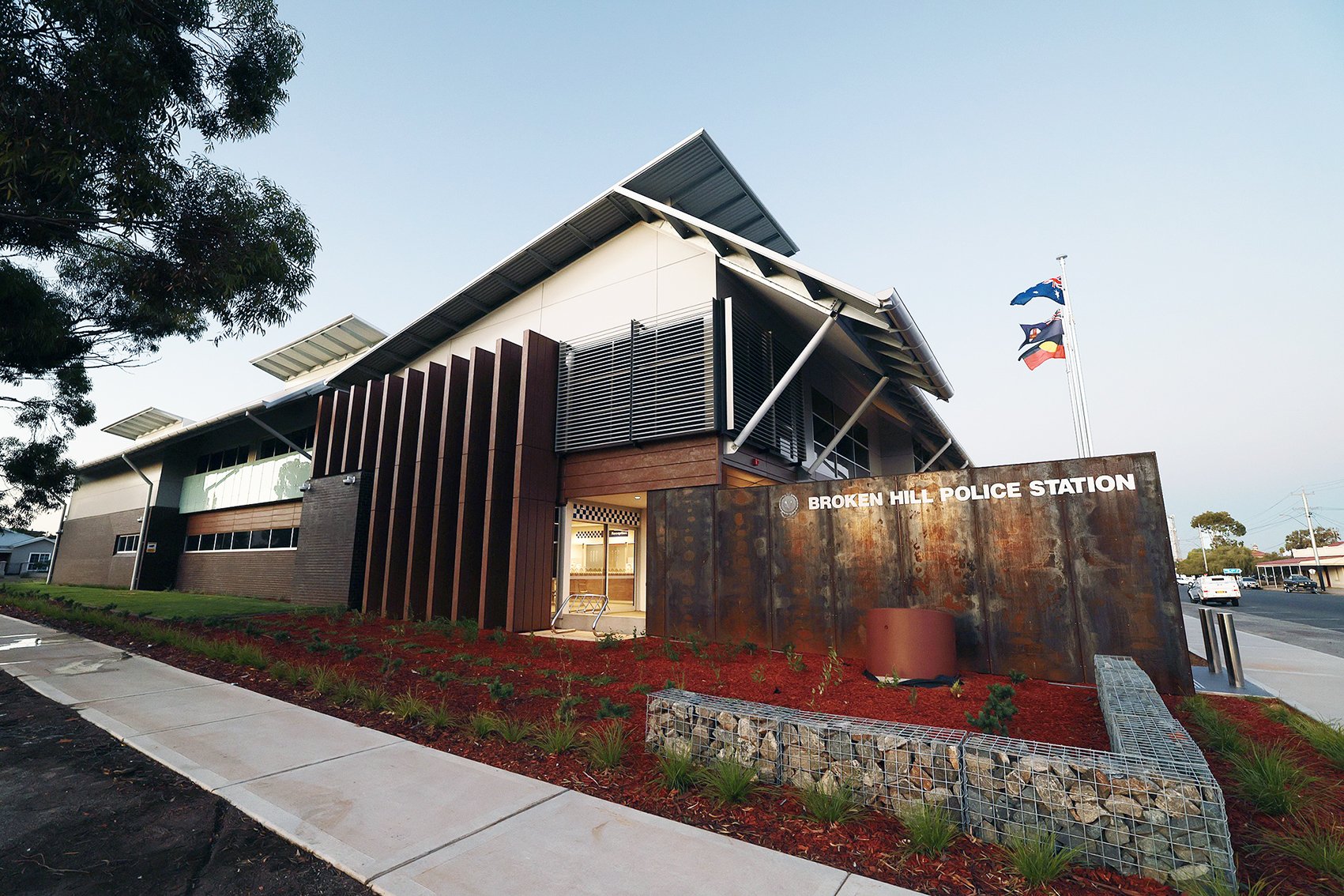
Broken Hill Police Station, New South Wales
Standing sentinel at 357 Argent Street since 1892, the Broken Hill Police Station embodies over a century of law enforcement in Australia's far west. From its origins in makeshift tents amongst silver claims to its current role as headquarters for the Barrier Police District, this weathered sandstone institution has witnessed mining riots, wartime vigilance, and contemporary mysteries. Its clock tower marks time against mounting investigations—from the 1915 Turkish attack to modern serial crimes threatening Silverton's artistic heart.
Born from Silver and Chaos
The Broken Hill Police Station came into existence as a necessary response to the mineral wealth that transformed empty outback into one of the world's richest mining deposits. When boundary rider Charles Rasp stumbled upon that outcrop of rocks in 1883, he inadvertently set in motion a human flood that would require more than handcuffs and batons to manage. By the time the Broken Hill Proprietary Company formally established operations in 1885, the population had swelled from a handful of prospectors to thousands of fortune-seekers, each convinced that silver, lead, and zinc represented their escape from poverty.
The early police presence operated from canvas tents pitched amongst the claims, officers making do with rudimentary equipment whilst trying to impose order on a community that valued mineral rights above civil authority. These pioneering constables faced challenges their city colleagues could scarcely imagine: disputes over claim boundaries that erupted into violence, theft of equipment worth fortunes, and the unique lawlessness that emerges when men believe they've found their chance at wealth. The red dust that coated everything—from wanted posters to arrest warrants—became the station's unofficial colour, a reminder that this was frontier justice adapting to industrial-scale extraction.
The construction of the permanent police station in 1892 represented Broken Hill's transition from mining camp to established town. The solid brick and sandstone structure on Argent Street featured a design common to colonial police architecture: ground floor cells with reinforced doors, upper-level offices for administrative work, and a courtroom where trials could be conducted without transporting prisoners to distant Adelaide. The clock tower, added during construction, became the building's defining feature—a vertical proclamation that law and order had arrived to stay, its face visible from the mining head frames that defined the town's skyline.
The station's design reflected late Victorian confidence in institutional authority. High ceilings provided relief from scorching summers, whilst thick walls offered protection during the inevitable confrontations that punctuated mining town existence. The cells, though spartan, represented an improvement over the chains and improvised lockups of earlier years. Officers finally had proper desks for paperwork, evidence storage that wasn't canvas bags, and accommodation that didn't collapse during dust storms.
The Era of Labour and Violence
The early twentieth century tested the station's capacity to manage a community increasingly divided between capital and labour. The Broken Hill miners, organised into powerful unions, represented a force that demanded recognition and fair treatment. The police found themselves walking precarious lines between enforcing law and navigating political tensions that city officers never confronted. Strikes became regular occurrences, each one transforming Argent Street into a flashpoint where officers faced crowds convinced that management's interests received preferential protection.
The 1915 Battle of Broken Hill—though officially termed an "attack"—remains the station's most searing trial by fire. On New Year's Day, two men of Turkish origin, Gool Mohamed and Mullah Abdullah, launched an assault on a civilian train carrying 1,200 picnickers, killing four people and wounding seven before police and armed civilians ended their rampage. The station's response, coordinated under extreme pressure with limited resources, earned widespread praise and solidified its reputation as a capable force. The incident also revealed the station's vulnerability: two determined individuals with firearms could create chaos that tested every officer's training and courage.
The decades following the attack saw the station adapting to changing social conditions whilst maintaining its core function. The 1920s brought prohibition-era tensions, with officers pursuing illegal alcohol operations whilst knowing that many residents considered temperance laws an overreach of government authority. The Great Depression of the 1930s filled the cells with men arrested for vagrancy and theft, their crimes born from desperation rather than criminal intent. Officers found themselves enforcing laws whilst privately sympathising with those forced to steal food or shelter to survive.
Modernisation and Expanding Responsibilities
The post-war period brought gradual modernisation to the station's operations. Telephones replaced telegrams as the primary communication method, allowing faster coordination with regional police units. Motor vehicles supplemented horses, though the vast distances of far western New South Wales meant officers still spent days on patrol in areas where roads existed more as concepts than physical realities. The addition of forensic capabilities—initially just fingerprint kits and basic evidence collection supplies—represented acknowledgement that crime investigation required scientific approaches alongside traditional detective work.
The station's jurisdiction, encompassing the Barrier Police District, meant responsibility for an area larger than many European nations yet with a population density that made every kilometre feel vast. Officers learned to navigate not just the physical geography of outback Australia but also the social landscapes of communities where everyone knew everyone else's business. Investigations that worked through anonymous tips in cities required different approaches where witnesses feared social consequences more than criminal penalties. The station developed a reputation for patience, understanding that solving crimes in isolated communities meant earning trust over months or years rather than days.
The 1970s and 1980s brought new challenges as Broken Hill's population began its slow decline. Mining operations mechanised, requiring fewer workers, whilst younger residents left for opportunities in coastal cities. The station's responsibilities shifted from managing labour disputes to addressing the social problems of a community adjusting to diminished prospects. Domestic violence cases increased, substance abuse created new patterns of crime, and property theft reflected both economic hardship and changing social cohesion.
The Shadow of the Silverton Strangler
September 1988 marked the beginning of the station's most haunting failure when sixteen-year-old Violet Dallow vanished from a school camp near Silverton. The discovery of her body, carefully positioned outside the ghost town, revealed the presence of a predator operating with chilling deliberation. A second victim that same year established a pattern that would torment the station for decades: young women murdered and displayed, the killer vanishing like smoke into the vast outback.
Detective Barry Glasson, who led the initial investigation, transformed the station into a command centre for pursuing what became known as the Silverton Strangler case. His office filled with maps marking potential connections, photographs of victims arranged to reveal patterns, and correspondence with other jurisdictions reporting similar crimes. The station's resources, adequate for routine policing, proved insufficient for tracking a killer who seemed to understand that Australia's size provided better protection than elaborate schemes. Glasson's dedication became legendary amongst fellow officers, his refusal to accept failure driving investigations long after official interest waned.
The decision, made at levels above the station's authority, to treat the murders as separate incidents rather than serial killings, represented institutional failure that would haunt subsequent investigations. Tourist concerns and political considerations overrode investigative judgment, leaving the station to pursue cases with one hand whilst being constrained by official narratives with the other. Officers like Glasson, who maintained private files and continued building cases beyond retirement, embodied the station's unofficial commitment to justice that transcended bureaucratic limitations.
The decades that followed brought additional murders fitting the pattern: Menindee in 2001, White Cliffs in 2009, Tibooburra in 2015. Each investigation ran through the station, each file added to the growing collection of unsolved cases that represented not just professional failure but personal torment for officers who had promised families that justice would come. The vast distances between crime scenes, the years between killings, and the lack of witnesses created investigative challenges that tested every resource the station possessed.
The Contemporary Force
By the early twenty-first century, the station had evolved into a modern law enforcement facility whilst maintaining its historic character. The clock tower still marked time against red sky, but interior renovations brought computer systems, digital evidence storage, and video conferencing capabilities that connected Broken Hill investigators with forensic specialists hundreds of kilometres distant. The courtroom became an evidence processing centre, the cells received upgraded security systems, and the officers traded batons for comprehensive training in de-escalation and community policing.
Detective Inspector Jeremy Marcus Harding's arrival in August 2015 represented the station's adaptation to contemporary crime investigation. Harding, transferring from Adelaide's Major Crime Investigation Section, brought experience with complex homicides and analytical approaches that urban policing demands. His methodical nature suited the station's culture, which valued thorough documentation and patient evidence gathering over flashy arrests. The adjustment from city to outback policing required learning different rhythms—witnesses who needed weeks to trust an outsider, evidence that might require days of driving to collect, and investigations where forensic laboratories represented distant resources rather than convenient partnerships.
The station's current complement reflects specialisation that earlier eras never imagined. Senior Constable Brock George Polden, a Broken Hill native who returned to serve his community, brings local knowledge and geocaching skills that prove surprisingly relevant to tracking suspects across outback terrain. Constable Felicity Jane Massey, arriving in 2018, represents a new generation of officers comfortable with technology yet adaptable to communities where relationships matter more than procedure. Michael James Brown, the forensic fingerprint analyst who relocated from Sydney in 2015, provides specialist expertise that transforms partial prints on sculpture pedestals into investigative leads.
The Smith Family Crisis
July 2018 brought the station into contact with mysteries that seemed to defy conventional investigation. When Claire Louise Smith reported her husband Paul missing following a domestic argument, the case initially appeared routine—another troubled marriage in a town where personal drama often masqueraded as criminal crisis. Claire's reputation for creating incidents, including previous false reports, suggested attention-seeking rather than genuine emergency.
The investigation's complexities emerged gradually as officers followed leads across state lines. Paul's airline tickets to Tasmania revealed interstate travel, but the reasons for his departure remained obscure. The involvement of Detective Harding's Tasmanian counterpart, Karl Jenkins, transformed what seemed like a domestic matter into something far more sinister when connections to five disappearances emerged. The revelation that Paul's brother Luke was the prime suspect in these cases suggested that Broken Hill's isolation offered no protection from evil that travelled easily across Australia's vast distances.
The crisis escalated when Paul and Claire's children, Rose and Mack, became pawns in family dynamics that officers struggled to untangle. The children's grandmother, Dawn Clift, made desperate decisions that nearly cost their lives, fleeing with them to an abandoned mining building miles from town where they waited for rescue that almost came too late. The station's officers, responding to Claire's frantic reports, found themselves pursuing leads whilst navigating family accusations and counter-accusations that obscured truth beneath layers of manipulation.
What the officers never learned—what remains locked in the silence of children who understood instinctively that some knowledge endangered rather than protected them—was that Rose and Mack witnessed something impossible in that abandoned building. They saw a man drag a woman through a Portal, that tear between dimensions, taking a victim to places the station's century of experience had never imagined. The Silverton Strangler's dimensional activities remained unknown to investigators pursuing only Earth-side evidence, creating a fundamental disconnect between the crime being investigated and the reality of how it occurred.
The Naomi Simmons Investigation
Saturday, 14th January 2023, brought the station's most recent confrontation with serial violence when Senior Constable Polden's 7:50 AM call reported Naomi Simmons' body discovered at Silverton's John Dynon Gallery. The 27-year-old volunteer, strangled and positioned amongst sculpture installations, represented the third murder in six months—a pattern suggesting that the Silverton Strangler had emerged from decades of dormancy.
Detective Harding assembled his investigation team with efficiency born from Adelaide experience: Detective Sergeant Patricia Wong for forensic coordination, Detective Constable James Mitchell for witness interviews, and Constable Massey for evidence documentation. The drive to Silverton became a mobile briefing session, officers reviewing what little information they possessed whilst preparing for the crime scene's reality.
The investigation revealed disturbing sophistication. Naomi's positioning amongst sculptures suggested artistic staging, the missing "Mirage" sculpture by Teppo Jalaskain indicated possible robbery motive, whilst her undisturbed purse eliminated conventional theft. Ligature marks spoke to premeditation rather than spontaneous violence, the killer possessing both patience and calculation. Partial shoe prints from expensive Italian leather, fingerprints on the sculpture pedestal, and textile fibres from natural rope provided physical evidence that would have solved simpler crimes, yet in this case merely deepened the mystery.
The investigation expanded through interrogations that revealed complex human relationships overlaying the physical evidence. Ethan Cummins, Naomi's boyfriend, whose shoe print contradicted his alibi and whose text messages revealed relationship strain. Liam O'Connor, the ex-husband whose genuine grief seemed authentic yet whose past connection to the victim demanded scrutiny. Julia Novak, the art enthusiast whose obsession with Jalaskain's work and admission to returning to the crime scene at night raised suspicions about her involvement.
Dr. Patricia Mulligan's autopsy findings, delivered via video conference on 15th January, provided clinical details that transformed speculation into evidence: death between 11:30 PM and 1:00 AM, defensive wounds suggesting struggle, ligature marks consistent with silk scarf or similar material. Each detail fed Harding's developing profile of a killer who combined calculation with violence, artistic sensibility with murderous intent.
By February 2023, despite extensive investigation consuming hundreds of officer hours and following every investigative protocol the station possessed, the case remained unsolved. Harding's 6th February press conference, held in the same building that had announced successful conclusions to countless investigations, revealed institutional vulnerability. His admission that "we need the public's help" marked a professional humiliation for a detective whose Adelaide career had been defined by solved cases and captured perpetrators.
The Weight of Historic Walls
The physical structure at 357 Argent Street has absorbed over 130 years of human drama within its sandstone walls. The cells have held claim jumpers and wife beaters, labour agitators and common thieves, each prisoner adding their small mark to the building's accumulated history. The courtroom, before its conversion to evidence processing, witnessed trials where mining fortunes hung in the balance and men faced transportation for crimes born from desperation. The offices have seen generations of officers struggle with paperwork that represented the difference between conviction and acquittal, their handwriting gradually replaced by typewriters and then computers, yet the fundamental task remaining unchanged.
The clock tower, that vertical proclamation of permanent authority, has marked time through the community's evolution from mining prosperity to heritage tourism. Its face, weathered by dust storms and scorching summers, continues keeping accurate time even as the town around it shrinks. From mining head frames, officers once watched for signs of industrial accidents that would require their response; now they observe tourists photographing Living Desert sculptures, an economy based on aesthetics rather than extraction.
The station's evidence rooms contain physical remnants of unresolved cases that haunt current officers as they haunted their predecessors. Barry Glasson's files on the Silverton Strangler, maintained long after his 2005 retirement, sit alongside contemporary evidence from the Simmons investigation. The ligature marks photographed in 1988 find echoes in 2023's forensic documentation, suggesting patterns that span decades yet resist definitive proof. Each unsolved case represents promises made to grieving families, commitments to justice that time has not fulfilled.
The Station's Living Culture
The institutional culture within the station walls reflects both historical precedent and contemporary adaptation. Officers learn early that investigations in isolated communities require patience that urban policing doesn't demand. Witnesses who would speak readily in anonymous cities require weeks or months of relationship-building before sharing critical information. Evidence collection might involve days of driving across terrain where GPS coordinates provide only approximate guidance. Forensic analysis happens at laboratories so distant that results arrive weeks after submission, requiring investigations to proceed on incomplete information.
The relationship between the station and the Broken Hill community embodies decades of accumulated trust and occasional betrayal. Families that have called Broken Hill home for generations regard officers with familiarity bordering on informality, yet this same comfort can complicate investigations when witnesses protect friends or relatives. The station's officers navigate complex social networks where everyone knows everyone else's history, making anonymous tiplines largely symbolic since voices are immediately recognisable.
The Philip Johnson Memorial Briefing Room, named for an officer killed in 1994, represents the station's acknowledgement that service sometimes demands ultimate sacrifice. Johnson's photograph watches over morning briefings, a reminder that the work involves genuine danger despite Broken Hill's small-town appearance. His presence influences younger officers, particularly those like Polden who knew him personally, serving as both inspiration and caution.
