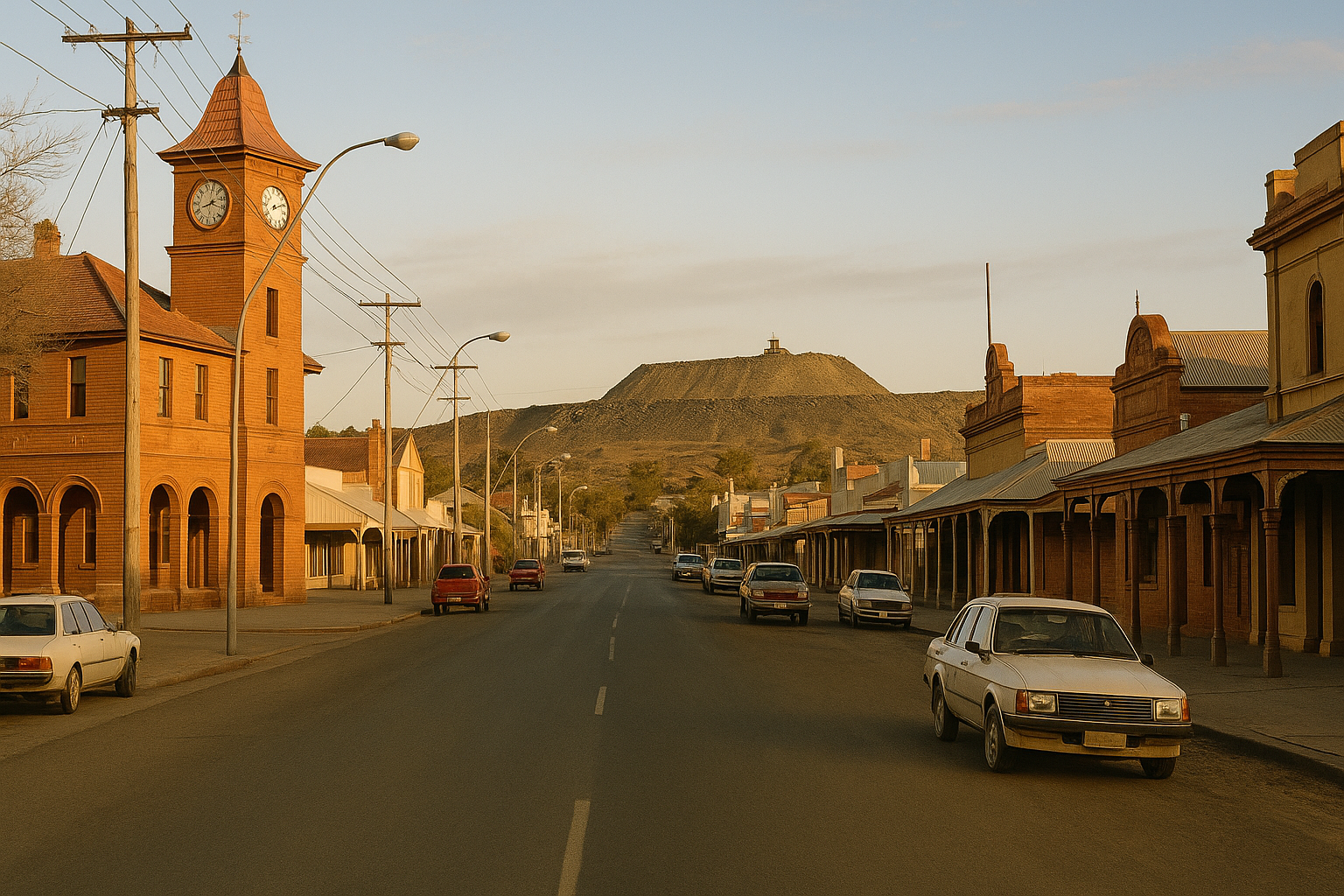
Broken Hill, New South Wales, Australia
Broken Hill, a mining town in far western New South Wales, rose from silver discoveries in 1883 to become an icon of outback resilience. Whilst its heritage is steeped in mining prosperity and labour history, the town's modern significance lies darker mysteries—the 1988 murder of Violet Dallow exposing connections to Project Ironsand, and the 2018 crisis when the Smith family's involvement with inter-dimensional Portals tore apart the Clift household, with children witnessing horrors no one should see.
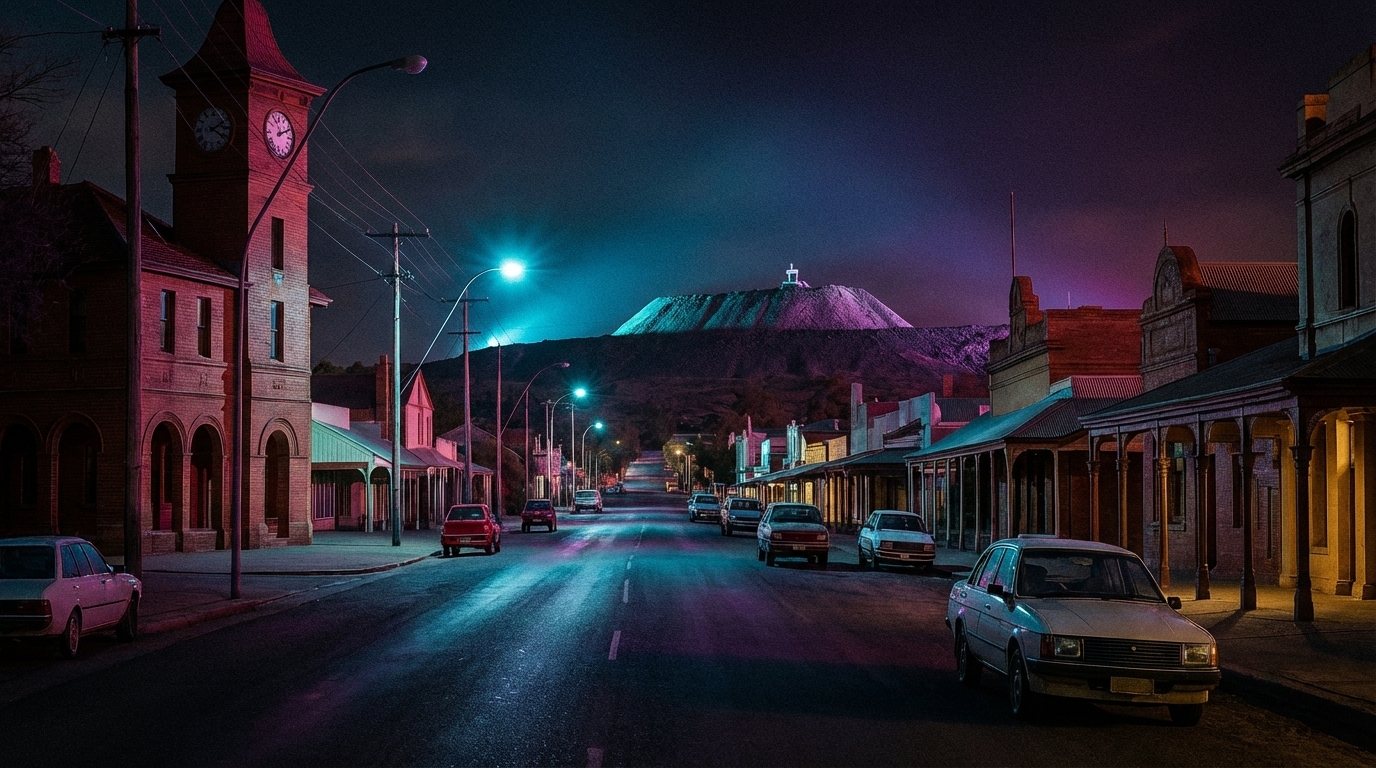
The Silver City
Broken Hill exists because of what lies beneath it. In 1883, boundary rider Charles Rasp discovered an outcrop of rocks that would transform empty outback into one of the world's richest mineral deposits. The broken ridge that gave the town its name contained silver, lead, and zinc in quantities that seemed almost impossible—a geological accident that would create fortunes, build Australia's largest mining corporation, and forge a community defined by the harsh realities of extracting wealth from unforgiving earth.
The formation of the Broken Hill Proprietary Company (BHP) in 1885 marked the beginning of industrial-scale operations that would shape not just the town but Australia's economic identity. Grand buildings rose from red dust—the Town Hall, the Trades Hall, hotels and schools that spoke to prosperity wrested from beneath scorching summers and freezing winters. The Umberumberka Reservoir, completed in 1915, became the lifeline that sustained both town and mines, whilst labour strikes and union movements forged a culture of solidarity amongst workers who faced dangers few outside understood.
For generations, families like the Clifts built their lives around the rhythms of underground work. Albert John Clift (1925–1988) followed his father into the tunnels, his body shaped by decades of manual labour, his silence heavy with unspoken pride and the constant awareness of danger. When a 1971 tunnel collapse crushed his leg and ended his career, it represented not just personal tragedy but the reality every mining family lived with—that the earth which gave could also take away.
Albert's son Gregory Alan Clift chose a different path, becoming a mechanic rather than following his father underground. That choice created tension that only eased after the accident, when Greg's earnings helped support the family and Albert finally recognised that a man's worth wasn't determined by where he worked, but by his skill and reliability. Greg would build Clift Automotive Repairs into a respected local business, marry Dawn Parker in 1978, and raise two daughters—Claire and Amelia—in the same red dust town that had shaped his father and grandfather before him.
But Broken Hill's significance would extend far beyond its mining heritage and the ordinary struggles of outback families trying to build lives from hard work and determination. By the late twentieth century, the town would become entangled in mysteries that had nothing to do with silver deposits and everything to do with darker forces operating beneath the surface of Australian society.
Violet Dallow and the Shadow of Project Ironsand
September 1988 brought fifteen-year-old Violet Dallow back to Broken Hill High during the school holidays, driven by questions about disappearances that were haunting the town. What began as a confrontation with her history teacher, Mr Clarke, would expose something monstrous—not supernatural horror, but the very human evil of predation hidden behind professional respectability.
Inside those sunbaked sandstone walls, Violet discovered evidence that Mr Clarke was involved in activities far more sinister than inappropriate behaviour. The crack in the classroom door, the glimpse of what lay beyond—these moments revealed a truth that connected to something larger than one teacher's crimes. Mr Clarke was linked to Project Ironsand, a decades-long conspiracy involving the Guardians of Clivilius and BHP, where the mining corporation's remote operations and complex supply chains provided perfect cover for covert activities that spanned dimensions.
Project Ironsand had begun as commercial opportunism in BHP's early years, gradually transforming into something far more intricate—a century-long arrangement where corporate expansion inadvertently enabled Guardian operations. By 1988, these connections had metastasised into networks that touched education, law enforcement, and community institutions across western New South Wales. Mr Clarke represented just one node in a system that had learned to hide in plain sight, using Broken Hill's isolation and its culture of discretion to conduct business that couldn't bear scrutiny.
Violet Dallow's confrontation with Mr Clarke should have led to investigation, to justice, to exposure of the networks he served. Instead, shortly after those September events, Violet herself became a victim—murdered by a killer who would come to be known as the Silverton Strangler. Her body was found carefully positioned outside in Silverton, one of two young women killed in 1988 in a pattern that would haunt western New South Wales for decades.
Detective Barry Glasson led the investigation, driven by personal connection—his daughter Mandy had been Violet's friend. But despite extensive work, the killer remained elusive, vanishing as suddenly as they'd appeared. More troubling still was the decision made at levels above Glasson's authority to treat the murders as separate incidents rather than the work of a serial killer, a choice justified by concerns about tourist income but which served other interests as well.
The 1988 murders would cast long shadows. Barry Glasson, even in retirement, maintained his own files in his Broken Hill study—newspaper clippings, copied reports, a timeline of potential connections that official channels wouldn't acknowledge. He corresponded with other retired investigators who shared his suspicions that the pattern extended far beyond what was officially recognised. Murders in Menindee in 2001. White Cliffs in 2009. Tibooburra in 2015. Each investigated separately, the connections visible only to those who looked for them across the vast distances that made pattern recognition nearly impossible.
The Silverton Strangler, whether one person or a network using a consistent method, seemed to understand that patience and distance provided better protection than elaborate schemes. The decades between confirmed activities, the careful selection of remote locations, the victims chosen from communities where disappearances might go unreported for days—all suggested someone who knew the outback intimately, who understood how Australia's size could hide patterns that would be obvious elsewhere.
The Smith Family Crisis and a Household Torn Apart
Thirty years after Violet Dallow's murder, Broken Hill would again become the setting for events that exposed the town's connection to forces operating outside normal understanding. This time, the crisis centred on the Smith family—specifically on Paul Smith, who had married Claire Clift and made Broken Hill his home.
Paul and his brother Luke had both become involved with Clivilius, the parallel dimension accessible through Portal technology. What had begun as discovery had evolved into something more complicated—involvement with networks, operations, and dangers that couldn't be explained to family members who knew nothing of dimensional crossings or the Guardian Order's long reach.
By July 2018, Paul's situation had deteriorated to the point where he went "missing"—a disappearance that wasn't quite disappearance, as he'd gone to Clivilius, but which left his wife Claire and his in-laws Greg and Dawn Clift scrambling to understand what had happened and how to protect the children.
Rose and Mack, Paul and Claire's young children, had been staying with their maternal grandparents at the Clift residence in Broken Hill. Greg and Dawn, pragmatic people shaped by lifetimes in a town where problems were solved through hard work and self-reliance, found themselves facing circumstances that defied all their experience. Their son-in-law had vanished. Strange people were asking questions. Threats were closing in around a family that had done nothing but try to live ordinary lives in an outback town.
On 25 July, when visitors came to the door—people who shouldn't have known where the children were, whose questions suggested knowledge that was impossible—Greg and Dawn made a decision that went against everything their orderly lives had taught them. Rather than answer the door, rather than trust in explanations or authorities, Dawn bundled Rose and Mack into the car, and fled into the red dust landscape that surrounded Broken Hill.
The Abandoned Building
The drive took them through familiar territory transformed by fear—past mining head frames, past the architecture that spoke to a century of prosperity built on silver, past the ordinary streets where Greg had run his garage and where families still lived lives untouched by knowledge of Portals or dimensional crossings. Dawn drove with desperate focus until she reached a desolate location miles from town, where she made a decision that would haunt her for whatever days remained.
She left Rose and Mack at an abandoned mining building—one of the countless derelict structures that dot the landscape around Broken Hill, rust-and-weatherboard monuments to played-out claims and abandoned hopes. The children, aged eight and ten, watched their grandmother drive away with instructions to wait, to stay hidden, to trust that someone would come for them.
The building became their shelter, their prison, their nightmare. For days, they waited. The phone they'd been given lost its charge. Food ran out. The promised rescue never came. In the suffocating heat of day and the profound darkness of outback night, Rose and Mack clung to each other and to rapidly depleting hope, whilst Broken Hill continued its ordinary existence miles away, unaware that two children were slowly starving in the scrubland.
On the night of 27 July, in the absolute darkness of that abandoned building, Rose and Mack witnessed something that would fundamentally alter their understanding of reality. Through rust and shadows, they watched a man drag someone—another child, a girl—through the scrubland toward their hiding place. He carried a device that created impossible light, colours that shouldn't exist, a tear in the fabric of space itself.
The man they were watching was the Silverton Strangler, though they had no way of knowing that name or understanding that they were witnessing a pattern that had repeated across thirty years. They watched as he activated the Portal—that rip between dimensions—and took the girl through it. To Clivilius. To a fate they couldn't imagine.
For one terrible moment, the Strangler's eyes met Rose's through the gap in the rusted wall. He saw her seeing him. He knew she'd witnessed what should never be witnessed. Then he stepped through the Portal and was gone, leaving the children with knowledge that was too dangerous to carry and too profound to ever forget.
When Claire finally found them on 28 July—their mother arriving in desperate search after piecing together scattered information about where Dawn might have taken them—Rose and Mack had learned the most important survival lesson: some truths cannot be spoken. They would never speak of that night, not to their mother, not to authorities, not to each other in ways that acknowledged its reality. The memory of the Silverton Strangler taking a child through a Portal into otherwhere would remain locked away, protected by the silence that was their only defence against forces far beyond their understanding.
The Aftermath and Continued Mysteries
The Smith family crisis left wreckage across Broken Hill. Paul's house stood empty, abandoned with the suddenness that speaks to flight rather than planned relocation. Neighbours like Gertrude watched with keen eyes and loose tongues, spreading stories about police visits and sudden disappearances, about a family torn apart by circumstances the town could only guess at.
Claire took Rose and Mack and fled across the country to Brisbane, putting as much distance as possible between her children and the town where they'd nearly starved, where they'd witnessed horrors, where their father had vanished into dimensions that shouldn't exist.
Greg and Dawn were left to process their own choices, to live with the knowledge that their desperate attempt to protect their grandchildren had nearly killed them instead. What conversations occurred between them and Claire, what explanations were offered or demanded, what understanding was reached—these remained family matters, kept behind closed doors in the way that Broken Hill families had always kept their private struggles private.
The fate of Charlie the dog, taken by police during those chaotic days, added one more loss to a family that had lost so much. Whether a casualty of bureaucratic process or something more sinister connected to the forces that had targeted the Smiths, his disappearance represented yet another piece of ordinary life torn away by circumstances that defied ordinary explanation.
Barry Glasson, now elderly but still maintaining his files on the Silverton Strangler, had no way of knowing that in July 2018, two children had witnessed the killer taking another victim through a Portal. The information that might have connected decades of investigation to current activity, that might have revealed the dimensional aspect of crimes investigated only on Earth, remained locked in the silence of children who understood instinctively that speaking would endanger rather than protect them.
Legacy and Unresolved Questions
Broken Hill continues its existence as a mining town transformed by tourism and heritage. The Living Desert sculptures stand against red earth and endless sky. Galleries showcase works inspired by stark beauty. For most residents and visitors, the town represents resilience, artistic culture, and the compelling strangeness of human settlement in places that seem determined to remain inhospitable.
But beneath that surface, for those few who know where to look, evidence remains of the town's darker significance. The abandoned mining building where Rose and Mack sheltered still stands in the scrubland, attracting no particular attention. Greg and Dawn's home continues its ordinary existence on ordinary streets that give no indication of the crisis that unfolded within. Paul's abandoned residence speaks only of sudden departure, not of dimensional crossings or Guardian conspiracies.
The connection between 1988's horrors and 2018's crisis remains unclear to most observers. Did Mr Clarke's involvement with Project Ironsand relate to the Portal networks that Paul Smith would later access? Were there other Broken Hill residents using dimensional crossings for purposes both corporate and criminal? The town's isolation, its culture of discretion, its history of keeping secrets—all these factors might make it ideal for activities that required operations hidden from scrutiny.
Barry Glasson's files remain in his Broken Hill study, a repository of patterns official investigations won't acknowledge. His correspondence with retired investigators suggests knowledge scattered across individuals who lack authority to act on suspicions. The Silverton Strangler's dimensional activities remain unknown to those investigating only Earth-side crimes, whilst those aware of Clivilius have no framework for connecting serial murders to Portal use.
Broken Hill stands as it always has—red earth, blue sky, the broken ridge that gave it birth and its wealth. The town absorbs human dramas the way it absorbs heat and cold, with the indifference of a place that has witnessed generations of joy and tragedy, prosperity and loss. The mines continue their slow decline, tourism grows in importance, and life proceeds according to rhythms established over more than a century of outback existence.
But for those who know the stories beneath the surface—Violet Dallow's murder connected to corporate conspiracy, the Silverton Strangler's decades of crimes spanning dimensions, the Smith family's fracture caused by Portal involvement, Greg and Dawn's desperate choices that nearly cost their grandchildren's lives—Broken Hill represents something beyond its tourist-friendly image. It stands as a threshold, a crossing point, a place where the membrane between ordinary and extraordinary wore thin enough that families found themselves caught in circumstances no amount of outback resilience could prepare them for.
