British Royal Navy
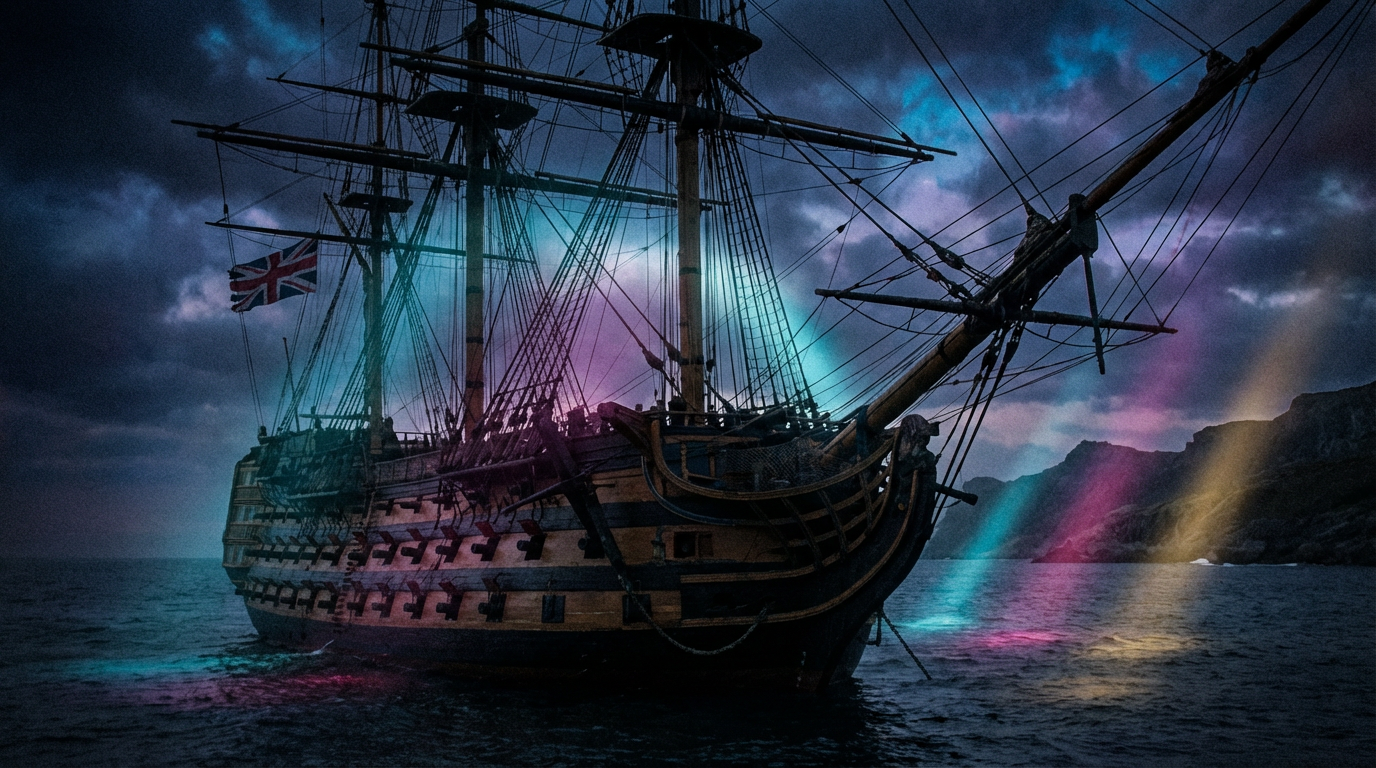
The British Royal Navy — formally the Senior Service and the oldest branch of the United Kingdom's armed forces — traces its institutional origins to the standing Navy Royal established by Henry VIII in 1546, though English kings had maintained fighting fleets in various forms since at least the ninth century. From the Tudor warships that faced the Spanish Armada to the three-decked ships of the line that broke the combined fleet at Trafalgar, the Royal Navy secured and sustained British maritime supremacy for over two centuries. At its Napoleonic zenith it outnumbered every other European fleet combined, and its reach extended to every navigable ocean — charting coastlines, suppressing piracy, enforcing blockades, transporting convicts to the penal settlements of Australia, and projecting the power upon which the British Empire depended. Its principal dockyard at Portsmouth provided both the warships and the infrastructure that made this dominance possible, and it was from Portsmouth that many defining journeys began — officers, convicts, and ordinary seamen alike passing through the same harbour mouth into lives that would carry them to the far side of the world.
From King's Ships to Navy Royal
England's relationship with naval power predates the Royal Navy by centuries. Anglo-Saxon kings raised fleets against Viking raiders as early as the ninth century, and the Cinque Ports of the southeast coast — Dover, Hastings, Hythe, Romney, and Sandwich — provided ships for royal service throughout the medieval period in exchange for trading privileges. Yet these arrangements were ad hoc: merchant vessels were enlisted when war demanded and dispersed when it ended. England possessed no permanent core of purpose-built warships, no standing administrative apparatus, and no professional officer corps. The mobilisation of fleets was slow, haphazard, and dependent upon the willingness of private shipowners to risk their vessels in the Crown's service.
The first significant moves toward a permanent navy came during the fourteenth century, when the post of Clerk of the King's Ships emerged to oversee the modest royal fleet. Edward III's 160 vessels destroyed a French force at the Battle of Sluys in 1340, and his navy at its peak may have numbered some 700 ships — though the great majority were borrowed merchantmen. Henry V revived naval ambitions in the early fifteenth century, expanding the fleet from six vessels to nearly forty, including the 1,400-ton Grace Dieu, whose remains still lie buried in the mud of the Hamble estuary. But these expansions were personal projects, tied to the reigns that created them. The fleet Henry V had built was allowed to decay after his death.
The decisive transformation came under Henry VIII, who recognised that an island kingdom's survival depended upon permanent control of the surrounding seas. He invested heavily in purpose-built warships armed with heavy cannon, established dockyards at Deptford, Woolwich, and Portsmouth, and in 1546 created the Navy Board to administer a standing fleet — the Navy Royal. By his death in 1547, the fleet numbered fifty-eight vessels, including carracks, galleys, and pinnaces. The Mary Rose, built at Portsmouth and sunk in the Solent in 1545 during an engagement with the French, embodied both the ambition and the risk of Tudor naval warfare. Henry's daughter Elizabeth expanded the fleet further, and it was under her reign that the Royal Navy fought its first defining engagement — the repulse of the Spanish Armada in 1588, when English warships combined with privately owned vessels to scatter Philip II's invasion fleet in the Channel.
Restoration, Revolution, and the Rise to Supremacy
The English Civil War disrupted but did not destroy the navy, which passed under parliamentary control during the Commonwealth period. The Restoration of Charles II in 1660 brought the fleet formally under royal authority and gave it the name by which it has been known ever since: the Royal Navy. Charles invested heavily in expansion and professionalisation, driven by the need to contest Dutch maritime supremacy in three wars fought between 1652 and 1674. Samuel Pepys, the diarist who served as Secretary to the Admiralty, reformed naval administration with an energy and competence that transformed the service from a collection of ships into an institution — with standardised ranks, systematic record-keeping, and a career structure that rewarded merit alongside patronage.
The Act of Union in 1707, which merged the English and Scottish crowns into the Kingdom of Great Britain, also merged the Royal Scots Navy with the English fleet, creating a single British naval force. Over the following century, this fleet fought a sustained struggle with France for maritime dominance — through the War of the Spanish Succession, the Seven Years' War, and the American Revolutionary War — emerging from each conflict with expanded capabilities and a deepening institutional confidence that naval supremacy was not merely desirable but essential to national survival.
By the mid-eighteenth century, the Royal Navy had developed the strategic doctrine that would sustain British power for over a hundred years: close blockade of enemy ports to prevent hostile fleets from concentrating, aggressive fleet action when battle could be forced on favourable terms, and the protection of merchant shipping upon which Britain's economic prosperity depended. The navy's principal dockyards — at Portsmouth, Chatham, Plymouth, and Deptford — employed thousands of shipwrights, ropemakers, sailmakers, and labourers whose skills were passed from father to son across generations. Portsmouth Dockyard, established by Henry VII in 1495 and massively expanded under his successors, became the beating heart of British naval power — the place where warships were built, repaired, armed, and provisioned for service in every ocean the Admiralty chose to contest.
Trafalgar and the Napoleonic Zenith
The Napoleonic Wars brought the Royal Navy to the summit of its power. Between 1793 and 1815, the fleet fought a continuous campaign against France and her allies that demanded unprecedented resources of men, ships, and administrative capacity. The great fleet victories of this period — the Glorious First of June in 1794, the Nile in 1798, Copenhagen in 1801, and supremely Trafalgar on 21 October 1805 — destroyed French, Spanish, and Dutch naval power in a sequence of decisive engagements that left the Royal Navy unchallenged on every sea.
At Trafalgar, Admiral Lord Nelson commanded twenty-seven ships of the line against a combined Franco-Spanish fleet of thirty-three. His tactical innovation — breaking the enemy line in two columns rather than engaging in the traditional parallel formation — produced a catastrophic defeat from which Napoleon's navy never recovered. Nelson was killed during the action, struck by a musket ball fired from the rigging of the French ship Redoutable, and his death transformed the victory into a national myth that would define British naval identity for the following century. His flagship HMS Victory, extensively refitted at Portsmouth, had sailed from that harbour on 14 September 1805 — Nelson's last departure from English soil.
After Trafalgar, the Royal Navy outnumbered every other European fleet combined, maintaining some 239 ships of the line and a total strength that at its wartime peak exceeded 145,000 men. This supremacy was maintained not through constant battle but through the grinding discipline of blockade — ships stationed off enemy ports month after month, in all weathers, preventing the French from rebuilding their fleet or concentrating forces for a renewed invasion attempt. The blockade squadrons consumed ships, men, and provisions at a rate that tested the Admiralty's logistical capacity to its limits. Portsmouth Dockyard expanded to accommodate over three thousand workers during these years, producing the blocks, ropes, sails, and hull repairs that kept the fleet operational. Marc Isambard Brunel's Block Mills, built at Portsmouth in 1802 and powered by steam, pioneered mechanised production techniques that represented one of the earliest applications of factory methods to military logistics.
Life Below Decks
The navy that won Trafalgar was sustained by men whose lives bore little resemblance to the heroic narratives that celebrated their victories. Below decks, ordinary seamen endured conditions of extraordinary hardship. Ships of the line carried crews of six hundred or more in spaces designed to maximise firepower rather than human comfort. Hammocks were slung barely eighteen inches apart; light and ventilation were minimal; drinking water turned brackish within weeks of leaving port; and the diet of salt beef, ship's biscuit, and small beer deteriorated rapidly on extended voyages. Scurvy, typhus, and dysentery killed more sailors than enemy action throughout the age of sail.
Discipline was maintained through a system of punishments whose severity was intended to deter insubordination in men who had often been pressed into service against their will. The press gang — authorised to compel able-bodied men into naval service during wartime — remained a legal instrument throughout the Napoleonic period, and many crews included men who had been seized from merchant vessels or swept up in port-side raids. Flogging with the cat-o'-nine-tails was the standard punishment for infractions ranging from drunkenness to dereliction of duty, and officers wielded absolute authority over men whose only recourse was endurance or desertion. The Nore Mutiny of 1797, in which the Channel Fleet at the Thames estuary refused orders for several weeks, exposed the depth of resentment that harsh conditions could produce — though its leaders were hanged and the mutiny's immediate impact was limited.
Yet the navy was also, in its way, a meritocratic institution. Talented men of modest origins could rise through the ranks if their abilities were noticed by the right superiors. Warrant officers — the masters, surgeons, pursers, and boatswains who kept ships operational — held positions that rewarded technical expertise rather than social connection. Naval surgeons, a profession that grew in importance throughout the eighteenth and early nineteenth centuries, were essential to sustaining crews through long voyages, treating injuries from battle and shipboard accidents, combating disease, and maintaining the physical condition upon which operational effectiveness depended. Their work, conducted in cramped cockpits by lamplight during battle, represented one of the most demanding applications of medical skill in the Georgian world.
Convict Transports and the Reach of Empire
The Royal Navy's role extended far beyond fleet engagement. After the loss of the American colonies in 1783 deprived Britain of its principal destination for transported convicts, the government turned to the newly claimed territory of New South Wales as an alternative. The First Fleet — eleven ships carrying 775 convicts, escorted by two Royal Navy vessels — departed Portsmouth on 13 May 1787, arriving at Botany Bay in January 1788. Over the following eighty years, more than 162,000 convicts would be transported to Australia aboard 608 ships, the great majority of them chartered merchant vessels rather than naval warships, but sailing under Admiralty oversight and often carrying naval surgeons whose presence became mandatory from 1801 onward.
The Royal Navy provided the escort, the navigational expertise, and the institutional framework that made transportation function as a system. Naval officers commanded many of the voyages, managed the convicts aboard, and oversaw their disembarkation at colonial ports. Some, like Captain Josiah Haverford — born in Portsmouth in 1776, educated at Harrow and the Naval Academy, and blooded at Trafalgar — commanded convict transports as a second phase of careers that had begun in fleet action. Haverford's HMS Resolution departed Portsmouth in April 1807 with one hundred and fifty convicts, among them the young dockworker William Jeffries Sr., convicted of a theft he did not commit and sentenced to transportation. The ten-month voyage to Sydney Cove tested every aspect of Haverford's command — disease, despair, and the constant threat of violence requiring a combination of disciplinary firmness and administrative competence that fleet battle alone could not teach.
Other Storiverse figures moved through the navy's world without holding commissions in it. Henry David Lawson, born in Greenwich in 1789 to a family steeped in maritime science, served aboard a succession of naval vessels as a navigator before becoming sailing master of the merchant vessel Persephone — the ship that would carry William Jeffries Sr. on his clandestine return voyage to London in 1818. Lawson's career illustrates the porous boundary between the Royal Navy and the merchant marine: men moved between the two services, carrying skills and institutional habits acquired in one into the other. The navy's influence extended through every level of Britain's maritime world — from the dockyards where ships were built and the academies where officers trained, to the harbour towns whose economies depended upon naval contracts and whose sons filled both wardrooms and lower decks.
The Dockyard Communities
The Royal Navy shaped not only the seas it patrolled but the towns that served it. Portsmouth, the navy's principal home port since the Tudor period, owed its existence almost entirely to the dockyard. By 1801, the city was the ninth largest in England, its population having quadrupled in a century as the dockyard's expansion drew shipwrights, labourers, ropemakers, victuallers, and their families into an economy built almost entirely upon naval demand. The dockyard employed men like Jonathan Blackwood, the shipwright whose son Nathaniel would become the beloved parish priest of St Thomas' Church, and Edward Jeffries, the dock labourer whose son William would be convicted and transported. These men worked twelve-hour days hauling timber and cargo, their wages barely sufficient to sustain families in the cramped housing that pressed against the dockyard walls. Injuries were common — crushed limbs, falls from scaffolding, damaged backs — and there was no system of compensation for those who were hurt or killed in the Crown's service.
The Naval Academy at Portsmouth, founded in 1733, trained the officers who would command the fleet. Josiah Haverford enrolled there in 1793, returning to the town of his birth to master the navigation, ship management, and tactical thinking that his subsequent career would demand. The academy's graduates carried Portsmouth's institutional culture into service across the globe — a culture shaped by proximity to the dockyard, by the sight of warships building and departing, and by the knowledge that the town's prosperity depended upon the navy's continued dominance of the seas.
Plymouth, Chatham, and the Thames-side yards at Deptford and Woolwich served similar functions, but Portsmouth's position on the Solent — facing France across the narrowest stretch of the Channel — gave it a strategic primacy that no other port could match. It was from Portsmouth that the First Fleet had departed for Botany Bay; from Portsmouth that Nelson had sailed for Trafalgar; and from Portsmouth that generation after generation of convict transports, troop ships, and men-of-war had put to sea, carrying the Royal Navy's power — and the lives caught within its machinery — to every corner of the known world.
Pax Britannica and the Long Nineteenth Century
The defeat of Napoleon inaugurated a century of virtually unchallenged British maritime supremacy. The Royal Navy's wartime strength was rapidly reduced — from 145,000 men in 1815 to barely 19,000 in the years that followed — but the fleet remained larger and more capable than any rival. The doctrine of the "two-power standard," formally adopted later in the century, held that the Royal Navy should maintain a strength equal to the combined fleets of the next two largest naval powers. In practice, this standard was rarely tested; for most of the nineteenth century, no nation possessed the industrial capacity or strategic incentive to challenge British control of the seas.
The peacetime navy performed functions that were less dramatic than fleet battle but no less consequential for the empire it sustained. Anti-slavery patrols off the West African coast, authorised by the Slave Trade Act of 1807, intercepted hundreds of vessels and freed thousands of enslaved people over the following six decades — an imperfect campaign, unevenly enforced, but one that represented the navy's first sustained humanitarian mission. Hydrographic surveys charted coastlines across the globe, producing the Admiralty charts upon which merchant shipping and colonial administration depended. Scientific expeditions — including the voyages of HMS Beagle, which carried Charles Darwin to the observations that would transform natural history — extended the navy's institutional reach into realms far removed from warfare.
The technological transformation of the nineteenth century reshaped the navy from its keels upward. Steam power supplemented and eventually replaced sail; iron and steel replaced oak; rifled breech-loading guns supplanted the smoothbore cannon that had won Trafalgar. Each transition demanded new skills, new infrastructure, and new administrative systems. The dockyards adapted, though not without tension between the hereditary shipwright families whose skills had sustained the fleet for generations and the engineers and metalworkers whose expertise derived from industrial rather than craft traditions. The abolition of flogging during peacetime in 1871 and the introduction of continuous service engagements in 1853 marked slow but significant reforms in conditions for ordinary seamen.
Two World Wars and the Passing of Supremacy
The naval arms race with Imperial Germany in the early twentieth century challenged the Royal Navy's dominance for the first time since Trafalgar. The launch of HMS Dreadnought in 1906 — a battleship whose speed and firepower rendered every existing warship obsolete — initiated a construction race that both nations pursued with desperate intensity. Britain maintained its numerical advantage, but the margin was narrower than at any point in the preceding century.
The First World War tested the fleet in ways that the age of sail could not have anticipated. The Battle of Jutland in 1916, the war's only major fleet engagement, produced an inconclusive result that left both sides claiming victory — though the German High Seas Fleet never again challenged the Royal Navy in open battle. The greater threat proved to be the submarine: German U-boats sank millions of tons of merchant shipping and nearly severed the supply lines upon which Britain's survival depended. The development of convoy systems and anti-submarine warfare became the navy's most urgent priorities.
The Second World War confirmed what the first had foreshadowed: the age of the battleship was ending, and with it the form of naval supremacy that Britain had maintained since Trafalgar. Aircraft carriers and submarines supplanted the surface fleet as the decisive instruments of naval power, and the industrial resources required to build and sustain a modern navy increasingly favoured the United States. Portsmouth endured devastating bombing raids that killed 930 people and destroyed much of the city centre. Yet the navy's contribution remained indispensable: the evacuation of Dunkirk, the Battle of the Atlantic against the U-boat menace, and the D-Day landings of June 1944 — launched primarily from Hampshire's Solent ports — depended upon Royal Navy planning, logistics, and operational command.
After 1945, the Royal Navy yielded its position as the world's foremost maritime force to the United States Navy, a transition that reflected broader shifts in economic and strategic power. The fleet contracted dramatically as the British Empire dissolved, though it remained one of the most capable navies in the world. The Falklands War of 1982 demonstrated both its continued operational effectiveness and the vulnerability of surface ships to modern anti-ship missiles. The transfer of Britain's nuclear deterrent to the navy in 1969, maintained by a fleet of ballistic missile submarines, gave the service a strategic role that its Georgian and Victorian predecessors could not have imagined.
The Senior Service
The Royal Navy's institutional continuity — from Henry VIII's Navy Royal through the Napoleonic zenith to the nuclear-armed fleet of the twenty-first century — represents one of the longest unbroken traditions of any military organisation in the world. Its influence has extended far beyond the ships it sailed and the battles it fought. It shaped the towns that served it, the families whose sons filled its crews, the colonial settlements its transports helped establish, and the global trading system its supremacy made possible. It was an engine of empire, a vehicle of scientific discovery, an instrument of humanitarian intervention, and a system of social control whose reach touched the lives of millions who never set foot on a warship.
For the men and women of Portsmouth and the towns that served it, the Royal Navy was not an abstraction but a daily reality — the institution that employed their fathers in its dockyards, educated their sons in its academy, transported their neighbours to penal settlements on the far side of the world, and shaped the harbour town whose rhythms of arrival and departure governed every aspect of their lives. The sound of hammering from the dockyard, the sight of warships at anchor in the harbour, the knowledge that the fleet's needs determined whether families prospered or went hungry — these were the textures of existence in a community built to serve the Senior Service, and from which the navy drew, in return, the labour, the loyalty, and the lives upon which its supremacy depended.







