4338.10 · January 10, 2018 AD
Blood and Threshold
Behind the frosted glass of Meeting Room 4B in a Hobart government building, a padded yellow envelope surrenders its contents — five thumb-sized devices of unidentifiable material, a blank security card, and a handwritten letter describing a world called Clivilius. When one of the devices draws blood from the man holding it and transforms an institutional wall into a shimmering dimensional gateway, something old and patient on the other side announces that it can see him.
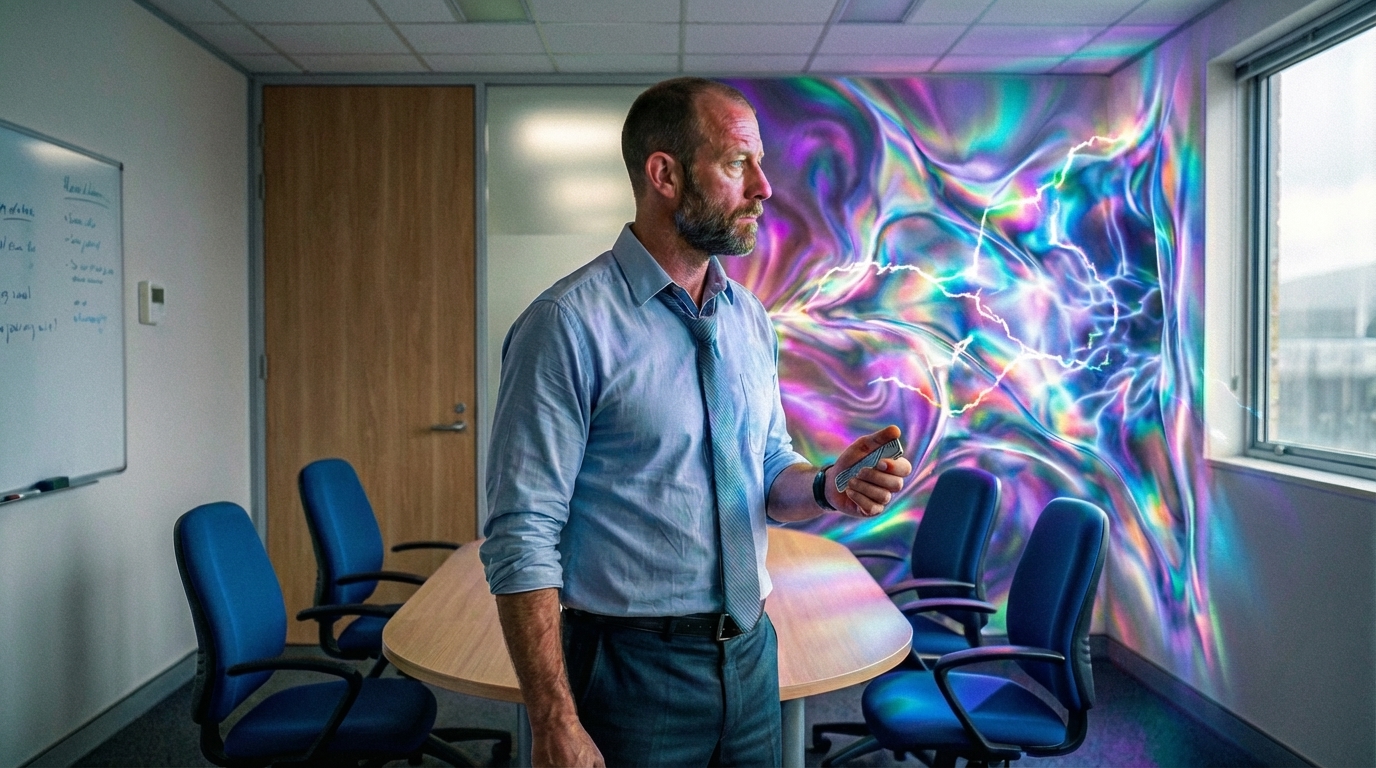
Meeting Room 4B occupied a corner of the fourth floor that the building's architects had clearly designed for forgettable purpose — plasterboard walls, a frosted glass partition facing the corridor, a single external window through which kunanyi's cloud-obscured summit maintained its geological indifference. The room's furnishings consisted of an oval table, six ergonomic chairs in institutional blue, a thermostat that responded to adjustment with grudging compliance, and a whiteboard no one had cleaned since before the holiday break. It was a space built for stakeholder briefings and quarterly reviews, for the particular species of boredom that government buildings cultivated with inadvertent expertise.
On this particular afternoon, with the door pulled firmly shut and the thermostat cranked downward against the January heat, it became something else entirely.
The envelope had been opened with more urgency than care, its sealed edge torn rather than slit, and the contents deposited across the polished table with a clatter that sounded disproportionately loud against the room's acoustic deadness. Five small rectangular objects, each roughly thumb-sized and wrapped in bubble wrap whose popping seemed designed to announce the violation of whatever secrecy had protected them. A white plastic card, hotel-key-sized, bearing no text, no logo, no indication of what it might unlock. And a single folded letter in Seth's handwriting — the same pressured script that had appeared on the Post-it note that morning, though here it ran to paragraphs that covered both sides of the paper in language that belonged to a different century's understanding of the possible.
The letter described Portal Keys. It described a world called Clivilius, accessible through dimensional gateways that these devices allegedly opened. It described Guardian Clans — groups of five individuals bound to their Portal Keys through blood activation — and an artificial intelligence called CLIVE whose intentions remained ambiguous even to those who had encountered it. It named a corporation called Killerton Enterprises, headquartered in San Francisco, whose archives supposedly contained blueprints that could locate CLIVE's physical infrastructure. And it named a person — Luke Smith — around whom a prophecy had gathered like weather around a pressure system, a prophecy that Seth's final, emphatic instructions demanded be intercepted.
The words sat on the page with the calm authority of statements that expected to be believed, despite asking belief to stretch beyond any shape it had previously been required to hold. An ancient civilisation. Hidden technology. A parallel world. The vocabulary of conspiracy theory and fantasy literature, rendered in the handwriting of a man whose trembling hands and disconnected phone number and hunted eyes suggested that whatever he was describing, he did not consider it fiction.
A call to Seth's number confirmed what the morning's silence had already implied. The automated voice that answered was not the recording of a phone switched off or temporarily unavailable but the flat, clinical announcement of a number that no longer existed within the telecommunications network. Disconnected. Not dormant but severed — a line cut rather than a signal lost.
The five devices lay on the table in their unwrapped state, stripped of their bubble-wrap casings, arranged in an accidental row that invited examination. They were identical — matte grey, smooth-surfaced, possessing a weight that seemed to contradict their dimensions, as though the material from which they were constructed obeyed different rules regarding the relationship between mass and volume. The surface was neither plastic nor metal but something that resisted categorisation, warm to the touch in a way that fluctuated subtly with handling, responsive in a manner that stopped just short of the organic. Near one end of each device, a tiny indent — barely perceptible, the kind of detail that would escape notice without deliberate scrutiny.
They looked like nothing. They looked like everything Seth's letter claimed they were. The two impressions occupied the same space without resolving into either, the devices existing in a state of suspended interpretation that only activation could collapse.
A shadow crossed the frosted glass partition and continued without pausing, an anonymous silhouette elongated by the translucent surface into something briefly grotesque. The corridor beyond remained empty. The office continued its afternoon routines — the murmur of conversation, the percussion of keyboards, the mechanical rhythm of a photocopier cycling through its task. The building's systems operated in serene ignorance of what was about to occur in its smallest meeting room.
The indent, when pressed, did not behave as a button. It behaved as a needle. The prick was precise and brief — a puncture that drew a single bead of blood from the thumb that had applied the pressure, the droplet appearing and vanishing in the same instant, absorbed into the device's surface with a speed that suggested not mechanism but appetite. The material pulsed once beneath the skin's contact, a shift in colour or density or temperature too subtle to name but too definite to dismiss, and then settled back to its original matte grey as though nothing had occurred.
What followed occupied perhaps three seconds and dismantled a lifetime's understanding of physical law.
A sphere of light erupted from the device's opposite end — small, concentrated, vibrating with an energy that registered in the bones before it registered in the eyes. It struck the far wall and expanded with silent, fluid speed, consuming the institutional off-white surface in a wash of colour that had no business existing inside a government building or anywhere else bound by the ordinary spectrum. The wall ceased to be a wall. The paint, the plasterboard, the scuff mark near the skirting board where someone's shoe had connected during an animated presentation — all of it dissolved beneath a shimmering membrane of shifting, iridescent light that moved with the organic complexity of something alive.
No sound accompanied the transformation. The silence was itself a violation — an event of this magnitude should have announced itself, should have torn the air or shaken the floor or triggered every alarm in the building. Instead, the portal opened with the quietness of a door left ajar, the colours flowing across the wall's surface like oil on water, blues bleeding into purples bleeding into greens bleeding into hues that existed at the outer margins of perception, colours the human eye could register but the human vocabulary could not name.
The room's atmosphere shifted. The recycled air that had tasted of climate control and cleaning products acquired a different quality — a pressure change, a textural alteration, as though the meeting room now shared a border with a space whose air carried different properties. The hum of the air conditioning faded beneath a vibration that operated at a lower frequency, something felt in the sternum rather than heard through the ears, a resonance that seemed to emanate from the portal itself or from whatever lay beyond it.
Physical contact with the portal's surface produced a sensation that defied analogy. The energy was neither warm nor cold, neither solid nor liquid, but something that communicated through the skin with the directness of language — a buzzing, carbonated awareness that seemed to read the hand it enveloped, measuring and assessing with a patience that suggested intelligence rather than phenomenon. The hand that passed through the membrane continued to exist — its owner could feel the air on the other side, different air, colder and cleaner and carrying the particular quality of atmosphere that has never been processed through mechanical filtration — but it vanished from visual confirmation at the point of contact, swallowed by the shifting colours as completely as though it had crossed into a space where the rules governing visibility no longer applied.
The voice arrived without sound. It bypassed the ears entirely, materialising within the consciousness of the person standing before the portal with a clarity that made spoken language seem crude by comparison. It was neither male nor female, neither young nor old — a voice that existed outside the categories by which human communication organised itself, carrying the quality of something that had been waiting for this particular moment across a span of time too vast for the word patience to adequately describe.
It spoke a name. It spoke it twice. And the name it spoke belonged to the man standing in Meeting Room 4B with blood on his thumb and the remnants of an ordinary Wednesday collapsing around him.
The crossing, when it came, was not dramatic. One step forward, then another — the mechanics of walking through a doorway, performed at the threshold of a dimensional boundary that should not have existed in a government building in Hobart, Tasmania, on an afternoon when the most significant thing scheduled had been a post-Christmas afternoon tea. A brief pressure at the base of the skull. A subtle warping of air. The meeting room — its table, its chairs, its frosted glass and motivational posters and the mountain framed in its window — receded not with violence but with the quiet finality of something that had simply ceased to be relevant.
On the other side, the air was still. The ordinary world was absent. And something ancient, patient, and unsurprised had already noted the arrival.







