Belkeep, Clivilius
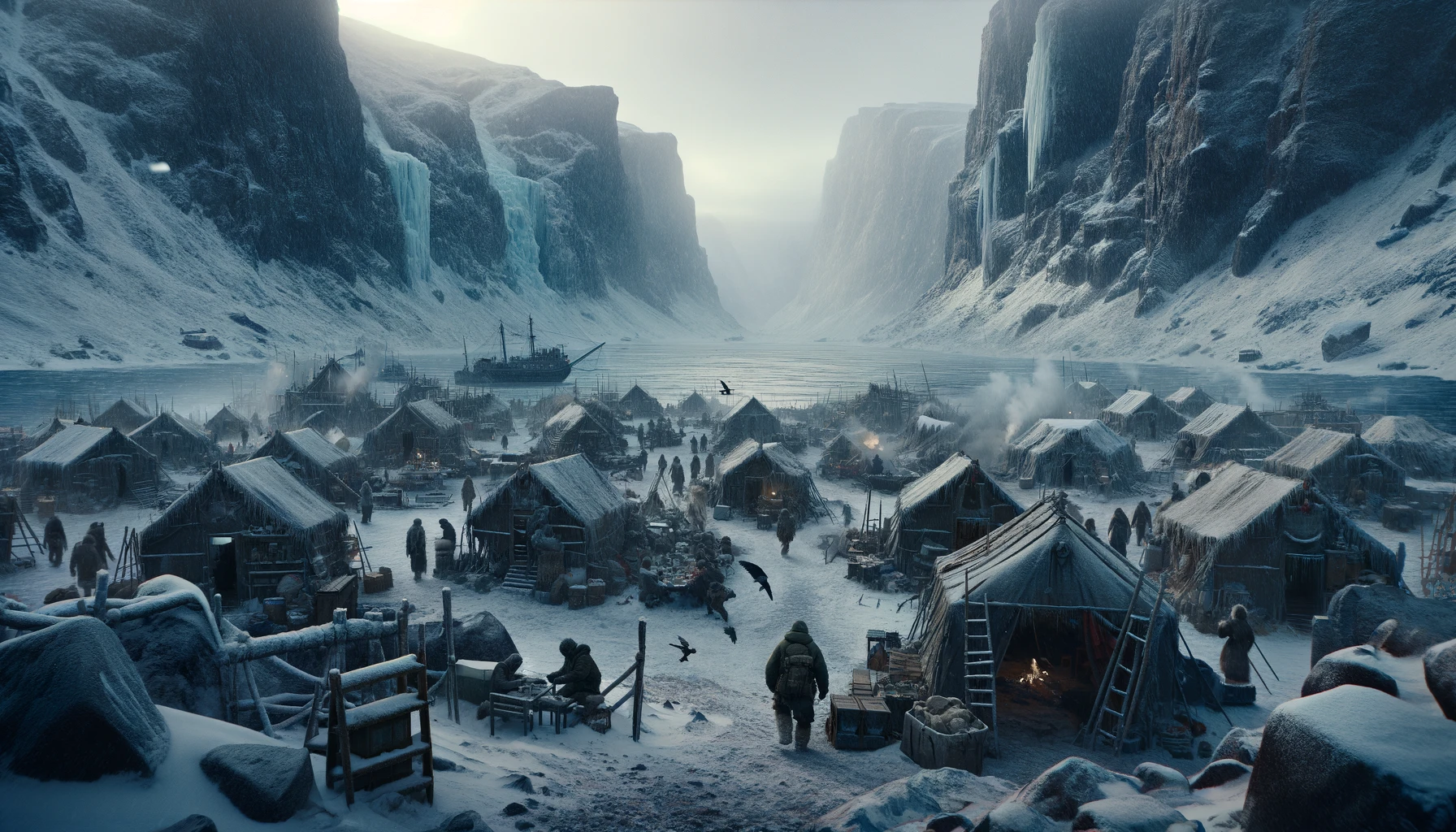
Belkeep is a remote settlement established in 1987 by Guardian Cody Jennings in a glacial valley locked in perpetual winter. For decades, its population of approximately 326 endured brutal isolation, resource scarcity, and psychological toll through hard-earned unity. Following rediscovery by Bixbus in 2027, most residents relocated between 2028–2030. Now redesignated as a Remote Research and Heritage Zone, Belkeep endures not through population but through memory—a study in resilience, loss, and the costs of frontier survival.
Geographic Context
Belkeep exists where hope goes to freeze. Situated in a stark, ice-locked valley surrounded by cliffs of dark stone and a sea that resists all attempts at navigation, the settlement occupies one of the most inhospitable locations yet discovered in Clivilius. Its landscape is dominated by Lake Gunlah—a vast, treacherously frozen body of water that defines both the town's physical geography and its cultural imagination. Beautiful in the way that dangerous things often are, the lake has claimed lives and shaped mythology in equal measure.
At the settlement's origin point lies the Portal Cave, a volcanic fissure embedded with the shimmering stone where Cody Jennings first activated the Portal on 30 October 1987. The cave remains a place of both reverence and regret—a threshold between worlds that delivered not the promised land Cody imagined, but a brutal testing ground that would define his life and the lives of everyone who followed him through.
The surrounding terrain offers nothing resembling mercy. Glacial formations create natural barriers that render overland travel nearly impossible during the worst weather. The sea, when not frozen solid, churns with currents too dangerous for the rudimentary vessels early settlers could construct. For decades, Belkeep existed in effective quarantine—not by choice or policy, but by simple geographic impossibility.
Founding and Origins
Cody Jennings took his first step into Clivilius on 30 October 1987, expecting adventure and finding instead a wasteland of ice and wind that would become his responsibility and his legacy. The Portal Cave delivered him into a frozen valley that bore no resemblance to the romantic other-world he'd imagined.
The name "Belkeep" came from memory and desperation. As a child, Cody had found sanctuary in a weatherboard cottage his family owned, tucked away from the chaos of his parents' deteriorating marriage. He'd called it Belkeep then—a combination of "belle" (beautiful) and "keep" (fortress)—and the name represented safety, escape, and the possibility of peace. When he needed to call this frozen hellscape something, he reached for that childhood comfort. The irony would not escape him in later years: his sanctuary had become everyone's prison.
By 13 December 1987, Randal Klein followed through the Portal, becoming Belkeep's second Guardian. The relief Cody felt at no longer being entirely alone was profound, though short-lived. Randal would be lost during the Wren's Pass Breach in 1988—the first of many deaths that would define Belkeep's history as much as any founding charter or governance structure ever could.
Sylvie Sprake arrived within months of Randal, bringing with her a pragmatic stoicism that would shape the settlement's character for the next two decades. The early population grew through deliberate recruitment—people entering through Portals, finding themselves trapped in winter, and discovering that survival required community whether they wanted one or not.
The first years were chaos barely contained by necessity. People died from exposure, from accidents, from despair. There were no systems, no structures, no established protocols for building civilisation from scratch in conditions that actively resisted human habitation. What emerged was not planned but survived into being—shelter built from scavenged materials, food preservation techniques developed through fatal trial and error, social bonds forged through shared trauma rather than shared values.
Climate and Environment
Belkeep's climate is not seasonal but perpetual. The settlement exists in a state of deep winter that never yields to spring, never softens into anything resembling warmth. Snowfall occurs with such regularity that residents measure time not by calendar dates but by accumulation depth. Agriculture is nonviable—the ground remains frozen year-round, and even the most optimistic attempts at greenhouse cultivation failed repeatedly in the early decades.
The surrounding sea offers little sustenance. Fish populations are sparse and difficult to access. The ice that forms across the surface is unpredictable—thick enough to support weight in some areas, lethally thin in others, and subject to sudden fracturing that has claimed numerous lives over the years. Lake Gunlah, for all its stark beauty, is fundamentally a hazard rather than a resource.
Wind presents perhaps the most psychologically corrosive element of Belkeep's environment. It howls constantly, battering structures, penetrating clothing, and creating whiteout conditions that can transform a twenty-metre walk into a fatal miscalculation. The sound alone—relentless, variable, never entirely absent—contributes to the psychological deterioration that settlers euphemistically call "Belkeep Winter."
The term originated in the early 1990s to describe a specific form of depression and cognitive decline observed in long-term residents. Symptoms include severe seasonal affective disorder compounded by trauma-linked depression, social withdrawal despite desperate need for human connection, and a peculiar form of temporal disorientation where residents lose track not just of dates but of whether events occurred months or years ago. The cold affects not only the body but the mind, and Belkeep's history is littered with casualties of both.
Even minor expeditions beyond the settlement's immediate perimeter become acts of extreme risk. The landscape offers no landmarks, no reliable navigation points when visibility drops. Search parties sent to recover lost individuals have themselves required rescue. By the mid-1990s, strict protocols governed all external movement—protocols born from accumulated tragedy rather than preventative planning.
Governance and Social Structure
Belkeep's governance emerged from crisis rather than design. The first years operated under what could generously be called Cody Jennings' reluctant authority—leadership exercised not through ambition but through the desperate need for someone, anyone, to make decisions when decisions needed making. It was inadequate, unsustainable, and resulted in preventable deaths that haunted Cody for the rest of his life.
The establishment of formal governance structures in 1990 came not from political philosophy but from Lachlan Barker's insistence that chaos was killing people more efficiently than the cold. Barker, who had arrived in 1989 with experience in local government administration on Earth, recognised that Belkeep's survival required systems, accountability, and distributed decision-making that didn't rest entirely on traumatised individuals making life-or-death choices without support or oversight.
The hybrid model that emerged—a Chief supported by a Council of Stewards, with daily decision-making occurring in the Council Cottage—reflected practical necessity rather than democratic idealism. The Chief held lifetime appointment, providing continuity and institutional memory in a settlement where population turnover (through death or departure) remained devastatingly high. Stewards were elected, ensuring that governance responded to community needs rather than becoming calcified around a single vision that might not serve changing circumstances.
Lachlan Barker served as Belkeep's first Chief from 1990 to 1995. His tenure established the frameworks that would define governance for decades: the Council Cottage as the settlement's administrative and social centre; the Steward system that distributed responsibility across expertise areas rather than consolidating power; and the principle that governance existed to serve survival rather than the other way around.
Barker was succeeded by Thrain Harper, who held the office from 1995 to 2005. Harper's decade was one of consolidation rather than invention—he inherited the founding frameworks intact and spent ten years proving they could outlast the man who built them, steering Belkeep through grinding scarcity without the improvisational chaos of the earliest years. In his final years he took a young, Belkeep-born resident named Lewyyd Drikarsus under his wing, preparing him for a responsibility that arrived sooner than either intended: when Harper died suddenly in 2005, the role fell to the boy at just fifteen.
Lewyyd Thrain Drikarsus held the office from 2005 until his death in 2021. He embodied Belkeep's ethos of community over charisma. Lewyyd was not inspiring. He was methodical, pragmatic, and utterly committed to the unglamorous work of keeping people alive through systems that functioned even when individuals failed. His leadership through the catastrophic events of 2014 and 2018 demonstrated the value of quiet competence over dramatic heroism.
The Steward system produced several individuals whose contributions shaped Belkeep as profoundly as any Chief. Adelaide Margaret Stirling pioneered food preservation techniques that reduced starvation deaths by over sixty per cent in the mid-1990s. Elda Marrick served from 2012 to 2018, managing crisis response during the Long Winter—a period when weather conditions deteriorated beyond even Belkeep's grim baseline, requiring resource rationing and population management that tested every social bond the settlement had built.
Evie Mackenzie, whose role as foundational logistician often went unrecognised by those who didn't understand how civilisation actually functions, created the inventory and distribution systems that prevented hoarding, ensured equitable resource allocation during scarcity, and maintained the detailed records that would later prove invaluable for understanding Belkeep's history.
Culture, Tradition and Psychological Landscape
Belkeep's cultural life is fundamentally shaped by loss. Every tradition, every ritual, every communal practice carries the weight of those who didn't survive to participate. This is not morbidity but realism—in a settlement where the death rate remained devastatingly high for decades, the dead outnumber the living in memory and influence.
The "Slates for the Lost" tradition, established by Sylvie Sprake in the early 1990s, exemplifies this relationship with mortality. Rather than constructing permanent gravestones that would be destroyed by frost heave and seasonal violence, Belkeep marks its dead with ground-level slate markers—simple, durable, and acknowledged as temporary. The practice accepts what the environment makes inevitable: nothing in Belkeep is immune to eventual erasure, and pretending otherwise serves no one.
The slate field, located on a slight rise northeast of the Council Cottage, contains hundreds of markers. Some are elaborately inscribed with dates, relationships, and carefully chosen remembrances. Others bear only names, carved by hands too cold or too grief-stricken to manage more. Walking through the field offers a compressed history of the settlement—clusters of dates revealing particularly deadly years, gaps showing periods of relative stability, and the sobering mathematics of how many children's names appear among the adult markers.
Music endures as one of Belkeep's few consistent sources of communal joy, though even this carries undertones of mourning. Instruments brought through the Portal—guitars, fiddles, harmonicas, a battered accordion—circulate through the population, maintained with a care that borders on reverence. Weekly gatherings in the Council Cottage feature music that ranges from Earth songs remembered imperfectly to original compositions created within Belkeep itself. The latter tend toward minor keys and lyrics that acknowledge rather than transcend the settlement's realities.
Storytelling serves similar functions: preservation of memory, transmission of practical knowledge, and creation of shared narrative that reinforces communal identity. Stories about the Wren's Pass Breach, about Grace Levis's death in childbirth, about the Long Winter and how specific individuals' actions saved or endangered the community—these circulate with variations that reveal what the community values, what it fears, and what it refuses to forget.
Shared meals, despite resource scarcity that makes them logistically challenging, occur with ritualistic regularity. The practice acknowledges that humans need more than calories to survive—they need connection, routine, and the psychological anchor of communal experience. Even when the food is minimal and repetitive, the gathering matters.
Children born within Belkeep, such as Krid Louwa, occupy a unique psychological space. They have never experienced another climate, never known a world where going outside doesn't require elaborate preparation, never encountered the concept of seasonal change except as abstract knowledge from stories told by Earth-born adults. Their perspective is simultaneously limiting and grounding—they cannot imagine alternatives, which means they also don't waste energy yearning for impossible transformations.
Krid's emerging abilities as a Premonitioner—someone who experiences glimpses of possible futures—represent a generational shift in how Belkeep conceptualises its relationship to time and possibility. The first generation survived through reactive crisis management. The second generation builds through methodical system development. Krid's generation, if they endure, might actually plan beyond immediate survival toward something resembling intentional future-building.
The Guardians of Belkeep
Belkeep's Guardians are not protectors in any conventional sense. They are witnesses, survivalists, and reluctant leaders thrust into responsibility they never sought and frequently cannot fulfil. The title carries weight without commensurate power—Guardians cannot control the weather, cannot make the land more hospitable, cannot prevent deaths that result from simple environmental hostility.
Cody Jennings, as founder and first Guardian, embodied this paradox most acutely. He opened the Portal expecting adventure and delivered himself and everyone who followed into decades of grinding survival. His leadership was characterised by guilt as much as competence—every death felt like personal failure, every hardship like evidence of his fundamental inadequacy. He never wanted to be anyone's leader, patriarch, or symbol, yet became all three through sheer chronological precedence and inability to abandon the mess he'd created.
Randal Klein, Belkeep's second Guardian, barely had time to understand what that designation meant before dying during the Wren's Pass Breach in 1988. His loss established the grim precedent that would define Guardian legacy in Belkeep: the role offered no protection, conferred no special immunity, and frequently ended in tragedy.
Sylvie Sprake served as Guardian from the late 1980s until her death in 2007, providing two decades of stoic, pragmatic leadership that shaped the settlement's character as profoundly as its climate. Sylvie did not inspire through charisma or vision—she led through competence, consistency, and refusal to indulge in false hope. She created the Slates for the Lost tradition, established protocols for resource management during crisis, and demonstrated daily that survival required accepting reality rather than romanticising it.
Her death in 2007 devastated the community not through dramatic loss but through the sudden absence of institutional knowledge and steady authority that had become so integrated into daily life that people forgot it was individual rather than structural.
Gladys Cramer became the Fourth Guardian of Belkeep in July 2018, following Cody Jennings's death. Her designation was accidental, circumstantial, and utterly unwanted—she received Guardianship whilst still processing Joel Gibbons's murder on Earth, whilst reeling from her sister Beatrix's revelations about Brody Taylor, whilst her entire understanding of reality was collapsing. She arrived in Belkeep with no preparation, no training, and no understanding of what the settlement would demand from her.
What she brought instead was professional experience in infrastructure resilience, regulatory compliance, and systematic risk management—skills that proved unexpectedly valuable in a settlement that desperately needed frameworks for sustainability rather than additional heroics. Gladys approached Belkeep the way she'd approached every challenge in her life: methodically, pragmatically, and with wine as a coping mechanism for trauma she couldn't process through official channels.
Fedor Sokolov, the fifth Guardian, brought different skills and different vulnerabilities. His tenure, in parallel to Gladys, coincided with Belkeep's transition from active settlement to research zone, requiring adaptation to shifting purpose and population decline that earlier Guardians never had to navigate.
Collectively, the Guardians of Belkeep achieved not lasting security but stubborn endurance. Their legacy is measured not in victories but in the simple fact that the settlement continued existing despite overwhelming environmental and logistical reasons why it shouldn't have.
Life and Death in Belkeep
Births in Belkeep are rare events, celebrated with intensity that reflects both joy and anxiety about the community's demographic sustainability. The settlement's harsh conditions, chronic resource scarcity, and psychological toll make reproduction a fraught decision. Those who choose to have children do so knowing they're bringing life into circumstances that actively resist it.
The death of Grace Levis in childbirth shortly after delivering twins Freya and Fryar Jennings in 1993 exemplifies Belkeep's paradox: joy and grief walk hand-in-hand here, inseparable and equally inevitable. Grace's death wasn't negligence or preventable tragedy—it was the brutal reality that even successful births in frontier conditions carry risks that Earth medicine has largely eliminated. The twins survived, raised collectively by a community that understood their existence as both blessing and burden.
Freya and Fryar Jennings grew up as Belkeep's most visible symbols of continuity—children born into the settlement rather than brought to it, embodying the possibility that Belkeep might endure beyond its founding generation. Their childhood was shaped by constant awareness of their mother's death, by the weight of communal investment in their survival, and by the responsibility of representing hope in a place where hope was a scarce resource.
Most residents in Belkeep's population are interdependent for both survival and sanity. The settlement's size—hovering around 326 at its peak in the mid-2010s—means everyone knows everyone, understands everyone's skills and vulnerabilities, and recognises that individual survival is impossible without collective support. This creates bonds of necessity that sometimes deepen into genuine affection but always carry the tension of forced intimacy.
The harshest years—particularly 2007, 2014, and 2018—are remembered not by calendar dates but by who didn't survive them. The year 2007 is "when Sylvie died." The year 2014 is "the Long Winter." The year 2018 is "when Cody finally couldn't anymore." This naming convention reflects how Belkeep measures time: not through abstract chronology but through accumulated loss.
Efforts to establish long-term sustainability through trade, hydroponics, or technological innovation have largely failed. Early attempts at greenhouse cultivation collapsed due to inadequate heating, structural failures during storms, and the simple reality that maintaining complex systems requires resources Belkeep never had in sufficient quantity. Trade with other settlements proved impossible due to geographic isolation and the logistical nightmare of transporting goods across hostile terrain.
Yet infrastructure projects persist, often under the guidance of practical figures like Nikolai Sokolov. A Russian engineer who arrived through the Portal in 2018 and found himself stranded by the same geographic barriers that trapped everyone else, Nikolai became Belkeep's linchpin for maintenance and repairs. His work was unglamorous—fixing heating systems, reinforcing structures against wind damage, jury-rigging solutions to problems that proper resources could have solved easily—but essential to sustained habitation.
Nikolai embodied a particular type of Belkeep resident: someone who never wanted to be there, never fully accepted the circumstances, yet contributed daily to collective survival because the alternative was watching everything collapse. His pragmatism, technical skill, and willingness to work without recognition or adequate resources kept the settlement functioning when enthusiasm and ideology had long since frozen solid.
Notable Locations
Lake Gunlah dominates Belkeep's landscape and imagination in equal measure. The frozen expanse serves as both symbol and threat—beautiful in its vast, unmarked whiteness, deadly in its hidden weaknesses and sudden transformations. The lake has claimed numerous lives over the decades: children who ventured too far during play, adults who misjudged ice thickness whilst fishing, search parties who became lost in whiteout conditions and never found their way back to shore.
The lake's ice produces distinctive sounds—cracking, groaning, and occasional explosive reports when temperature fluctuations create internal stress. Long-term residents learn to interpret these sounds, distinguishing between normal settling and dangerous fracturing, but newcomers often find the acoustic landscape unsettling. The lake speaks constantly in a language of threat that residents cannot ignore even when they learn to live with it.
The Portal Cave remains Belkeep's spiritual and tactical origin point. Located in a volcanic fissure approximately two kilometres from the settlement's centre, the cave contains the shimmering stone formation where Cody Jennings first activated the Portal on 30 October 1987. The site is marked, monitored, and treated with reverence not because it's sacred but because it represents the only reliable connection to Earth—the sole route for supplies, information, and escape for those with Guardian access.
The cave's interior is expansive, cold, and unremarkable except for the Portal itself. The formation generates faint luminescence even when inactive, and the temperature around it runs several degrees warmer than the surrounding rock—a detail that saved Cody's life during his first months in Clivilius and has provided emergency shelter for numerous others over the decades.
The Council Cottage serves as Belkeep's administrative, social, and emotional centre. Built during the early 1990s under Lachlan Barker's direction, the structure is larger and better insulated than most residential buildings, reflecting its importance to communal function. The main room accommodates Council meetings, communal meals, music gatherings, and crisis assemblies. Side rooms contain administrative records, resource inventories, and the accumulated paperwork of frontier governance.
The building's walls are lined with maps—some accurate, some aspirational, all documenting attempts to understand Belkeep's geographic context and relationship to the wider landscape. For decades, these maps showed Belkeep in isolation, surrounded by vast unmarked territories that might as well have been blank edges of known civilisation. The 2027 updates, following connection with Bixbus, transformed these maps from exercises in isolation into documents of actual relationship.
The Jennings Residence, once a family home, became symbolic of Belkeep's paradox: warmth existing amid loss, continuity persisting despite tragedy. Cody Jennings lived there until his death in 2018, sharing the space with his children Freya and Fryar and creating what passed for domestic normality in circumstances that actively resisted it. After Cody's death and the settlement's transformation, the residence was preserved as a case study in adaptive frontier architecture—not for its sophistication but for its pragmatic solutions to problems that proper resources could have solved better but weren't available to solve at all.
Discovery and Integration with Bixbus (2027–2030)
For nearly four decades, Belkeep remained geographically and communicatively isolated. Its location—surrounded by glacial formations and hostile terrain—combined with deteriorating weather patterns effectively erased it from active settlement maps. The settlement was never officially declared abandoned, but the logistical impossibility of reaching Belkeep meant its status became unknown, its population presumed lost or dead by those who knew it had once existed at all.
The breakthrough came in 2026, when Beatrix Cramer, Guardian of Bixbus, initiated a coordinated investigation through the Bixbus Office of External Settlements (BOES) in partnership with the Clivilius Urban Connectivity Commission (CUCC). Gladys Cramer and her sister Beatrix, had maintained limited contact whilst both were on Earth, their respective Guardian status allowing Portal access, but their Clivilius locations had never intersected. Years of searching through unofficial channels yielded nothing.
The 2026 initiative marked a shift from individual inquiry to institutional investigation. BOES and CUCC launched a large-scale cartographic audit and multi-modal surface survey campaign across western territories previously marked as non-viable. The project cross-referenced archived travel records with data drawn from the Clivilius Terrain Mesh Array (CTMA)—a continent-spanning network of atmospheric beacons, long-range drift sensors, and echo-mapping relays that had been gradually expanding coverage across previously unmapped regions.
The effort identified a specific frozen basin that exhibited persistent thermal irregularities inconsistent with uninhabited glacial zones. Though lacking any active settlement markers in the central registry, the region's environmental profile and structure density readings strongly suggested long-term habitation. The data prompted physical investigation.
Confirmation came in early 2027, when a ground-based expedition—equipped with low-temperature traversal units, short-range terrain drones, and thermal-resonance imaging gear—made visual contact with Belkeep's outer perimeter. Structural indicators, degraded boundary markers, and residual thermal signatures consistent with semi-active habitation confirmed the site's identity and the survival of at least some population.
In the days that followed, a temporary high-bandwidth relay line was established using field-linked comm towers and short-range pulse triangulation. This allowed Beatrix and Gladys Cramer to speak directly for the first time within Clivilius—their first intra-world communication. The conversation marked not only a significant personal reunion but also a historic operational milestone in Guardian coordination that would eventually form the basis of new inter-settlement reconnection protocols adopted by BOES.
What followed was a full recovery and welfare assessment jointly undertaken by BOES, CUCC, and representatives from the Clivilius Public Health Authority (CPHA). The findings were sobering. Belkeep's remaining population had declined to 183—nearly half the 2018 peak. The assessment documented clear evidence of long-term environmental stress, limited access to fresh nutrition, chronic psychological strain, and infrastructure deterioration that threatened sustained habitation even with external support.
The demographic composition revealed additional concerns. The population skewed heavily toward older adults who'd arrived decades earlier, with minimal representation of children or young adults. Birth rates had effectively ceased. The community was dying not through catastrophic crisis but through gradual attrition—a slow bleeding of population that no amount of stoic endurance could reverse.
In response, a phased and fully subsidised relocation programme was approved. The decision sparked debate—some residents viewed it as rescue, others as abandonment, and many held both perspectives simultaneously. The programme respected individual choice whilst acknowledging that Belkeep's continued habitation was unsustainable without resources that would cost more to maintain than any practical return could justify.
Between late 2028 and early 2030, the majority of Belkeep's population voluntarily resettled in Bixbus. Transition support included housing, medical treatment, psychosocial reintegration, vocational retraining, and educational access—delivered through coordinated efforts between the Bixbus Urban Development Authority (BUDA) and the Clivilius National Resettlement Services (CNRS).
The relocation was not evacuation but transformation. Residents didn't flee crisis but accepted changed circumstances that offered better futures than Belkeep could provide. Some left with relief, others with grief, most with complicated mixtures of both. They carried with them decades of accumulated experience, trauma, and hard-won knowledge about survival in conditions that tested every human capacity for endurance.
By mid-2030, Belkeep ceased to operate as a civilian settlement. The remaining population—primarily those choosing to stay for research purposes or personal reasons—numbered fewer than twenty. The settlement was formally designated for non-residential use, clearing the way for its transformation into a research and heritage zone under controlled access protocols.
Belkeep’s Post-Settlement Role (From 2030)
In 2030, Belkeep was formally redesignated as a Remote Research and Heritage Zone, administered jointly by the Clivilius Environmental Research Authority (CERA) and Clivilius National University (CNU). Its hostile environmental conditions, prolonged isolation, and unique sociopolitical history transformed from liabilities into research assets—the very factors that made sustained habitation unsustainable now serve as foundations for long-duration scientific and cultural study.
The site is no longer classified as residential. Access is restricted to accredited research personnel, technical maintenance teams, and authorised historical documentation crews operating on seasonal rotations. The work is challenging—Belkeep's conditions haven't improved simply because the purpose shifted—but researchers rotate through rather than endure indefinitely, and support infrastructure that was impossible during active settlement now facilitates the work.
Current research focuses include climate modelling through ice core extraction and comparative atmospheric sampling across the Lake Gunlah basin. The region's perpetual winter conditions and relatively undisturbed ice layers offer unique opportunities for understanding the region's long-term climate patterns and potential future trajectories.
High-isolation population dynamics study draws on first-person accounts, communal records, and psychological data gathered from Belkeep's original inhabitants. The research examines how humans adapt—or fail to adapt—to extreme environmental stress, chronic resource scarcity, and social isolation. The work has implications beyond Belkeep, offering insights relevant to any context where small populations must sustain themselves in hostile conditions without external support.
Key sites have been preserved or repurposed for research and heritage use. The Council Cottage now serves as a field operations base and rotating archival repository, housing both active research materials and historical documents that chronicle Belkeep's decades of habitation. The building maintains its original function as communal centre, though the community now consists of researchers rather than permanent residents.
The Jennings Memorial Shelter, established in Cody Jennings's former residence, operates as a case study in adaptive frontier architecture. The structure demonstrates pragmatic solutions to problems that proper resources could have solved better—insulation techniques using available materials, heating systems that maximised efficiency despite fuel scarcity, and spatial organisation that balanced privacy with communal necessity. It's not beautiful or innovative, but it worked, and that success matters for understanding how humans create habitability in places that resist it.
The Slates of the Lost remain under custodianship of the Clivilius Historical Foundation (CHF), forming part of the Remote Memory Archive initiative. The slate field is maintained, documented, and protected from further environmental degradation whilst remaining accessible for research and remembrance.
Belkeep is incorporated into Guardian curriculum training at CNU, though only through simulation rather than direct experience. The settlement serves as a historical case study in environmental hazard governance, communal adaptation, and the sociocultural toll of long-term isolation without resupply. Students analyse decisions made under crisis conditions, examine governance structures that emerged from necessity, and grapple with ethical questions about when settlements should be maintained and when transformation serves populations better than stubborn continuity.
The educational use of Belkeep's history sparked debate among survivors. Some felt their suffering was being academicised, transformed into abstract lessons divorced from lived experience. Others valued the recognition that their decades of endurance produced knowledge worth teaching. Most held both perspectives simultaneously, uncomfortable with how their lives had become curriculum but acknowledging that learning from their experience might help others avoid similar suffering.
