Anika Aruna Patel
Anika Aruna Patel, born on 12 June 2008 in Brisbane, was the elder of twin daughters of Rajesh Patel, a paediatrician, and Meera Patel, a neonatal specialist. She was ten when the school bus carrying her, her twin Maya, and their father passed through a Portal into Clivilius. With Raj present in the settlement, Anika apprenticed at the Bixbus Medical Centre from childhood and enrolled in the Bachelor of Medical and Human Sciences at the Clivilius National University at seventeen.
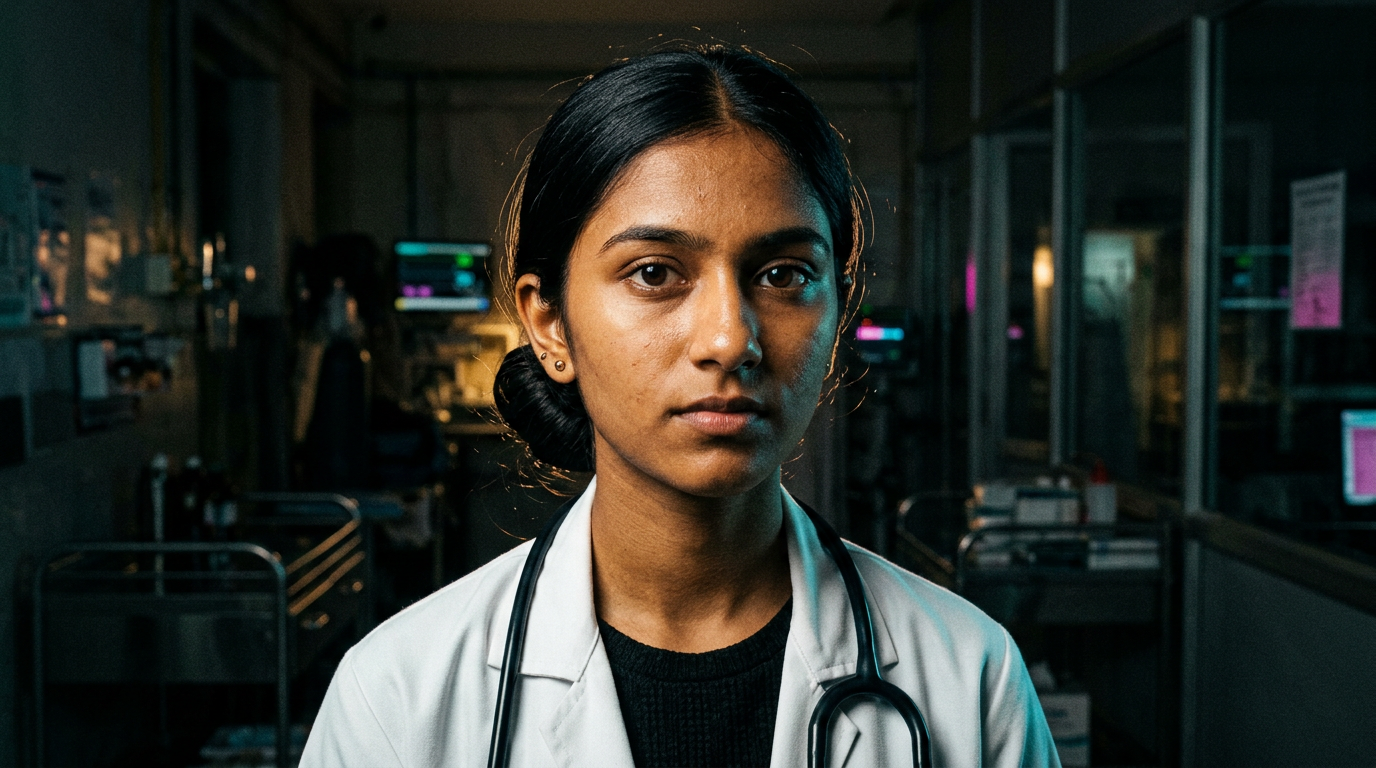
The Doctor's Daughters
Anika Aruna Patel was born on 12 June 2008 at the Mater Mothers' Hospital in South Brisbane, eleven minutes before her twin sister, Maya Aria Patel. Their father was Rajesh Patel, a paediatrician known to everyone as Raj, and their mother was Meera Patel (née Sharma), also a paediatrician. The family lived in a weatherboard house in Taringa, on a quiet street where the jacarandas formed a canopy in October and the possums crossed the power lines at dusk with the casual entitlement of animals who had been there first.
Raj was from Leicester, in the English Midlands, the eldest of three children of Pravin Patel, a pharmacist, and Asha Patel (née Desai), a secondary school teacher. The Patels were Gujarati — Pravin had emigrated from Ahmedabad in 1968, part of the wave of South Asian families who settled in Leicester and built a community around temples, textile shops, and the conviction that their children would be educated beyond argument. Raj had a younger brother, Nikhil, who became a solicitor in Birmingham, and a younger sister, Sunita, who taught mathematics in Nottingham. The assumption that Raj would study medicine had been present for so long that nobody could identify who had first articulated it.
He completed his A-levels at the Wyggeston and Queen Elizabeth I College in Leicester, studied medicine at the University of Cambridge, and finished his paediatric residency at Great Ormond Street Hospital in London in 2001. He was a careful, thorough clinician — not brilliant in the way that attracted headlines, but reliable in the way that attracted trust, and the children he treated remembered him as the doctor who sat on the edge of the bed rather than standing at the foot of it.
Meera was from Brisbane. Her parents, Vikram Sharma and Anita Sharma (née Kulkarni), had emigrated from Pune in 1972 — Vikram an electrical engineer with the Queensland state government, Anita a pharmacist who managed a chemist's shop in Toowong. Meera was the second of their three children, between an older brother, Sanjay, who became a cardiologist in Sydney, and a younger sister, Deepa, who ran an accounting practice in Brisbane. She had grown up in Indooroopilly, studied medicine at the University of Queensland, and completed her paediatric training at the Royal Children's Hospital before taking a fellowship in London, where, at a conference in Edinburgh in 2001, she met a quiet paediatrician from Leicester whose interest in plants was either eccentric or endearing depending on the day.
They married in 2003, in a ceremony in Leicester that Pravin and Asha organised with the thoroughness of people for whom an eldest son's wedding was a community event as much as a family one. They lived in London for three years before Meera's desire to return to Brisbane and Raj's restlessness in the English weather converged into a decision. He secured a consultant position at the Royal Children's Hospital in Brisbane in 2006, and they moved into the Taringa house that December, six months before the twins arrived.
The household was medical to its foundations. Both parents worked at the Royal Children's — Raj in general paediatrics with a research interest in ethnobotany, Meera in neonatal care — and the conversation at the dinner table moved between clinical observations and domestic logistics with the fluency of two people whose professional and personal vocabularies had merged. Raj's ethnobotanical interests filled the back garden with plants he was studying for their medicinal properties, and the twins grew up understanding that a garden was not decorative but investigative.
Anika was eleven minutes older than Maya, and the eleven minutes had assumed a significance out of all proportion to their duration. The firstness had settled into her personality with a permanence that Meera found both amusing and slightly exasperating. Anika organised. She planned. She tracked. She kept Maya's school diary updated when Maya forgot, found Maya's left shoe when Maya lost it, and reminded Maya of deadlines with the patient insistence of a person who genuinely could not understand how anyone forgot things that were written down.
She was not bossy, or not precisely. She was systematic in a way that occasionally resembled bossiness but was rooted in a different impulse — not a desire to control but a discomfort with disorder. Her room was neat. Her schoolwork was filed. Her pencils were sharpened to the same length. The habits emerged from Anika herself, from a mind that found satisfaction in things being where they were supposed to be and mild distress when they were not.
The Stethoscope and the Specimen Jar
The twins entered Brisbane Grammar School in Prep in 2014, their fees managed through two hospital salaries and a mortgage in Taringa. Anika adapted immediately. She liked the structure, the routine, the knowable sequence of a school day. She sat in the front row and completed worksheets with a precision that her Prep teacher described as "meticulous beyond her years."
Her academic strengths emerged early and remained consistent. Science and mathematics were her natural ground — not because she found them easy, though she did, but because they rewarded the kind of thinking she did instinctively: sequential, logical, building from evidence toward conclusion. She asked questions that reflected Meera's neonatal precision — specific, targeted, oriented toward understanding how rather than knowing that.
Maya, by contrast, drifted toward the subjects that rewarded imagination — art, creative writing, environmental studies. The twins were not competitive, or not obviously. But Anika was aware that Maya's gifts were more visible — more charming, more immediately impressive to adults who valued creativity over rigour — and the awareness produced not resentment but a quiet determination to be excellent in her own domain.
She shadowed Raj at the hospital on professional development days, when the school closed and parents scrambled for childcare. Raj brought both twins, but it was Anika who stayed at his side, who watched him examine a child's ear with an otoscope and asked to look through it herself, who studied the stethoscope's diaphragm and wanted to know why it amplified sound. Maya wandered to the hospital garden and sketched the plants. The division was not planned, and Raj, who loved both daughters with equal intensity and understood them with unequal ease, recognised in Anika the clinical curiosity that had drawn him into medicine.
By Year 4, her teachers described her as one of the strongest science students in her cohort. She designed an experiment for a class project — testing whether different soil types affected the growth rate of bean seedlings — that was methodologically sound enough to impress the Year 6 science teacher who happened to see the results. She recorded data in tables, drew graphs with rulers, and wrote conclusions that distinguished between what the data showed and what it did not.
She had friends — steady, reliable friendships with girls who shared her work ethic — and she was warm in a contained way, loyal, and protective of Maya with a fierceness that surfaced only when someone was unkind to her sister. Maya protected Anika differently — by softening her, by pulling her into laughter, by reminding her that not everything needed to be planned. The relationship was the central fact of both their childhoods, the particular closeness of twins who were different enough to need each other and similar enough to understand why.
His Daughters, His Patients
The overnight field trip to D'Aguilar National Park was scheduled for the weekend of 4–5 August 2018. Raj volunteered as a parent chaperone, his medical qualifications making him a reassuring presence on excursions. Meera stayed home — rostered for a weekend shift in the neonatal unit — and kissed all three of them at the door on Saturday morning with the distracted tenderness of a woman whose mind was already at the hospital.
Anika packed methodically: a change of clothes, a torch, her biology textbook, and a notebook with graph-paper pages. Maya packed coloured pencils and a small muslin bag of dried lavender she had prepared from the garden, which she tucked into the front pocket of her backpack with the seriousness of a ritual.
At D'Aguilar, Anika walked the guided trail beside Raj, asking questions about canopy species and the relationship between altitude and vegetation density. She wrote observations in neat, labelled entries — species, location, time, conditions. She was not the most enthusiastic child on the walk. She was the most systematic.
The bus departed D'Aguilar on the morning of 5 August. Raj sat near the front. The twins sat together in the middle section — Anika by the window, Maya on the aisle, their backpacks wedged between their feet.
The bus passed through a Portal that opened across a road in the Brisbane suburbs and collided with vehicles on the far side, in the landscape of Clivilius. The impact was violent and sudden. Anika was thrown forward against the seat ahead. She had been holding her backpack on her lap — a habit — and it absorbed some of the impact against her chest. Her left wrist bent sharply as she braced against the seat back, spraining the joint. Bruises spread across her forearms and ribs. The pain was sharp and immediate, a wrongness in the joint that she assessed with the detachment of a child who had spent years watching her father assess injuries and who applied, instinctively, the same clinical distance to her own body.
Maya hit the window. The side of her head struck the glass and a concussion settled behind her eyes. Anika heard the impact and turned to her sister before she registered her own pain. Maya was conscious, blinking, a graze across her temple where the skin had split against the window frame. Anika held Maya's face between her hands — the left wrist screaming, ignored — and said her sister's name, and the steadiness in her voice was not bravery but training, the calm of a child who understood that panic was a luxury people in medical situations could not afford.
Raj, at the front of the bus, had struck the seat ahead with his chest. Two ribs fractured on the left side. He was on his feet within a minute, moving through the bus with the methodical urgency of a doctor in triage, assessing injuries, directing the other adults. He reached the twins and examined Maya's head, splinted Anika's wrist with fabric and a strip of rigid plastic from a broken armrest. His hands were steady. His voice was professional. Anika watched him work and understood, for the first time, that her father's calm was not an absence of fear but a decision to function despite it.
The Half-Orphaned
The wrist healed in four weeks. Maya's concussion resolved in ten days, monitored by Raj with the attentiveness of a father whose medical training made him both the best and the worst person to care for his own children. The rib fractures took longer. Raj moved carefully for six weeks, his breathing shallow on the left side, and the twins learned to read his pain in the way he stood up from a chair — slowly, with a hand pressed flat against his ribs, the gesture so habitual that it outlasted the injury by months.
Anika and Maya were the only children on the bus who had a parent in Clivilius — anomalous in a community defined by total loss. The other bus children had lost every family member they possessed. The Patels had Raj. They slept in the same shelter. They ate together. They had a father who held them at night when the strangeness pressed in, who maintained the rituals of a family even when the family was halved and the world was wrong.
The advantage was real and it was isolating. Anika understood this before Maya did. She did not talk about Raj in the way the other children talked about their parents — in the past tense, with the ache of absence. She could not, because Raj was present, sleeping ten metres away, cooking their meals over the settlement's communal fire. The other children's grief was for people who were gone. Anika's grief was for Meera alone — specific, focused, undiluted by the generalised catastrophe that defined everyone else's loss.
She missed her mother with the precision of a child whose memory was detailed and whose mind did not allow details to soften. The smell of Meera's hair — coconut oil, applied every Sunday evening in a ritual inherited from Anita. The sound of Meera's voice reading to them in Hindi, which Meera spoke imperfectly but insisted on because language was heritage and heritage was not optional. The last morning — Meera at the door, the distracted kiss, the car keys already in her hand — preserved in the amber of a mind that could not stop cataloguing and could not bring itself to discard.
Raj grieved in front of his daughters, because there was nowhere else to do it. He spoke about Meera — at meals, during the long evenings — with the deliberate frequency of a man who understood that silence about a lost parent was more damaging than sadness. He told them about Edinburgh, about Leicester, about the night the twins were born and Meera had laughed through the last hour of labour because the midwife's accent reminded her of a character from a television programme she loved. The stories were maintenance — the preservation of a person who could not be present, conducted by a man who knew that children's memories were fragile.
The Apprentice
Anika entered the Learning Grove in September 2018, ten years old, and Jenny Triffett placed her in an ability group near the top of her age cohort. Her reading was strong, her writing clear and structured, her numeracy the best in her group. Her science comprehension was exceptional — not merely good recall but genuine understanding of process, of causation, of the difference between correlation and evidence.
The afternoon practical sessions presented no ambiguity. Anika gravitated to the makeshift clinic where Raj and the other adults with medical training treated the settlement's injuries and illnesses with salvaged supplies and improvised equipment. She was ten years old and she wanted to help, and the wanting was not sentimental but practical: she had knowledge, absorbed from years of proximity to her parents' work, and Anika's fundamental orientation toward the world was to be useful.
Raj did not discourage her and did not indulge her. He treated her as he would have treated a first-year medical student — with patience, with rigour, with the expectation that she would learn properly or not at all. She observed wound care, learned to dress minor injuries, memorised the symptoms of dehydration, infection, heat exhaustion. By eleven, she could take a pulse, assess a wound's severity, and explain to a frightened child what was happening to their body in language that was accurate and calm.
The transition to Bixbus School formalised the arrangement. Her mornings were academic — science consistently the strongest, mathematics close behind, English and history competent but unremarkable. Her afternoons were spent at the Bixbus Medical Centre, which had grown from a tent into a permanent facility with examination rooms and a dispensary. Raj ran the paediatric service. Anika assisted.
The assisting deepened as she grew. At twelve, she conducted initial assessments of children presenting with common complaints. At fourteen, she assisted with more complex procedures under Raj's direct supervision, her questions precise enough that the other medical staff treated her as a colleague rather than a child. By sixteen, she was a fixture at the Medical Centre — the doctor's daughter who had become, through sustained apprenticeship, a clinician in everything but qualification.
The proximity to Raj was both her advantage and her complication. She learned faster than she would have without a parent-mentor, but she carried the weight of being Raj Patel's daughter in a settlement where Raj was respected and relied upon, where the expectation that Anika would follow him into medicine was held by everyone except Anika herself, who had chosen medicine because it was the thing her mind did best and who resented the assumption that her choice was inheritance rather than decision.
The City and the Twin
Bixbus grew into a metropolis around the Patel family. The dusty encampment became a city of millions — residential complexes climbing the hills, roads connecting districts that had not existed three years earlier. The Medical Centre became dwarfed by the Royal Bixbus Hospital, a multi-storey facility with operating theatres and diagnostic equipment. Raj's role expanded from sole paediatrician to head of the paediatric department, and Anika watched the expansion with the awareness of someone who understood how far the distance was between a bandage made from a bus curtain and a hospital that would not have been out of place in Brisbane.
Her relationship with Maya remained the central axis of her personal life, though the axis had shifted as they grew. Maya had found ethnobotany — the study of plants and their medicinal uses — and worked at the Verdant Nursery, cataloguing flora, testing extracts, recording properties with the same detailed attention that Anika applied to patients. They were converging on the same territory — medicine, healing, the alleviation of suffering — from opposite directions, and the convergence delighted Raj in a way that neither twin fully appreciated.
Anika's social world was narrower than Maya's. She had friends at the school and at the Medical Centre — colleagues, really, people who shared her work and understood its demands — but the friendships lacked the easy warmth that Maya generated without effort. Anika was respected. She was trusted. She was not, in the way that Maya was, loved on sight. She understood that her temperament invited a different kind of connection — slower to form, more durable once formed, built on shared competence rather than shared feeling.
Among the bus children, she occupied a position that only Amelia Harris partly shared — having a parent in Bixbus. But Amelia's father was a bus driver who had become a depot worker. Anika's father was a paediatrician who had become the settlement's most important doctor. The asymmetry meant that Anika's privilege was not merely parental presence but parental prominence, and the prominence attracted attention she did not seek and expectations she had not chosen.
She handled the expectations by exceeding them. She worked harder than she needed to, stayed later at the hospital than she was asked to, read medical texts with a voracity that was genuine and also defensive. If she was excellent, nobody could say she had been given her position. If she was indispensable, the advantage of having Raj as her father became indistinguishable from the merit of being Anika Patel, and the distinction mattered to her more than she admitted.
The Faculty of Life Sciences
Anika enrolled at the Clivilius National University in early 2026, at seventeen, in the Bachelor of Medical and Human Sciences within the Faculty of Life Sciences. The programme — anatomy, physiology, pathology, pharmacology, and the integration of Earth and Clivilius medical knowledge — formalised the education she had been receiving informally for eight years. She arrived already knowing more than some of the coursework could teach her, and the challenge was not instruction but extension — pushing her beyond what apprenticeship had provided into the theoretical frameworks that clinical experience alone could not supply.
Her mornings were spent at the university. Her afternoons remained at the hospital, where her role had shifted from assistant to junior practitioner — still supervised, still learning, but trusted with responsibilities that reflected eight years of accumulated competence. She maintained the dual schedule with the organised intensity that had defined her since childhood, her days plotted in the same neat columns she had used in her D'Aguilar notebook.
Maya enrolled in the same intake, in the Bachelor of Ethnobotany and Sustainable Medicine. The twins ate lunch together when their schedules aligned and walked home to the quarters they shared with Raj through a city that neither of them, at ten, could have imagined existing. The walk took them past the hospital where Anika had spent her adolescence, past the Verdant Nursery where Maya had spent hers — a map of their divergent paths through the same strange life.







