Andrew "Drew" James Polden
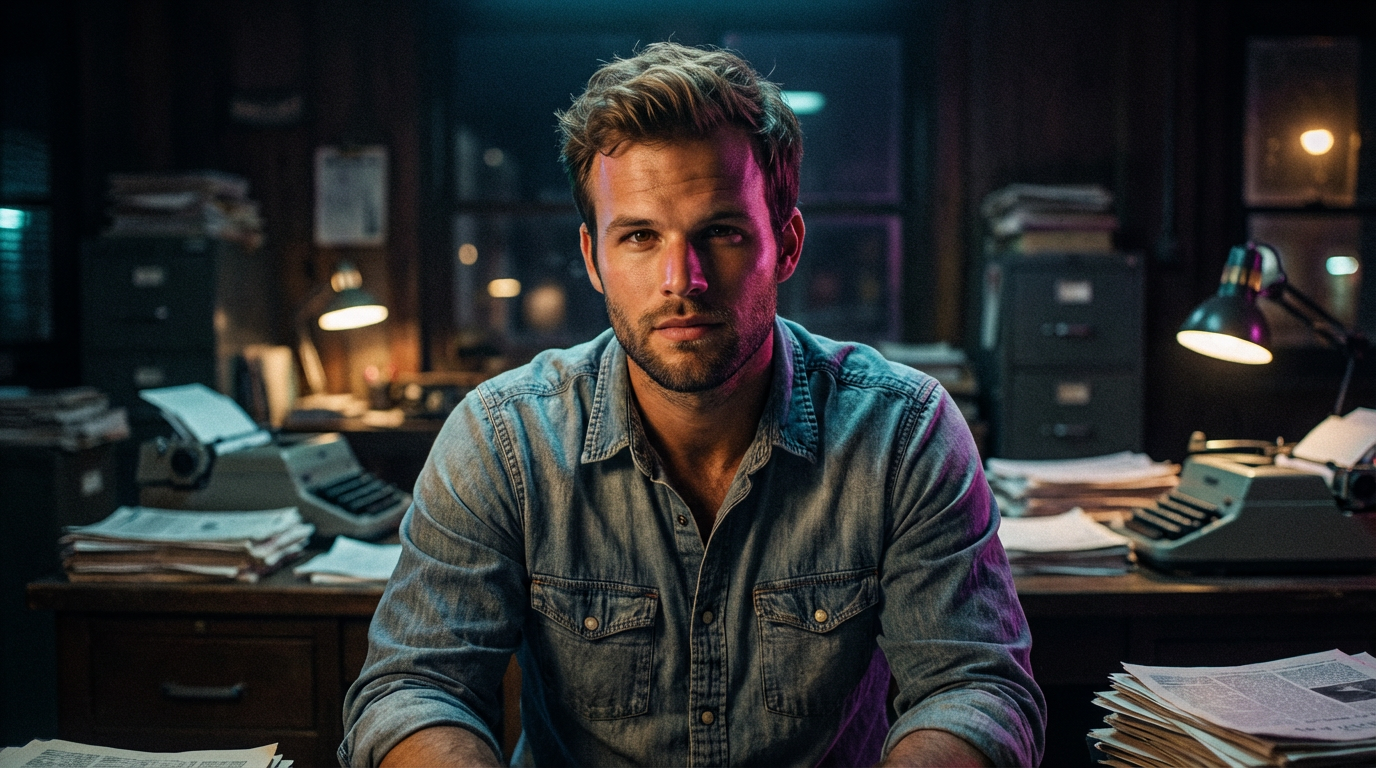
Andrew James Polden was born on 27th October 1991 at Broken Hill Base Hospital, the second son of Robert and Susan Polden, whose sheep and cattle property fifteen kilometres from town provided his earliest education in the distance between what stories appear to be and what they contain. His trajectory from outback childhood through a journalism degree at the University of Adelaide to a career at Adelaide's digital media fringe and back again to Broken Hill's Silver City Sentinel traces the arc of a man who travelled far enough to understand that the stories worth telling had been waiting at home. He is senior reporter at the Sentinel and his brother Brock's closest confidant.
The Second Son (1991–2003)
Andrew James Polden — christened Drew almost immediately to distinguish him from the several Andrews already populating Broken Hill's social registers — was born on 27th October 1991 at Broken Hill Base Hospital, the second child of Robert and Susan Polden. His brother Brock, already six years old and established in the household's rhythms, received Drew's arrival with the particular interest of a child whose routines were sufficiently settled to accommodate novelty without disruption. Robert, a third-generation farmer whose relationship with the land was defined by the persistence it demanded rather than the rewards it offered, and Susan, who had trained as a nurse before marriage redirected her into the domestic management of a property whose needs exceeded its income, welcomed their second son into circumstances that were modest, stable, and shaped by the understanding that useful work was the organising principle around which everything else arranged itself.
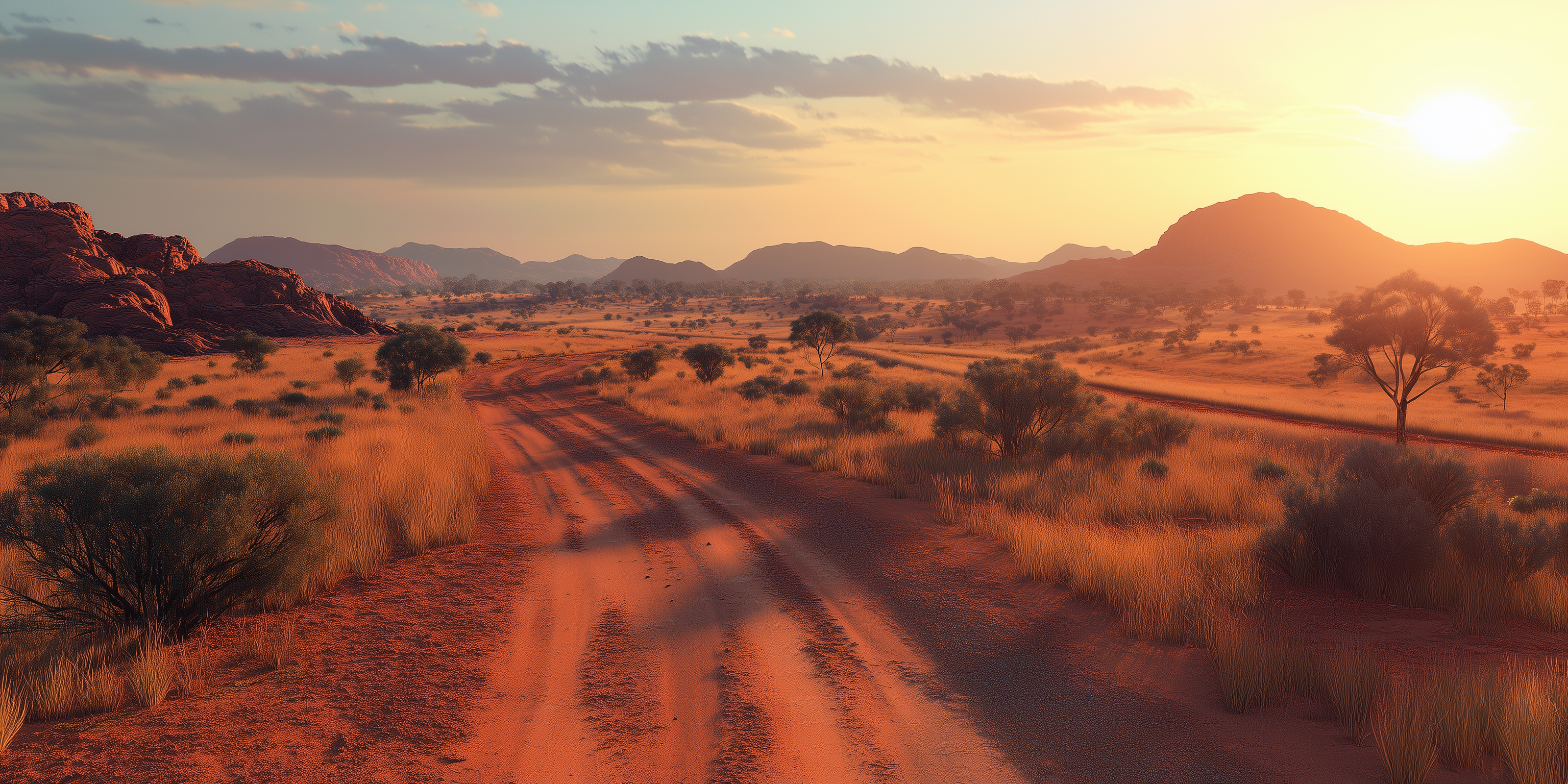
The Polden homestead sat fifteen kilometres from town along a dirt track whose condition varied with rainfall from merely rough to temporarily impassable. The distance was sufficient to ensure that Drew's earliest experiences of the world were governed by agricultural reality — the cycles of drought and rain, the economics of livestock, the mechanical temperaments of equipment whose maintenance constituted a permanent negotiation between function and budget — whilst remaining close enough to Broken Hill for the schooling and social engagement that Susan insisted her children would receive regardless of what the geography suggested was practical. She drove them into town for library visits and swimming lessons with the determination of a woman who understood that remoteness was a condition of their lives but need not become a limitation upon their minds.
Drew absorbed his parents' qualities in proportions that inverted his brother's inheritance. Where Brock had developed Robert's pragmatic steadiness — the capacity to assess a situation, identify the necessary action, and execute it without the interference of excessive deliberation — Drew displayed Susan's curiosity about the world beyond the property's boundaries, a restless intelligence whose appetite for narrative exceeded what the homestead's routines could satisfy. He demanded stories rather than toys, transforming the ordinary events of farm life into material whose dramatic potential he recognised before he possessed the vocabulary to articulate what he was doing. A broken fence became a catastrophe requiring investigation. Sheep clustering for shade became conspirators whose intentions warranted surveillance. Susan, recognising in these inventions something beyond the usual creativity of childhood, fed the appetite with library books whose weekly arrival constituted Drew's most reliable excitement.
The six-year gap between brothers established a dynamic that would persist, in modified forms, throughout their adult lives. Brock played protector and guide rather than competitor — leading Drew through paddocks to check water troughs, into town for errands, around the property's boundaries on expeditions whose educational purpose was disguised as adventure. Drew trailed behind, absorbing not merely the practical knowledge Brock was transmitting but the peripheral details that his brother's task-oriented attention did not register: the way drought altered the quality of people's greetings in town, how cancelled orders changed the texture of dinner conversations, which families withdrew from community events when their circumstances shifted. He was learning to read social weather with the same attentiveness his father applied to atmospheric pressure, understanding before he had any use for the knowledge that stories lived in silences as much as in words.
Primary school at Broken Hill Public, beginning in 1997, expanded Drew's access to the raw material his temperament required. Unlike Brock's initial shyness, Drew adapted to the social environment with the facility of someone whose curiosity about other people constituted a form of charm — classmates discovered that he remembered their stories, asked questions about their families, and possessed the ability to retell what he had heard in versions that were somehow more interesting than the originals without being less true. His teachers noted this capacity with the approval that genuine talent generates in educators whose professional satisfaction depends upon encountering it occasionally.
Broken Hill High School (2004–2009)
Drew's entry into Broken Hill High School in 2004 coincided with Brock's departure for Charles Sturt University, removing the protective presence that had smoothed his passage through childhood's social terrain. The high school's scale and complexity initially overwhelmed, but Drew found his environment in the library and computer lab — spaces where curiosity was valued — and in the school's literary magazine, "Desert Voices," which became the platform upon which his instinct for narrative found its first public expression.
Where his peers contributed poetry about adolescent preoccupations or short fiction whose autobiographical origins were inadequately disguised, Drew submitted profiles of community members — the Serbian baker who had fled civil war, the Indigenous artist whose grandmother remembered the town's founding, the mine engineer who collected Victorian-era equipment. His English teacher, David Chen, recognised in these pieces something beyond competent student writing: an ability to listen without judgement and to translate complex lives into prose that honoured their subjects without simplifying them. By Year 9, Drew had assumed editorial control of "Desert Voices," converting it from a repository of creative writing into something that resembled, in ambition if not always in execution, actual journalism.
His academic performance reflected selective commitment rather than uniform achievement. English and history grades were exceptional; mathematics and science survived on the minimum effort their compulsory status demanded. Report cards repeated the observation that Drew would excel if he applied himself equally to all subjects, missing the point that he was applying himself — just not to the curriculum his teachers had designed. His evenings were spent reading journalism blogs, studying how different publications covered identical events, and developing an understanding of the relationship between editorial decisions and the truths they produced or suppressed.
The 2008 financial crisis provided Drew with his first encounter with journalism's capacity to document the intersection of private suffering and historical force. As neighbouring properties failed and families departed for cities whose employment prospects were uncertain but whose agricultural impossibility was at least not the specific impossibility they were fleeing, seventeen-year-old Drew documented the collapse for a Year 11 project. He interviewed departing families, photographed abandoned homesteads, and analysed the economic data whose abstraction concealed the human specificity of what was happening. The project earned school recognition, but its greater significance lay in crystallising Drew's understanding of what journalism could do when it attended simultaneously to the statistical and the personal.
His parents' retirement from active farming in 2010, following years of accumulated pressure that the financial crisis had intensified, coincided with Drew's final preparations for university. Robert, whose body bore the evidence of decades spent negotiating with land that gave less than it demanded, and Susan, whose energy had been distributed between domestic management and the effort of ensuring her sons' access to opportunities their location might otherwise have denied, sold most of the property whilst retaining the homestead and surrounding acres — preserving connection without sustaining the obligation that connection had imposed.
Adelaide (2010–2013)
The University of Adelaide, where Drew enrolled in February 2010 to study for a Bachelor of Journalism and Professional Writing, provided everything Broken Hill did not — architectural grandeur, intellectual diversity, historical density, and a population sufficient for the anonymity that small-town upbringings make simultaneously attractive and unsettling. His initial months overwhelmed with possibility. Courses in media ethics, investigative techniques, digital storytelling, and political communication addressed subjects he had previously approached only through independent reading, and his rural background, initially a source of self-consciousness, became an asset as tutors recognised the authentic perspective he brought to discussions about regional representation and the assumptions that metropolitan media imposed upon communities it reported from but did not inhabit.
His roommate, Marcus Chen from Singapore, introduced international perspectives that challenged assumptions about Australian experience Drew had not previously recognised as assumptions. Late-night dormitory conversations about press freedom, cultural representation, and journalism's evolving purpose expanded his understanding whilst reinforcing his conviction that storytelling's fundamental value lay in facilitating comprehension across difference — between communities, between individuals, between the experience of living somewhere and the experience of reading about it.
The summer internship at the Adelaide Advocate between his second and third years provided Drew's first immersion in professional journalism. The newspaper, established in 1978 and operating from its Waymouth Street offices as a subsidiary of the National News Network, maintained a reputation for investigative rigour that its commercial pressures increasingly complicated. Drew was assigned wherever assistance was needed — sports coverage, court reporting, lifestyle features — absorbing the rhythms of deadline-driven work whilst observing the compromises that sustained it. The assignment that proved formative came when the rural affairs reporter fell ill and Drew was dispatched to cover a farmers' protest about water allocations. His background allowed him to understand nuances that city-raised journalists missed — the difference between irrigation and stock water, why certain properties held historical priority, how drought cycles altered negotiating positions. His coverage earned editorial praise and a bylined feature in the Advocate's "Voices of Adelaide" section.
It was at the Advocate, in November 2011, that Drew first encountered Jasper Murphy, an investigative journalist whose career trajectory would intersect with his own across the following decade in ways neither anticipated. Their initial meeting in the newsroom kitchen — Jasper seeking Drew's rural expertise for an investigation into corporate agricultural land acquisition — established a professional connection built on mutual recognition rather than friendship. Jasper saw in Drew an understanding of regional dynamics that metropolitan reporters typically lacked; Drew saw in Jasper a model of investigative commitment whose intensity he admired without entirely wishing to replicate. Their collaboration during Drew's final week as intern — a chemical spill at the Prominent Hill copper mine that required overnight reporting combining environmental science, corporate accountability, and community impact — produced Drew's first shared byline on a major story and confirmed that journalism's most significant work occurred at the intersection of technical skill and genuine human connection.
Drew's honours thesis, "Vanishing Voices: Media Representation and Regional Australian Decline," combined statistical analysis of coverage patterns with ethnographic interviews from three rural communities, including Broken Hill. The work earned first-class honours and a university medal. His supervisor, Dr Sarah Mahmoud, a former foreign correspondent, suggested postgraduate research and a potential academic career. Drew declined, understanding that his vocation required practice rather than theory — stories mattered most when they reached the people who needed them, and academic publication, however prestigious, operated at a distance from immediate impact that his temperament could not accommodate.
Graduation in December 2013 brought the family to Adelaide. Robert and Susan, uncomfortable in city attire but radiating pride, occupied front-row seats. Brock took leave from Sydney to attend, his police bearing unmistakable despite the civilian clothing. Drew kept catching his father's eye during the ceremony's formal rituals and suppressing the shared amusement at proceedings whose solemnity exceeded what either Polden was equipped to receive without irony.
Metropolitan Disillusionment (2014–2018)
The transition from academic distinction to professional journalism proved jarring. Drew's position at Digital South, a small Adelaide media startup focused on "disrupting traditional media paradigms," offered creative latitude and negligible security. The outlet's operating philosophy — maximum content for minimum cost — required him to produce sponsored material disguised as journalism, aggregate international news he had not personally verified, and accept that "pure journalism" was, as his twenty-five-year-old editor explained, a luxury the digital economy could not finance.
The ethical compromises eroded the convictions his education had cultivated. A profile of a property developer required ignoring environmental violations. A feature on workplace innovation meant overlooking wage theft allegations. Drew raised concerns and was instructed in the economics of survival. He supplemented his inadequate salary with freelance work — restaurant reviews, corporate communications, occasional pieces for established publications that paid poorly but offered the legitimacy Digital South could not.
His professional relationship with Jasper Murphy continued intermittently. In March 2016, they met at Café Troppo in Adelaide's Whitmore Square, where Drew discussed his frustration with Digital South and his contemplation of applying for a position at the Silver City Sentinel in Broken Hill. Jasper, himself increasingly disillusioned with traditional media's limitations, advocated for regional journalism's importance with a conviction that surprised Drew — the metropolitan investigator arguing for the value of the local. The conversation planted a seed whose germination would require two further years and a phone call about his father's health.
That call came in early 2018. Robert had suffered a heart attack — recoverable, but carrying the particular authority that medical emergencies exercise upon children's understanding of their parents' mortality. Beyond immediate concern, the event clarified something Drew had sensed without articulating: the stories he had travelled to Adelaide to learn how to tell existed more powerfully in the place he had left. The Silver City Sentinel position, advertised as if the timing were providential, required someone with modern training and regional sensibility, technical capability and human connection. Drew applied, was accepted, and in March 2018 returned to Broken Hill.
The Silver City Sentinel (2018–Present)
The Sentinel's newsroom occupied a heritage-listed building on Argent Street, its distinctive clock tower visible from most approaches to the town centre. The staff comprised five full-time journalists and various contributors, their experience ranging from veterans who had reported Broken Hill's news for decades to recent graduates cycling through regional postings. Drew's editor, Margaret Thompson, a sixty-year-old who had begun as a cadet reporter in the 1970s, assessed his potential with the accuracy of someone whose career had provided extensive calibration data for the difference between promising and useful.
Initial assignments tested his willingness to accept community journalism's mundane requirements. Council meetings about rate increases, school presentation nights, agricultural show results — stories that would never attract attention beyond Broken Hill but mattered profoundly to their subjects. Drew approached each with the discipline his education had instilled and the understanding his upbringing had provided, discovering that careful attention to apparently trivial events revealed patterns whose significance exceeded their individual scale. Council budget priorities reflected demographic shifts. School achievements correlated with economic circumstances. Agricultural results documented climate change's local expression.
His investigative instincts found application through longer-term projects Margaret approved between daily responsibilities. A series on youth unemployment examined why Broken Hill's teenagers left and rarely returned. An investigation into water rights revealed corporate manipulation affecting local farmers. A profile series on long-term residents captured oral histories whose preservation required urgency that the subjects' advancing ages imposed.
In August 2019, a routine investigation into environmental violations at Consolidated Mining Group's Broken Hill operations uncovered irregularities in the company's tax arrangements — a network of shell companies and political donations suggesting systematic corruption whose scope exceeded the Sentinel's investigative capacity. Drew contacted Jasper Murphy, and their subsequent collaboration — conducted through encrypted communications, a covert meeting in Adelaide's Botanic Gardens to exchange physical evidence, and the eventual coordination of a whistleblower whose terminal illness motivated disclosure — produced simultaneous publication in the Sentinel and the Adelaide Advocate that triggered government investigation and corporate collapse. The exposé represented the most significant investigative achievement of Drew's career and the fullest expression of what regional and metropolitan journalism could accomplish when their complementary strengths were directed at the same target.
Brothers (2018–Present)
Drew's return transformed his relationship with Brock from the affectionate distance that geography had imposed into something approaching genuine adult friendship. Both brothers had made the same essential journey — departure, metropolitan experience, return — and both had arrived at the same conclusion from different professional directions: that meaningful work required the kind of connection to community that could not be manufactured through career strategy or achieved through ambition alone.
Their regular Friday evening drinks at the Silver Crown became rituals whose importance exceeded their social function. Brock processed the accumulating weight of rural policing — domestic violence, drug crime, the serial murders that had begun devastating the region — through conversations whose privacy Drew respected absolutely. Drew tested his investigative instincts against Brock's operational knowledge, developing the unspoken protocols that their overlapping professional domains required: Brock never disclosed operational details, Drew never pressed for exclusive information, both understanding that the boundary between fraternal intimacy and professional integrity required maintenance rather than negotiation.
The boundary grew more complicated in December 2024, when Drew received an encrypted email from Jasper Murphy — their first contact in twenty months — requesting assistance with a cold case from 1990s Broken Hill that intersected with Brock's recently assigned cold case review. The request placed Drew precisely at the point where journalistic pursuit of truth and loyalty to his brother could not occupy the same space without one compromising the other. Jasper's evolution from award-winning investigative journalist into increasingly paranoid independent researcher — convinced he was approaching truths that powerful forces would protect through violence — added uncertainty about the request's reliability to the ethical complexity of its implications.
The Journalist at Thirty-Three
By 2025, Drew occupied a position within the Sentinel and within Broken Hill that fulfilled the purpose he had intuited since childhood whilst confronting the limitations that purpose could not transcend. His promotion to senior reporter with editorial responsibilities recognised contributions that had materially altered the publication's ambitions. He mentored junior journalists, modernised story approaches, managed the Sentinel's digital presence, and maintained the investigative commitment that distinguished his work from the competent reporting the position's minimum requirements would have accepted.
The professional recognition — state awards for investigative reporting, conference speaking invitations, guest lectures at universities, occasional republication in national outlets — validated his work's quality without resolving the question of whether quality was sufficient. His investigations increasingly revealed problems whose exposure did not produce solutions. Corporate malfeasance continued despite documentation. Government programmes failed despite scrutiny. Community challenges persisted despite the awareness his reporting generated. The gap between journalism's capacity to identify what was wrong and its power to make things right widened as experience accumulated, and Drew found himself navigating the particular exhaustion of someone whose professional obligation was to bear witness to damage he could describe but not repair.
His personal life remained suspended between contentment and incompletion. He rented a cottage near the town centre, furnished with second-hand pieces and bookshelves whose capacity he had exceeded, and maintained a social circle composed of fellow journalists, artists attracted to Broken Hill's creative community, and young professionals who had similarly returned after metropolitan experience had clarified what they valued. Romantic relationships developed occasionally — a teacher, a tourism officer — without progressing beyond the stage at which professional absorption and emotional availability revealed themselves as competing demands whose simultaneous satisfaction his circumstances did not permit.
His parents' declining health imposed responsibilities whose weight increased as their capacity diminished. Susan's diagnosis with early-stage dementia in 2024 transformed caregiving from periodic assistance into permanent concern. Drew researched memory care facilities with the same investigative thoroughness he applied to professional stories, documenting his mother's history whilst she remained able to contribute to its preservation. Robert's health, never fully recovered from the 2018 heart attack, required the monitoring that proximity allowed and that Drew and Brock divided between them with the complementary efficiency their different schedules and temperaments made possible.
The Friday drinks at the Silver Crown continued — two brothers processing the pressures of their parallel vocations through conversation whose intimacy neither would have described in those terms. Brock dealt with crime's immediate consequences; Drew examined the conditions that produced them. Neither possessed solutions, but presence proved sufficient. They walked the property's remaining acres on Sunday afternoons sometimes, retracing the boundaries their father had taught them to read, the landscape unchanged in its geological patience whilst everything human about it continued to shift beneath the weight of time and circumstance and the stories that Drew Polden had committed his life to telling.







