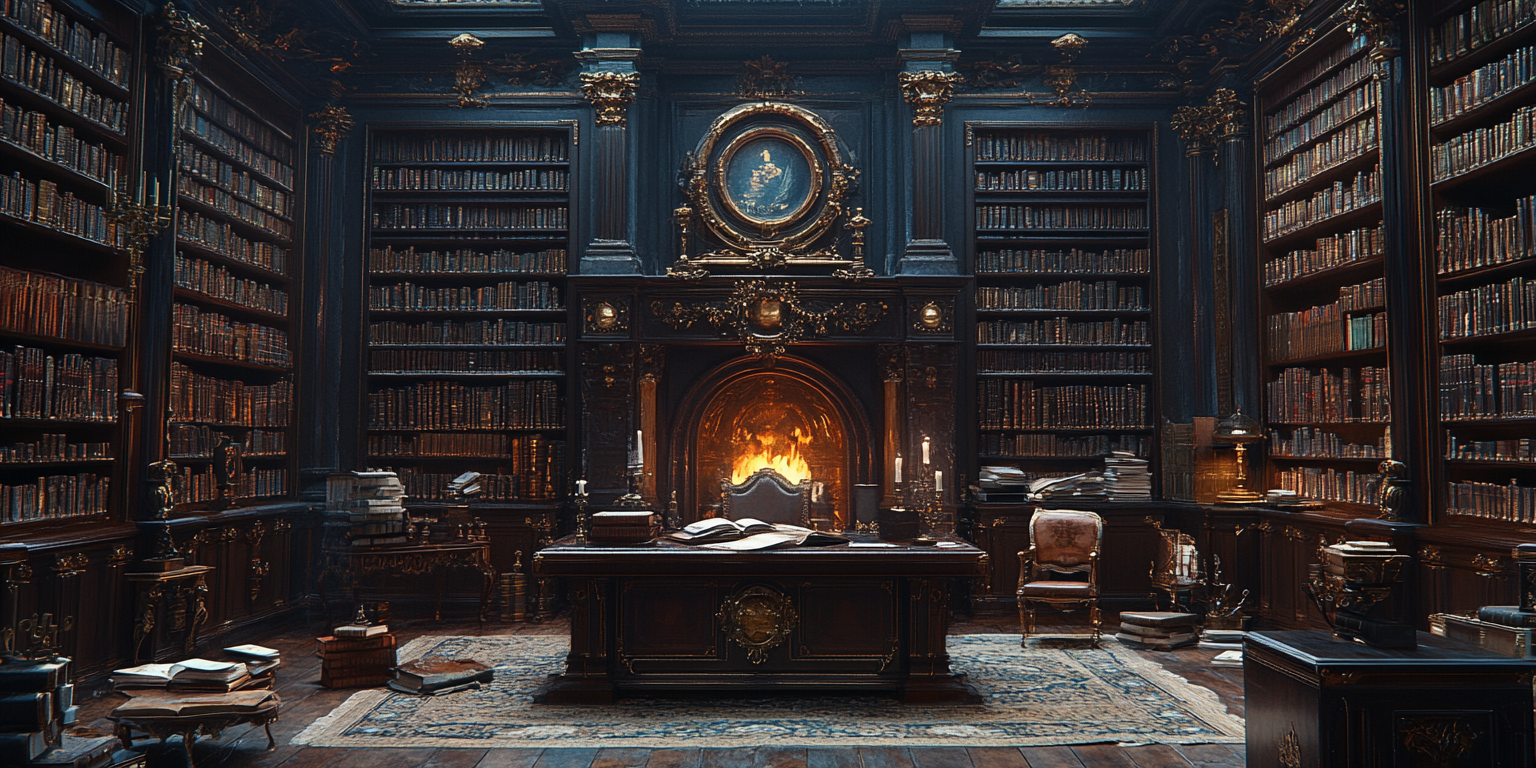
Alastair Thaddeus Blackwood
Alastair Thaddeus Blackwood, born 1 January 1785 in Portsmouth, Hampshire, emerged from magistrate lineage to become a founding Guardian of Aeternum and architect of one of history's most morally complex enterprises. His transformation from Oxford-educated gentleman into interdimensional strategist culminated in orchestrating systematic convict trafficking between Earth and Clivilius through manipulation of William Jeffries Sr. He vanished mysteriously in September 1839, aged fifty-four, leaving behind a legacy of vision shadowed by profound moral compromise.
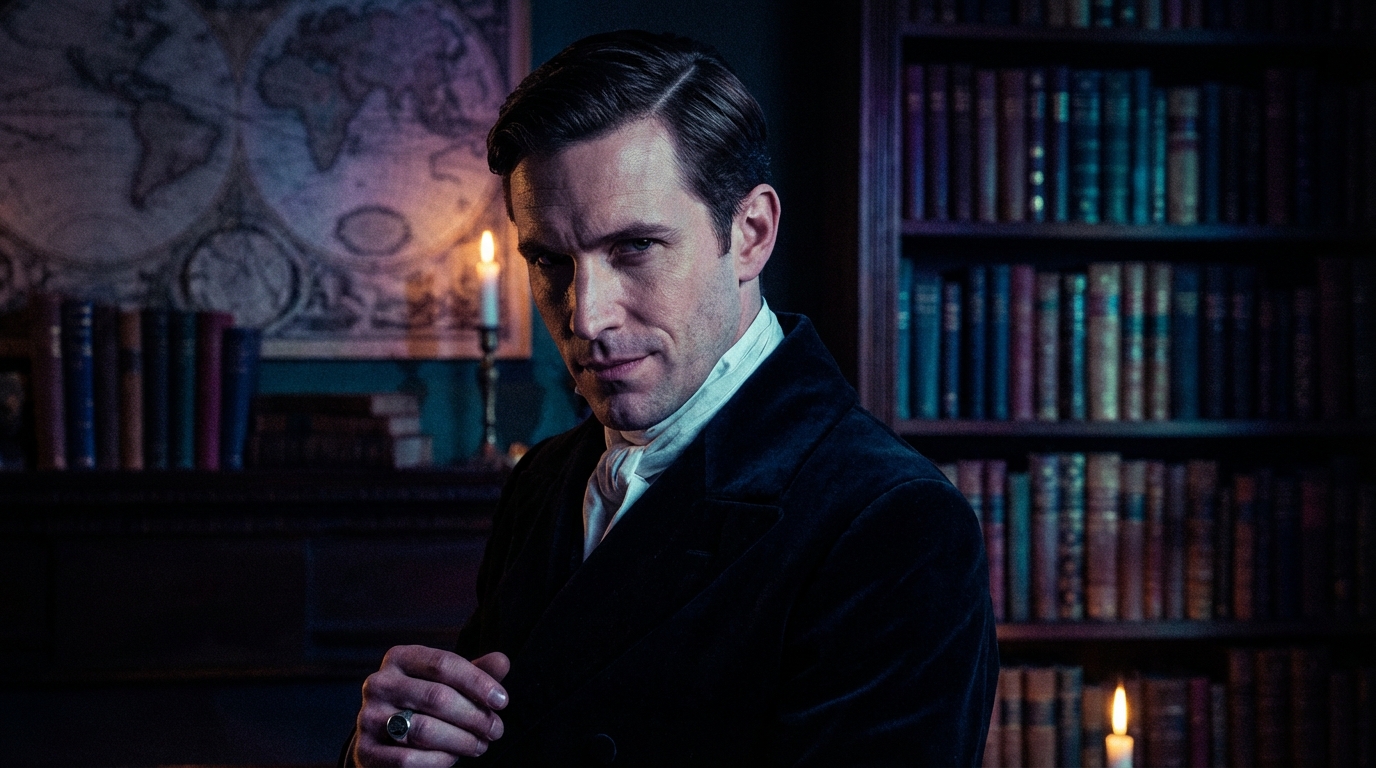
Portsmouth Privilege and Early Formation
Alastair Thaddeus Blackwood arrived into the world on the first day of 1785, delivered in the comfortable residence on High Street, Portsmouth, where his father Cornelius Jonathan Blackwood presided over both household and local jurisprudence with equal authority. The child's birth represented the culmination of his parents' aspirations—Cornelius, at thirty, had already established himself as a magistrate whose legal scholarship commanded respect throughout Hampshire, whilst his wife Lydia, née Ashton, brought connections to Southampton's prosperous merchant class that elevated the family's social standing beyond mere professional achievement.
The household into which Alastair entered combined intellectual rigour with civic engagement in ways that shaped his character profoundly, though perhaps not as his parents intended. Three siblings followed him into the world: Jeremiah Alexander in 1787, destined for scholarly exploration that would earn him Fellowship of the Royal Society; Abigail Victoria in 1789, whose botanical and entomological work would challenge gender conventions through pseudonymous publication; and Cornelius James Junior in 1792, who would channel their father's legal passion into reform advocacy. Yet it was Alastair, the eldest, who demonstrated from early childhood the most acute understanding of power's mechanics—not its moral foundations, but rather the practical machinery through which influence operated.
Portsmouth in the 1780s and 1790s existed as a crucible of imperial ambition, its harbour perpetually alive with naval vessels moving between Britain's far-flung possessions. The constant flow of ships, cargo, and men created an atmosphere where the young Alastair absorbed lessons about commerce, authority, and the ways that official channels could be navigated—or circumvented—by those who understood their workings. His father's position as magistrate brought a steady stream of naval officers, barristers, and merchant captains through the Blackwood household, their conversations providing the boy with an informal education in the exercise of power that proved far more influential than his formal studies.
Cornelius arranged private tutors for his eldest son's early education, engaging Reverend Samuel Thorne for classical languages and moral philosophy, Mr Oliver Phipps for history and legal principles, and Madame Celeste Vernoux for French and continental manners. By age ten, Alastair could translate legal maxims from Latin and conduct polite conversation in French—accomplishments that impressed his father's colleagues whilst revealing the boy's aptitude for presenting himself advantageously. Yet there emerged in Alastair's character a quality that troubled his mother, though she struggled to articulate her concern: the boy seemed to regard even family interactions as opportunities for practice in persuasion, testing which approaches elicited desired responses whilst maintaining a charming exterior that made such calculation difficult to identify.
Education and the Cultivation of Influence
In 1798, at age twelve, Alastair entered Winchester College, where the transition from private tutoring to institutional education revealed both his strengths and the trajectory his life would follow. He showed little interest in mathematics or natural sciences, finding such subjects too constrained by immutable laws that offered no room for interpretation or manipulation. Instead, he excelled in rhetoric and formal disputation, demonstrating an unsettling ability to argue any position convincingly regardless of his personal beliefs. The school's debating society became his theatre, where he honed skills in identifying audiences' vulnerabilities and crafting arguments that bypassed logic to appeal directly to emotion and self-interest.
More significantly, Winchester provided Alastair with his first opportunity to build a network of connections that transcended immediate circumstances. He cultivated relationships with fellow pupils whose futures pointed towards military command, legal practice, and government service—not through genuine friendship, observers noted, but through strategic calculation about whose patronage might prove valuable in years to come. Masters at Winchester recorded both admiration for his rhetorical abilities and unease about his character, with one notation from 1801 describing him as "possessed of remarkable gifts for persuasion, yet one wonders to what purposes such talents will ultimately be directed."
His matriculation at Magdalen College, Oxford in October 1803 to read Literae Humaniores reflected his father's belief that grounding in classical philosophy and political thought provided proper preparation for legal or diplomatic service. Alastair proved adequate rather than exceptional in his formal studies, yet thrived in the Magdalen Lyceum debating society, where a surviving record from February 1805 documents his successful defence of the motion "That the influence of commerce upon national policy outweighs that of military might"—an argument he would later enact through his Guardian activities, though in ways his Oxford colleagues could never have imagined.
His social circle at Oxford extended deliberately beyond Magdalen to encompass acquaintances at Oriel and Balliol whose ambitions aligned with his developing vision of influence operating through unofficial channels rather than formal institutions. These relationships proved instrumental when, years later, he required discreet assistance in arranging shipments, securing documentation, and maintaining the elaborate deceptions that his Guardian enterprises demanded.
The Path Towards Clandestine Purpose
After completing his Bachelor of Arts in June 1806, Alastair entered Lincoln's Inn to read law under Sir Thomas Willoughby, a barrister with connections to both the Admiralty and East India Company. His father regarded this as natural progression towards respectable legal practice, yet Alastair demonstrated from the outset that his interests lay less in courtroom advocacy than in the arrangement of affairs before they reached litigation. He possessed an intuitive understanding of how to identify leverage points in disputes and deploy them to achieve outcomes without formal proceedings—a talent that brought him discreet patronage from commercial clients who valued results over righteousness.
In August 1807, he undertook his first independent journey abroad, ostensibly serving as legal attaché to a mercantile consortium travelling to Lisbon. The true nature of this journey remains somewhat obscure, though Guardian Order records later identified several individuals he encountered there as "prospective initiates." This suggests that his recruitment into the Order's activities predated any formal induction, with his Lisbon sojourn serving as evaluation rather than mere commerce.
By 1808, back in Portsmouth and taking selected legal work whilst assisting his father with magistrate's business, Alastair had begun demonstrating the duality that would characterise his entire adult life: maintaining an impeccable public facade of civic engagement—supporting dockside sanitation improvements that happened to benefit shipowner clients—whilst simultaneously cultivating the clandestine connections that would eventually draw him into the Guardian Order's most ambitious enterprises.
Guardian Induction and the Portal Key
The winter of 1809 brought the encounter that transformed Alastair's trajectory entirely. An unnamed senior Guardian, operating within London's mercantile elite, approached him during a private salon in Soho. The meeting introduced concepts that would have struck most men as fantastical delusion: the existence of Clivilius, an alien world accessible through Portal Keys that bound themselves to individual DNA through blood, and the Guardian Order's mission to preserve Earth's knowledge by establishing settlements in this other dimension.
Yet Alastair accepted these revelations without the scepticism that characterised most prospective recruits. He possessed the rare combination of political acumen, resource acquisition skills, and financial independence that made him ideal for prolonged undertakings requiring secrecy and moral flexibility. More importantly, he recognised in the Guardians an opportunity for influence on scales unreachable through England's rigid social hierarchies—a chance to shape history itself whilst operating beyond conventional oversight or accountability.
On 25 October 1810, in a candlelit chamber at a Hampshire property he had leased specifically for the purpose, Alastair underwent the ritual that bound him to his Portal Key. The moment when the device drew his blood, transforming from inert metal to shimmering gateway, marked an irreversible threshold. Activating the Portal Key for the first time, stepping through into a barren plateau overlooking a gorge—the site that would become Aeternum.
Founding Aeternum and the Architecture of Ambition
The plateau that Alastair surveyed during his initial crossing presented both promise and profound challenges. Entirely devoid of vegetation or wildlife, its primary assets consisted of defensible elevation, a spring-fed water source, and isolation from any existing Clivilian settlements. Over subsequent weeks, alternating between reconnaissance in Clivilius and recruitment on Earth, he mapped water sources, identified agricultural terraces, and marked defensive perimeters with the systematic attention that would characterise all his Guardian work.
His recruitment of Sebastian Hawke in February 1810—a former Royal Navy lieutenant and Royal Engineers officer—demonstrated strategic brilliance in recognising that his own talents required complementary military expertise. Though Hawke's formal induction occurred in March 1811, he activated his Portal Key in July 1810, becoming Aeternum's second Guardian. The relationship between the two men combined mutual respect with fundamental tensions that would ultimately contribute to the settlement's trajectory: Hawke's militaristic governance conflicted repeatedly with Alastair's preference for long-term political manoeuvring over immediate security concerns.
On 23 March 1811, Alastair presided over Aeternum's first coordinated Guardian arrival, welcoming Margaret Sinclair (agricultural specialist), Isabella Farnsworth (archival custodian), and Jonathan Blackwell (mechanical innovator) through the portal. His deliberate distribution of authority—military command to Hawke, agricultural oversight to Sinclair, civic organisation to Farnsworth, infrastructure to Blackwell—reflected his understanding that shared power, whilst creating friction, prevented any single Guardian from challenging his position as political head.
Through 1811 to 1814, Alastair devoted himself to establishing supply lines between Earth and Clivilius, leveraging his mercantile connections to secure tools, livestock, and manufactured goods through channels sufficiently discrete to avoid official attention. His ability to present legitimate business reasons for unusual purchases and shipping arrangements proved invaluable during this period, when Aeternum's survival depended entirely on Earth-sourced resources.
The Van Diemen's Land Arrangement
Yet by 1815, Alastair had concluded that Aeternum's ambitious construction projects—the Outer Wall, Gorge Road expansion, sustained agricultural development—could not progress adequately with voluntary settlement alone. The solution he devised revealed both his strategic genius and his willingness to embrace profound moral compromise: systematic exploitation of coerced labour drawn from British penal colonies.
His logic combined cold calculation with elaborate self-justification. Convict workers could be tightly controlled, their presence in Clivilius would remain invisible to Earth's official records, and their "rehabilitation" through Guardian service could be framed as merciful alternative to harsh colonial conditions. That this reasoning ignored the workers' agency, their forced separation from any hope of eventual freedom, and the fundamental injustice of trafficking human beings to serve Guardian ambitions—these concerns Alastair dismissed as sentimentality that could not be permitted to obstruct necessity.
In 1818, whilst in Hobart Town, Van Diemen's Land, Alastair met William Thomas Jeffries Sr. at the Governor's Arms Inn. The encounter appeared coincidental, yet Alastair had researched Jeffries thoroughly: a convict who had transformed himself into wealthy landowner through ruthless exploitation of assigned prisoners, a man whose moral boundaries had already been compromised by ambition, and whose notorious treatment of workers suggested he would accept arrangements that more scrupulous businessmen might reject.
Alastair's seduction of William Jeffries demonstrated his manipulative abilities at their apex. He began at The Red Lion Tavern in London days earlier, on 15 June 1818, presenting himself as successful merchant captivated by William's entrepreneurial achievements. The conversation combined genuine praise with carefully planted hints about opportunities beyond conventional commerce—whispers about secret brotherhoods, allusions to wealth and influence unavailable through normal channels, suggestions that William's talents warranted recognition from those who shaped history's hidden currents.
Five days later, on 20 June 1818, at Alastair's Mayfair residence, the seduction reached its conclusion. In a study lined with books whose titles William could not read, over brandy poured from crystal decanters that represented months of a labourer's wages, Alastair revealed his true proposal: William would provide young male convicts—troublesome prisoners whose disappearance would occasion no official investigation—in exchange for resources that would cement his position amongst Van Diemen's Land's elite.
William's initial hesitation lasted mere minutes before ambition overrode conscience. Alastair had judged his mark perfectly: this was a man who had already sacrificed moral considerations for advancement, who viewed other human beings as instruments rather than equals, and whose capacity for self-justification would allow him to frame participation in human trafficking as merely another business arrangement.
The Human Machinery of Progress
On 12 March 1819, the first transfer occurred through the concealed portal beneath Jeffries Manor's wine cellar. Thomas Harrington and Edward Sinclair—carpenter and blacksmith, skilled workers whose talents Alastair required—passed through the shimmering gateway into Sebastian Hawke's custody on Aeternum's plateau. Alastair's journal entry that evening recorded satisfaction with the "trial run," noting the men "bore the journey well" and were "productive within the week"—language that reduced human beings to assessments of their utility whilst revealing his emotional detachment from the moral enormity of his actions.
Encouraged by this success, Alastair orchestrated increasingly ambitious transfers. On 15 September 1819, twenty-eight convicts marched through the manor's cellar portal in a single operation, delivered directly to Aeternum's Lower Terrace for assignment to high-priority worksites. Through 1819 to 1821, this systematic trafficking continued, with Alastair managing logistics from both sides of the dimensional divide—ensuring William maintained sufficient cover stories on Earth whilst Hawke absorbed and deployed the arriving labour in Clivilius.
Yet the arrangement's inherent instability became apparent on 9 August 1821, when convict prisoners overpowered their guards, and William Jeffries himself tumbled through the portal.
Mysterious Disappearance
Alistair's final confirmed sighting occurred in September 1838, when observers recorded him boarding the merchant brig Argent Swan at Falmouth, bound for undisclosed destination. The vessel was later reported lost off the Azores with no survivors. Whether Alastair perished in the wreck or used it as cover to vanish entirely remains speculation, though the convenient timing and his demonstrated capacity for elaborate deception suggest the latter possibility.







