Alastair James Drummond
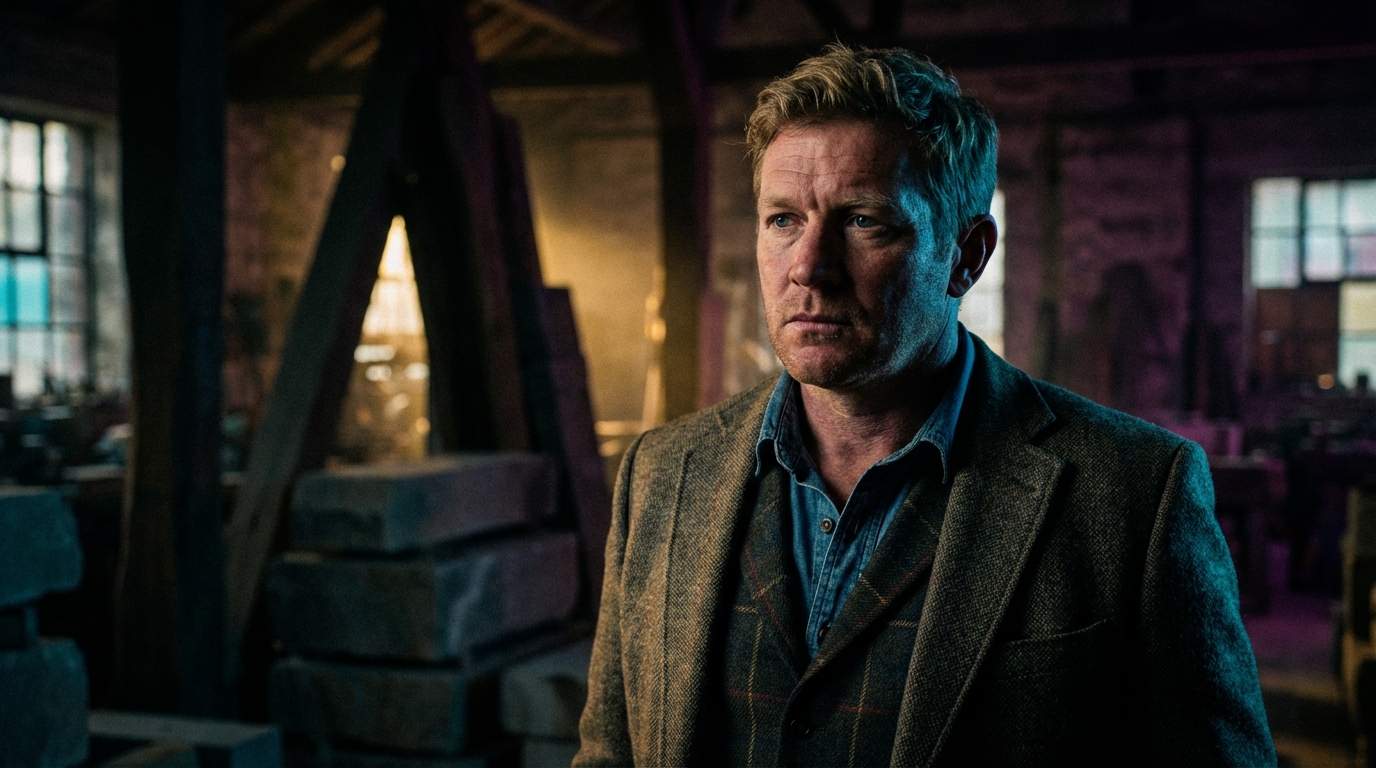
Alastair James Drummond, born in New Edinburgh, Stewartshire, Caledonia, was a master builder trained in the stone-and-timber traditions descended from the settlement's eighteenth-century Scottish founders. In August 2018, he led a New Edinburgh construction crew dispatched to the fledgling Bixbus settlement, where he oversaw the Bixbus Wildlife Sanctuary's earliest permanent structures. What began as a temporary assignment became permanent when Alastair relocated his family to Bixbus, establishing a new building practice in one of the region's most rapidly expanding settlements.
Early Life and Family
Alastair married Fiona Jean Ogilvie on 4 October 1997 at Elspeth's Kirk in the Thornlaw Quarter of New Edinburgh. Fiona, born in 1975, was the daughter of a Chewbathian Hunters quartermaster and had grown up in the military burgh five kilometres to the east. She was direct, practical, and possessed a talent for organisation that Alastair relied upon more than he readily admitted. She managed the accounts for A. Drummond Construction from its founding, bringing a discipline to the firm's finances that compensated for Alastair's tendency to underquote on jobs he found interesting.
Their first child, Iain Gregor Drummond, was born on 22 January 1999. A second son, Callum Alastair Drummond, followed on 11 September 2001. A third son, Ross Duncan Drummond, arrived on 3 May 2005 — a pregnancy that had not been planned and that placed additional financial strain on the household during a period when the firm was already stretched thin. Fiona managed the adjustment with characteristic efficiency. Alastair managed it by taking on two additional commissions simultaneously, a workload that left him exhausted and short-tempered through much of that year.
Alastair James Drummond was born on 27 August 1973 in New Edinburgh, Stewartshire, Caledonia, the second of four sons born to Gregor Andrew Drummond and Isla Margaret Drummond (née Farquhar). The family lived in the Thornlaw Quarter, one of New Edinburgh's older residential districts on the city's northern fringe, where terraced houses built from locally quarried sandstone lined streets that had changed little in over a century. Gregor Drummond worked as a joiner in the employ of the Stewartshire Public Works Office, maintaining civic buildings and infrastructure across the shire. Isla taught at Broadstone Primary School, a position she held for twenty-two years, and was known in the neighbourhood for a dry wit and an unwillingness to tolerate excuses from children or adults alike.
Alastair's eldest brother, Duncan James Drummond, born in 1970, left New Edinburgh at nineteen to take a position with a timber merchant in Millfield, fifteen kilometres to the north. The two were never close. Duncan had inherited their mother's sharp tongue without her warmth, and the age gap between them produced a relationship that functioned better at a distance than it ever had under the same roof. Alastair's younger brothers fared differently. Finlay Ross Drummond, born in 1976, followed their father into the Public Works Office and remained there his entire career, eventually rising to senior maintenance supervisor. The youngest, Robbie Gregor Drummond, born in 1981, was the family's unexpected late arrival and its most troubled member — bright but restless, he drifted between apprenticeships without completing any, worked intermittently as a labourer on building sites across Stewartshire, and developed a dependence on grain spirits that the family acknowledged privately but rarely discussed. Alastair maintained quiet contact with Robbie through adulthood, occasionally finding work for him when the younger man was sober and willing, though the reliability of those periods diminished over the years.
The Drummond household was practical and unostentatious, though not without its tensions. Gregor was a quiet man who expressed affection through competence — a shelf hung level, a door that closed without sticking, a garden shed rebuilt over a single weekend without being asked. Isla provided the household's conversational energy and its standards of conduct. The marriage was functional rather than romantic, held together by shared routines and a mutual investment in the boys' futures, though Isla's frustration at Gregor's passivity — his unwillingness to challenge anything, including his own sons' mistakes — surfaced occasionally in arguments that ended not in resolution but in silence. Alastair absorbed both influences. He inherited his father's quiet competence and his mother's intolerance for shoddy work, though he also inherited Gregor's tendency to retreat from emotional confrontation — a trait that would cause him difficulty in later life.
Education and Apprenticeship
Alastair attended Broadstone Primary School from 1978, where his mother's presence on the teaching staff ensured that any tendency toward complacency was corrected before it could take root. He was a competent student without being a conspicuous one — his marks in mathematics and technical drawing were consistently strong, and his teachers noted a practical intelligence that expressed itself more readily through making than through writing. He was the sort of boy who built things during lunch breaks: crude catapults from scrap timber, a birdhouse that survived an entire winter, a miniature cart with working axles that became the envy of his year group.
At twelve, he enrolled at Castellum Grammar School, a secondary institution in the neighbouring settlement of Castellum, ten kilometres to the northeast. The school had a strong technical programme that fed directly into the trade guilds and apprenticeship systems underpinning Stewartshire's construction industry. Alastair thrived in the workshop more than the classroom, though he maintained adequate academic results across most subjects — English composition being the persistent exception, a deficiency his mother took personally. His technical drawing instructor, a retired builder named Donald Cargill, identified in him a spatial awareness that went beyond simple measurement — Alastair could look at a set of plans and see the finished structure in three dimensions, anticipating where loads would concentrate and where movement in the ground might cause problems years after construction. Cargill encouraged him to pursue a formal building apprenticeship upon leaving school.
In 1989, at sixteen, Alastair commenced a five-year apprenticeship with Farquhar & Menzies, one of New Edinburgh's most established building firms. The company had been operating continuously since 1843 and specialised in the stone-and-timber construction methods that defined the New Edinburgh tradition — heavy sandstone foundations, load-bearing masonry walls, mortise-and-tenon joinery, fired-brick chimneys, and slate roofing. These techniques descended directly from the Scottish stonemasons and carpenters who had founded the settlement in 1762, adapted and refined through more than two centuries of building in Clivilius. The New Edinburgh approach favoured heavy foundations, generous drainage, and a deep respect for what the ground would and would not tolerate — principles tested against the particular demands of Clivilian soil and climate and proved across generations.
His master builder at Farquhar & Menzies was Roderick Menzies, grandson of one of the firm's co-founders and a craftsman whose standards bordered on the punitive. Roderick believed that a wall built properly should outlast the builder, the client, and several subsequent generations of occupants, and he communicated this philosophy through practical demonstration and withering commentary in roughly equal measure. Alastair endured the commentary and absorbed the demonstrations. He was not the most talented apprentice Roderick had trained — that distinction belonged to a contemporary named Iona Blackett, whose stonework Alastair privately admired and publicly refused to acknowledge as superior — but he was the most consistent. By the end of his second year, he was trusted to lay foundation courses unsupervised. By his fourth, he was managing small residential projects with a reliability that earned him responsibilities typically reserved for qualified tradesmen.
He completed his apprenticeship in 1994 and accepted a position as a journeyman builder with Farquhar & Menzies, though he had already begun to consider establishing his own practice in time.
The New Edinburgh Building Tradition
The construction methods in which Alastair trained represented more than a set of technical skills. They were a living tradition, passed from master to apprentice across generations, connecting the contemporary builders of Stewartshire to the four Stewart sisters who had founded New Edinburgh on 22 May 1762 and to the Scottish tradespeople who had followed them through the portals in the settlement's earliest decades.
New Edinburgh worked in stone, timber, and fired brick. The settlement's quarries produced the pale gold sandstone that gave the city its distinctive visual character — warm in afternoon light, almost luminous at dusk, and hard enough to resist the particular abrasiveness of Clivilian dust over centuries of exposure. Timber came from the Whispering Woods, the vast forest twelve kilometres to the east that Violet Stewart had discovered in 1763. Fired brick, produced in kilns along the settlement's western fringe, served for interior walls, chimneys, and decorative features where stone was impractical.
The tradition also incorporated knowledge inherited from the Ironhold refugees who had arrived in New Edinburgh on 18 October 1767, bringing metalworking skills from a settlement founded in 1480 by German Guardians led by the master blacksmith Gunther Eisenmann, twenty-five kilometres to the southwest. Though Ironhold itself had long since been abandoned, the metallurgical expertise of its descendants had become integral to New Edinburgh's building vocabulary. Iron fixings, hinges, brackets, and structural reinforcements produced by the Ironhold-descended smithing families were woven into every significant structure in Stewartshire, and the relationship between builder and smith — each understanding the other's materials and limitations — remained a defining feature of Caledonian construction.
Alastair never questioned the superiority of these methods within their context. He had never worked with prefabricated steel or corrugated iron. He had never poured a concrete slab or erected a building from manufactured components shipped in crates. He built the way his master had built, and the way his master's master had built, because the methods worked and because the structures they produced were still standing a century or more after completion. This was not conservatism for its own sake. It was an empirical confidence born of evidence — walls that held, roofs that shed water, and foundations that settled exactly as predicted into ground that the builders of Stewartshire had been reading by hand and eye for over 250 years.
Career in Stewartshire
Alastair remained with Farquhar & Menzies until 2001, progressing from journeyman to senior builder. He supervised a terrace of twelve townhouses in the Drumgate district, managed the restoration of a nineteenth-century wool store in Bridgetown, built farmhouses in the agricultural settlements west of New Edinburgh, and completed a chapel in Shepherd's Rest that became one of his most personally satisfying commissions. He was good at his work. He was not, however, particularly good at navigating the politics of a firm whose founding family treated seniority as birthright. When Roderick Menzies retired in 2000 and his nephew was appointed senior partner over several more experienced builders, Alastair said nothing publicly. He handed in his notice three months later.
In 2002, he established A. Drummond Construction, operating from a modest yard in the Langrigg district. The firm was small by design — between three and six tradesmen at any given time — and undertook projects he could personally supervise from foundation to handover. He had no interest in growing the business into something he could not control. He wanted to build, and he wanted to build well, and the distance between those two ambitions and the demands of managing a large workforce was a distance he saw no reason to cross.
Over the following sixteen years, A. Drummond Construction built and restored properties across Stewartshire. The firm's reputation rested on the same qualities that had defined Alastair's apprenticeship: heavy foundations, precise stonework, joinery that fitted without forcing, and an unwillingness to compromise on materials or methods when clients pressed for speed or economy. He was not inflexible — he adapted designs to individual sites and maintained good working relationships with the smithing firms whose ironwork his buildings required. But he held a line on structural integrity that clients learned not to push against, and the buildings he produced repaid that stubbornness with decades of reliable service.
The business was never lucrative. Alastair charged fairly but not generously, and his insistence on quality over volume meant that the firm completed fewer projects per year than competitors of comparable size. There were lean stretches — winters when commissions dried up and Fiona's bookkeeping revealed margins thinner than either of them found comfortable. Alastair responded to these periods the way he responded to most difficulties: by working harder and saying less, a strategy that kept the business solvent but did little to address the underlying anxiety.
Personal Life
Alastair married Fiona Jean Ogilvie on 4 October 1997 at Elspeth's Kirk in the Thornlaw Quarter of New Edinburgh. Fiona, born in 1975, was the daughter of a Chewbathian Hunters quartermaster and had grown up in the military burgh five kilometres to the east. She was direct, practical, and possessed a talent for organisation that Alastair relied upon more than he readily admitted. She managed the accounts for A. Drummond Construction from its founding, bringing a discipline to the firm's finances that compensated for Alastair's tendency to underquote on jobs he found interesting.
Their first child, Iain Gregor Drummond, was born on 22 January 1999. A second son, Callum Alastair Drummond, followed on 11 September 2001. A third son, Ross Duncan Drummond, arrived on 3 May 2005 — a pregnancy that had not been planned and that placed additional financial strain on the household during a period when the firm was already stretched thin. Fiona managed the adjustment with characteristic efficiency. Alastair managed it by taking on two additional commissions simultaneously, a workload that left him exhausted and short-tempered through much of that year.
The family lived in a sandstone cottage in the Whiteburn district that Alastair had purchased in poor condition in 1996 and spent two years restoring — re-pointing the stonework, replacing the roof timbers, rebuilding the kitchen and hearth. The cottage served as both home and advertisement, though Fiona observed more than once that the builder's own house was always the last to receive attention when something needed fixing.
Alastair was not a demonstrative father. He expressed care through action — a fence mended before Fiona noticed it sagging, weekends spent teaching the boys to use hand tools with the same patient repetition his own father had shown him. He attended school events, coached Iain's junior football team for two seasons with moderate success and considerable frustration, and maintained the close ties with Finlay that had characterised the Drummond family since childhood. He was less successful at navigating the emotional demands of adolescence. Iain's quiet temperament mirrored his own, and they understood each other without difficulty. Callum, more volatile and socially oriented, required a kind of verbal engagement that Alastair found draining, and the relationship between father and middle son was marked by periods of friction that neither handled particularly well.
Dispatch to Bixbus
In mid-August 2018, a patrol of Chewbathian Hunters ranging further south than their usual circuits encountered settlers from a fledgling settlement called Bixbus, struggling to erect perimeter fencing against Shadow Panther incursions. The encounter led to diplomatic contact, and the Parliament of New Edinburgh agreed to send skilled tradespeople to assist with construction.
Alastair was selected to lead the crew — a decision reflecting both his reputation and his temperament. He was forty-four, had never travelled beyond Caledonia, and had never encountered Earth-manufactured materials or construction methods. He accepted without hesitation, left instructions with Fiona regarding the firm's two active commissions, and departed New Edinburgh with his crew approximately nine days before the Bixbus Wildlife Sanctuary's groundbreaking ceremony on 29 August 2018.
His crew comprised four men: Hamish Kincaid, a masonry specialist whose family had been laying stone in Stewartshire for four generations; Ewan Maitland, the oldest at fifty-three, a carpenter of extraordinary precision; Callum Baird, the youngest at twenty-two, a former Chewbathian Hunter reassigned to the construction detachment; and Tavish Renfrew, a metalworker from the Ironhold-descended smithing tradition, who arrived separately for the steel frame stage.
The Bixbus Assignment
The Bixbus that Alastair encountered bore no resemblance to New Edinburgh's ordered civic landscape. It was a settlement of tents, tarps, and improvised structures, populated by people who had arrived from Earth through portals under circumstances ranging from deliberate extraction to violent abduction. The dust was inescapable. The infrastructure was rudimentary.
Adrian Pafistis, an Australian master builder serving as the settlement's Construction Engineer, became Alastair's primary working contact. The two men came from construction traditions separated by dimensions and centuries — Adrian trained in Earth-based steel-and-concrete engineering, Alastair in Clivilian stone-and-timber methods descended from eighteenth-century Scottish settlers. Their first conversation established a mutual professional respect. Adrian recognised that Alastair's practical knowledge of Clivilian ground conditions exceeded what any engineering textbook could provide. Alastair recognised that Adrian's understanding of manufactured materials brought capabilities the New Edinburgh tradition had never needed to develop.
The crew's initial assignment was the Bixbus Wildlife Sanctuary's first permanent structures — the Sanctuary Supply Depot and Sanctuary Operations Hub — built to specifications provided by Adrian and sanctuary director Grant Ironbach. The work introduced the New Edinburgh builders to unfamiliar materials and methods: Portland cement, prefabricated steel framing, corrugated iron cladding, solar panel installation. Alastair adapted without complaint, applying the underlying principles of his training — structural integrity, ground behaviour, load distribution — to technologies he had never previously encountered. The Supply Depot was completed on 17 September 2018, twenty days after the first steel pegs had been driven into the ground.
But the sanctuary was only the beginning. As Phase 1 construction progressed through the enclosures and aviaries, the crew's skills were increasingly sought for broader settlement work. Bixbus was growing faster than its available labour could accommodate, and five experienced Caledonian tradesmen represented a resource the settlement leadership was disinclined to release. Alastair's crew contributed to early infrastructure work through late 2018. When BUDA was formally established on 1 December 2018, Alastair found himself consulting on foundation standards for the settlement's first ambitious residential project — The Arlington, twin twenty-storey towers that represented a scale of construction utterly beyond anything Stewartshire had attempted.
Decision to Relocate
The assignment that had been intended as temporary extended through the end of 2018 and into 2019. Alastair returned briefly to New Edinburgh in early November to check on his firm's outstanding commissions and to see Fiona and the boys. The visit clarified something he had been reluctant to articulate: the work in Bixbus was not finished, and it was not going to be finished in weeks or months. The settlement's construction needs were escalating, not diminishing. Adrian had offered him a standing position on the BUDA advisory panel. Grant Ironbach had asked whether the crew could remain through the sanctuary's full Phase 1 completion. The Parliament of New Edinburgh, recognising the diplomatic and strategic value of maintaining a Caledonian presence in the fastest-growing settlement, had signalled willingness to extend the detachment indefinitely.
The decision to relocate was not straightforward. Fiona had built a life in New Edinburgh — her involvement in the Whiteburn Community Association, her network of friendships, her familiarity with a city whose rhythms she had known since childhood. The boys were settled in school. A. Drummond Construction had two active clients and a waiting list that would evaporate if the firm's sole proprietor left Stewartshire permanently. Alastair presented the opportunity as a practical matter — more work, better prospects, a chance to build at a scale that Stewartshire could not offer — but Fiona recognised what he was less willing to say directly: he had found something in Bixbus that New Edinburgh no longer provided. The work challenged him in ways that the steady repetition of Caledonian commissions did not.
They argued about it. Not dramatically — neither of them was inclined toward theatrics — but with the sustained, low-frequency tension of two people who agreed on the facts but disagreed on what the facts meant. Fiona's concern was not the move itself but the manner of its presentation. She wanted to be consulted, not informed. Alastair, who had spent a career making decisions on building sites and communicating them as settled conclusions, struggled to adjust his approach to a conversation that required something other than certainty.
They relocated to Bixbus in early 2019. Fiona brought the boys — Iain, now twenty, Callum, seventeen, and Ross, thirteen — and began the process of establishing a household in a city that bore no resemblance to anything she had previously experienced. Alastair wound down A. Drummond Construction, transferring his remaining Stewartshire clients to Finlay's contacts at the Public Works Office and closing the Langrigg yard that had been the firm's home for seventeen years.
Building in Bixbus
Alastair established a new practice in Bixbus in mid-2019, operating initially as a subcontractor for BUDA projects. The transition was not seamless. His Caledonian methods — stone foundations, timber framing, lime mortar — were largely impractical in a settlement that built with steel, concrete, and materials delivered through portals from Earth. He was, for the first time in his professional life, working outside the tradition that had defined him. The experience was humbling in ways he had not anticipated and was not always graceful in accepting.
What he brought, however, was an understanding of Clivilian ground that Earth-trained builders did not possess. The three-layer soil system — the Veil, the Shield, the Cradle — behaved in ways that confounded engineers accustomed to stable, predictable substrates. Alastair had been reading Clivilian soil his entire life. He knew how the Cradle responded to loading, how moisture migrated through the Shield, how foundations settled over time in ground that was, in ways the Earth-trained builders found unsettling, alive. This knowledge made him valuable. It did not make him comfortable.
He worked on residential developments through 2019 and 2020, contributing foundation assessments and ground-condition reports to BUDA's expanding portfolio of projects. He advised on The Gardenia Residences, completed in early 2021, and took on subcontracting work for smaller residential builds in the districts growing outward from the city centre. His crew — Hamish, Ewan, and Callum Baird, all of whom had also chosen to remain in Bixbus — formed the core of his new operation, supplemented by labourers recruited from the settlement's growing population.
Tavish Renfrew returned to New Edinburgh in 2019, the only member of the original crew to do so. His smithing skills, whilst adaptable, were less consistently in demand in a settlement that sourced its metalwork through portal logistics rather than local forges. Alastair understood the decision and did not attempt to change it, though the loss of the crew's metalworker underscored the distance between the construction culture he had been trained in and the one he now inhabited.
Ewan Maitland retired from active building work in 2022, at sixty-seven. His hands, which had shaped Clivilian hardwood with uncanny precision for over forty years, had developed a tremor that made fine joinery unreliable. He remained in Bixbus, where he had settled with characteristic quietness into a routine of morning walks and occasional advisory visits to building sites where younger carpenters sought his opinion on timber selection. Alastair visited him weekly — one of the few social obligations he maintained without prompting from Fiona.
Adaptation and Friction
The years in Bixbus tested Alastair in ways that Stewartshire never had. He was a capable builder, but he was not a natural diplomat, and the collaborative, multi-disciplinary environment of BUDA's construction programmes required negotiation skills he had never needed to develop. In New Edinburgh, a builder's authority on site was unchallenged. In Bixbus, decisions were made by committees, reviewed by engineers, and approved by administrators whose understanding of construction was theoretical at best. Alastair found this process inefficient and occasionally infuriating, and his frustration expressed itself in a bluntness that colleagues tolerated but did not always appreciate.
His relationship with Fiona stabilised after the initial disruption of the move, though the dynamics of their marriage shifted in Bixbus. Fiona, freed from the familiar routines of New Edinburgh, developed a social network and community involvement that gave her an independence she had not fully possessed in Stewartshire. She found work managing accounts for a Bixbus provisions supplier and became involved in neighbourhood governance in the residential district where they settled. The marriage functioned — it had always functioned — but the balance of it changed, and Alastair was slow to recognise that the woman who had managed his accounts and raised his sons in the Whiteburn cottage was becoming someone whose life no longer orbited entirely around his.
The boys adapted at different speeds. Iain, the eldest, found work with a Bixbus construction firm and settled quickly. Callum, whose social connections in New Edinburgh had been abruptly severed, struggled with the transition and spent much of his first year in Bixbus in a state of resentful withdrawal that tested both parents. Ross, the youngest, adapted with the resilience typical of his age and enrolled in one of the settlement's rapidly expanding secondary schools without apparent difficulty.
The Builder at Fifty
Alastair Drummond turned fifty in August 2023. The occasion passed without ceremony — Fiona organised a family dinner; Alastair tolerated it with the good grace of a man who understood that resistance was futile.
His practice in Bixbus had found its footing by then, though it looked nothing like the firm he had operated in New Edinburgh. He no longer built in stone. He no longer worked exclusively within a tradition he could trace back through generations. He built with whatever materials the project demanded, applied his knowledge of Clivilian ground conditions to foundations that supported structures his apprentice-master Roderick Menzies would not have recognised, and occupied a professional niche that was defined less by method than by reliability. Builders in Bixbus came and went. Alastair stayed, and the work he completed held up, and in a city growing as fast as Bixbus, that consistency carried its own quiet authority.
He maintained contact with Finlay in New Edinburgh through the inter-settlement communication networks, and received occasional word of Robbie through the same channels — news that was rarely encouraging but that Alastair absorbed without comment. Duncan remained distant. The family Alastair had grown up in and the family he had built were separated by hundreds of kilometres of Clivilian terrain, and the distance suited him better than he was entirely comfortable admitting.
Hamish Kincaid continued to work alongside him, the two men operating with the wordless efficiency of colleagues who had been reading each other's intentions on building sites for years. Callum Baird, now approaching thirty, had developed into a competent builder in his own right and increasingly managed projects independently. The firm — still small, still defined by its founder's preference for control over scale — took on residential and light commercial work across Bixbus's expanding districts, building for a city that showed no signs of slowing down.
He did not speak often of New Edinburgh. When he did, it was with the measured affection of a man who understood that the place he had left was not the place he remembered, and that the version of himself who had built sandstone cottages in the Whiteburn district would not entirely recognise the man who now poured concrete in a city that had not existed when he was born. The tradition he carried — the knowledge of ground and load, of structure and patience, of walls that should outlast the builder — had survived the crossing. The materials had changed. The principles had not.







