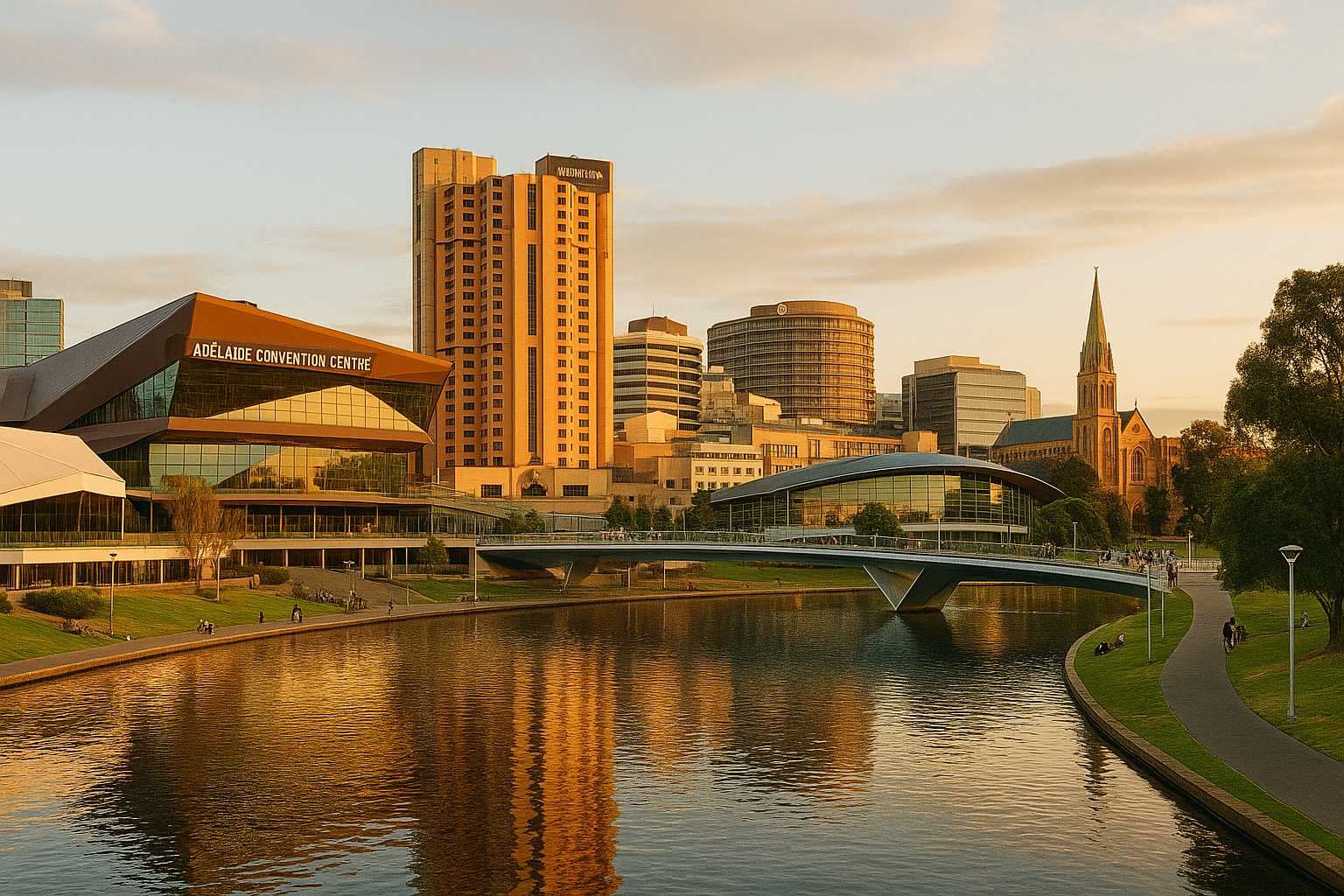
Adelaide, South Australia, Australia
Adelaide, capital of South Australia, stands as a city shaped by visionary planning and progressive ideals. Founded in 1836 according to Colonel William Light's grid design, the city became the first Australian colony to grant women the right to vote and stand for parliament. From colonial origins through cultural transformation, Adelaide produced generations whose lives intersected with events that its orderly parklands and sandstone facades gave no indication of harbouring.
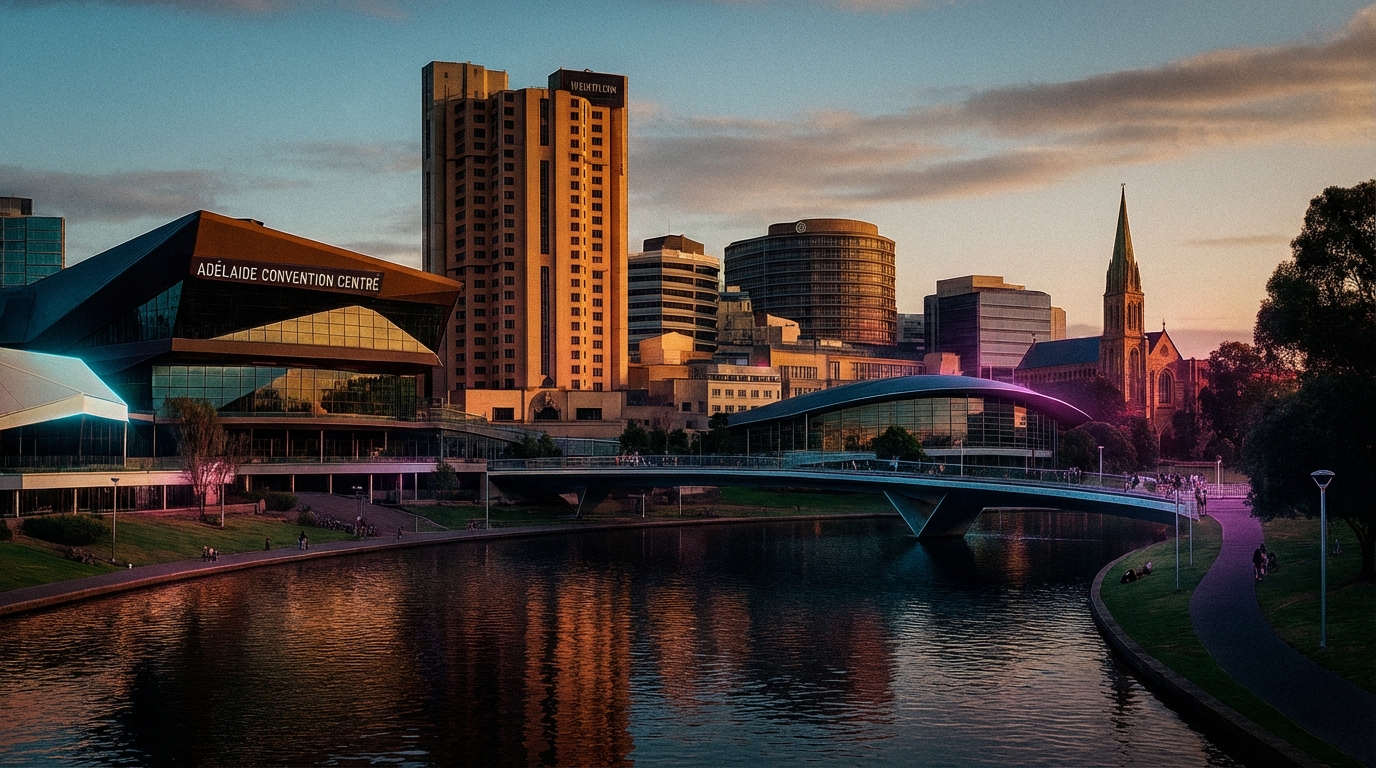
Colonial Origins and Light's Vision
Adelaide's founding in 1836 represented a deliberate departure from the convict-settlement model that characterised other Australian colonies. Named after Queen Adelaide, consort of King William IV, the new settlement attracted free settlers seeking opportunity in a planned community built on principles of religious tolerance and civil liberty. Colonel William Light's survey plan gave the city its distinctive character — a geometric grid of streets surrounded by extensive parklands separating the city proper from its suburbs. This green belt, radical for its time, provided recreational space, prevented urban sprawl, and created the leafy quality that defines Adelaide to this day. Light placed the city between the Adelaide Hills and Gulf St Vincent, with the River Torrens dividing North Adelaide from the central business district. The Adelaide Botanic Garden, established within this parkland framework, evolved into one of the nation's premier horticultural institutions.
The decision proved controversial. Governor John Hindmarsh and members of the colonial administration preferred a site nearer the coast, and the dispute consumed precious months during which settlers endured makeshift conditions at Glenelg, where the Proclamation of South Australia had been read beneath an old gum tree on 28 December 1836. Light's vindication came gradually, as the wisdom of his chosen location — sheltered, well-watered, and blessed with fertile hinterland — became apparent through decades of growth that justified every acre of parkland he had insisted upon preserving.
Institutional development proceeded with a rapidity that reflected the colony's ambitions. The Sisters of Mercy arrived in 1846, establishing educational and charitable works that shaped the city's social fabric for generations. Among those who dedicated their lives to this work was Bridget Doyle, a Sister of Mercy whose decades of quiet teaching and caregiving in Adelaide ended only with her death in 1990 — a life of service that spanned the transformation of the city from colonial settlement to modern metropolis. St Peter's Anglican Church rose as a spiritual centre for the growing population, whilst West Terrace Cemetery became the final resting place for pioneers who built the settlement from wilderness into a functioning colonial capital.
Progressive Reform and Educational Achievement
South Australia's progressive heritage found its fullest expression in Adelaide. In 1894, the colony became the first in Australia — and among the first jurisdictions globally — to grant women both the right to vote and to stand for parliament, a reform that reflected the city's founding commitment to civil liberty. This reformist spirit permeated Adelaide's institutions across subsequent decades, shaping expectations about civic participation that distinguished the city from more conservative capitals to the east.
The University of Adelaide, founded in 1874, established the state's premier research and teaching institution, eventually producing five Nobel laureates — a distinction disproportionate to the city's modest population that reflected the intellectual ambition embedded in the colony's founding culture. St Catherine's School for Girls, founded in 1898, embodied the commitment to women's advancement by providing rigorous education during an era when such opportunities remained severely limited. Adelaide High School and the University of South Australia, established in 1991 with its emphasis on combining academic rigour with industry relevance, continued this tradition, producing graduates who distinguished themselves across fields from environmental science to robotics engineering, from investigative journalism to medical research. Darren Andrew Radford, born in Adelaide on 22 April 1986, exemplified the city's capacity for technical innovation — his background in mechatronics engineering at the University of Melbourne led to a career in robotics that would intersect, through his childhood friendship with journalist Jasper Murphy, with investigations whose scope exceeded anything his engineering training had anticipated.
Healthcare and Institutional Development
Adelaide's medical institutions established the city as a centre for healthcare excellence that served the state and shaped individual lives in ways both ordinary and extraordinary. The Royal Adelaide Hospital, serving as the principal public hospital since 1841, anchored a network of specialised facilities that expanded throughout the twentieth century. Jessica Anne Turner, née Jenkins, built a distinguished career at the Royal Adelaide, rising from graduate nurse to Director of Nursing through clinical competence, quiet leadership, and genuine care for both patients and staff — professional achievements that existed alongside the unresolved grief of her brother Karl's disappearance in 2018.
The Queen Victoria Hospital, founded in 1899, pioneered women's and children's healthcare. Its maternity wards welcomed generations of South Australians into the world, including — in October 1962 — a baby girl named Heather Marie, delivered in a private clinic in Adelaide under circumstances that separated mother and child within hours of birth. Jane held her daughter for three hours before Patricia became mother and Jane became the woman who gave her away. Such private tragedies accumulated behind institutional walls whose public purpose masked the quiet heartbreaks that unfolded within them.
The Queen Victoria Hospital merged with the Adelaide Children's Hospital in 1989 to form the Adelaide Women's and Children's Hospital on King William Road in North Adelaide, creating one of Australia's leading paediatric and maternal health centres. The Adelaide Forensic Science Centre achieved international recognition the same year by pioneering DNA profiling techniques, whilst Dr Samantha Mulligan's subsequent contributions to forensic pathology would prove instrumental in high-profile cases including the 2023 murder of Naomi Simmons.
Grimshaw General Hospital, established in 1925, followed a different trajectory. When the Obsidian Healthcare Group formally acquired the facility in August 1980, the transaction appeared unremarkable — a private corporation modernising an ageing asset. Yet evidence would later suggest that Obsidian's involvement with Grimshaw preceded the formal acquisition by more than a decade, raising questions whose answers the hospital's genuine transformation into a leading provider of paediatric care made easier to avoid. The relationship between Obsidian's corporate operations and the networks they enabled would remain obscure to most Adelaide residents, who knew Grimshaw only as the place where their children received excellent care.
Faith Communities and Family Networks
The Church of Jesus Christ of Latter-day Saints established a significant presence in Adelaide's northern suburbs through the Playford Ward, whose chapel in Craigmore hosted the family evenings, youth activities, and ordinary devotional rhythms of a suburban LDS congregation. Gregory William Hahn, born in Adelaide on 18 May 1974 and called as Bishop in 2015, brought spiritual maturity and a thoughtful temperament to his leadership of a ward whose families included some of the congregation's deepest roots. He worked closely with Relief Society President Evelyn Margaret Baker, née Dawson, born in Adelaide on 12 March 1969 — a woman whose quiet grace and unwavering clarity had anchored the Playford Ward community for nearly a decade. Evelyn's marriage to Jonathan Edward Baker in 1991 established a household in Smithfield centred on faith and environmental stewardship, producing seven children whose lives reflected their parents' dual commitment to progress and devotion.
Brother Richard Paul Evans, born in Adelaide on 14 October 1958, served as the ward's unofficial historian, his deep passion for genealogy and church history preserving the stories of a community whose continuity he considered sacred. Among the ward's most prominent families were the Smiths — Noah and Greta, whose home in Craigmore served as a gathering point for a household that included children whose early experiences had left marks not easily healed. Greta Anne Morrison, born in Adelaide on 18 April 1968, was an artist and community builder whose watercolours, garden, and tireless pastoral care made her one of the ward's most beloved figures. That such a community — quiet, suburban, unremarkable in every external respect — would be shattered by the events of July 2018 remains, for those who lived through it, a source of bewilderment that no amount of subsequent understanding has fully resolved.
The mysterious temple gathering of 29 July 2018, led by Apostle Nathaniel Carter, set in motion departures that hollowed the Playford Ward congregation over the following months. Families who had attended Sunday services for years simply ceased appearing. Chairs that had been occupied by familiar faces remained empty. Bishop Hahn, left to shepherd a diminished flock through questions he could not answer, faced the particular anguish of a leader whose calling demanded certainty that circumstances could not provide.
Journalism and the Boundaries of Investigation
The Adelaide Advocate, founded in 1978, emerged to fill a void in the city's media landscape that no one dared name aloud. Adelaide's previous newspaper of record, The Advertiser, had been destroyed thirty-five years earlier under circumstances that demonstrated how completely institutional power could silence inconvenient reporting. The Advocate built its reputation through careful excellence within invisible boundaries — winning Walkley Awards and exposing corruption whilst never quite investigating why certain Port Pirie warehouses remained off-limits or why shipping records from 1943 stayed classified. The newspaper succeeded brilliantly as Adelaide's conscience precisely because it never questioned the framework within which that conscience was permitted to operate.
Jasper Murphy, born in Adelaide in April 1983, embodied the investigative tradition that the Advocate cultivated. His first encounter with Drew Polden in the newsroom in November 2011 initiated a fifteen-year professional partnership marked by collaborative exposés, ethical debates conducted over deadline coffee, and an increasingly divergent approach to investigating phenomena that resisted conventional explanation. Their January 2012 collaboration demonstrated the creative friction that defined the partnership — Polden's caution against Murphy's instinct to pursue stories beyond the point where conventional methodology could follow.
Jasper's sister Olivia Murphy, born in Adelaide in January 1986, applied similar analytical skills as an art consultant and investigative researcher, extending the family's intellectual networks through consultations and coordinated publications that sought to illuminate patterns others preferred to keep hidden. The South Australian Press Club, hosting its 2013 awards ceremony and the pivotal April 2023 gathering where warnings circulated among journalists who had independently reached similar conclusions, served as the professional backdrop against which reporters grappled with stories that accumulated beyond what coincidence could comfortably explain. The 2021 Journalism Innovation Conference brought practitioners together to wrestle with how traditional methods might adapt to evidence that defied documentation — a question whose implications extended well beyond media theory.
Transportation and the Threshold
Adelaide Airport, opened in 1955 six kilometres west of the city centre, evolved into the primary aviation gateway for South Australia, handling over eight million passengers annually and connecting the city to domestic and international destinations. The terminal's celebrated transparency — its glass walls and open sight lines designed to reassure travellers — could transform, for those with secrets to protect, into exposure. Nathan Cowdrey's arrival sequence through the terminal became a tense passage as pursuers tracked his movements through crowds and security systems, the airport's architectural openness serving purposes its designers had never anticipated.
The Adelaide Parklands Terminal provided interstate rail connections, including service on the Indian Pacific transcontinental railway linking Adelaide to Perth and Sydney. These transportation networks positioned the city as a hub through which people and information moved between regions — and through which, for those few who understood the full picture, individuals passed between circumstances whose nature defied the categories that timetables and boarding passes were designed to contain.
The City's Children
Adelaide's residential character produced generations whose lives would prove consequential in ways that the city's orderly grid could never have predicted. The Jenkins household, established through Thomas and Elizabeth Jenkins's marriage in April 1974, produced three children whose paths diverged dramatically. Jessica, born on 3 September 1978, built her nursing career at the Royal Adelaide Hospital. Karl, whose detective's instinct would draw him into investigations that no training manual had prepared him for, vanished without trace in 2018 — a disappearance that left his family navigating grief without the closure that explanation might have provided. Daniel, the youngest, born on 28 February 1982, left Adelaide at eighteen to study computer science at the University of Melbourne, building a career in software engineering and artificial intelligence whose distance from his family sharpened into guilt when Karl disappeared.
Jonathan Baker and Evelyn Dawson, married in 1991, established the roots of a family whose seven children would navigate the tension between their father's quiet pragmatism and their mother's intuitive spiritual leadership. Their youngest daughter, Chloe Marie Baker, born on 15 April 2001, possessed a sharp intellect and digital fluency that balanced environmental consciousness with a quiet spiritual depth — qualities that guided her relationship with Charles Smith through circumstances that neither Adelaide's educational institutions nor its faith communities had equipped their young people to face.
Greta Morrison's artistic upbringing in Adelaide gave her the creative sensibility that sustained her through years of nurturing family and community, her compassion and practical wisdom touching lives that extended far beyond the suburb where she raised her children. Detective Inspector Jeremy Marcus Harding, born in Adelaide in 1975, carried his criminal justice studies from the University of South Australia into twenty-four years of distinguished police service before his posting to Broken Hill, where the weight of unsolved mysteries and the hope of grieving families tested the methodical patience that Adelaide's institutions had instilled in him.
The Cowdrey family's return to Adelaide in December 2025 gathered threads whose significance would emerge only through subsequent decades. Joshua Cowdrey, born in April 1983, and his brother Nathan, born in June 1984, grew up in Adelaide's suburban landscape alongside the footballers, nurses, and real estate agents that the city produced in abundance — yet their particular aptitudes would carry them into territory that no suburb, however comfortable, could have prepared them for.
Contemporary Adelaide
Modern Adelaide balances its colonial heritage with contemporary vitality. Don Dunstan's premierships — from 1967 to 1968 and again from 1970 to 1979 — transformed the city's cultural ambitions through the establishment of the South Australian Film Corporation, the decriminalisation of homosexuality, and the expansion of the Adelaide Festival of Arts into the centrepiece of a calendar that now includes the Adelaide Fringe, WOMADelaide, and a constellation of events drawing visitors from across the world. The Adelaide Convention Centre hosts gatherings ranging from academic conferences to industry events, whilst the Central Market, wine regions, and laneway bars sustain a reputation for sophistication that the city's modest population belies. Luxury accommodations including Jasmine's Boutique Hotel, operated by the Dallow Hotels Group under the direction of Jasmine Anne Collins née Dallow, serve visitors drawn by cultural offerings that Dunstan helped cultivate and that subsequent decades have elaborated into an industry.
The Adelaide Botanic Garden, established within Light's parkland framework, continues to serve as one of the nation's premier horticultural institutions — though its grounds hosted, in August 2019, a meeting whose significance to the investigative efforts of the Advocate's journalists exceeded anything that the garden's peaceful appearance suggested. Adelaide Waterfront Property developments extended the city's residential ambitions toward the coast, whilst the Adelaide Metropolitan Police maintained the investigative capacity that the city required — capacity tested by Detective Dave Santos, born on 14 July 1965, whose twenty-five years at the CIB gave him the institutional memory to recognise when missing persons statistics drifted beyond expected baselines. His colleague Kelly Muscat, born in Adelaide in 1990, brought fresh analytical perspective to cases that Santos and his senior colleagues acknowledged were troublingly familiar — disappearances that left no forensic trail and resisted the categorisation upon which investigative methodology depended.
That Adelaide — planned, progressive, parkland-encircled — should harbour within its orderly geography events of such extraordinary consequence speaks to the particular irony that Colonel Light's vision inadvertently created. A city designed for transparency, whose wide streets and open squares were intended to prevent the dark crowding that bred disease and conspiracy in older cities, became the setting for patterns that transparency alone could not illuminate. The parklands that separate Adelaide from its suburbs remain, as Light intended, green and generous. What they separate, and what passes between them, has proved rather more complex than any surveyor's plan could accommodate.
