4338.209 · July 28, 2018 AD
What the Silence Knows
Karl Jenkins keeps vigil outside a house that won’t speak, caught between duty and obsession as the night deepens around him. Ignoring his partner’s calls and his own better judgement, Karl begins to realise the silence he’s studying isn’t confined to the house — it’s inside him, and it’s starting to answer back.
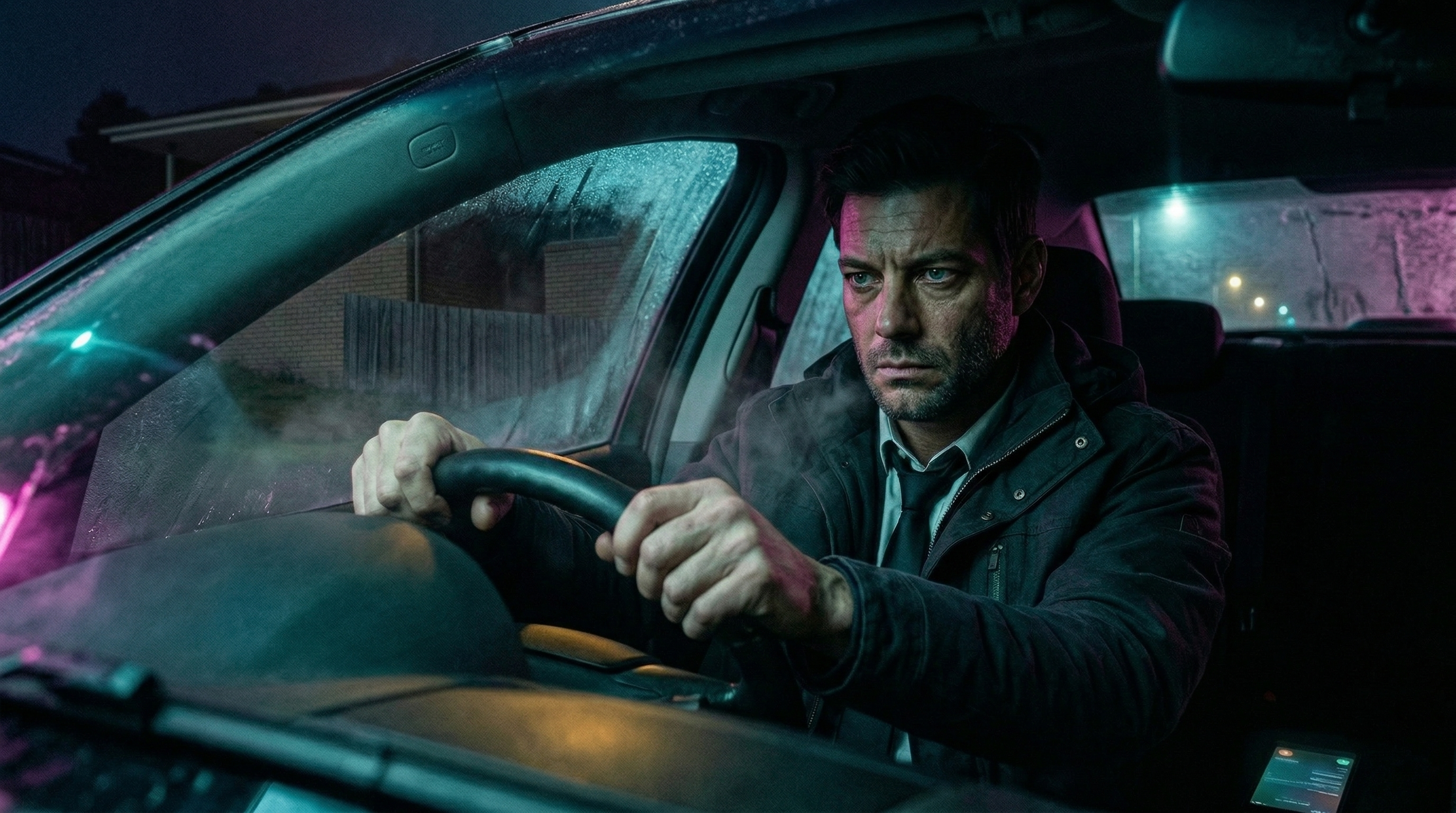
“Silence isn’t the absence of sound. It’s the sound of everything that’s been buried trying not to be heard.”
I returned to the Holden in silence, the crunch of frost beneath my boots the only sound accompanying me through the darkness. Each footfall seemed too loud, too definite, announcing my retreat when stealth had been the intention. The car welcomed me like a tomb—cold, still, expectant. I slid into the driver's seat without switching on the interior light, closing the door gently behind me as though afraid to alert the night to my presence.
The dashboard clock glowed a dull, indifferent 10:47 PM.
Late enough that respectable people were settling in for the night, early enough that the truly committed insomniacs hadn't yet surrendered to sleep. The liminal hour when the world divided into those at rest and those still restless. I'd always belonged to the latter category.
I sat there for a moment, hands resting loosely on the steering wheel, heart refusing to slow. The adrenaline that had carried me through the reconnaissance was beginning to ebb, leaving behind the familiar hollow ache of anticlimax. I hadn't found answers. I'd found more questions. The same result I seemed to get from every aspect of this case.
My breath had begun to fog the windscreen from within, turning the glass opaque—another barrier between me and the world I was supposed to navigate with certainty. The moisture accumulated in the corners first, then spread inward, creating patterns that looked almost deliberate. Frost ferns, they called them. Nature's geometry rendered in ice.
My mobile sat on the passenger seat, screen facing up like an accusation. It pulsed once, the soft glow revealing a string of notifications I had no intention of acknowledging. Each illumination felt like a small betrayal—the device insisting on connection when I'd chosen isolation.
Three missed calls.
Five messages.
All from Sarah.
The last one, timestamped twenty minutes ago, carried just enough bite to register as more than frustration:
If you don't check in soon, I'm escalating to Claiborne. I'm serious, Karl.
She wasn't bluffing. She never bluffed. It was one of the things I valued about her—that directness, that unwillingness to play games. Except lately I'd been treating our partnership like a game, withholding information, making decisions without consultation, going rogue in ways that would've earned a suspension if anyone was paying close enough attention.
My thumb hovered near the screen, but I didn't touch it. Couldn't. Because replying would mean explaining—and I didn't have an explanation that made sense to anyone but me. Even to me, it was starting to feel inadequate. Starting to feel like obsession masquerading as instinct.
How do you justify watching an empty house for hours on end with no plan, no legal grounds, no actionable suspicion—just a gnawing certainty that something wasn't right?
You don't.
You keep watching. You sit there with the engine off, wrapped in layers of your own doubt and determination, and you pretend that this—this—is still part of the job. That you're still a detective conducting an investigation rather than a man chasing ghosts that might only exist in his own head.
Except it isn't, not really. Not when you've crossed from professional inquiry into something that looks increasingly like personal compulsion.
Each ignored message from Sarah was another brick in the wall I could feel rising between us. Slowly, methodically, I was cutting her out. Not out of malice. Not even mistrust. Just necessity. Or what I'd convinced myself was necessity.
This case... this case wasn't standard.
And Sarah—sharp, by-the-book, brilliant Sarah—couldn't operate without structure. She needed her lines drawn, her facts neat, her boxes ticked. She needed probable cause and proper procedure and evidence that would hold up under scrutiny. What I was working with wasn't that. It was messy, emotional, haunted. It didn't fit neatly within the guidelines of a procedural brief or a forensic report. It lived in the shadows between people. Between past and present.
Between Jamie and me.
The past had a way of collapsing distance, making fifteen years feel like fifteen minutes. Sitting here in the cold, watching a house that refused to yield its secrets, I could almost convince myself I was back in Queensland. Back at Moggill Creek. Back at the moment where everything fractured.
The difference was that then, I'd known what I was running from. Now, I wasn't sure if I was running towards something or just running.
I turned my head towards the house again, just visible across the road through the frost-misted windscreen. The porch light remained off. Blinds drawn. No sign of life. No car in the driveway. No figure shifting behind the windows.
The same perfect silence.
Too perfect.
It was the kind of house a man built to hide inside. Everything in it curated—even the absence.
And that was the part I couldn't let go of. Because absence wasn't neutral. It wasn't just the lack of presence. It was active, deliberate, constructed. You had to work to make a house this empty. You had to plan it.
My fingers flexed against the steering wheel, the leather cold and slightly damp beneath my palms. A small muscle jumped in my jaw—tension I couldn't release, couldn't name. I didn't know the answers. I barely knew the questions. But I knew I wasn't ready to let them go either.
Not yet.
Not when everything in my gut was telling me that the silence in that house wasn't just absence.
It was concealment.
It was the sound of something held back, something waiting to be discovered. Or something that had already been discovered and was now being hidden.
Outside, the wind moved through the trees along the fence line, and the bush beyond answered with a low, formless rustle—the only thing out here still willing to make a sound. The house wouldn't. Sarah's messages wouldn't. Even my own reasons had gone quiet.
The bush didn't care about missing persons reports or police investigations, or the structures we built to convince ourselves we were in control. It just kept up its indifferent noise, filling a silence I couldn't.
I sat in the dark, unmoving.
Surrounded by questions without answers.
Watching a house that said nothing.
And hiding from a partner who was growing tired of silence.
The irony wasn't lost on me. I'd spent my entire life building walls between myself and other people, maintaining professional distance, keeping emotional entanglements at arm's length. And now, in the midst of a case that was unravelling every carefully constructed boundary, I was doing the same thing. Cutting Sarah out. Cutting everyone out.
Because if I let her in, if I explained what I was really doing here, she'd ask questions I couldn't answer. She'd want to know why I was so invested. Why I couldn't let this go. Why a missing persons case involving two men I barely knew was consuming me in ways that cases involving actual murders hadn't.
And I'd have to admit something I wasn't ready to admit. That this wasn't about justice or duty or professional obligation.
This was about Jamie. About unfinished business. About guilt that had been festering for fifteen years. About wondering if I could've prevented this if I'd been a different person back then. If I'd known how to bridge the distance instead of widening it.
About wondering if finding him now could somehow undo what I'd done then.
Which was, of course, impossible. Time didn't work that way. Guilt didn't work that way. You couldn't solve the past by solving the present, no matter how much you wanted to believe otherwise.
But that didn't stop me from trying.
The mobile screen pulsed again. Another message from Sarah. I didn't need to read it to know what it said. Some variation of concern and frustration, delivered with the bluntness that was both her greatest strength and the thing that made working with her sometimes unbearable.
I reached for the phone, then stopped. My hand hovered over it, trembling slightly—whether from cold or indecision, I couldn't say.
If I responded now, I'd have to lie. Tell her I was following up on a lead, conducting routine surveillance, doing the kind of methodical police work that justified the hours and the absence of communication.
Or I could tell her the truth. That I was sitting outside an empty house at nearly eleven o'clock at night because I couldn't shake the feeling that everything I thought I knew was wrong. That the rubbish bags I'd glimpsed through a window were somehow significant in ways I couldn't articulate. That the smudge on the bedroom window might be evidence of... something.
Neither option felt satisfactory.
So I did what I always did when faced with choices I couldn't navigate: I chose inaction. I let the phone sit there, pulsing its accusations into the darkness, whilst I stared at a house that refused to answer any questions.
The cold was beginning to seep through my jacket now, finding the gaps between fabric and skin, settling into my bones. My fingers were numb on the steering wheel.
I should start the engine. Drive home. Feed Jargus properly instead of leaving him with nothing. Get some sleep. Come back tomorrow with proper procedures in place, with backup, with warrants if necessary.
Should.
But I didn't move.
Because somewhere in the back of my mind, beneath all the rational arguments about procedure and evidence and professional conduct, there was a voice that said: If you leave now, you'll never know. If you walk away, whatever happened in that house will stay hidden. If you give up, Jamie stays missing.
And it'll be your fault. Again.
The thought lodged itself with familiar weight. This was the voice that had driven me through three police jurisdictions, through countless cases, through relationships that couldn't sustain the intensity I brought to everything. This was the voice that said the only thing worse than not being good enough was not trying hard enough.
Thomas's voice, maybe. Or Elizabeth's. Or just my own, shaped by years of being told that competence was everything, that failure was unacceptable, that if something was worth doing it was worth destroying yourself over.
I'd built my entire career on that voice. And it had cost me everything that wasn't career.
The house remained dark. Silent. Secretive.
And I remained in the car, unable to leave, unable to act, caught in the paralysis of knowing something was wrong but not knowing what to do about it.
The dashboard clock ticked over to 10:48 PM.
Somewhere in Hobart, Sarah was debating whether to call Claiborne. Somewhere in Adelaide, my family was living their lives without me, as they'd learned to do over the years of my absence. Somewhere in the universe of possible outcomes, there was a version of tonight where I made the right choice, took the right action, became the detective I'd always aspired to be.
But I didn't know which choice that was.
So I sat. And watched. And waited for something to change.
Knowing that the only thing that could change was me, and that I'd spent forty-two years constructing a self that was rigidly resistant to change.
The wind picked up again. The trees whispered. The house kept its secrets.
And I kept mine.
