4338.205 · July 24, 2018 AD
Two Bottles, One Truth
As Beatrix finally arrives, Gladys lays bare the truth she can no longer contain. A bottle, a message, and a long-buried secret ignite a night of wine, accusation, and revelation—until the sisters make a pact: silence, not as surrender, but as the only way to survive what’s coming.
"Families never bury the past. They bottle it, label it something else, and dare you to open it."
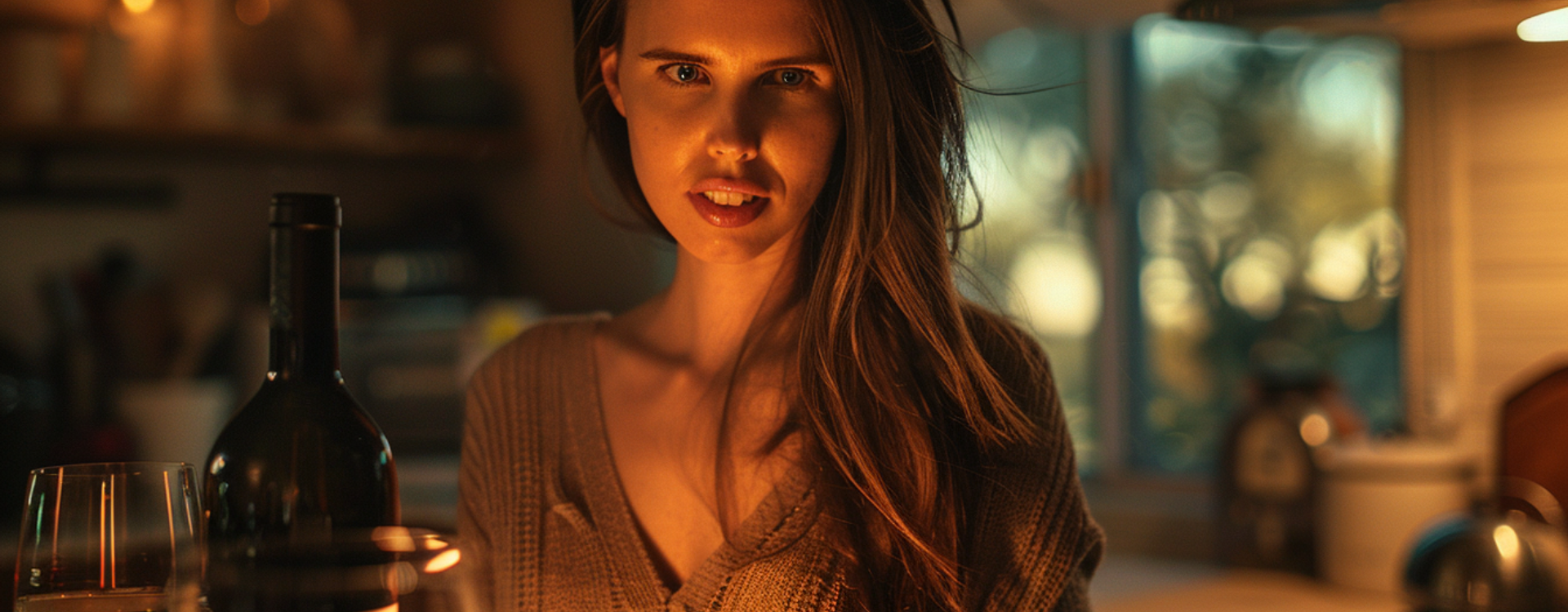
Sitting on the edge of the couch, I cradled a wine glass without real thought, the stem cool between my fingers. The glass tilted slightly in my grasp, catching the light from the kitchen behind me, casting soft golden arcs across the glossy floorboards.
My eyes were fixed on the lounge room window.
Outside, the stars shimmered in the thick navy of the sky, their reflections scattered across the glassy surface of the Derwent River like tiny lanterns set afloat. It should have been peaceful—was peaceful, in that detached, cosmic way. Hobart nights often carried that kind of quiet reverence. But tonight, the serenity grated against the turbulence inside me.
My foot tapped against the white leather of the couch, fast and restless. I wasn't even aware I was doing it until the soft thud began to irritate me.
What the hell is taking Beatrix so long? She only lives around the corner. Ten minutes, fifteen if she was dragging her heels. Which she probably was.
Typical.
Beatrix had always had a flair for being late—an unconscious rebellion against the rigidity of my life. Six years younger, and somehow always determined to live in opposition to everything I was. Where I'd collected antique rugs and a healthy property portfolio, she'd collected vintage scarves, broken pottery, and dead-end jobs. And heartache.
Especially that.
The loss of her lover had left her changed—hollowed out in places, sharp in others. She wore the grief like a threadbare coat, heavy and familiar, never quite shedding it no matter the weather. I didn't think she'd ever really recovered, not in the proper sense. Not fully. Some days, I wondered if she even wanted to.
The promise I'd made to Luke—to keep my mouth shut about the portal, Clivilius, the bottle, all of it—was a weight I hadn't been prepared to carry. It pressed on my chest like someone sitting on it, calm but immovable.
But Jamie's message… That bloody bottle. It haunted me.
Ever since I'd woken sprawled on the cold floor of the entryway, legs tangled and cheek pressed to the tile, the words he'd written had looped inside my mind, refusing to be buried. I couldn't even bring myself to say them aloud, not even in the silence of my own home.
The thought of the message made my head throb—an actual, pulsing ache blooming behind my eyes. I set the wine glass down before I dropped it.
How could Beatrix have kept something like that from me? Her own sister.
The betrayal didn't burn—it gnawed. Quietly. Persistently. It was the kind of wound that didn't scream, just bled slowly under the skin.
And Jamie—how had he figured it out? What else did he know? What had he seen on the other side?
The questions spiralled around me, thick and unrelenting. I pressed my fingertips to my temples, trying to steady myself, to breathe through the dizziness.
I felt the chasm widening. Not just between Beatrix and me—but between me and the world I had once inhabited without question. My friends, my family, even my own home now felt faintly unfamiliar, like walking through a dream just a step too far from waking.
I looked again out the window.
The stars twinkled as if nothing had changed.
But everything had changed.
The longer Beatrix delayed, the worse it became. My anticipation curdled into anxiety. I needed her here—not just to confront her, but to anchor me. To see me. To hold a corner of the truth with me so it didn't feel like it might consume me whole.
And yet, with every passing minute, my faith in her arrival thinned.
The river outside kept shimmering. Unbothered.
Inside, I was unravelling.
The moment I spotted movement at the bottom of the driveway—just the faintest bob of a silhouette under the porch light—a mix of relief and urgency surged through me like an electric current.
"Finally," I muttered, already rising from the couch, wine glass clinking softly as I set it down.
I didn't wait for the knock. There wasn't time for ceremony. I threw open the front door with a clatter, my breath catching in my throat, limbs trembling not from cold, but from the dam of emotion ready to burst.
Beatrix had barely reached the top step when I seized her by the arm. My fingers closed tightly around the sleeve of her coat, and without even thinking, I yanked her inside. The door slammed shut behind us with a jarring thud, reverberating through the narrow hallway, sharp against my already-frayed nerves.
"Shit, Beatrix. What took you so long?" I snapped, not bothering to mask the irritation and relief tangled in my voice. I was already half-dragging her through the lounge, her slight frame no match for my momentum.
She resisted.
"Don't shit me," she barked back, voice rising with her familiar spark of rebellion. "What's wrong with you?"
I didn't answer. Not yet. I needed her there—in the kitchen, seated, glass in hand—before I dared to open my mouth again. I released her only once we reached the island bench.
"Here," I said, pushing an already-filled glass of wine in her direction. My tone hovered somewhere between command and apology. The glass slid slightly on the marble surface, leaving a trail in its wake.
She hesitated. Watched me.
I turned away and retrieved my own glass—nearly drained—and took a long sip, hoping it would steady the churn in my chest. Wine had become my truce offering, the olive branch extended between sisters who could never quite decide if they were at war or simply weathering their shared history.
Beatrix lifted the glass to her lips with theatrical poise, taking a single, defiant gulp. "Looks like the crazy has really come out tonight," she quipped, eyebrows raised just enough to needle me.
I froze. The word hung in the air—cloying, impossible to ignore.
"Beatrix, stop it!" I snapped, the edge in my voice sharper than I meant it to be. I turned to face her, anger flashing behind my eyes. "You know I don't like that word."
Her eyes flickered, but she didn't apologise. She never did.
Instead, she took another sip and leaned back against the counter, her body language all ease and exasperation, a contrast to the tension she'd just walked into.
"So, what is it that you have summoned me here for so desperately, my dear sister?" she asked, voice lilting with that maddening combination of curiosity and condescension. The same voice she'd used since we were girls and she needed to remind me that she was unimpressed by anything I said or did.
And I couldn't take it anymore.
"Jamie is gone!" I blurted out, the words crashing out of me. Raw. Unfiltered. There was no build-up, no slow reveal. Just truth. Painful, absurd, impossible truth.
Beatrix blinked.
"Gone?" she echoed, eyebrows rising. "What do you mean, gone?"
My heart pounded against my ribs like a warning bell.
"He's gone. He's in Clivilius and he can't get back out!" The words tumbled out faster now, panic bleeding through them. I could feel the heat in my cheeks rising, the adrenaline beginning to surge again.
"Clivilius?" Beatrix asked, brow furrowed, the syllables foreign on her tongue.
"Yes! Clivilius!" I shouted, louder than I meant to. My voice hit a fevered pitch. "He went in there with Luke and Paul and now Clivilius has them!"
It felt ridiculous to say out loud. Clivilius has them. As though I were recounting a storybook tale instead of real events. But the words came anyway, ragged and fraying at the edges.
Beatrix stared at me, mouth slightly open.
Then—
"You sound like you've got Clivilius," she muttered dryly, with a derisive snort.
A punch.
That's what it felt like—a verbal punch. One she knew would land.
The sting was instant.
Her doubt wasn't just frustrating—it was heartbreaking. After everything I'd been through, everything I'd seen… She still looked at me like I was being dramatic. Like I'd simply had too much wine and not enough sleep.
I stood there, glass in hand, unable to speak, the silence between us ballooning into something heavy and irreparable.
She didn't believe me. Of course she didn't.
And worse, I had no proof.
Just a message in Jamie's handwriting.
Just a memory of colour and light and terror.
Just my word.
And in this house, in this family—when had my word ever been enough?
I reached for the empty water bottle on the bench—the one Luke had handed me, the one I'd clutched like a lifeline since returning. Its crinkled plastic felt brittle in my palm, like the fragile web of truth it carried.
And in a sudden wave of frustration, I hurled it across the kitchen.
It sailed through the air in a crooked arc and landed with a sharp clatter on the floor, just shy of Beatrix's shins.
"What the hell, Gladys!" she shouted, jerking back, nearly sloshing wine across her blouse. The sound of the bottle hitting the tiles echoed through the room like punctuation—sharp and final.
"Read it," I said, the words tight in my throat. Not a request. A demand. Desperation coloured my voice with an urgency I could no longer contain.
"Read what?" Beatrix asked, blinking down at the bottle as though it were an animal that had just leapt at her from the shadows.
"Just read it," I insisted, more firmly now. My hands were trembling, but I hid them behind my back.
She stared at me for a moment—long enough to silently accuse me of being drunk, dramatic, unstable—but then set her wine glass down and crouched to retrieve the bottle. Her movements were slow, hesitant.
She turned it in her hands, eyes narrowing as she scanned the label.
I watched her like a hawk. I was wound so tight I barely heard the rustle of the bottle as she rotated it. She was searching—her scepticism still evident in the pinch of her brow.
And then… she saw it.
Her eyes froze. The colour drained from her face.
She gasped—sharp and audible—as if the air itself had struck her. Her fingers slackened, and the bottle slipped again from her grip, bouncing once, then rolling to a halt beside the bench leg.
"What the fuck, Gladys? Is this some sort of cruel joke?" she asked, her voice rough with disbelief, a flash of anger creeping in beneath the shock.
"I almost wish it were," I said quietly. My voice was flat, threadbare. There was nothing else to offer. No comfort. No context that wouldn't make me sound insane.
A silence fell between us, heavy and raw. Then, slowly, with visibly shaking hands, Beatrix bent to pick the bottle up again.
She held it with more care this time. Reverence. Dread.
Her lips moved, soundless for a moment—then her voice emerged, soft and unsure.
"Brody's death wasn't…"
"Beatrix, don't!" I screeched. My voice cracked at the edges, sharp and wild. "Never say those words aloud!"
The sound of my fear filled the kitchen like a cold draft. It wasn't just what the words meant—it was what they could do. Speaking them aloud made them real. Fixed. Unchangeable.
Beatrix looked up at me, stunned. Her mouth closed. She swallowed.
I saw the lump in her throat rise and fall as she tried to contain the emotion. Her fingers clenched tighter around the bottle.
Then, after a breath that shook in her lungs, she did it anyway.
"Brody's death wasn't an accident," she said, her voice wavering but resolute. "I know why he was murdered. And so does Beatrix!"
The words—my sister's name in Jamie's handwriting—hung in the space between us like smoke. Heavy. Unforgiving. Irrefutable.
A tear slipped silently down Beatrix's cheek.
I didn't speak.
There was nothing left to say in that moment. The truth had passed from my hands to hers, and now we were both standing on the same impossible edge.
I watched her, watched the way she held the bottle now as if it were made of glass instead of plastic. Her shoulders had fallen. The fight in her posture had dissolved into something rawer, something real.
I wasn't imagining it. Jamie had known. Jamie had told us. And now the truth was burning in Beatrix's hands the way it had burned in mine.
She lifted her gaze, finally meeting my eyes. No sarcasm. No retort. Just shock and something else—something like grief resurfacing after years of being buried too deep.
"I think we had better sit down and talk," she said. Her voice was steadier than her tear-streaked face.
I nodded wordlessly, the motion slow and automatic. My hand found the wine bottle and tilted it without hesitation.
Beatrix, who had barely taken a sip before, now extended her glass towards me, her fingers trembling just slightly. I refilled it without comment, the sound of the pour the only movement in the stillness between us.
The world hadn't collapsed.
But the foundation beneath us had shifted.
And there was no going back.
We drifted into the lounge room in a kind of quiet truce, the tension trailing behind us like the tail of a storm. Neither of us said much as we took our usual places—opposite ends of the soft, white leather couch.
The cushions dipped gently beneath us, familiar and forgiving, as though they didn't care that tonight's silence was not the kind we usually shared. There was comfort in the couch, its pale surface still holding the warmth of earlier hours. But that comfort sat at odds with the discomfort curling tightly in my chest.
We weren't here to relax.
Beatrix tucked one leg underneath her, the other bouncing slightly with barely-contained nerves. Her wine glass rested delicately in her lap, tilted at a precarious angle.
"So, tell me about this Clivilius," she said at last, her voice low and careful.
There was a cautious curiosity there, but something else too—like someone reaching for a door they weren't sure they wanted to open.
I leaned forward instinctively, mouth half-open, ready to return to the message, to Brody, to the unspeakable truth that had cracked the evening wide open. "But what about…?" I started, unable to stop myself.
Beatrix raised her hand.
"I don't want to talk about Brody," she said firmly.
Her voice wavered at the edges, a quiet tremble beneath the surface.
That single sentence, spoken with such finality, landed like a lock clicking into place. She couldn't go there. Not yet. Maybe not ever. And I, standing on the ledge of everything that had just been unearthed, was being asked to step back.
So I did.
Reluctantly, I leaned away, letting the weight of restraint settle between us.
My eyes flicked to the bottle of wine near her elbow. There was barely half a bottle left inside.
"I think we might need another bottle," I said, already pushing myself up from the couch.
It was easier to move than sit with everything unsaid.
As I crossed to the kitchen, I felt Beatrix's gaze trail after me, but she didn't comment. Not yet. She'd said her piece, and in this moment, that silence was her boundary.
Still, I could hear her voice in my head, or maybe it was just the old familiar loop of judgement: You're drinking too much again, Gladys.
But she hadn't said anything, so I beat her to the argument—internally, at least.
I don't have a drinking problem. And even if I did… tonight wasn't the night to bring it up.
Besides, this wasn't about drinking. This was about survival. It was about holding onto something—anything—that could soften the edges of a conversation I wasn't remotely prepared to have.
The wine wasn't indulgence.
It was armour.
And if I was going to explain Clivilius—to speak aloud the impossible—I needed all the armour I could get.
"So, tell me about Clivilius," Beatrix repeated, her voice steadier now. She'd shed some of the earlier snark, though not all of it. I watched her from across the couch as I settled back down, placing the freshly opened bottle of wine on the small table between us with a soft thud. The night outside pressed against the windows like a silent observer, its stillness a stark contrast to the seismic shift happening in here.
The seriousness of the situation lingered in the air, dense and unspoken.
"Well…" I began, my voice trailing uncertainly.
Where was I meant to start? With Luke? With the portal? With the way I'd thought—truly thought—I'd killed him when he vanished into that electric wall of colour?
I drew a deep breath and began anyway. I told her everything. The hallway. The swirl of impossible colours. The way Luke had returned with my handbag. Jamie's message on the water bottle. The word "Clivilius" and the way it had sounded like nonsense… until it didn't.
As I spoke, Beatrix didn't interrupt much. She sat still, listening—actually listening—her wine glass rising to her lips more often than usual. Whether it was to soften the sharp corners of my story or to slow down the mounting dread in her chest, I couldn't tell.
Occasionally she asked a question, sharp and practical, as though she were trying to poke holes in a dream—but mostly, she just let me speak. Let me pour the surreal, impossible contents of the last twenty-four hours into the space between us.
And then, when the story was finally told, when I had nothing left to add, the room fell silent.
I sat there fiddling with the stem of my wine glass, fingers twitching against the cool glass, waiting for her verdict. The quiet pressed in around us like fog.
Beatrix took another slow sip. Then she exhaled, long and deliberate.
"Well, I'm still not completely convinced," she said, her expression unreadable.
I blinked. My mouth fell open.
"Beatrix. How…?" The words struggled out of me, bewildered and breathless. I stared at her, reeling from the indifference.
And then—she grinned.
"I'm kidding," she laughed, a light, teasing sound that shattered the tension like a plate dropped on tiles. "There's no way that anyone but Jamie could have known what was written on that bottle," she said. "I'd be very surprised if even you knew it."
Relief hit me first—a sudden loosening in my chest. Then came the irritation.
"I had no idea at all," I confirmed, my tone softened by her rare moment of honesty. "Why didn't you tell me?" I asked, the words falling out more gently than I expected. It wasn't an accusation—more a wound asking to be dressed.
Beatrix shrugged, lifting one shoulder with casual detachment. "It doesn't matter," she said flatly, but her eyes told another story—one filled with shadows she wasn't ready to name. "Does anybody else know?"
"About the bottle?" I asked, thrown by the sudden shift.
"No, about Clivilius, stupid," she said, rolling her eyes in that way only a sister can.
"Oh, no, I don't think so," I replied, shaking my head as thoughts spiralled. "But Beatrix, you mustn't breathe a word of this to anyone," I warned, the levity draining from my voice. "You must keep this a complete secret."
She didn't flinch.
"People have a right to know," she said with a sudden intensity. Her tone had changed—resolute, bold. "This could be humanity's escape."
"Escape?" I echoed, blinking in disbelief. "Absolutely not!"
I sat forward on the couch, wine forgotten. The idea of Clivilius as some kind of utopia—some shining escape hatch for humanity—was ludicrous. She was missing the point entirely.
"But Gladys…" she started, trying to make her case, but I cut across her.
I couldn't let her twist this into some grand idea about salvation. That wasn't what this was. That place wasn't salvation. It was unknown. It was Jamie trapped and Luke lying and messages on water bottles that spoke of murder.
I felt the crack snap inside me.
"There is more than one thing about you, Beatrix, that I could share with our parents if you open your mouth, and when I do, you can kiss goodbye to your free rent," I said sharply, the threat quiet beneath every word.
Beatrix scoffed, her eyes narrowing.
"Whatever. As if they'd believe you anyway," she muttered with a roll of her eyes, but I didn't flinch. Didn't blink.
Because I knew they would.
I held her stare, cool and unyielding. Her defiance may have been louder, but mine was older. Sharper. More dangerous.
"And I'm not talking about the stolen silverware," I added, my voice low and even. I lifted the water bottle slightly, letting it speak for itself. It wasn't just evidence. It was leverage. A truth that couldn't be undone.
Beatrix's lips parted as if she might fight me on it. But something in my expression must've warned her off. She looked away.
And then—deflated—she reached for the bottle of wine.
"Fine," she muttered, pouring herself a heavy-handed glass, her voice edged with resignation.
It wasn't a surrender. Not really. But it was close enough.
As she took a long sip, I watched her carefully, my own emotions churning beneath the surface. Relief. Guilt. Vindication. Sadness.
Our usual rhythm—sharp jabs, low blows, old wounds—had given way to something quieter, heavier. We weren't just sisters anymore. We were something else now.
Witnesses. Keepers. Co-conspirators in a reality that had changed without our consent.
And we both knew—without saying it aloud—that nothing between us would ever be the same again.
A full bottle of wine later, the mood in the house had shifted.
Not entirely relaxed—no, not that. But the sharpness had dulled. The brittle tension that had crackled between us earlier had softened, melted into something quieter. A mutual weariness, maybe. Or simply resignation.
Beatrix and I stood shoulder to shoulder at the kitchen sink, the tiled floor cool beneath our bare feet, the overhead light casting a soft glow over everything. There was something oddly ceremonial about it, as though we were about to conduct a rite. Perhaps we were.
Between us, clutched loosely in our hands, was the water bottle.
That stupid, ordinary bottle—creased and half-crushed—held weight now. Not physical, but something else. A gravity. A secret. A scar.
Neither of us spoke for a moment. The silence wasn't awkward anymore. It had grown into something solemn, something mutual.
Beatrix's fingers moved first, steady and deliberate, as she picked at the corner of the label. Her nails worked carefully under the adhesive. There was no urgency—just grim determination. She peeled it away in a single motion, slow and smooth, and held it in her palm.
It fluttered slightly as she passed it to me, light as tissue, but it might as well have been a court summons.
"Do it, Gladys," she said.
Her voice was steady, but I heard it—the tiny fracture underneath. Like a surface that had frozen over too fast.
I struck the match. The scent of sulphur curled into the air, sharp and momentarily grounding. A flicker of heat blossomed at my fingertips as the flame bloomed.
We both watched.
I touched the flame to the edge of the label. It caught quickly, curling inward with orange hunger. The writing disappeared first—blackening, warping—as the fire consumed the paper. Beatrix let it drop into the stainless steel sink.
We stood there in silence, not moving, watching it shrivel.
The ashes curled like petals. The flame flickered, then died, leaving only smoke and char.
It was done.
The weight of what we had just destroyed seemed to hang in the space between us. We hadn't said goodbye to a bottle label—we'd buried a truth. A violent, painful truth that had clawed its way back from the past, only to be scorched back into silence.
"Nobody else needs to know," I slurred, the wine tugging softly at my speech. I didn't mean to sound so casual. It wasn't casual. It was final. And even in my haze, I knew the cost of that sentence.
Beatrix nodded slowly, her eyes still on the blackened scraps in the basin. Her face was unreadable—neither grief nor relief. Just… quiet.
The air was heavy with smoke and the faint scent of burnt glue. But there was something else there too, something that lingered even after the ashes cooled.
A pact. A shared silence. And the knowledge that we'd just burned our own history.
After another half a bottle of wine and a meandering string of half-formed thoughts masquerading as conversation, the alcohol's effects became increasingly obvious—especially in Beatrix. Her words began to slur at the edges, her movements losing their sharpness, softening into a sway.
She leaned too heavily against the back of the dining chair as she stood, blinking at it like it had appeared out of nowhere.
I watched her from across the room, the faint throb of responsibility knocking on the back of my mind.
"Beatrix, you're too drunk to make your way home safely," I said, my voice firm but kind. "You should stay the night in the spare room."
She looked at me blankly for a moment, like she hadn't registered the suggestion, then gave a slight nod and shuffled off down the hallway, one hand grazing the wall as a makeshift guide. Her steps were unsteady, but stubborn—classic Beatrix. I resisted the urge to follow too closely, instead trailing her with my ears.
Her door clicked shut with a soft, final sound.
I lingered outside my own room, hand resting on the doorknob. I waited for a moment longer than necessary, listening for any signs of a stumble or call for help. Nothing came.
Satisfied, or at least convinced enough that she wouldn't choke on her own tongue, I slipped into my bedroom.
The air in here was cooler, still untouched from earlier. The blinds were drawn, but not fully, and a faint stripe of moonlight slashed diagonally across the carpet. I didn't bother changing into pyjamas—just peeled off my jeans and slipped beneath the sheets with a shiver.
The pillow was cool beneath my cheek, the mattress familiar. And yet my body refused to settle.
The day's chaos washed over me in fragments. The portal. Jamie. The truck. Paul's card. Luke's cryptic calm. And then the bottle, the message, and the final silent ritual of fire and ash.
My temples pulsed. My limbs felt heavy, like they belonged to someone else.
And then there was Beatrix.
Her laughter. Her scepticism. Her grief. Her secret.
The way she'd poured more wine into her glass after reading Jamie's message aloud was burned into my memory—less an act of indulgence than one of defiance. Or defence. Or desperation. I wasn't sure which.
I shifted under the doona, twisting the sheet around my ankle. Sleep wouldn't come. My mind, even dulled by alcohol, kept poking at the scab of the day's discoveries.
Brody.
Clivilius.
Secrets I'd never asked for.
I shut my eyes tighter.
Favourite liquid fruit, I muttered to myself in the darkness—a quiet, ridiculous comfort.
Slowly, blessedly, the wine began to wrap itself around the sharper thoughts, dulling them at the edges. The heat in my cheeks softened. The ache in my temples dimmed. The clamour in my mind quieted into something more distant. Muffled.
And eventually, the blackness came—not fearful, not dramatic—just soft and blank. A welcome nothingness.
