4338.204 · July 23, 2018 AD
Through the Veil
Shaken from a nightmare into his study, Luke discovers a strange device that defies explanation. What begins as curiosity soon becomes a crossing point—where the ordinary world gives way to something impossibly vast.
“Some doors don’t creak open. They split the world apart.”
The wrench from nightmare into waking came without warning—a violent severance, like a cord snapped between two worlds that shouldn't have been connected. One moment I was fleeing through that impossible doorway, technicolour lights cascading around me like something bleeding colour into reality. The next I was here—jerked forward so hard my body nearly drove itself into the edge of my desk, forehead grazing close enough to the cold glass surface that I felt its chill kiss against my skin before momentum died.
My heart hadn't received the memo that I was awake. It continued its frantic sprint, hammering against my ribs with the desperate rhythm of something trying to escape its cage. Each beat reverberated through my skull, hollow and too loud, as though my body was still convinced we were being chased—still certain that something with ember-red eyes waited in the darkness just behind us.
I blinked. The motion felt deliberate, almost violent, as though the simple act of closing and opening my eyes might somehow scour the lingering phantoms from my vision. Gradually, stubbornly, shapes began to reassert themselves around me. My study emerged from the blur like a photograph developing in chemical bath—half-filled bookshelves climbing the walls, notebooks scattered across surfaces in what Jamie called chaos but I understood as a system that made sense only to me. The familiar scent of dust and ink hung in the air, that particular combination that had come to mean mine in a way few places ever had.
But nothing felt safe.
The ordinary world and the dreadful one I'd just fled from existed simultaneously in my perception, superimposed like double-exposed film. Every shadow seemed too deep. Every silence stretched too taut. The afternoon light filtering through the blinds felt thin and uncertain, as though it might withdraw at any moment and leave me back in that hallway, back before those impossible eyes, back in the childhood home I'd left behind three decades ago but had never truly escaped.
It took me a moment to realise I was trembling.
My study. My desk. My life—the one I'd built with Jamie in this Berriedale house, the one that was supposed to be the stable chapter after so many unstable ones. Three years in this space, arranging books on these shelves, filling notebooks with thoughts I couldn't share with anyone, trying to anchor myself in something real. The bookshelves held novels I'd read and reread, poetry collections inherited from my mother before she retreated entirely from mothering, reference texts from my missionary days that I kept more from habit than belief. Each spine represented some version of myself I'd been or tried to become.
I sat there in the aftermath, still shaking, and wondered whether I'd somehow failed some test I hadn't known I was taking.
It was in that muddled space between relief and unease that I became aware of the sound.
A buzzing. Persistent. Coming from somewhere close.
I turned toward it, still operating on instinct rather than thought, and saw my phone screen glowing against the glass desktop like a shard of captured sunlight in the dim room. Jamie Greyson. His name flared there, stark and somehow accusatory. How long had he been calling? The sight of those letters—that name belonging to the man I'd shared a home and bed and life with for nearly a decade—produced a complicated tangle of emotion I couldn't immediately untangle.
Relief, perhaps. A lifeline. A tether to the ordinary world, to the person who knew me best in the waking realm even if he didn't know the half of what lived inside my head.
But also something else. Guilt, maybe. Or the shadow of it.
I reached for the phone with fingers that still trembled slightly, desperate for that anchor. But just as my fingertips brushed the glass, the glow vanished. The call ended, leaving only silence and a notification I couldn't bring myself to address. Jamie, reaching out from whatever shift he was working at Vaucluse, and me—unable to answer, unable to explain, unable to bridge the distance that had grown between us like frost creeping across a window.
I exhaled sharply, fumbling to steady myself against the desk's edge.
That was when something small slipped from my grasp.
The sound it made—a sharp clack against the glass—cut through the fog in my mind like a blade through fabric. Too crisp. Too striking. After the muffled unreality of the nightmare, after the hollow silence of the waking aftermath, that simple sound seemed impossibly loud.
My eyes fell to it.
The object lay there against the desktop, catching glimmers of the pale afternoon light. At first glance, it resembled a USB stick—the kind I had a drawer full of, accumulated from conferences and promotional giveaways and forgotten purposes. But something was wrong with this one. Something that made me lean closer even as some instinct whispered I should lean away.
It was heavier than it should have been. I could tell just from how it had fallen, how it sat against the glass with a gravity that seemed wrong for its size. The surface was strangely textured, almost archaic in quality—not the smooth plastic of modern technology but something that suggested age, history, purpose I couldn't name. A small button was set into one side, incongruous and deliberate.
It shouldn't have been here.
It shouldn't have been mine.
And yet here it was, sitting in my study as though it had always belonged there, waiting for me to wake from a nightmare so I could finally notice it.
I have lived with strange things all my life. The voice that first spoke to me when I was eight years old, during a dream so vivid I'd woken crying. The visions that came without warning, showing me places I'd never been and couldn't describe to anyone without sounding unhinged. The persistent sense—running through my existence like a deep underground river—that reality was thinner than most people believed, that somewhere beyond the everyday world I navigated, something vast and patient was waiting.
But this was different. This was tangible. This was here, in my hand, solid and cold and undeniably real.
My curiosity sharpened itself against the lingering tremors of the nightmare, honed to an edge that overrode caution. I shifted forward in my chair, eager to examine the strange object more closely—too eager. The chair gave a sudden lurch beneath me, tilting backwards with a groan of protest that seemed almost like warning. My fumbling grip betrayed me. The device slipped from my fingers, bounced off the glass desktop, and clattered to the floor somewhere beneath the desk.
A muttered curse escaped me—low, sharp, the kind of language I'd trained myself out of during my missionary years but which surfaced now when no one was listening. I dropped to my knees, scanning the shadows beneath the desk until my fingers brushed against the object once more.
When I retrieved it, the metal felt colder than before. As though it had drawn something from the air around it—some measure of warmth or certainty—and absorbed it into itself. The weight of it settled into my palm with a gravity that belied its size. It felt important in a way I couldn't articulate, the way certain moments feel important before you understand why. Like the first time I heard the voice. Like the moment I stepped off the plane in Tasmania and felt something inside me click into place.
What is this?
The question burned through my mind, demanding answers I didn't have. How had such a thing come to rest in my study, amongst papers and forgotten pens and the accumulated debris of a life half-lived? I thought of Jamie finding it, thought of trying to explain where it had come from, and felt a cold certainty that I could never show this to him. Whatever it was, it belonged to the part of my existence I couldn't share—the part that lived in dreams and visions and whispered words that spoke my name.
The small, recessed button drew my gaze like something magnetic. In holding this object, I felt as though I cradled a secret waiting to unravel—something poised to lift me out of the fragile safety of my waking life into a deeper, stranger current.
My fingertip brushed the button almost by accident—a tentative contact, exploratory rather than deliberate. A jolt of anticipation shot up my arm, electric and immediate.
And then the answer came. Not in light or sound, but in pain.
A sudden, sharp sting pierced the pad of my finger, so swift and unexpected that I gasped aloud.
I recoiled instinctively, pulling my hand close to my chest the way a child might. A bead of crimson welled up from the pad of my finger and slipped across my skin, sliding down the curve of my knuckle in a bright, defiant line. The sight of it jarred me more than the pain—that vivid red standing in cruel relief against the studied clutter of my life, against the sterile familiarity of glass and paper and wood.
Blood. My blood. Real and warm and undeniable.
Whatever fragile doubt had remained—whatever whisper of hope that I might still be dreaming, that I might wake again into something more normal—evaporated in that instant. The pain was too sharp. The blood too vivid. Any thought that I remained trapped within some labyrinth of nightmare dissolved completely.
This was real.
Unquestionably, irrevocably real.
Then the object in my hand betrayed a secret I could never have imagined.
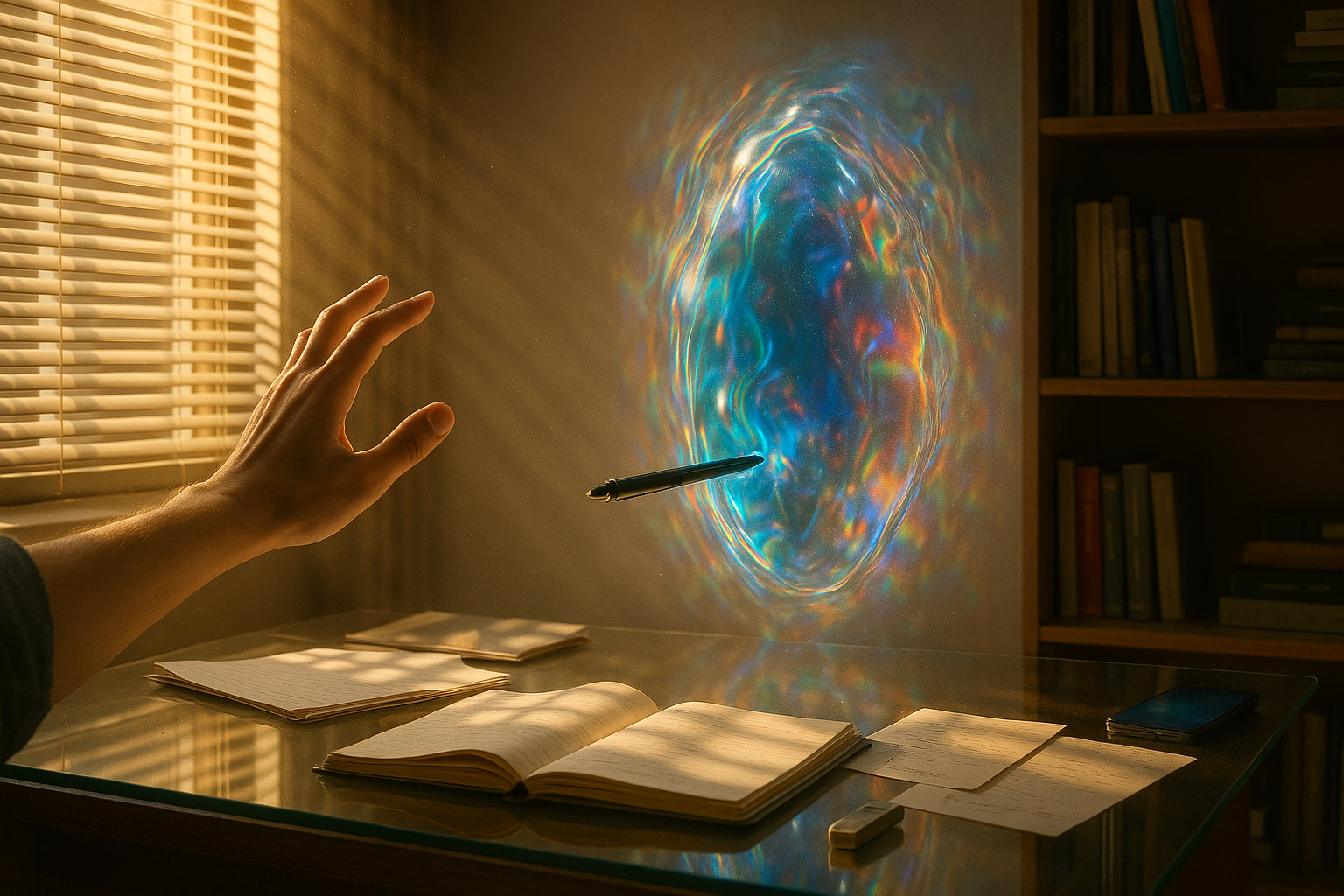
From the narrow seam of the device, a spark leapt free. It was brilliant and tiny, no larger than a marble, yet possessed of an intensity that seemed impossible for its size. For the briefest instant, it hovered in the air before me—alive, aware, considering—and then it raced toward the wall with a purpose that seemed almost intelligent.
The impact was silent.
The effect was thunderous.
The orb burst open against the wall like a egg containing captured stars, blooming into an explosion of colour that obliterated everything I understood about the world. The familiar austerity of my study—the orderly bookshelves, the warm grain of wood, the muted papers scattered across my desk—vanished utterly. In their place came a tide of light that moved like liquid, that breathed like a living thing, that painted the walls and ceiling and floor in shifting hues that belonged to no palette I'd ever seen.
The air itself changed. It became charged, electric, alive in ways that made the hair rise on my arms and the back of my neck. Every nerve in my body fired with the awareness that something fundamental had shifted—that the rules governing reality had been suspended, or perhaps revealed as insufficient for what was now unfolding.
I forgot to breathe. Or breathing forgot to matter. Either way, I stood frozen, chest rising in shallow bursts that couldn't quite supply enough oxygen for what I was witnessing.
It was mesmerising. Swirls of sapphire wound themselves through veins of emerald. Crimson pulsed and flickered like arterial blood seen through translucent skin. Threads of gold wove through everything, binding the chaos into something that almost—almost—resembled intention. The colours played across my skin, painted my trembling hands in shades that had no names, reflected in eyes that had widened beyond conscious control.
Beautiful.
Impossibly, terrifyingly beautiful.
Yet beneath the wonder, unease coiled like a serpent in tall grass. Some part of me—the part that had survived a violent childhood, that had navigated a fractured family, that had learned to distrust beauty because beauty so often concealed harm—that part understood this was not meant for mortal eyes. That whatever had opened in my study wall belonged to somewhere else. Somewhere that had been waiting for an invitation.
I rose without deciding to rise, my chair scraping against the floor in a sound that seemed to come from very far away. My legs felt uncertain beneath me, my movements hesitant, yet I was drawn forward by something stronger than mere curiosity. Something that felt like recognition. Like homecoming.
Like the voice that had spoken to me since I was eight years old, finally showing me what it had been describing all along.
Awe wrestled with caution in my chest. Caution lost. It always had, when it came to the things that truly mattered.
I snatched up a pen from the desk—a cheap plastic thing, utterly mundane, its ordinariness suddenly feeling both absurd and precious against the impossible light. With cautious scepticism, and perhaps a touch of defiance at a universe that had apparently decided to rewrite its own rules in my study, I tossed the pen into the kaleidoscopic display.
Half of me expected it to clatter against the wall behind the illusion. Expected the colours to dissolve, the light to fade, physics to reassert itself and dismiss this vision as some elaborate trick of traumatised perception.
But reality had apparently abandoned its post.
The pen did not strike. Did not fall. Did not obey any law I'd ever been taught to trust.
It was devoured.
One moment it existed in my world—solid, tangible, possessing all the mundane permanence of stationery purchased in bulk from an office supply shop. The next it was gone, swallowed whole by the vortex of light without sound or trace, as though it had never existed at all. The colours shifted slightly where it had disappeared, accommodating the intrusion for the briefest instant before returning to their endless dance.
My jaw slackened. My lips parted around words that couldn't form themselves into coherent speech. I stood there, transfixed, watching the place where the pen had vanished as though staring hard enough might bring it back. Might make sense of what I'd just witnessed.
It couldn't be real. It couldn't.
Yet every nerve screamed that it was true. The evidence burned before me, undeniable, impossible, and therefore merely unexplained rather than unreal.
Fear felt too small a word for what coursed through me in that moment. Too simple, too human, too insufficient. Terror had no foothold here—not in the face of such wonder. What rose instead was something far more complex and dangerous: exhilaration. A fevered, anxious excitement that licked at the edges of my reason like flame testing the boundaries of a firebreak.
The thrill of discovery. The dizzying pull of standing before a door half-opened, knowing it could lead to marvels or to ruin, but unable to resist the temptation to see which.
This was what the voice had been preparing me for. Thirty years of dreams and visions and whispered words. Thirty years of feeling like I belonged somewhere else, like the ordinary world was a waiting room for something I couldn't name. Thirty years of carrying a secret inside me that I couldn't share with anyone—not my parents, not Paul, not Jamie, not the missionaries I'd served with or the therapists I'd been sent to or anyone else who might have offered understanding if I'd only been able to explain.
This was the answer.
The colours writhed and beckoned, an aurora captured and pressed against the plaster, promising everything or nothing in equal measure. Their shifting hues whispered of uncharted places, secrets veiled in brilliance, truths that had no business existing in a suburban study in Berriedale. I felt them pulling at something in my chest—not physically, but with the gravity of destiny, the way certain moments feel inevitable before they occur.
Despite everything—despite the rational voice in my mind that begged for restraint, that catalogued reasons why I should step back, call Jamie, call Paul, call anyone who might anchor me to the world I knew—I felt my feet carrying me forward.
Each step was surrender. Each breath was consent.
The energy radiating from the vortex thrummed against my skin even at a distance, pulsing with a rhythm I could feel in the hollow spaces of my bones. It was a wordless invitation, clear as any language I'd ever learned: step through. See what waits. Become what you were meant to become.
My chest tightened with the knowledge—absolute and terrifying—that I was about to do something irrevocable. Something that could not be undone or unseen or unfelt. I thought briefly of Jamie, working his shift at Vaucluse, unaware that the universe had apparently chosen this afternoon to tear itself open in our spare room. I thought of the missed call I hadn't returned, the distance that had grown between us, the things I couldn't tell him because he would never believe me and because some part of me feared his belief more than his doubt.
I thought of Paul, my brother, my protector in that turbulent childhood, now living his own careful life in Broken Hill with his careful wife and careful children. I thought of my father, remarried and content, and Greta, who had tried so hard to fill a mother-shaped absence she hadn't created. I thought of everyone I might be leaving behind if I stepped through—and found, to my surprise, that the thought changed nothing.
Can this really be happening?
The question ricocheted through my mind, chasing its own tail in tightening circles. Disbelief clawed at me, desperate and diminishing, but my senses refused to cooperate with reasonable doubt. The light was real. The vortex was real. The very fabric of reality was bending before me, trembling at its seams, and what was possible and what was not had become indistinguishable.
I found myself standing at the threshold.
The brilliance of the portal reflected in my eyes—I could feel it, could feel the colours dancing across my irises, could feel my pupils dilating to drink in more of that impossible light. My hand rose without conscious command, trembling as though it carried the accumulated weight of every choice I had ever made or failed to make. Fingers stretched toward the swirling radiance, caught in the space between dread and anticipation.
The instant my skin grazed the surface, the world came apart.
Energy surged through me—not pain, not pleasure, but something more fundamental than either. It cascaded from fingertip to spine, lighting every nerve like a fuse reaching toward inevitable detonation. My breath tore free in a gasp that held no word, only the pure expression of intensity too vast for language.
And in that jolt—that impossible connection between my flesh and whatever waited on the other side—I knew with certainty that transcended thought: this was no illusion.
This was real.
A boundary had been crossed. Something had reached back when I reached forward. The unknown wasn't simply waiting—it was responding.
I steadied myself. Or tried to. Every fibre of my being quivered with uncertainty, with the accumulated weight of a decision that couldn't be unmade. Yet beneath the trembling ran a current of resolve that refused to retreat. The same stubborn determination that had carried me through my parents' divorce, through the midnight terrors of childhood, through every moment when giving up would have been easier than continuing.
I had been preparing for this my entire life. I understood that now.
The very air seemed to shift around me, thickening with expectation, vibrating with the sense that something ancient and patient was holding its breath to see what I would do.
I drew in a breath.
Even that felt charged—sharp with apprehension, heavy with determination, alive with possibilities I couldn't begin to enumerate. My lungs filled with something more than oxygen. Something that tasted like beginning.
Before reason could rise to stop me—before caution could find its voice or fear could find its feet—I hurled myself forward.
The act was faith made physical. A surrender to forces I couldn't name, a denial of every natural law I had ever trusted, a rejection of the careful boundaries between what I knew and what I had only dreamed.
The transition was nothing like I had imagined.
No twisting tunnel spinning me through impossible geometries. No tearing of fabric as reality yielded to my passage. No roaring void between worlds, no sense of being unmade and reconstituted molecule by molecule.
Instead, it was seamless. Almost insultingly simple—just the movement of a body through space, no stranger than a step across a threshold. My foot left the floor of my study and came down on something else entirely. The storm of colours dissolved around me, fell away like curtains parting to reveal the stage they'd been concealing.
And in that instant—in that single heartbeat where the impossible light withdrew and a new world took its place—I knew with absolute certainty that I had left everything behind.
My study. My home. Jamie and the dogs. Tasmania and its forests and the comfortable life I'd been trying to build. The phone with its missed call notification. The complex tangle of my family. Everything familiar. Everything safe.
Gone.
Sunlight—pure and unfiltered and mercilessly bright—exploded across my vision. It seared my eyes with an intensity that made Tasmania's pale winter light seem like twilight by comparison. Tears welled immediately, my body's automatic protest against brilliance it had never evolved to handle. I staggered, raising a hand to shield my face, breath stolen by the sheer overwhelming presence of this light.
When I could finally see—blinking, weeping, struggling to make sense of shapes that refused to resolve into anything recognisable—I understood that this was real.
This was somewhere else.
Not Tasmania. Not Australia. Not Earth.
I had crossed.
The air tasted different. Thinner, perhaps, or simply other—carrying flavours my lungs had never processed, lacking some essential quality I'd always taken for granted. The ground beneath my feet was hard and strange. The sky—what I could glimpse of it through squinted, streaming eyes—was wrong in ways I couldn't immediately articulate.
And then it came.
The voice.
It was not sound as I had ever known sound. No vibration in the air. No words carried on breath from throat to ear. It was deeper than hearing, stranger than speech—felt rather than heard, resonating within the very marrow of my bones, threading itself into my thoughts with an intimacy that should have been violation but felt instead like recognition.
Vast. Intimate. Ancient. Gentle.
A presence pressing into me with authority that was both invasive and impossibly tender—like an embrace from something so large that its arms could hold the universe entire.
The words unfurled with a clarity that brooked no doubt:
Welcome to Clivilius, Luke Smith.
They rang not in my ears but in my soul. Each syllable settled into place as though it had always belonged there, as though my entire existence had been shaped to receive exactly these words in exactly this moment. The air around me seemed to vibrate with the echo, humming with unseen power, and I understood—with a certainty that went beyond knowledge, beyond faith, beyond anything I had ever felt before—that the voice which had spoken to me since childhood had finally revealed its source.
I had found what I'd been searching for.
Or perhaps it had finally finished searching for me.
Either way, standing there in the impossible light of an alien sun, tears still streaming down my face and my heart hammering with a mixture of terror and elation I couldn't separate, I understood that my life was no longer mine alone.
It never had been.
And now, at last, I was beginning to understand why.
