4338.204 · July 23, 2018 AD
Through the Thorns
When Luke's cryptic phone call shatters Paul's deteriorating evening, he makes a split-second decision that leads to an undignified escape through the bedroom window and Claire's rose bushes. As he drives west towards Adelaide with scratched arms and a purchased plane ticket he didn't ask for, Paul can't shake the feeling that he's not just running to his brother—he's running from a life that's been slowly suffocating him for years.
"Sometimes escape looks like climbing out a window. Sometimes it's a five-hour drive through the desert. And sometimes—if you're lucky—it's your brother's voice on the phone, offering you permission to run."
"What the hell did you...?"
Claire's voice sliced through the kitchen like a blade finding flesh. The words hung there, suspended in air thick with accusations I'd already heard a thousand times before. The scent of burnt coffee lingered from this morning's pot—neither of us had bothered to clean it. Dishes from last night's silent dinner sat in the sink, crusted with food that had gone hard hours ago. The whole place smelled of neglect, of two people going through motions without meaning.
My phone erupted into that ridiculous jingle I'd downloaded months back. Something cheerful, something that used to make me smile when Mack programmed it in. Now it just sounded absurd, grotesquely out of place against the backdrop of our failing marriage. The contrast was almost funny—almost.
I reached for the phone without looking at Claire. Couldn't look at her, really. Each glance felt like confronting a version of myself I didn't want to see reflected back—the man who'd promised forever to his high school sweetheart and delivered only this slow erosion of everything we'd once been. Her contempt was a living thing between us, and I'd grown expert at dodging it, at finding exits, at manufacturing reasons not to be in the same room.
The phone was a lifeline. It didn't matter who was calling. Anyone, anything that gave me permission to walk away from this conversation that had started before I'd even entered the kitchen and would continue long after I left. We'd been having the same argument for years now, just with different words. The specifics changed—money, the kids, my work, her dance studio—but the underlying melody remained constant: You're not enough. You've never been enough. Why am I still here?
I turned my back on her, on the kitchen, on the whole suffocating tableau of our domestic discontent. My feet felt heavy as I moved towards the bedroom, each step a small act of cowardice I'd justify later. I could feel her gaze burning into my shoulders, could practically hear the thoughts running through her head. Of course he's walking away. Of course he's not staying to fight this out properly. That's what he always does.
She wasn't wrong.
The bedroom door clicked shut behind me with a sound that felt final, even though I knew it was temporary. Everything was temporary now—these moments of peace, these brief respites from the constant low-level warfare that defined our marriage. I let myself breathe, properly breathe, for what felt like the first time all morning.
"Hey, stranger," Luke's voice crackled through the phone, and something in my chest loosened immediately.
"Hey, you," I said, and was surprised to find myself smiling. Actually smiling. My face felt strange, muscles moving in ways they hadn't in days, maybe weeks. "What's up?"
"You feel like flying to Hobart tomorrow morning?"
The question was so casual, so Luke. He might as well have been asking if I fancied a coffee. The audacity of it—the sheer improbability—was exactly the sort of thing Luke would suggest without preamble, without context, without any acknowledgement that normal people don't just drop everything and fly across the country.
"I'd love to. But I have work and—" I started, already cataloguing the obstacles. Work deadlines. Client meetings. The budget spreadsheet that needed finishing. The practical considerations that had become my default language, my way of explaining why I couldn't do what I wanted to do.
"You can do your work from here," Luke cut in, his voice carrying that particular note of persuasion he used when he'd already decided something and was just waiting for me to catch up.
"I suppose..." I heard myself say. The word felt foreign. When had I last supposed anything? When had I last entertained possibilities rather than immediately shutting them down with reasons, with responsibilities, with all the careful calculations that kept me locked in place? "But I can't afford it, especially at this late notice. Besides, I don't have any annual leave left."
True on all counts. The money was tight—it was always tight. Claire's studio did well enough, and my business ventures kept us comfortable, but comfortable wasn't flush. And the leave situation was worse. I'd used up most of my flexibility taking the kids to Adelaide for a week in June. Three days left. Three precious days I'd been hoarding for Christmas.
"Paul," Luke said, and something in how he said my name made me stop. There was weight there, a heaviness that didn't match his usual breezy tone. "I need you... I'm having a few... a few issues."
The pause stretched out. I pulled the phone away from my ear, covering my mouth to muffle the involuntary snorts of laughter bubbling up. Even through the seriousness of his tone, I could sense the play beneath it. Luke had always been rubbish at emotional manipulation, at least with me. We'd tried those tactics on each other too many times growing up, each failed attempt adding to a shared history of brotherly bullshit detection.
The absurdity of it struck me—that even now, even in the middle of my own mess, Luke thought he could pull one over on me with that wounded voice.
"Oh, shut up!" Luke's laughter came through the line, confirming my suspicion.
I couldn't help it. I erupted into proper laughter, the kind that comes from deep in your belly and forces tears to your eyes. Luke was breaking already, crumbling under the weight of his own joke. That was Luke—all big plans and dramatic setups, but unable to hold the performance. It was one of the things I loved most about him, this inability to sustain deception, this fundamental honesty that kept surfacing no matter what role he was trying to play.
But then the line went silent.
Not the comfortable silence of shared understanding, but an absence. A void where Luke's presence should have been. The laughter died in my throat.
"So, what are the issues you're having then?" I managed, trying to push past it, trying to recapture the moment. I took a breath, steadying myself against the residual chuckles threatening to bubble back up.
"I've already bought you a plane ticket."
The words hit me like cold water. My laughter turned into helpless snorts, a physical reaction I couldn't control even as I registered what he'd said.
"Paul, I'm serious."
"You? Serious? Yeah, right!" I scoffed, unable to resist. It was reflex, this pushing back, this testing of boundaries. But Luke's voice when he responded had an edge I rarely heard.
"For fuck's sake, Paul, would you just focus, please!"
That stopped me. Luke didn't snap at me. Luke was the easy-going one, the dreamer, the brother who floated through life on some current I'd never been able to find. This was different. This was real.
"Okay, okay," I said, my laughter subsiding as reality began creeping in. The argument with Claire had left me emotionally hollow, scraped clean of the capacity for genuine concern. It was terrible, but it was true—I had nothing left to give, not even to Luke.
"I've sent the e-ticket to your phone."
"Oh. I'll... I'll check," I said, fumbling for the email app. Luke, the eternal penny-pincher, had actually bought me a plane ticket. Luke, who'd once spent twenty minutes arguing with me over splitting a restaurant bill down to the last dollar. Luke, who was generous in so many ways but always carefully, always with limits, always with an eye to the practical, despite his dreamy demeanour.
The e-ticket loaded on my screen. Adelaide to Hobart. Tomorrow morning.
"Yeah. Got them," I said, and my forehead creased as the implications settled in. This wasn't Luke being spontaneous. This was Luke in trouble.
"What's going on?"
The question came out smaller than I'd intended, barely more than a whisper. Something was shifting, something I couldn't quite name. The levity had evaporated completely, replaced by a growing unease that made my stomach tighten.
"It's serious, Paul. Jamie and I are having some major issues and I really need a bit of support right now. You know I don't really have anyone else here."
The weight of those words settled on me immediately. Luke's isolation in Tasmania had always worried me. He and Jamie had built a life there, yes, but it was just the two of them. No extended family. No close friends that I knew of. Just Luke and Jamie in their house in Berriedale, carving out an existence that looked nothing like the life we'd been raised to want.
"I know you don't," I said, and felt guilty for not having thought about it more, for not having checked in more regularly, for letting the distance between us become more than just geographical. "But I really can't afford these tickets, or taking time off work."
Even as I said it, the words felt pathetic. My brother needed me and I was worried about money. But the worry was real. The budget was real. The consequences of disappearing for days without notice were real.
"You don't need to worry about any of it. I'll cover your expenses, and you don't need to worry about paying me back."
I found myself sinking onto the edge of the bed, phone pressed against my ear. Luke had made an offer like this only once before—that Christmas several years back when he and Jamie had insisted on flying me over. I'd been touched then, genuinely moved by the gesture, knowing how much it cost them both financially and in terms of swallowing pride. Luke and Jamie weren't wealthy. They were comfortable enough, but this kind of expense wasn't something they could do casually.
Which meant this wasn't casual. This was serious, truly serious, in ways that Luke's uncharacteristic snapping and strained voice had already suggested but which this offer confirmed.
"Are you sure we can't just talk about this over the phone?"
The question came out desperate, and I hated how I sounded. The truth was I didn't want to go. The truth was I had my own problems, my own marriage falling apart, my own life that needed tending. The kids were coming home from their grandparents' place in a few days. I'd been looking forward to it, to having Mack and Rose back, to the noise and chaos they brought that at least made the house feel alive rather than like this mausoleum of dead affection.
"I'm sure," Luke said, and the certainty in his voice left no room for argument. "It'll only be a couple of days. I promise."
I took a deep breath, feeling the air fill my lungs whilst my mind ran through calculations I already knew didn't matter. Luke needed me. When had he ever asked for help like this? Never. Not once. Not when Dad married Greta. Not when he'd come out. Not when he'd moved to Tasmania. Not when he’d bought a house with Jamie. Luke solved his own problems, carried his own burdens, floated along on that mysterious current that seemed to carry him through life's difficulties with a grace I'd never managed.
If Luke was asking, it was because he had no other options.
"Fine," I said, the word heavy. "I'll leave Broken Hill in an hour and drive to Adelaide."
"Thank you so much," Luke's gratitude came through warm and genuine, and I felt something shift in my chest. "I'll see you tomorrow then."
He hung up before I could respond, leaving me sitting on the edge of the bed with the phone still pressed to my ear and the silence rushing in like water filling a vacuum.
Tomorrow. Hobart. Whatever crisis Luke was facing that he couldn't explain over the phone, that required my physical presence, that had driven him to spend money he didn't have to spare.
I lowered the phone slowly, staring at the blank screen. The bedroom around me felt suddenly unfamiliar, as though I were seeing it for the first time—the unmade bed, the pile of clean washing Claire had dumped on the chair three days ago that neither of us had bothered to put away, the framed photo of us on our wedding day that I couldn't remember the last time I'd actually looked at.
The kids. The thought hit me with a force that made me wince. Mack and Rose wouldn't be back for four more days, but still. I was leaving. Running, really, though I could dress it up as helping Luke. Running from Claire's contempt, from the weight of a marriage I didn't know how to fix, from the constant grinding awareness that I was failing at the life I was supposed to want.
I needed to pack. I needed to tell Claire. I needed to move, to act, to stop sitting on this bed feeling sorry for myself.
But first, I needed to know what I was walking into. I cracked the bedroom door open, just a sliver, enough to hear but not be seen. Claire's voice filtered through immediately, sharp and clear.
"That bastard! I don't know why I'm still with him, really! He's so precious."
Each word landed like a physical blow. She was on the phone with her sister, then. Amelia was the only one who got that particular tone from Claire, that mixture of venom and theatrical frustration that they amplified in each other.
There was a pause. I could imagine Amelia's response—sympathetic noises, probably, maybe some choice words about men in general and me specifically.
"In the bedroom. Sulking."
The disdain in her voice was palpable, a living thing that reached through the gap in the door and wrapped itself around my throat. Sulking. As though my retreat from constant verbal warfare was childish rather than self-preservation. As though I was the problem here, the weak link, the defective component in our matrimonial machinery.
I closed the door softly, leaning against it for a moment. Claire and Amelia had always brought out the worst in each other. Together, they could transform minor irritations into major crimes, could build elaborate narratives of victimhood and heroic endurance that bore little resemblance to reality. Separately, they were both difficult but manageable. Together, they were a toxic feedback loop.
I'd become the villain in Claire's story, and listening to her vent to Amelia, I could hear the full extent of my villainhood—the bastard, the precious one, the sulker. Never mind the reasons. Never mind the context. Never mind that she'd been the one screaming at me before I'd even finished my coffee.
The realisation that leaving, even temporarily, might be the best thing for both of us settled over me like a blanket. Not comfortable, exactly, but familiar. Maybe some distance would help. Maybe a few days apart would give us both perspective, space to breathe, room to remember why we'd chosen this in the first place.
Or maybe we'd realise we'd stayed together long past the point of salvageability, held in place by inertia and children and the sheer weight of expectations from a church and community and family that saw divorce as failure of the most catastrophic kind.
I moved to the wardrobe, pulling out my overnight bag. The movements were automatic, muscle memory from years of occasional business trips and family visits. Clothes for three days. Toiletries. Laptop and charger because Luke was right—I could work from there. Phone charger. A book I'd been meaning to read for months. My jacket.
Each item felt like a small act of defiance, a declaration that I had the right to leave, to prioritise my brother's crisis over my wife's displeasure, to choose escape over confrontation even if only for a few days.
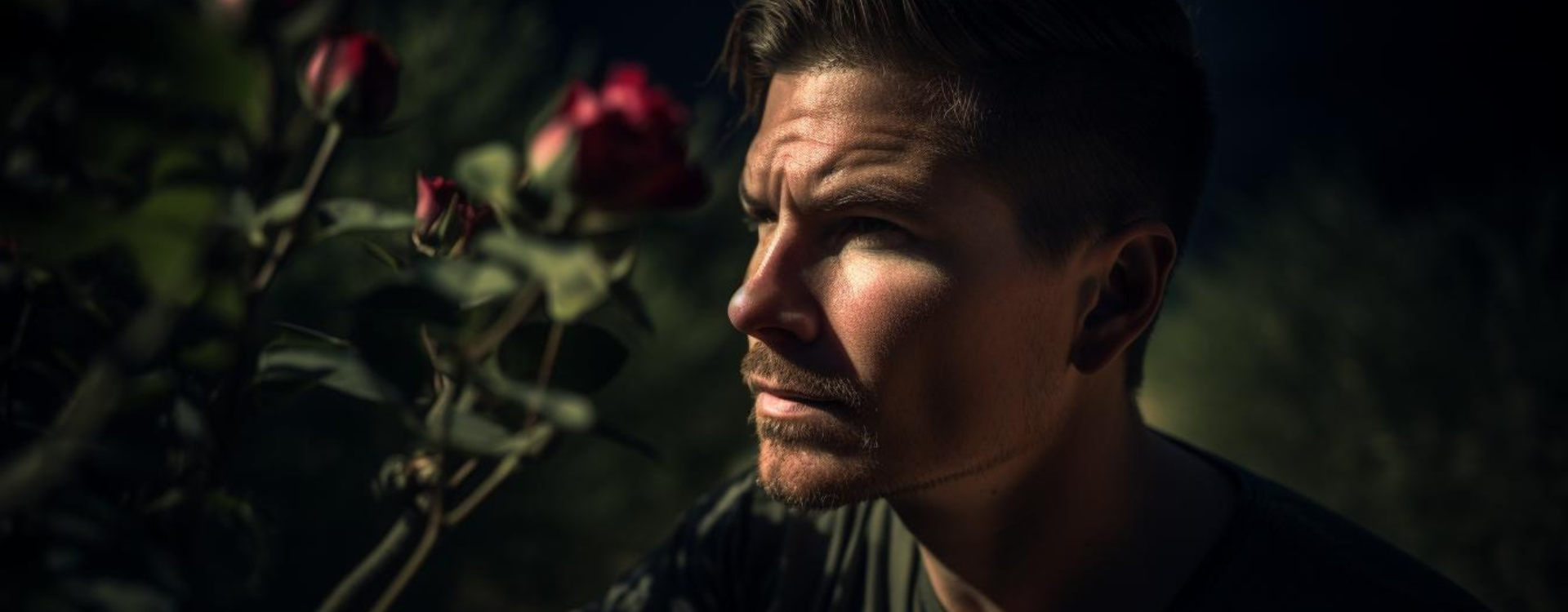
The window caught my eye. The bedroom window that looked out onto the side garden where Claire's roses grew—or tried to grow, in Broken Hill's harsh climate. They were more thorns than flowers these days, struggling things that seemed to resent their existence as much as I resented mine.
The window that was ground-floor height. The window that opened easily. The window that meant I could leave without walking past Claire, without enduring another round of accusations, without having to explain or justify or defend.
I was thirty-five years old and I was genuinely considering climbing out my own bedroom window to avoid my wife.
The absurdity wasn't lost on me. But neither was the appeal.
I opened the window slowly, testing how far it would go. Wide enough. Just. The cool air hit my face, carrying the scent of red dust and struggling eucalyptus. Broken Hill's particular perfume—hardy and harsh and unforgiving.
My bags went first, tossed onto the weary patch of grass with soft thuds that made me wince. They landed just clear of the rose bushes, though not by much. The thorny bastards seemed to lean towards them menacingly.
I looked at the distance to clear the rose bushes. Not far, really. Maybe four feet. Less than what I'd jumped plenty of times as a kid, climbing trees in the Adelaide backyard before Mum and Dad’s marriage imploded and took our childhood with it.
But I wasn't a kid anymore. I was trim but lanky, all awkward angles and disproportionate limbs that had never quite learned to work together gracefully. Claire used to joke about it, back when she joked about things rather than hurled them as weapons. Like a baby giraffe, she'd said once, watching me try to navigate my way down from a climbing wall. All legs and confusion.
"Right, here we go," I muttered to myself.
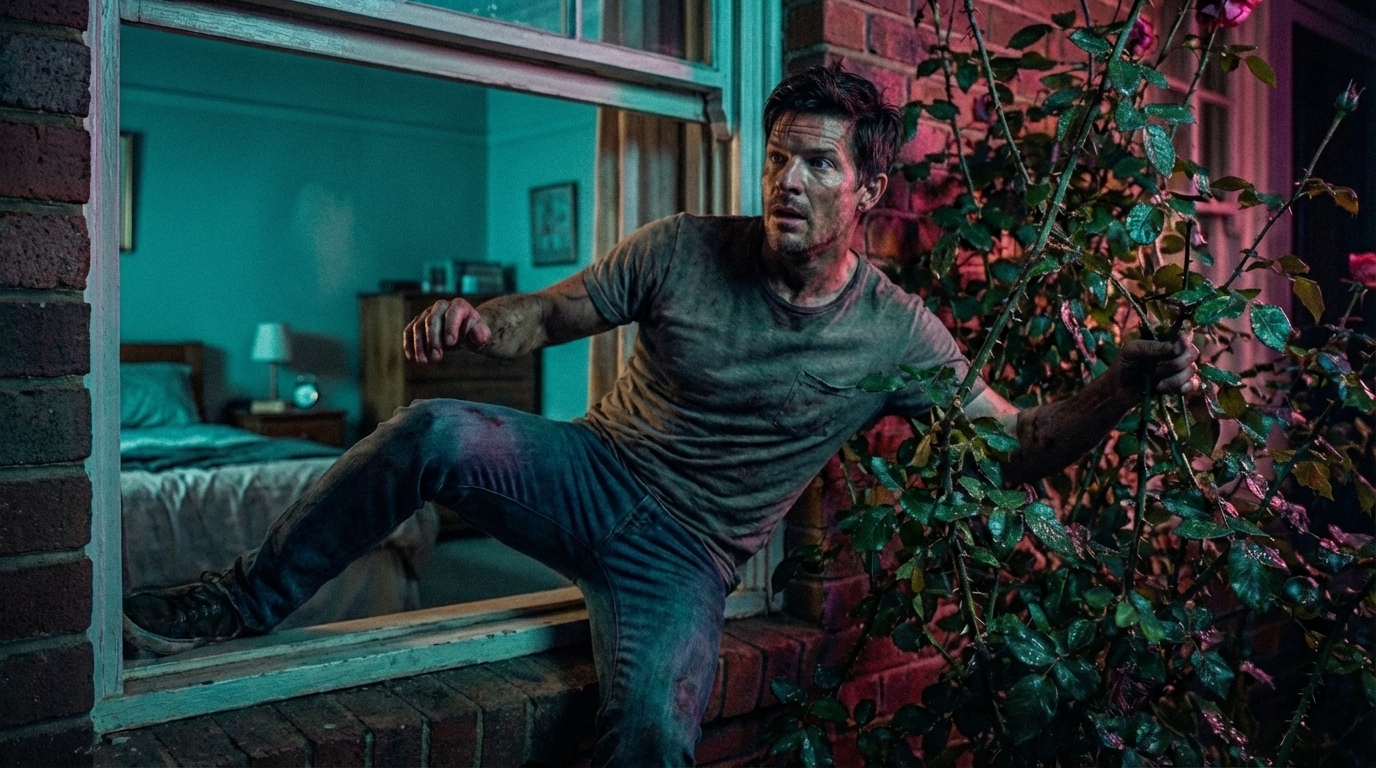
I swung my legs out, perched on the sill like some sort of demented bird preparing for flight. The distance looked bigger from this angle. The rose bushes looked hungrier. This was a terrible idea.
"Paul! What in the name of fuck are you doing hanging out the window?"
Claire's voice came from behind me, shrill with disbelief. I twisted automatically, trying to look back at her, and that's when my hands—slick with the nervous sweat I'd been trying to ignore—lost their grip on the windowsill.
Time did that thing it does in moments of impending disaster, stretching and compressing simultaneously. I was falling. I was definitely falling. My body was at entirely the wrong angle, momentum carrying me backwards, gravity asserting its dominance with the kind of authority that brooks no argument.
The rose bushes caught me first.
Sharp, biting pain erupted across my back and arms as thorns tore through my shirt and found flesh beneath. The sound of snapping stems filled my ears, oddly loud in the early evening stillness. I flailed, instinctively trying to find purchase, trying to arrest my fall, but succeeded only in driving more thorns deeper into skin.
Then the ground met me with a thud that knocked the wind from my lungs.
For a moment, I just lay there amongst the wreckage of Claire's roses, staring up at the pale blue sky and trying to remember how breathing worked. My back hurt. My arms stung. My dignity, such as it was, had fled entirely.
"Paul!?"
Claire's voice came from the window, and I could hear the mixture in it—anger, yes, but also something that might have been concern if I squinted at it right. But I had no energy left for concern, for explanations, for anything that required more emotional bandwidth than I currently possessed.
I pushed myself up, feeling thorns snap beneath me, feeling the denim of my jeans tug where it had caught on remaining branches. Thank God I'd worn jeans. Thank God for small mercies and thick fabric that had taken most of the damage meant for my legs.
My arms, though. My arms had borne the brunt of it. Scratches and punctures marked the exposed skin, thin lines of blood already beginning to well up where the thorns had dug deepest.
I grabbed my bags and made for the car with the single-minded determination of a man who'd already committed to his course and couldn't afford to look back.
The car was sanctuary. I threw myself and my bags inside, fumbled the keys into the ignition, and the engine roared to life. As I reversed down the driveway, I couldn't quite resist the urge to glance back at the house.
Claire's head protruded from the bedroom window, her features contorted in what I could only assume was a string of insults I was grateful not to hear. Her mouth was moving, her face was red, and if looks could kill, I'd have been dead three times over.
"Holy shit," I whispered to myself.
I pulled over a block away, hands shaking slightly as the adrenaline began to ebb. The stinging from the thorn punctures was becoming more pronounced now, competing for attention with the dull ache in my lower back where I'd hit the ground hardest.
I examined my arms gingerly, probing the wounds with careful fingers. Nothing serious. Painful, yes, but superficial. The scratches would heal. The damage to Claire's roses, though—that might take longer.
I waited there until my heartbeat returned to something approximating normal, until the shaking in my hands subsided, until the reality of what I'd just done finished settling over me like dust after a storm.
I'd just climbed out my bedroom window to avoid my wife. I'd fallen into rose bushes. I'd left without explanation, without proper goodbye, without doing any of the things a responsible adult was supposed to do.
And you know what? I didn't regret it. Not even slightly.
Adelaide was five hours away. Five hours of highway cutting through country that grew harsher and more beautiful the further you travelled. Five hours to think, to process, to prepare myself for whatever Luke needed from me.
I put the car in gear and pulled back onto the road, pointing the nose west towards South Australia, towards my brother, towards whatever drama came next.
The road stretched out before me, and for the first time in longer than I could remember, I felt something that might have been relief.
