Thelma Jeffries (née Rose)
Thelma Jeffries, née Rose, was born on 14th January 1927 in New Norfolk, Tasmania, the youngest of three children of a carpenter and his wife. Her adolescent friendship with Jane Lewis and Bob Gangley endured for over seven decades, surviving her marriage to James Jeffries III in 1947 and her absorption into Tasmania's most powerful and troubled dynasty. She bore one son, Charles, and dedicated her life to education, charitable work, and the quiet management of a family whose capacity for self-destruction exceeded its considerable wealth. She disappeared on 11th August 2018 during the Jeffries Manor Massacre, aged ninety-one. No trace of her was ever found.
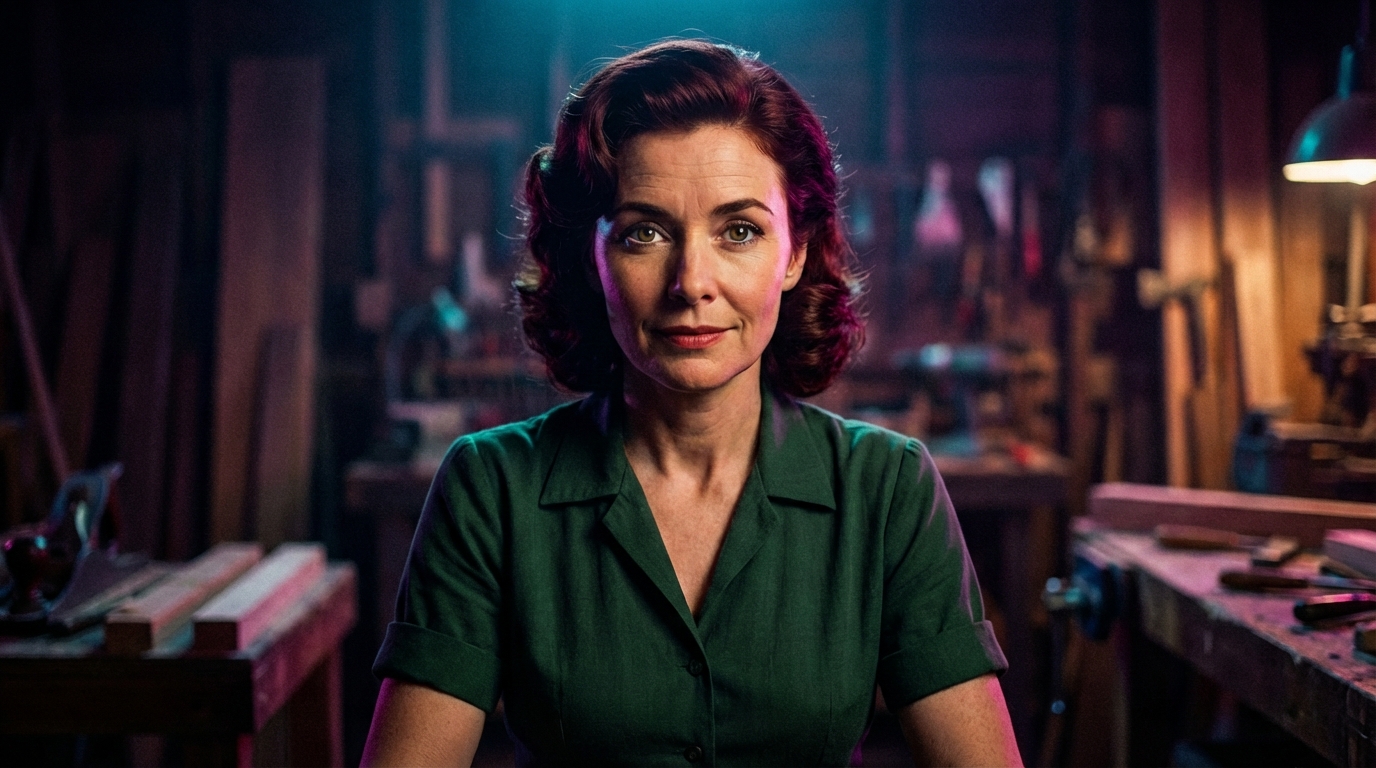
A Carpenter's Daughter (1927–1942)
Thelma Rose arrived on 14th January 1927 in the small town of New Norfolk, Tasmania, the third and youngest child of Arthur Rose, a carpenter whose skill with Tasmanian timbers provided modest but reliable income, and his wife Dorothy, née Crane, whose domestic management stretched that income further than its face value suggested possible. The Rose household occupied a cottage whose solidity reflected Arthur's profession — well-built, carefully maintained, and unadorned by anything that might be mistaken for pretension. Thelma grew up in a home where competence was valued above cleverness, where work preceded pleasure as a matter of principle rather than punishment, and where love expressed itself through practical attention rather than verbal declaration.
Her elder siblings — Harold, born in 1921, and Vera, born in 1923 — had established the household's patterns before Thelma's arrival, and she inherited the particular freedom that youngest children enjoy when the important anxieties of first-time parenting have been exhausted on their predecessors. Harold was already his father's apprentice by the time Thelma was old enough to notice, learning the trade that would eventually provide him with his own livelihood. Vera possessed their mother's gift for organisation, managing domestic responsibilities with an efficiency that would later translate into a successful career in hospital administration. Thelma, released from the obligations that eldest and middle children bore, was permitted a latitude for exploration that her siblings had not received.
The Tasmanian landscape provided the education that the local school supplemented but could not replace. New Norfolk sat in the Derwent Valley, surrounded by forests whose antiquity dwarfed human settlement, and Thelma developed an intimacy with this landscape that would persist long after her circumstances had changed beyond anything the carpenter's daughter could have imagined. She walked for hours in bushland that most adults considered too wild for children, learning to read weather in cloud formations, to navigate by the angle of light through canopy, and to find beauty in environments that required attention rather than spectacle to reveal themselves. This capacity for sustained, patient observation — for seeing what was actually present rather than what she expected to find — would prove the most valuable skill she ever acquired.
The Trio (1942–1946)
The summer of 1942 produced the friendship that would define the remainder of Thelma's life. During a church youth expedition to the Tasmanian rainforest, she encountered Jane Lewis — a girl from Hobart whose quiet determination and extraordinary observational skills complemented Thelma's own adventurous energy — and Bob Gangley, two years older than Jane and already displaying the cantankerous wit that would become his defining characteristic. The three of them recognised in each other something that their respective domestic circumstances had not provided: companions whose curiosity about the world matched their own and whose loyalty, once given, would prove absolute.
They spent their remaining teenage years exploring Tasmania's hidden corners together — mapping trails that no one else knew existed, discovering waterfalls that had no names, and sharing ambitions that seemed impossibly grand for three working-class young people whose futures, by every reasonable calculation, would be circumscribed by the same modest expectations that had governed their parents' lives. Thelma was the most physically adventurous of the three, the one who climbed higher, walked further, and pressed into terrain that Jane's caution and Bob's pragmatism would not have reached alone. But it was Jane's intelligence and Bob's blunt wisdom that shaped the trio into something greater than its individual components — a partnership built on complementary strengths that would prove, over the next seven decades, more durable than any of their marriages.
The war years compressed their adolescence into premature adulthood. Thelma completed her schooling and began teacher training in Hobart, drawn to education by the conviction that knowledge should not be restricted by the accident of birth — a belief that her own experience of learning more from the forest than from the classroom had permanently installed. Jane pursued secretarial studies. Bob enlisted, his wartime service shaping the guarded temperament that peacetime would harden into habitual reticence. The trio's friendship survived these separations through correspondence whose frequency and candour exceeded what any of them shared with their families, establishing the pattern of private communication that would persist — and deepen into something more complex — in the decades ahead.
James Jeffries (1946–1950)
In February 1946, Jane Lewis made the introduction that would redirect Thelma's life. Through her clerical work at a Hobart law firm, Jane had encountered James Jeffries III — heir to Tasmania's most powerful industrial dynasty, recently returned from reconnaissance service in New Guinea, and possessed of an artistic sensibility and emotional warmth that sat uncomfortably within the family name he carried. Jane recognised something in the potential connection between her adventurous friend and the troubled young aristocrat — a complementary energy that might, she judged, transform them both.
The introduction succeeded in ways that complicated existing arrangements. James had been seeing Jane herself, or rather Jane had been in his social orbit in a capacity whose precise nature remained tactfully unspecified in later accounts. What was clear was that James fell in love with Thelma with an immediacy that ended whatever connection he had maintained with Jane, and that the transition — potentially catastrophic for the friendship between the two women — was navigated with a grace that spoke to the depth of loyalty Jane and Thelma had built during their years in the Tasmanian bush. Jane remained close to both, serving as maid of honour at their wedding and becoming a permanent fixture at Jeffries Manor in the years that followed.
Grace Matilda Jeffries, née Woolley — James's mother and the formidable matriarch who had married into the dynasty from origins as modest as Thelma's own — recognised in her future daughter-in-law the pragmatism and resilience that the Jeffries household required of the women who sustained it. The two women understood each other with the instinctive clarity of people who have arrived at identical conclusions about what matters from entirely different starting points. Grace's approval mattered more than any social endorsement Hobart could offer, and she gave it without reservation.
James and Thelma married in a small ceremony in Melbourne on 5th April 1947, returning to Tasmania to take up residence in a cottage on the Jeffries Manor grounds. The modesty of the arrangement reflected both their preferences and the gathering storm of the inheritance crisis that would soon engulf the family. Within months of their return, William IV's decision to bypass his eldest son and name James as heir detonated the most destructive conflict in Jeffries history — a conflict Thelma had not anticipated and for which nothing in her carpenter's-daughter upbringing had prepared her, but which she would navigate with the same steady competence she had once applied to reading weather patterns in the Derwent Valley canopy.
The legal battle between James and William V consumed the years between William IV's death in June 1948 and the court's final resolution, during which Thelma managed a household under siege — emotionally from within, legally from without. Grace's presence at the manor during this period provided essential stability, and the relationship between the two women deepened into genuine partnership. When Grace's final words — spoken to Thelma rather than James on 18th September 1962 — acknowledged that the role she had played as a Jeffries wife was simultaneously a performance and a truth, Thelma understood the observation with an intimacy that required no explanation.
Motherhood and Manor (1950–1980)
Charles William Jeffries, born on 12th June 1950, was Thelma and James's only child. Grace, sixty and still resident at the manor, devoted herself to her grandson with an enthusiasm that suggested both genuine affection and the desire to correct mistakes she believed she had made with her own children. Thelma welcomed this involvement, understanding that Grace's experience of managing the emotional complexities of Jeffries family life was a resource she could not afford to decline.
Thelma's approach to motherhood reflected her origins more than her circumstances. She was hands-on in ways that the Jeffries household's servants found either refreshing or bewildering — walking Charles to school rather than sending him by car, teaching him to build things with his hands, ensuring he understood that wealth was a condition rather than an identity. Her commitment to education extended beyond her own child: she served on the boards of several schools and charitable institutions, advocating for children whose circumstances resembled those she had known in New Norfolk rather than those she inhabited at Jeffries Manor. Her charitable work earned genuine respect in Tasmanian communities that might otherwise have regarded her as merely the latest woman absorbed by the Jeffries dynasty.
The friendship with Jane and Bob continued throughout these decades, evolving from adolescent adventure into something more complex and more carefully guarded. Their regular bushwalks persisted — three ageing friends returning to the landscape that had forged their bond — though the nature of what they carried with them, and what they discussed during these expeditions, grew increasingly opaque to anyone observing from outside. Thelma's diary from this period, unlike Jane's meticulously detailed journals, contained almost nothing of substance — a deliberate restraint that suggested either an absence of secrets or a discipline about protecting them that exceeded even Jane's considerable discretion.
James's management of Jeffries Industries consumed the intellectual energy that his artistic temperament would have preferred to direct elsewhere, and Thelma's role in supporting this displaced ambition was both essential and largely invisible. She managed the domestic infrastructure that permitted James to function professionally, hosted the social obligations that his position demanded, and provided the emotional stability that the Jeffries inheritance — with its accumulated weight of obsession, estrangement, and mystery — perpetually threatened to undermine. She performed these functions without complaint, recognising that the partnership she had entered required contributions whose value could not be measured and would not be publicly acknowledged.
The Losses (1980–2010)
Charles's relationship with James deteriorated through the 1970s and 1980s along a trajectory that Thelma observed with the helpless precision of someone who understood the dynamics at work but lacked the authority to interrupt them. The tension between father and son reproduced, in modified form, the pattern that had defined every Jeffries generational transition — the elder's expectations clashing with the younger's need for autonomy, the weight of inherited obligation crushing the space in which a separate identity might develop. Charles was brilliant and volatile, capable of the commercial competence the family business required but unwilling to accept that competence as sufficient definition of his worth. James's investment of hope and attention in Charles's son Tom — the grandson in whom he saw the possibility of redemption that every Jeffries patriarch projected onto the generation that followed the one they had failed — deepened Charles's conviction that his father regarded him as merely a conduit rather than a person.
Charles's abrupt departure from Tasmania in the late 1990s, cutting off contact without explanation, inflicted upon Thelma the wound that she had spent decades anticipating without ever developing an adequate defence against it. She lost her son not to death but to a severance so complete that it operated as a form of extinction — leaving behind the particular grief of a mother who cannot mourn because the person she has lost is not dead, merely absent in ways that resist every attempt at comprehension or repair.
James's increasing reclusion during his final decade placed upon Thelma the management of a household that had contracted around two elderly people and the ghosts of everyone who had departed it — through death, estrangement, or the mysterious disappearances that seemed to constitute a Jeffries family tradition. She managed his declining health, his obsessive engagement with the family's ancestral mysteries, and the practical demands of an estate whose maintenance required competence she provided without acknowledgement. When James died peacefully on 8th August 2010, Thelma was eighty-three, and she received the condolences of mourners at St David's Cathedral with the composure of a woman who had spent sixty-three years learning to carry whatever the Jeffries name deposited upon her shoulders without permitting the weight to become visible.
The Final Years (2010–2018)
Widowhood simplified the demands upon Thelma without diminishing their emotional intensity. She remained at Jeffries Manor, the estate that had been her home for over six decades, living alongside her grandson Tom, his wife Louise, and their children in an arrangement that provided the intergenerational continuity she valued and the daily companionship that solitary old age in a manor house would otherwise have denied her. Tom's determination to understand the mysteries that had consumed previous Jeffries generations — the disappearance of the founder, the patterns of obsession and loss — both concerned and consoled her, his engagement with the family's history representing either the continuation of its curse or, possibly, its resolution.
Jane's decline through 2017 and into 2018 — culminating in the pancreatic cancer diagnosis that foreclosed whatever time remained — drew Thelma into the particular intimacy that approaching death creates between people whose friendship has survived every other test. Thelma visited Vaucluse Nursing Home regularly, sitting with Jane and occasionally with Bob in conversations whose content, by the long-established habits of their friendship, left no trace in any record. When Jane died on 4th August 2018, Thelma delivered the eulogy at New Norfolk's Anglican Church — her words acknowledging the complexity of a life whose full dimensions only she and Bob understood: "Jane Lahey lived with uncommon courage, keeping faiths that couldn't be spoken, protecting truths that weren't hers to tell."
Bob Gangley died three days later, on 7th August 2018, as though the removal of Jane had severed whatever thread connected him to continued existence. Thelma was the last of the trio — the final keeper of secrets that three teenagers had begun accumulating in the Tasmanian rainforest seventy-six years earlier.
Disappearance
On 11th August 2018, the Jeffries Manor Massacre — the event that would become Tasmania's most notorious modern crime — struck the estate that had been Thelma's home for seven decades. Tom and Louise Jeffries and two of their children were found dead. Thelma and her great-granddaughter Katie Jeffries were reported missing. No trace of either was ever recovered.
The absence of Thelma's body, combined with the absence of any evidence establishing her death, created a void that investigation could narrow but not close. Theories proliferated — escape, abduction, something stranger — but certainty remained beyond reach. She was ninety-one years old, and she had spent those years navigating a landscape of secrets, obligations, and loyalties whose complexity exceeded what any official account could reconstruct from the evidence available. Whatever happened in the final hours of Thelma Jeffries's known existence, it occurred within the walls of a house whose capacity for absorbing people without explanation had been established two centuries earlier, when the convict founder walked out of his own manor and into a mystery that his descendants were still attempting to solve when the dynasty itself came apart.
