4338.210 · July 29, 2018 AD
The Woman in Jamie’s Car
What begins as a routine traffic stop turns into the first real crack in Karl’s missing persons case. When a stranger named Gladys Cramer is found driving Jamie Greyson’s car, the line between coincidence and conspiracy blurs—and Karl’s instincts tell him they’ve just opened a door that won’t close easily.
“Sometimes the truth doesn’t knock—it cuts you off in traffic and dares you to follow.”
"There! Look!" Sarah exclaimed, her finger jabbing excitedly towards a car that had just screeched around a corner, emerging from the bottle shop’s car park. Its abrupt turn sent a flock of pigeons into a frenzied flight, their wings slicing the air like startled paper kites.
The birds exploded upward in a grey cloud, their panic visible in the chaos of their flight—no formation, just raw survival instinct. A few feathers drifted down in the aftermath, catching the afternoon light as they spiralled towards the bitumen.
The sudden commotion snapped me out of my thoughts—those same looping questions about Jamie and Kain that had gnawed at me all afternoon. We’d been parked near the Glenorchy shopping centre for close to forty minutes, ostensibly watching traffic patterns and discussing the case. In truth, it was a tactical pause—a buffer of stillness in a day that had otherwise swung between urgency and ambiguity. For once, I wasn’t rushing between scenes or chasing down leads. I was just… sitting. Thinking. Drowning a little in it.
The car’s interior had taken on that particular quality of confinement that came from too much time stationary. The windows had fogged slightly at the edges from our breath. The coffee in the cupholder had gone from hot to lukewarm to cold, its surface developing that faint iridescent film that marked abandonment. My back ached from the driver’s seat, and I’d been shifting position every few minutes, trying to find comfort that wasn’t there.
"Shit! That was a close call," I muttered, leaning forward instinctively, my eyes locking on the car’s reckless trajectory.
A silver Mazda had launched itself out of the car park like a kicked dog, missing a parked red hatchback by centimetres. The squeal of rubber still echoed faintly in the air, that distinctive sound of tyres pushed beyond their grip. My pulse surged, a sharp spike of adrenaline that sharpened everything: the angle of the sun, the bitter smell of cheap coffee cooling in the cupholder, the soft hiss of Sarah’s breath beside me.
The Mazda’s erratic movements spoke volumes. Either the driver was off their head or had no business holding a licence. Possibly both. I watched as it righted itself and tore off down the main road, sunlight bouncing off its bonnet in a glare that momentarily washed out everything else. The reflection was fierce enough to make me squint, turning the vehicle into a moving star of white light against the darker street.
Through the darkened rear window, the driver was little more than a suggestion—a silhouette slouched in the seat, faceless and featureless, yet suddenly the most interesting person in the world.
"Random?" Sarah asked, raising an eyebrow.
Just the one word. But we’d worked together long enough that it said everything—Do we go for this? Is it worth it? And maybe even, You need this, don’t you?
She understood. We’d been spinning our wheels on the Jamie Greyson case, chasing leads that evaporated like morning mist. Every interview had yielded contradictions. Every timeline had holes. Louise’s certainty that something was wrong clashed with the almost deliberate absence of evidence. Everything pointed to a man who’d simply chosen to disappear—except for the gnawing sense in my gut that said otherwise.
A straightforward drink-driving stop would be clean. Simple. A problem with a solution. The kind of policing that made sense.
I nodded. "It would be irresponsible of us not to," I said, a grin forming before I could stop it.
There was something gratifyingly simple about this kind of call. No complicated timelines, no contradictory witness statements, no gut-wrenching missing persons reports that led nowhere. Just instinct, observation, and the very real possibility of catching someone red-handed. A brief moment of clarity in a job increasingly defined by grey areas.
People were endlessly surprised when drink-driving still cropped up as often as it did. As if the signs outside bottle shops were purely decorative, or the laws didn’t apply between 2pm and 5pm. I never understood the logic. Maybe there wasn’t any. Maybe it was just the same human capacity for self-deception that underpinned every crime I’d ever investigated—the belief that consequences were for other people, that this one time wouldn’t matter, that surely they could make it home without incident.
Sarah glanced over at me, her eyes alight with something just shy of glee. "Here we go then," she said, and reached for the dashboard controls.
The moment the red and blue lights flared to life, our unmarked vehicle underwent its usual transformation—from mundane to authoritative in a blink. The siren gave a short, aggressive whoop, just enough to make a point. Around us, traffic responded with Pavlovian precision: brakes tapped, lanes cleared, a pathway opened.
The psychology of those lights always intrigued me. That instantaneous shift in power dynamics, the way people moved aside without question. You could live a hundred lives in uniform and never lose the satisfaction of that response. It was one of the few genuinely clear-cut aspects of the job—lights on, authority asserted, compliance rendered. No ambiguity. No negotiation.
I swung the car into motion, following the Mazda as it wove past a set of traffic lights and finally slowed, pulling in beside a row of bargain stores and chain takeaway joints. Glenorchy’s main drag—charity shops with cluttered windows displaying sun-faded clothing and decade-old electronics, a vape lounge wedged between a kebab shop and an abandoned newsagent. Pedestrians loitered on the footpath, their eyes darting between the flashing lights and the silver car, all of them craning for the same answer: What’s going on?
This stretch of Main Road had seen better days. The footpath was cracked and uneven, patched with different generations of concrete that had weathered at different rates. The shopfronts bore the marks of multiple occupants—ghost signage visible beneath current names, paint schemes that clashed where businesses had changed hands without bothering to repaint the whole facade. It was Glenorchy in microcosm: functional, unpretentious, showing its age.
"You want to do the honours?" I asked, glancing sidelong at Sarah.
My tone was light, but the offer wasn’t just friendly delegation. Between the wrist and my general desire to avoid questions I wasn’t prepared to answer, it made tactical sense to let her take point. She looked clean. Professional. Uncompromised.
The wrist had been aching all day—a dull, persistent throb that pulsed in time with my heartbeat. The bruising had darkened to a spectacular purple-yellow, and I’d taken to keeping my jacket sleeve pulled down to hide it. Officially, I’d caught it on a door frame. Unofficially, I’d slammed my elbow through a window at Luke Smith’s house in the early hours of this morning, manufacturing evidence that might prove Jamie had been there. Or that might prove I was losing my grip on professional boundaries.
"Sure," she said, already unclipping her seatbelt, her hand moving to the door handle.
She lived for these moments—fieldwork, fast decisions, the quick pivot from calm to confrontation. It was one of the things I respected most about her. That clarity. It was a quality I simultaneously admired and occasionally found exhausting. Sarah didn’t do ambiguity well. She needed action, resolution, forward movement. The slow grind of investigation without breakthrough chafed at her like sandpaper on skin.
"I’ll do a plate check," I added, reaching for the mobile data terminal as she stepped out.
She moved with assurance, crossing the bitumen in a few swift strides, posture open but firm. Her approach would set the tone—polite, professional, unthreatening, but ready. That careful balance we all trained for, but few truly mastered. Sarah had learned it through trial and error, through early-career mistakes that had left her with a suspension and a notation in her file. She’d learned the hard way that aggression wasn’t the same as authority.
I didn’t rush the plate check.
Instead, I watched Sarah.
She came up on the driver’s side with the same composed control I’d seen her use a hundred times before. No aggression, no posturing. Just authority, quietly worn. Her shoulders squared, but relaxed. Her right hand hovered close enough to her belt to access whatever she might need, but not so obviously that a nervous driver would pick up on it. It was the kind of thing civilians never noticed—hell, most coppers didn’t either—but I did.
Despite the times we’d butted heads, I never doubted her skill in the field. That instinctive calibration between presence and restraint was rare. Watching her work always reminded me why I trusted her when it counted. We might argue about tactics, about when to push and when to wait, but when it mattered—when there was genuine threat or genuine opportunity—Sarah was solid.
She leant in, said something I couldn’t hear through the windscreen, then gestured for the driver to take the plastic breathalyser tube. Standard issue, pen-sized, absurdly fragile-looking. The driver complied. No fuss. No slurred words or shaky hands. Just compliance.
I exhaled slowly and turned back to the laptop perched on the dash. Time to do the boring bit. The grunt work that no one saw but which quietly tethered every action to policy. My fingers moved with muscle memory across the keyboard, typing in the registration number. The system, in its usual glacial fashion, began to churn. A hollow whir. The pixelated hourglass flickering like it was clinging to life support.
The bloody thing might as well have been powered by a hamster on a wheel.
Budget requests for upgrades had been floating around the department for years. Each one kicked into the long grass with a nod and a platitude about resource allocation. Meanwhile, we sat in cars with tech that belonged in a museum, praying it didn’t crash before a search went through. The system was running Windows XP, for Christ’s sake.
Finally, the screen pinged. A short, sharp beep that jolted my focus. My eyes scanned the results.
And then stopped.
I blinked. Looked again.
"Surely that’s not right," I murmured, the words falling out of my mouth without conscious thought.
The name on the registration details made my gut tighten. Jamie Nigel Greyson.
I stared at it, as if prolonged scrutiny might change the pixels into something more rational. But there it was. Jamie’s name. His bloody car. The same Jamie who apparently hadn’t been seen in days. The same Jamie who’d haunted my thoughts every waking moment since Louise first walked into the station. The same Jamie whose house I’d broken into this morning, whose windows I’d peered through, whose life I’d been dissecting with the obsessive focus of someone who couldn’t let go.
And now his vehicle had just screeched out of a bottle shop and landed in front of us. By pure chance.
No. Not chance. That was too convenient. Too clean. Coincidences that neat always made my skin crawl. In more than twenty years of policing, I’d learned that genuine coincidences were far rarer than people believed. What looked like random chance was usually just invisible connections waiting to be discovered.
Before I could get the door open, Sarah returned to the window, her face composed but slightly drawn with disappointment.
I wound it down, still staring at the screen. The mechanism made that slight grinding sound it always did, a reminder that this car was due for maintenance it probably wouldn’t receive until something actually broke.
"Well, that’s a bit disappointing. She’s recorded a zero blood-alcohol reading," she said.
She.
The word broke the fog in my head.
"She?" I repeated, my eyes flicking up to hers.
Did I misread the database? Impossible. The number plate was staring at me from the back of the vehicle less than ten metres away. I could see it clearly. The same number I’d just entered. The same result on my screen.
"Yeah," she said, handing me the driver’s licence. The name printed in bold letters hit me like an elbow to the ribs: Gladys May Cramer.
It meant nothing. No connection. No red flags. Just another name in a sea of strangers. Except she wasn’t a stranger. She was behind the wheel of Jamie’s car.
The licence photo showed a woman with long dark hair, a slight smile, eyes looking directly at the camera with the faint resignation everyone wore for driver’s licence photos. Date of birth: 17 August 1981. Making her thirty-six, nearly thirty-seven. Address in Claremont. Organ donor. No restrictions.
"I think we might have a little problem," I muttered, more to myself than to Sarah.
The name Gladys Cramer hadn’t come up once. Not in the briefings, not in the case files, not even in the tangle of half-formed theories I kept stored at the back of my head. Louise hadn’t mentioned her. Jamie’s workplace hadn’t mentioned her. None of the neighbours that had been canvassed had mentioned anyone matching that description visiting the house.
Yet here she was, driving the vehicle registered to the one person I couldn’t stop thinking about.
Sarah was watching me now, the shift in my tone not lost on her. "What is it?"
"Is Gladys the only person in the car?" I asked, my voice low, tight.
"Yeah. Why?" There was a flicker of concern in her eyes now. Not fear. Just awareness. She knew something had changed. Could read it in my posture, in the way my hands had tightened on the licence.
"This car belongs to Jamie Greyson."
The name sat heavy in the air between us.
I saw it land on her like a slap—eyes widening, posture tensing, the easy rhythm of the stop abruptly fracturing. The transformation was immediate and total. We’d gone from routine traffic enforcement to potential breakthrough in the space of one name.
"Shit!" she hissed. Her eyes flicked towards the Mazda. "Ok, what do you want me to do?" Her right hand moved instinctively to her holster. "Should I get my gun out?"
"No! Jesus, Sarah, what is it with you and your bloody gun?" I snapped, too fast, too harsh.
She flinched—barely—but I caught it. The slight recoil, the flash of hurt across her features before she masked it. She didn’t rise to the bait. Just waited.
I immediately regretted the sharpness. It wasn’t her fault. She was doing exactly what her training dictated—assess the threat, prepare for escalation. But the last thing we needed was to spook Gladys Cramer into a panic or a runner, and Sarah’s tendency to reach for her weapon as a first response rather than a last resort had been a source of tension between us for months.
"You wait here. I’ll deal with her," I said, pulling my thoughts back into order.
The friction between us simmered and faded as quickly as it came, eclipsed by the sudden weight of what we’d stumbled into.
Gladys Cramer wasn’t just some inattentive driver. She was now a possible link to Jamie. The first real one we’d had. I couldn’t afford to screw this up. Everything hinged on the next few minutes—how I approached her, what questions I asked, whether I could extract information without alerting her to our suspicions.
Easing myself out of the car, I felt the cool afternoon air sweep across my face—clean, crisp, with that faint metallic tang Glenorchy always carried after rain. It woke my skin and sharpened my senses. My mind was already racing, gears grinding through half-formed questions. Who the hell was Gladys Cramer, and why was she driving Jamie Greyson’s car?
I shut the door quietly behind me. Each step I took was steady, deliberate—outwardly composed, but inside I was anything but. The day had twisted on its axis. What began as routine surveillance—little more than tactical loitering—had become something else entirely. This wasn’t just happenstance. This was the kind of development that made you question your grip on causality itself.
My footsteps echoed faintly on the bitumen as I approached the silver Mazda. The vehicle sat idling, placid and unremarkable—just another car on another main road. Yet it might as well have been a crime scene. The badge on my hip felt heavier than usual, the way it always did when something big was looming—an almost superstitious sensation, like the metal knew before I did.
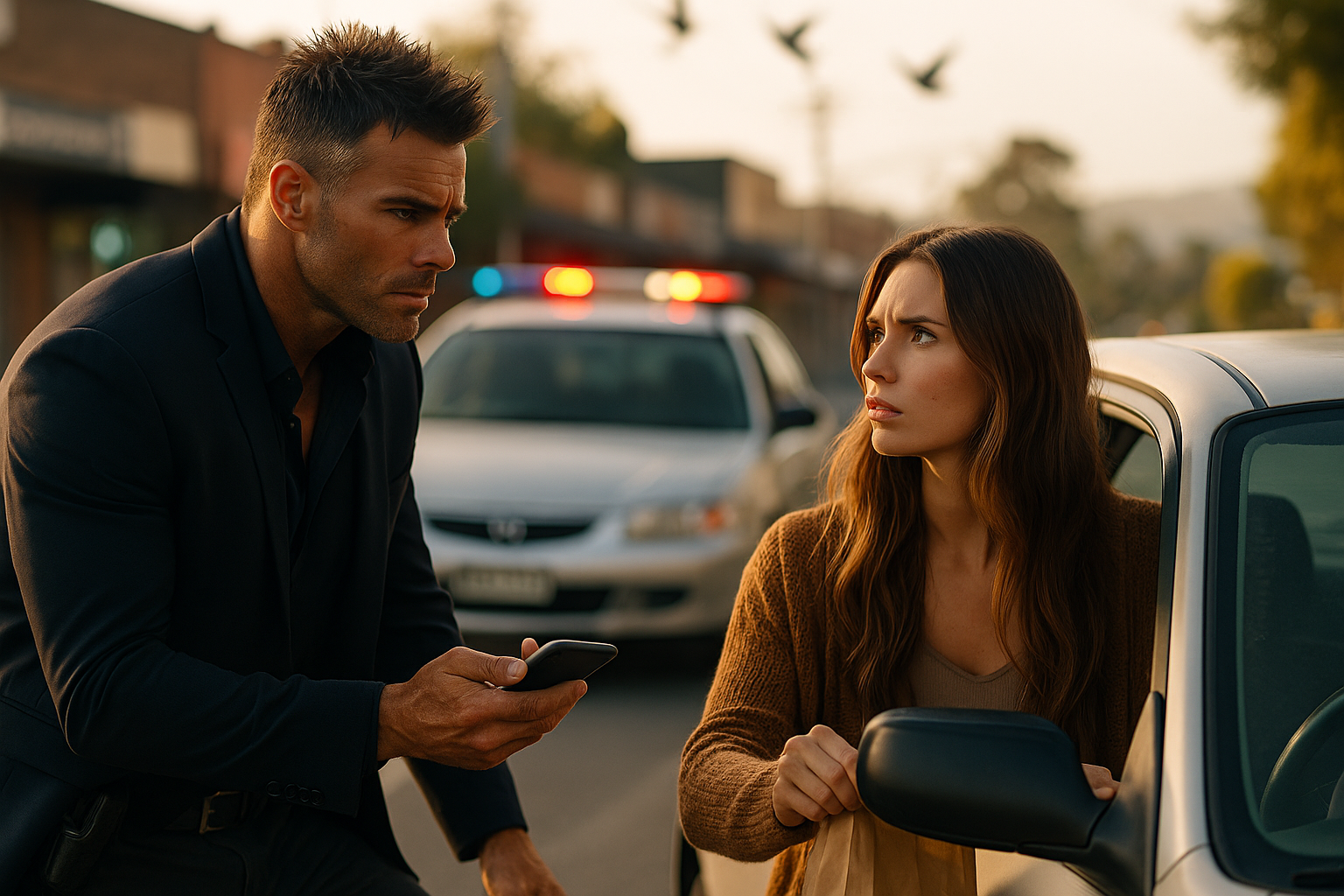
I stopped beside the driver’s window and leaned in slightly. The woman behind the wheel turned her head and met my gaze without flinching.
She looked to be in her late thirties, maybe early forties, with soft features. Stylish but informal. Not corporate, not plain. Someone used to standing out, maybe even relying on it. But nothing about her rang a bell. Not from statements, not from surveillance, not from the endless hours I’d spent cross-referencing names and photographs in the missing persons cases.
Her hair was shorter than in the licence photo—cut to shoulder length, with lighter highlights that caught the afternoon sun. She wore minimal makeup, but what she had was well applied. Casual clothes—jeans, a knit jumper, boots. Not the outfit of someone planning anything clandestine, but also not someone who’d thrown on whatever was closest.
"Gladys Cramer?" I asked, holding up the licence Sarah had given me. My tone was firm but civil. The kind of voice that offered no invitation to lie, yet didn’t issue a threat either.
"Yes," she said, brows lifting slightly. "Have I done something wrong?"
Her tone was light. Unbothered. If it was an act, it was a bloody convincing one. She didn’t bristle, didn’t squirm. Just mild confusion, the kind you might show after being pulled over twice in ten minutes and still not understanding why.
Her body language supported the performance—relaxed hands, steady breathing, no furtive glances. I’d spent enough time watching liars to recognise when someone wasn’t. Or was very, very good at it.
"I’m Senior Detective Karl Jenkins," I said, slipping into the formality like a well-worn coat. "Is this your car, ma’am?"
The question came quick and clean. Designed to trip the unwary, to catch a flicker of hesitation. Timing was everything. The jump from traffic stop to formal interview without transition sometimes jarred people into revealing more than they intended.
And there it was—just a heartbeat’s delay.
Her eyes flicked briefly to the passenger seat, then back to me. The movement was minute, almost imperceptible, but I caught it. A tell. Not necessarily deception, but calculation. She was deciding what to say, how much to reveal.
"No," she admitted. "It’s a friend’s car. He told me I could use it to go to the bottle shop." She gestured towards the passenger seat where a brown paper bag bulged with glass bottles. "We were planning on having a trashy movie binge session, but then we realised we didn’t have any drinks to go with it. He’s at home cooking now, which is why I went to get the wine."
It flowed easily—too easily, perhaps. But the details were mundane enough to be real. The kind of story no one invents unless it’s true. Still, my instincts remained taut. Too many variables. Too many assumptions I’d made already today that hadn’t paid off.
The bag in the passenger seat was from Liquorland—I could see the logo. Two bottles, probably. The weight and shape suggested wine rather than spirits. The story held together on the surface level.
"Who is this friend of yours?" I asked, careful to sound offhand, almost disinterested.
Inside, I was coiled tight. This was the question that mattered. Everything hinged on her answer.
"Oh, Jamie Greyson, of course. This is his car," she said without pause.
Her casual confirmation sent a jolt of adrenaline through my system. After barely thirty-six hours of investigation, interviews, and increasingly questionable personal actions, Jamie’s name emerged not from careful detective work but from random chance. If Gladys was telling the truth, our missing persons case might dissolve into simple miscommunication rather than a potential crime.
But if she was lying—if this was misdirection—then we were standing at the threshold of something far darker.
"Jamie Greyson, did you say?" I echoed, trying to keep my voice even. My heart was thudding like a warning drum, fast and low and certain. A knot tightened in my stomach, part instinct, part fear. Is this it? Is this all it was?
I’d chased shadows, followed threads, bent rules—and now some woman we’d pulled over by accident was telling me Jamie was at home cooking dinner, as if he hadn’t dropped off the map days ago. As if his sister’s distress was unfounded. As if my breaking and entering this morning had been the paranoid act of a detective spiralling out of control.
"Yes," she said simply, confirming it without a flicker of uncertainty.
I let out a quiet breath. "Well, how’s that for timing," I said, managing to keep my expression neutral. The current coursing through me was something between hope and suspicion, and it wasn’t easy to contain.
"We’ve been trying to contact Jamie for the last few days," I continued. "We’ll just follow you back to his house, if you don’t mind."
The words came out smoothly, but beneath them was urgency—controlled but unmistakable. If she was lying, we’d find out soon enough. If she wasn’t… then everything needed re-evaluating. Louise’s distress, the unanswered calls, the silence—all of it might be explainable. Might.
Or this was the beginning of something else. Something that started with a woman driving a missing man’s car and ended somewhere I couldn’t yet see.
Gladys glanced at the passenger seat again. That flick of the eyes was subtle, but not nothing. A hesitation. A recalibration.
What was she thinking? Was she weighing how much trouble she’d be in if we discovered Jamie wasn’t actually at the house? Was she calculating how quickly she could call ahead to warn someone? Or was she simply nervous about having police follow her home—an innocent person’s natural anxiety about law enforcement scrutiny?
"Not at all," she said at last, smiling—too brightly. It was a good smile, distractingly so. But forced.
It lodged in my brain. Filed away for later analysis. The smile that said yes whilst the eyes said something else entirely.
"Alright then," I said, tapping the edge of the car door as a signal. A ritual more than anything.
As I turned and walked back towards our vehicle, a thousand thoughts competed for space. Was this the break we needed, or just another diversion? A fluke? A trap? Or worse—was Jamie not missing at all? Had I poured so much into finding him that I’d manufactured a crisis out of a missed phone call and a worried sister?
I didn’t know yet.
But I couldn’t shake the feeling that something just shifted.
And we were now crossing into territory I hadn’t prepared for.
In a few minutes, we might be face to face with Jamie Greyson. The man whose disappearance I’d been investigating. The man whose house I’d broken into. The man I’d been obsessing over.
What would I say to him? How would I explain?
And if he wasn’t there—if Gladys led us to an empty house or another convenient story—what then?
