4338.213 · August 1, 2018 AD
The Witness on the Couch
Detective Sarah Lahey enters Luke Smith's house expecting to face only the ghosts of her own crimes—until she finds Gladys Cramer sitting motionless on the couch, eyes vacant with shock, staring at nothing. The question isn't whether Gladys discovered the body, but what she plans to do about it, and whether Sarah can arrest her way out of this nightmare or if the one person who could destroy her has already sealed both their fates.
"Finding a traumatised witness at your own crime scene is the universe's way of telling you that things can always get worse."
"Shit!" The exclamation burst from my lips before I could stop it, sharp with genuine surprise that made my heart skip several beats.
My entire body jerked in startle response, gun automatically tracking towards the unexpected figure, training overriding conscious thought in that split second of pure reaction. Every muscle tensed, ready for threat, for confrontation, for whatever violence this new development might bring.
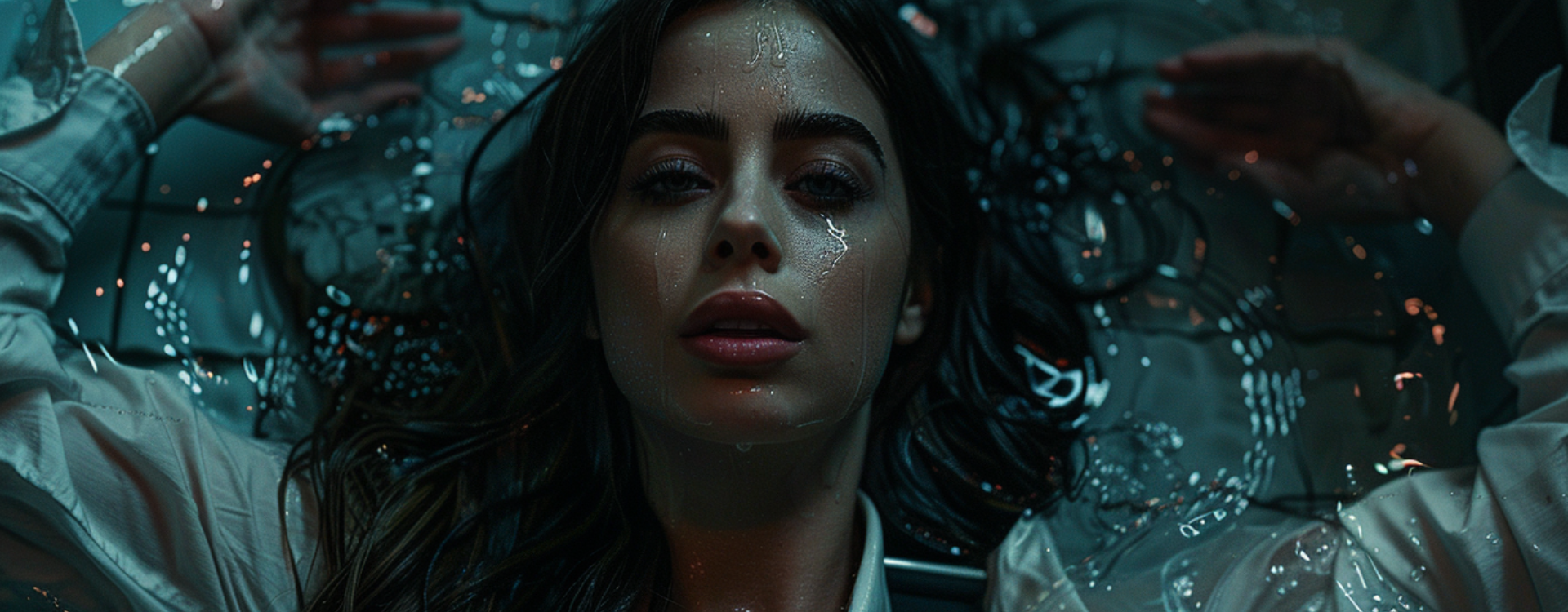
The woman sat upright on the couch, unnaturally still, her posture rigid in ways that suggested either extreme tension or complete disconnection from her surroundings. Her eyes were empty — not closed or looking at anything in particular, just... vacant, staring at some distant point only she could see.
Her expression was numb, all emotion seemingly drained away or suppressed so thoroughly that her face had taken on a mask-like quality. It was the look of someone in profound shock, someone whose mind had temporarily retreated from reality because reality had become too much to process.
I recognised her immediately despite the vacant stare, despite the absolute stillness that made her seem almost sculptural rather than human.
Gladys Cramer.
The woman who'd led us on a high-speed chase through Collinsvale's streets. The person of interest we'd been pursuing in connection with the missing persons investigation.
What the fuck is Gladys doing here?
The question exploded through my mind with force that made thinking about anything else momentarily impossible. Of all the possible complications I'd imagined encountering when I'd decided to return to this house, finding Gladys Cramer sitting on a couch in the living room hadn't made the list.
"What the fuck are you doing here, Gladys?" I demanded, my voice carrying a mix of authority and genuine confusion.
The profanity felt unprofessional but entirely appropriate to the surreal situation. Nothing about this made sense. Why would Gladys be here? How had she gotten in? What did she know about what had happened in this house?
Gladys didn't reply. Didn't even acknowledge that I'd spoken. Her gaze remained fixed on that distant point, her body motionless except for the slow rise and fall of breathing that proved she was alive rather than some macabre decoration.
The lack of response was somehow more unsettling than any words could have been.
As I cautiously took a few steps closer — gun still raised, every sense on high alert — the depth of sadness in Gladys's face became more pronounced. Sunlight streaming through the windows illuminated her features with brutal clarity, revealing lines of despair and confusion etched into skin that looked grey and lifeless.
This wasn't the defiant woman who'd led us on that chase. Wasn't the confident suspect who'd fled into Myrtle Forest in the middle of a thunderstorm. This was someone broken, someone who'd seen something that had shattered whatever composure or resistance she'd once possessed.
My eyes couldn't help but glance towards the stairs — towards the door at the top that I now noticed had been closed.
Shit.
The realisation hit with sick certainty, puzzle pieces slamming together with horrible clarity.
Gladys must have found the body. She must be the one who called it in.
The timeline reconstructed itself in my mind: Gladys entering the house somehow, discovering the corpse in the cupboard, being so traumatised by the discovery that she'd sealed the upstairs — perhaps trying to contain the horror, perhaps unable to bear the thought of that door being open.
And then calling police to report a break-in, because... why? Because she was in shock and couldn't process what she'd actually seen? Because she was protecting someone? Because reporting murder would require explanations she wasn't prepared to give?
But as the theory formed, something about it didn't quite fit.
If it was Gladys, then why only report a break-in and not a murder?
A civilian discovering a body would call emergency services, would report the death, would be hysterical or at least visibly distressed in ways that demanded immediate response.
They wouldn't calmly report property crime whilst leaving a corpse unmentioned. Wouldn't seal off part of the house and then sit on a couch in shock without ensuring authorities knew about the actual emergency.
Unless...
Was she trying to protect someone? Or was she simply just in shock, unable to process what she'd seen?
That seemed more likely given her current state. Profound trauma could make people behave in ways that seemed irrational, could cause them to fixate on smaller, manageable problems — like a broken window — whilst completely dissociating from larger horrors their minds couldn't handle.
I scrutinised Gladys more carefully, looking for any sign, any clue that might explain her presence and actions. Her vacant stare and unresponsive demeanour were genuinely unsettling.
She was dressed in casual clothing — jeans and a jumper. Her hands rested in her lap, fingers loosely intertwined. She'd entered this house of her own volition, which raised questions about how she'd gained access and why she'd chosen to come here at all.
You need to secure her, my professional training insisted. Need to establish control of the scene, need to determine what she knows, need to process this according to procedure.
But my personal involvement screamed conflicting priorities: Find out what she's seen. Determine if she knows about your presence here last night. Figure out if she's a threat or a potential ally. Assess whether she's already destroyed you or if there's still time to salvage something from this catastrophe.
The internal war raged whilst I stood there with my gun trained on an unresponsive woman sitting on a couch, in a house that had become ground zero for the complete destruction of my integrity.
Do your job, I told myself firmly. Whatever else is happening, whatever complications Gladys represents, right now you're a police officer responding to a scene. Act like it.
The command helped, gave me something concrete to focus on beyond spiralling anxiety and impossible moral calculations.
"Stand with your back to me and place your hands on your head," I instructed firmly, my voice taking on the authoritative tone I'd practiced until it became automatic.
Aiming the gun directly at her chest, I held my breath, my eyes locked on Gladys, watching for any sign of compliance or resistance, any indication of how this was going to play out.
Will Gladys comply?
The question echoed through my mind, each second stretching into eternity as I waited for her response. She could do anything — could refuse, could attack, could simply continue sitting in that vacant state, could start screaming about bodies in cupboards and corrupt detectives who'd contaminated crime scenes.
Any of those responses would create problems ranging from manageable to catastrophic, and I had no way of predicting which I'd get.
After a moment that felt like an age, Gladys slowly stood up.
She rose from the couch with visible effort, her body moving with the kind of disconnected quality that suggested she was operating on autopilot, following commands without consciously processing them.
She fixed me with a stare that sent chills down my spine — those eyes that had been vacant and empty suddenly focusing with intensity that felt almost physical. Her gaze was piercing, cutting through all my defences, seeing things I desperately needed her not to see.
For a terrible moment I thought she was going to speak, was going to say something that would shatter the fragile control I was barely maintaining over this situation.
But she didn't. Instead, she simply turned around and placed her hands on the back of her head.
The compliance was both a relief and fresh source of anxiety. Relief because it meant I could proceed with arrest without any physical confrontation.
But anxiety because the ease of her compliance felt wrong somehow, felt like someone who'd already made calculations about costs and benefits and had decided that resistance wasn't worth the effort. Like someone who had bigger concerns than being arrested, who was focused on something beyond the immediate situation.
What does she know? What has she seen? What is she thinking behind that vacant stare?
The questions multiplied, but I pushed them aside in favour of immediate action. Whatever was happening in Gladys's head could be addressed later. Right now I needed to secure her, to prevent any possibility of her interfering with the scene or fleeing before I could determine how much of a threat she actually represented.
With Gladys now complying, I cautiously lowered my weapon. I placed it tentatively back into its holster, though, not quite securing it fully, keeping it accessible in case circumstances changed and I needed it again quickly.
"Gladys Cramer," I said firmly, my voice taking on the formal cadence of official police action.
I took hold of Gladys's left arm — my grip controlled, applying enough pressure to guide but not enough to hurt — and pulled it down from behind her head. Her arm moved without resistance, dead weight that suggested complete passivity or profound dissociation, perhaps both.
"I'm placing you under arrest for dangerous driving and resisting arrest."
The charges were technically accurate — we'd been pursuing her for exactly those offences when she'd sped through the streets of Collinsvale, abandoned her car at Myrtle Forest, and fled the scene, the point when everything had started spiralling towards the catastrophe that had brought us all to this moment. But they felt inadequate somehow, trivial compared to the larger truths this house contained.
"You have the right to remain silent," I continued, reciting the familiar words even whilst my mind raced with complications those words couldn't address. "Anything you do or say may be used against you in a court of law."
The warning felt hollow in the context of last night's events, felt like dark irony given my own situation, given that I was the one who should be receiving warnings about rights and consequences and the machinery of justice I'd dedicated my life to serving.
But I continued anyway, because that's what you did. You followed procedure even when procedure felt meaningless, maintained the forms even when the substance had been corrupted beyond recognition.
With a swift motion I snapped Gladys's right hand into the cuffs.
My heart was still racing — pounding against my ribs with sustained intensity that suggested my body hadn't received the message that immediate physical danger had passed, that the adrenaline flooding my system was no longer necessary for survival.
But there was also a sense of control returning, that familiar feeling of protocol providing structure when everything else felt chaotic. This I knew how to do. This was within my training and experience. Arrest a suspect, secure the scene, transport them to the station for processing and interview.
Simple. Straightforward. Professional police work.
Except nothing about this was actually simple.
We moved through the space together — detective and suspect, captor and captive, two women who both knew more than they were saying about the horrors this house contained. My hand remained on Gladys's arm, steady contact that provided guidance and control.
The living room passed around us — and below us, just a few metres away, concealed behind a door I knew far too well, a body waited. Decomposing. Cooling. Becoming evidence that would eventually destroy everything.
Don't think about it, I commanded myself. Get Gladys secured. Get out of this house. Deal with one crisis at a time.
But ignoring the cupboard was like ignoring an elephant in the room — possible through sustained effort, but never truly successful, never really achieved. It was there. Would always be there. Would haunt every moment until it was discovered and I was forced to answer for what I'd done.
As we reached the front door — me guiding Gladys with practised efficiency, her complying with disconnected passivity — I allowed myself one last glance back at the room.
Everything looked ordinary. Nothing suggested the violence and death and criminality that had saturated this space.
That's the most terrifying thing, I realised as I unlocked the door and stepped outside with my prisoner. How normal evil looks in daylight. How ordinary the spaces are where horrible things happen. How easily horror hides in plain sight.
The fresh air hit my face with shocking immediacy, crisp and clean and utterly different from the stale atmosphere inside. I gulped it gratefully, filling my lungs with oxygen that hadn't been tainted by proximity to death and decay.
Gladys walked docilely beside me, her compliance total, her expression unchanged. Whatever was happening in her mind remained locked behind that vacant stare, inaccessible to observation or interrogation.
The patrol car waited — an official vehicle that represented law and order and everything I'd supposedly dedicated my life to serving. I would secure Gladys in the back seat, would transport her to the station, would hand her over for processing and interview.
I would perform my duty as though nothing had changed, as though I hadn't just arrested someone in a house containing a body I'd helped conceal, as though any of this was normal police work rather than sustained criminal conspiracy.
You've crossed so many lines, the internal voice observed with something between horror and resignation. What's one more? What difference does it make now?
But it did make a difference. Each new transgression added to the burden I was carrying, made the eventual reckoning more severe, pushed me further from any possibility of redemption or forgiveness.

