The Whispering Menagerie, New Norfolk
The Whispering Menagerie, established in New Norfolk in 1998, presents as a modest pet shop selling budgerigars and hamsters whilst concealing far more extraordinary operations. Owner Johnny Ryman transformed this weatherboard shopfront into a nexus between worlds—where Tasmania's colonial-era smuggling routes facilitate transfers of exotic species to Clivilius's Bixbus Wildlife Sanctuary. Beneath displays of aquarium supplies and rabbit hutches, a hidden basement holds creatures destined for inter-dimensional conservation.
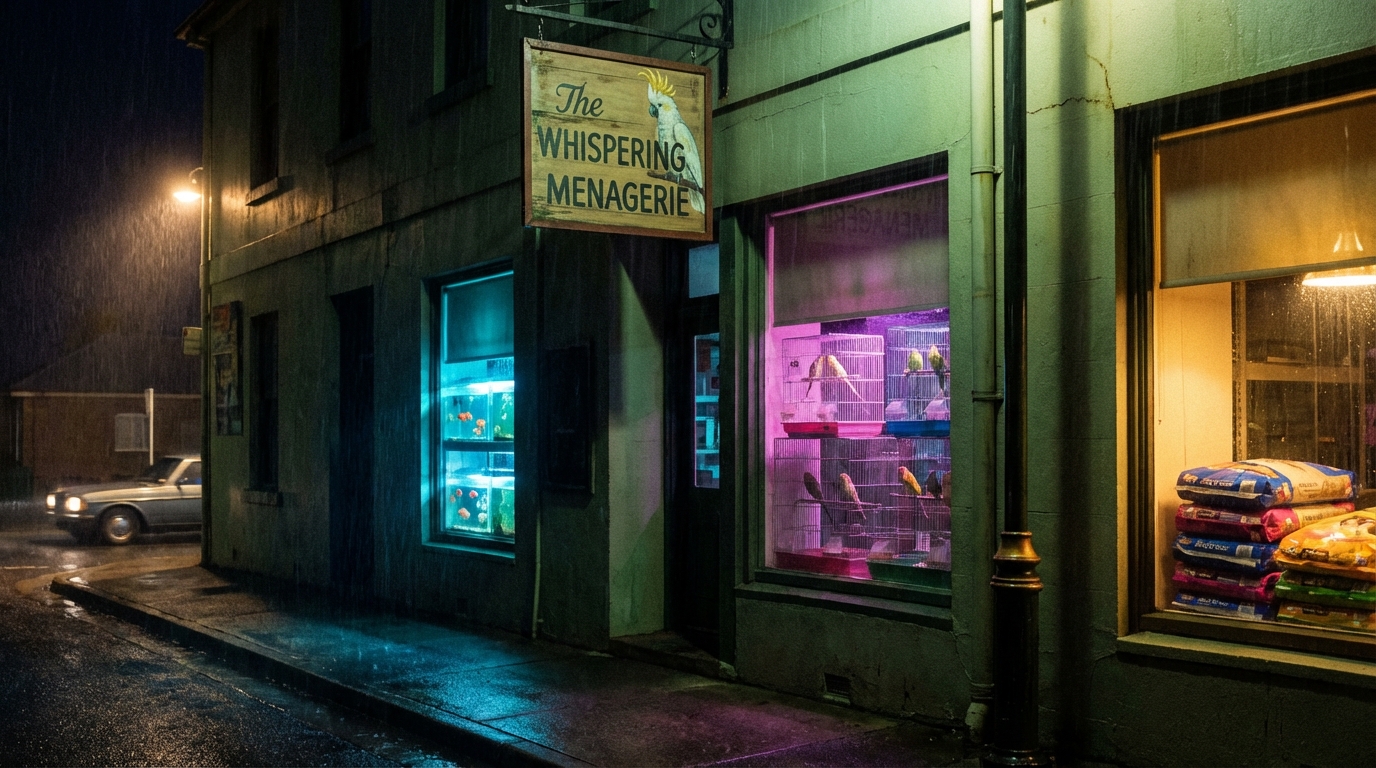
The Shopfront and Its Setting
The Whispering Menagerie occupies a single-storey weatherboard building on a quiet side street in New Norfolk, just two blocks from the Derwent River's banks and within walking distance of the town's colonial-era heritage precinct. The shop's exterior presents no particular distinction—faded green paint, a hand-lettered sign depicting a cockatoo, and window displays featuring the standard accoutrements of small-town pet retail: aquariums bubbling with goldfish, wire cages housing budgerigars in cheerful yellows and greens, stacked bags of dog food, and promotional posters for worming tablets and flea treatments.
The building itself, loated on 56 High Street, dates to the 1920s, constructed during New Norfolk's interwar expansion when the hop industry's prosperity encouraged commercial development along the town's secondary streets. Originally a grocer's shop serving the neighbourhood's working families, the premises passed through various incarnations—haberdashery, second-hand furniture, brief vacancy periods—before Johnny Ryman acquired the lease in late 1997. He spent the winter months renovating: installing proper ventilation for reptile enclosures, reinforcing floorboards to support aquarium weight, and, crucially, excavating and stabilising the basement that would eventually serve purposes far beyond simple storage.
The shop's location, whilst appearing unremarkable, possessed strategic advantages that Johnny recognised immediately. The side street received minimal foot traffic, reducing casual browsers who might notice inconsistencies between the Menagerie's modest retail offerings and the occasional exotic specimens passing through. The building's rear accessed a narrow laneway running parallel to the Derwent, providing discreet loading access away from High Street's perpetual observation. Most significantly, the site connected—through networks of colonial-era drainage culverts and riverbank pathways—to the same smuggling routes that New Norfolk's 19th-century residents had employed for moving contraband tobacco, spirits, and the occasional fugitive away from official scrutiny.
Inside, the shop maintained carefully orchestrated ordinariness. The front room displayed commercial pet supplies: shelving units bearing premium dog food brands, rotating stands of leashes and collars, refrigerated sections for live crickets and mealworms, and wall-mounted displays of grooming equipment. Three aquariums along the left wall housed tropical fish—common varieties like neon tetras, guppies, and corydoras catfish that any Tasmanian pet shop might stock. A glass terrarium near the counter contained a blue-tongued lizard named Trevor who served as the shop's unofficial mascot, his docile temperament and photogenic appearance making him perfect for children's visits and deflecting attention from more unusual inventory.
The right side of the shop housed small mammals and birds. Wire cages contained rabbits, guinea pigs, and the occasional ferret. A larger aviary accommodated budgerigars, cockatiels, and finches whose constant chirping provided ambient soundtrack masking conversations Johnny preferred to keep private. The counter area featured impulse-purchase items: chew toys, mineral blocks, cage accessories—all the mundane commerce that sustained the Menagerie's legitimate operations and provided unremarkable entries in account books should anyone ever examine them.
The Hidden Depths: Infrastructure of Dual Purpose
The basement, accessed through a reinforced trapdoor concealed beneath a rolling display unit of birdseed bags, represented the Menagerie's true heart. Johnny had excavated and expanded the original cellar, installing proper drainage, climate control, and reinforced concrete walls that dampened sound transmission. The space measured approximately twelve metres by eight, with ceiling height sufficient for Johnny to stand comfortably whilst tending enclosures.
Unlike the shop above, the basement made no pretence of ordinariness. Custom-built terrariums lined three walls, each designed for specific environmental requirements: arid zones for inland taipans and desert pythons, humid tropical environments for green tree pythons and water monitors, temperature-controlled sections for species requiring precise thermal regulation. Sophisticated filtration systems maintained air quality despite the density of reptilian inhabitants. Separate enclosures accommodated mammals destined for Bixbus—sugar gliders, quolls, and occasionally specimens of threatened species that Johnny acquired through networks operating in moral and legal grey zones.
The basement's fourth wall featured floor-to-ceiling shelving holding supplies that would seem excessive for a modest pet shop: bulk quantities of frozen rodents for python feeding, specialised vitamin supplements, veterinary equipment for basic medical procedures, shipping crates designed for long-distance animal transport. A small workbench accommodated record-keeping—though Johnny's meticulous documentation remained coded, species identified by numbers rather than names, sources obscured through deliberate vagueness.
Most significantly, the basement provided privacy for meetings that required absolute discretion. The space's soundproofing, its separation from street-level observation, and the legitimate cover provided by the shop above made it ideal for conversations about matters that could not occur in public venues. Here, in July 2018, Beatrix Cramer would reveal the existence of Portals and Guardians to Jarod James whilst a carpet python named Maggie draped companionably around his shoulders. Here, plans for inter-dimensional conservation would take shape between individuals whose trust had been forged through years of smaller collaborations and shared appreciation for creatures most people feared or misunderstood.
Establishment and Early Operations: 1998-2006
Johnny Ryman opened The Whispering Menagerie in March 1998, timing the launch for the approach of autumn when New Norfolk's population swelled slightly with seasonal workers arriving for the late hop harvest. His initial capital came from savings accumulated through years of odd jobs, a modest loan from his father George (who believed his son was simply opening a conventional pet shop), and proceeds from preliminary exotic trading that Johnny had conducted informally since the mid-1990s.
The shop's early months focused on establishing legitimacy. Johnny stocked standard inventory, cultivated relationships with local families seeking pets for children, and integrated himself into New Norfolk's small business community. He joined the Chamber of Commerce, sponsored a youth football team, and became a familiar presence at the Saturday market where he sometimes operated a stall selling rabbit hutches his father constructed. This community embedding served dual purposes: it normalised the Menagerie's presence in town whilst creating networks of goodwill that might prove protective should questions ever arise about the shop's less conventional operations.
By late 1998, Johnny began carefully expanding into exotic species. His first acquisitions were legal but unusual—monitor lizards, larger python species, exotic birds that required import permits but attracted no particular suspicion. He advertised these offerings through specialist reptile forums and hobbyist publications, attracting clients from Hobart, Launceston, and occasionally mainland Australia. This legitimate exotic trade established patterns—interstate shipping, occasional unusual deliveries, clients visiting from outside New Norfolk—that would later provide cover for operations that strayed considerably further from regulatory compliance.
The formalisation of Ryman's Exotic Trading Company in 1999 marked the Menagerie's evolution from pet shop with exotic sideline to sophisticated operation straddling legal boundaries. The company operated as a separate entity—registered, possessing legitimate import permits for certain species, maintaining relationships with breeders and dealers across Australia and Asia. Yet from its inception, Ryman's Exotic Trading Company facilitated transactions that conventional commerce could not accommodate: species prohibited under CITES regulations, animals sourced through networks that deliberately obscured provenance, transfers arranged for clients whose collecting habits exceeded what wildlife authorities would approve.
The early 2000s brought both growth and challenges. Johnny's network expanded to include contacts in Indonesia, Thailand, and the Philippines—regions where biodiversity and limited regulatory enforcement created opportunities for acquiring species unobtainable through legitimate channels. He developed relationships with shipping facilitators who understood how to move live cargo without attracting customs scrutiny, with veterinarians willing to provide health certificates for animals whose origins would not withstand close examination, and with clients whose discretion was guaranteed by their own investment in maintaining opacity.
The Southern Protection Front emerged as a persistent complication. This organisation—presenting publicly as a conservation group dedicated to protecting Tasmania's endemic species whilst operating privately as participants in the same exotic animal trade they ostensibly opposed—viewed Johnny's independent operation with hostility. The Front demanded tribute: a percentage of profits, priority access to certain species, information about Johnny's supplier networks. Their leverage came from capacity to cause trouble—anonymous tips to authorities, vandalism of shipments, harassment of Johnny's contacts.
Johnny resisted these demands with characteristic stubbornness. He paid enough to avoid immediate confrontation whilst maintaining operational independence, a balancing act that required constant vigilance and willingness to absorb occasional losses when the Front made examples of shipments they sabotaged. The 2006 raid on the Menagerie—triggered by Front-aligned informants—nearly ended Johnny's operations. Only advance warning from a sympathetic customs officer (whom Johnny had cultivated carefully over years) allowed him to relocate incriminating inventory to temporary storage before authorities arrived. The raid found nothing actionable, but the incident reinforced Johnny's understanding that his operations existed on sufferance, vulnerable to collapse should circumstances shift unfavourably.
The Mundane Years: Routine Operations and Community Integration
Between 2006 and 2018, The Whispering Menagerie settled into rhythms that balanced legitimate retail with clandestine trading. The shop maintained consistent hours—open Tuesday through Saturday, 9 AM to 5:30 PM, closed Sundays and Mondays when Johnny used downtime for animal care, record-keeping, and coordination with his wider network. The front-of-house operations remained genuinely conventional: local families purchased guinea pigs and goldfish, farmers bought working dog supplies, school groups occasionally visited Trevor the blue-tongued lizard for educational purposes Johnny tolerated with bemused patience.
The exotic operations continued in parallel, conducted with practised discretion. Shipments arrived typically on Tuesday evenings when New Norfolk's streets emptied early. Johnny would meet delivery vehicles in the lane behind the shop, transferring crates through the rear entrance directly to the basement. Animals remained in the basement for assessment periods—quarantine to ensure health, acclimatisation to reduce transport stress, documentation to establish provenance stories that would satisfy client inquiries. Transfers to buyers occurred through equally discrete channels: clients visited after hours, collections happened in locations away from the shop, shipping arrangements employed couriers who understood the value of incurious efficiency.
During these years, Johnny refined his operational security. He maintained multiple sets of records: legitimate books that would satisfy tax authorities and casual inspection, coded ledgers documenting actual trading activities, and mental catalogues of information too sensitive to commit to any written form. His basement inventory rotated regularly—species remaining only as long as necessary before transfer to clients or longer-term holding facilities Johnny operated at rural properties outside New Norfolk. This rotation minimised risk: a surprise inspection would find interesting but explainable inventory rather than volumes suggesting systematic illegal trading.
Johnny's relationship with the Southern Protection Front evolved into wary détente. He paid their demanded percentages—enough to maintain the appearance of cooperation without crippling profitability—whilst developing intelligence networks that warned him of Front operations that might affect his business. The Front, for their part, found Johnny more valuable as a reliable source of tribute than as a target for elimination. This equilibrium, though perpetually unstable, allowed both parties to operate with reduced conflict.
The Menagerie's community integration deepened through this period. Johnny sponsored local events, donated supplies to the primary school's classroom pets, and employed part-time staff from New Norfolk families—young people who worked front-of-house retail and never accessed the basement or learned about operations occurring beneath their feet. This employment served multiple purposes: it provided legitimate cover for Johnny's absences when exotic operations demanded attention, created goodwill with local families, and demonstrated the shop's normalcy through teenagers cheerfully discussing weekend plans whilst selling rabbit food to elderly customers.
The Transformation: Beatrix, Jarod, and the Bixbus Connection
July 2018 brought disruption that would fundamentally transform the Menagerie's purpose. Beatrix Cramer—whom Johnny knew through years of occasional dealings involving her antiques shop's more questionable acquisitions and her appreciation for the aesthetically unusual specimens he could source—approached him with a proposal that initially seemed like elaborate delusion or complex deception.
The basement meeting where Beatrix revealed the existence of Portals, Guardians, and Clivilius represented a threshold moment. Johnny's initial scepticism—rooted in decades of dealing with eccentric clients whose grandiose claims rarely matched reality—dissolved when Beatrix demonstrated her Portal Key, rainbow light bursting against basement walls in ways that no conventional explanation could accommodate. The presence of Jarod James, whose partnership with Beatrix in previous ventures Johnny respected, leant credibility that Beatrix's claims alone might not have secured.
The proposition was simultaneously audacious and aligned with inclinations Johnny had suppressed for years. Rather than sourcing animals for private collectors whose motivations ranged from scientific curiosity to ego gratification, he could supply species to Bixbus Wildlife Sanctuary—an ecological project aimed at establishing Earth-equivalent biodiversity in Bixbus's blank canvas environment. The work would involve greater complexity and risk than conventional exotic trading, but it offered purpose beyond profit: genuine conservation rather than commerce disguised with environmental rhetoric.
Johnny's decision to commit required remarkably little deliberation. The Southern Protection Front's persistent harassment had soured him on profit-focused trading. His growing unease about supplying collectors who treated rare species as status symbols or investment commodities clashed with the love of wildlife that had drawn him to this work initially. The Bixbus proposal offered transformation: his skills and networks serving conservation rather than commerce, his risk-taking channelled toward creation rather than accumulation.
The practical arrangements revealed the scope of what Johnny was agreeing to undertake. He would continue operating the Menagerie as cover, maintaining legitimate retail and selective exotic trading to avoid suspicion from sudden changes in business patterns. Simultaneously, he would source species specifically for Bixbus transfer—targeting animals that would contribute to ecosystem establishment rather than satisfying collector whims. Jarod, who had transitioned to Guardian status, would handle inter-dimensional transport, but Johnny's role remained crucial: selection, acquisition, health assessment, preparation for the extraordinary journey through Portal technology to an alternate world.
The implications rippled through every aspect of the Menagerie's operations. Johnny's sourcing criteria shifted—prioritising breeding potential, genetic diversity, and ecological functionality over rarity or visual appeal. His network contacts received revised requests that must have seemed peculiar: less emphasis on spectacular morphs and more interest in robust, adaptable individuals capable of establishing wild populations. His basement infrastructure expanded to accommodate longer holding periods as animals underwent preparation for conditions they would encounter in Bixbus's developing ecosystem.
