4338.212 · July 31, 2018 AD
The Web
Karl and Sarah arrive at a pristine Battery Point home to investigate another disappearance—only to find themselves pulled deep into a chilling pattern. When the name Luke Smith is spoken, everything fractures. With timelines aligning and nightmares manifesting, Karl must face the truth: this is no longer a string of coincidences. It’s a web—and they’ve just stepped into its centre.
“Sometimes the trap doesn’t spring shut—it waits, quiet and patient, until you realise you were in it all along.”
The tension in the car was palpable as Sarah and I drove to the Pafistis residence, a presence as real as either of us. Each kilometre stretched uncomfortably between us, the car’s interior shrinking with every passing minute despite the actual dimensions remaining unchanged. The silence wasn’t merely an absence of sound—it was active, oppressive, like fog thickening with every turn of the tyres. There was no radio, no idle conversation to fill the void, only the hum of the engine and the occasional hiss of tyres against the road still damp from last night’s rain. The air between us held the residue of last night’s emotional wreckage, the press of words unsaid grinding against the remnants of what we’d once called partnership.
Sarah stared resolutely out the passenger window, her profile framed by fleeting glimpses of the Derwent as we skirted the river’s edge. Her jaw was set, unmoving, lips pressed together as if physically holding something in—words, perhaps, or accusations I deserved. One finger tapped rhythmically against the folder in her lap—soft at first, then sharper with each poorly judged corner or sudden brake on my part. A metronome of quiet judgement. I could feel the sting of it even without looking at her directly.
The worst part wasn’t the silence itself. It was the fact that I deserved every second of it.
My mind, meanwhile, was a fractured mosaic of flashbacks that refused to stay buried. The nightmare lingered at the edges of my vision like afterimages burned into my retinas—Gladys’s scream, the glint of Luke’s knife catching lamplight, Sarah’s retreat from me at the Entertainment Centre car park. Even as I tried to focus on the case ahead, on the professional task at hand, they looped like static images on a malfunctioning screen, flickering in and out of relevance without my permission. The world outside the window passed in a smear of suburban facades and wet streets, but none of it anchored me to the present. I was adrift, and the woman sitting next to me, once my tether to sanity, now felt like a distant shore I could no longer swim to.
Sandy Bay faded behind us, its neat streets giving way to the affluence of Battery Point where the real money lived. Here, the homes became more ostentatious—weatherboard cottages replaced by stone terraces and glass-fronted modernist temples to wealth that screamed their owners’ success. I felt my grip tighten on the steering wheel as we rounded the corner onto the Pafistis street, knuckles blanching.
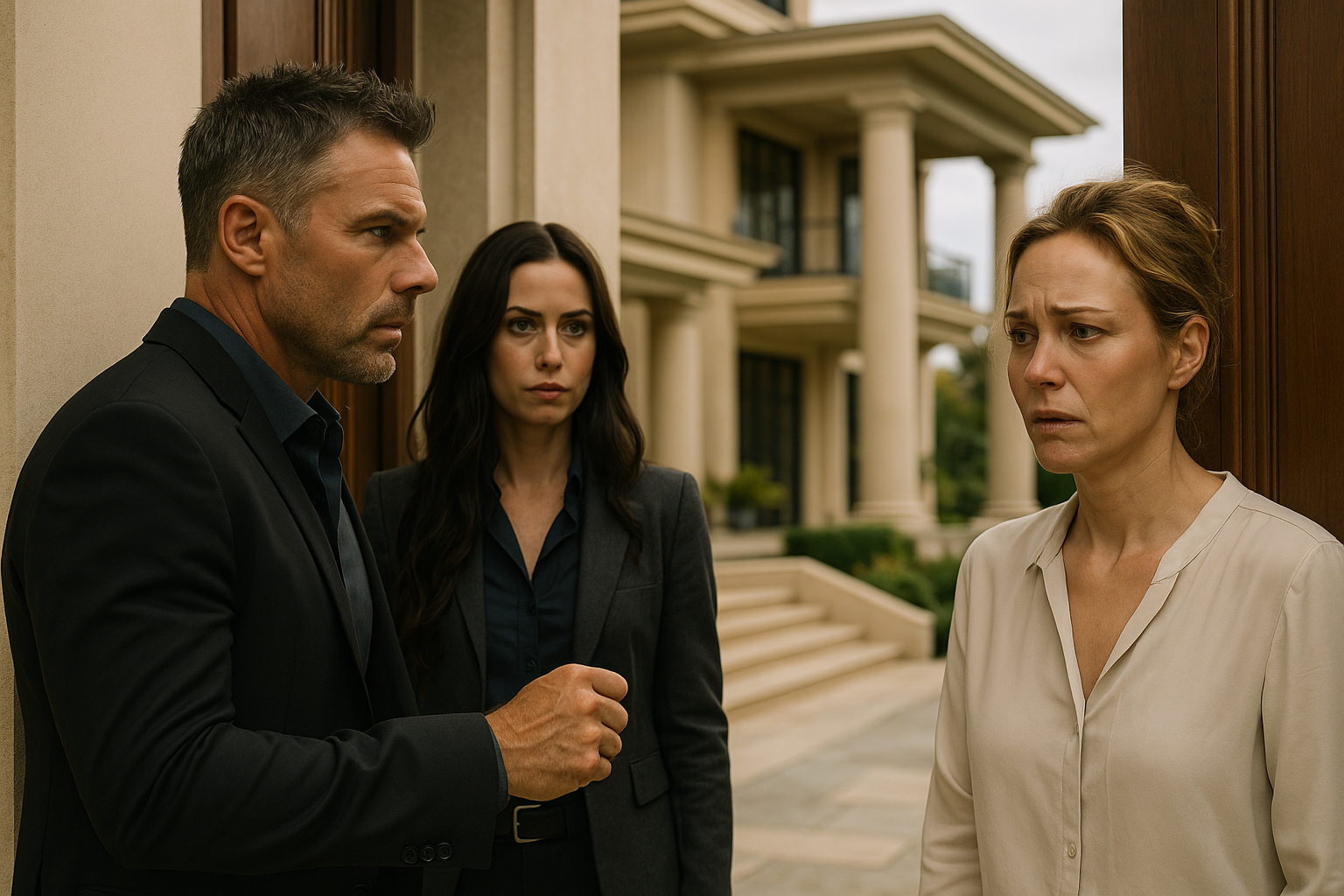
When we finally located the house, I let out a slow breath that didn’t quite release the tension. The place was a monument to quiet opulence, the kind that didn’t need to shout. A three-storey limestone structure rose from manicured lawns like it had always belonged there, regal and untouchable, looking down on lesser dwellings. The circular driveway cradled a stone fountain that murmured with gentle arrogance, water arcing in delicate plumes that sparkled in the late morning light. This wasn’t just a home—it was a statement about success and permanence.
Sarah and I exchanged a glance as we stepped from the car—the first direct eye contact since leaving the station. It was fleeting, unreadable, but mutual. Whatever else had transpired between us, whatever damage had been done, we were detectives first. And now we were on duty.
Before we could ring the bell, the door opened with disarming promptness, as though someone had been watching our arrival. A woman in her mid-forties stood framed in the doorway, composed and poised in ways that suggested money and good schooling. Her cream silk blouse and tailored trousers spoke of wealth and taste, but it was the way she held herself—still, but not stiff—that made me pause. Her grief, if it existed, was buried beneath layers of elegance and restraint that money could purchase.
"This way please, Detectives," Mrs Pafistis said, her voice smooth, accented faintly with British roots that had been softened but not erased by time in Australia. Her tone was polite but clipped, like she’d practised this welcome several times already—though perhaps never with the fact of a missing husband behind it, lending it new gravity.
The entrance hall was a showpiece. A crystal chandelier refracted morning light into fractured rainbows across the marble floor, while the high ceilings made my boots sound too loud, too ordinary, too working-class. We passed the kitchen on our right—stone countertops, brushed steel appliances, and a knife block so precisely arranged it could’ve passed for a museum exhibit. Even the fruit bowl looked more like a still-life than something people actually ate from.
I felt like a trespasser in my mud-stained boots and yesterday’s suit.
We followed her into the main living area, which opened out into something like a gallery—floor-to-ceiling windows showcasing a garden sculpted within an inch of its life by professionals. The infinity pool beyond was eerily still, its glassy surface reflecting the clouds above like a mirror too proud to ripple or acknowledge wind.
Original art lined the walls—pieces I recognised from auction catalogues and museum brochures I’d leafed through in waiting rooms. Rothko. Olsen. Something that looked like a Whiteley. If any of it was a reproduction, I couldn’t tell, and that was probably the point. This wasn’t just wealth. This was legacy, the kind that outlived its creators.
Sarah, always less easily impressed than me, always more at home in these spaces, gave a quiet breath of appreciation. "Your house is exquisite," she said, the compliment slipping past the mask of professionalism with surprising ease.
"Thank you," Mrs Pafistis replied. Her smile was gracious, but cool as the marble we stood on. "Much of this is my husband’s handiwork." Her eyes scanned the room briefly, the gesture filled with an odd melancholy, or perhaps uncertainty. As if she was trying to see it all from a distance, from an outsider’s perspective.
"Impressive," Sarah said, and I nodded, my voice stuck somewhere in the back of my throat. It was impressive. And somewhat uncomfortable. Standing in that room, with its curated elegance and studied perfection, I felt like I had no place here, no right to track my working-class problems across these floors. I thought of my cluttered little flat, of Jargus asleep on the bed this morning, the dented kettle, the mismatched mugs. I thought of the simple comfort of dog hair on the couch and laundry left to dry on a chair.
This place was another world—one where people didn’t vanish without reason, where nightmares were kept at bay by the thickness of glass and imported marble. Or at least, that was the illusion money bought.
And yet here we were, chasing another missing person behind another perfect facade.
Seated on the Italian leather sofa, the luxurious feel of the material was lost on me as I focused on the task at hand. The cushion yielded beneath me, enveloping me in a comfort that felt unearned, almost accusatory in its expense. This wasn’t the kind of house I ever felt at ease in—too immaculate, too still, too much like a stage set. I perched rather than settled, my boots leaving faint damp impressions on the edge of a rug that probably cost more than my car.
Across from us, Mrs Pafistis sat in a matching armchair with the posture of someone who had been taught to sit straight in childhood and never unlearned it. Hands folded neatly in her lap, ankles crossed at a precise angle, spine rigid with the tension of contained emotion. Her composure remained calm, nearly glacial, but it was the small things that betrayed her—eyes slightly red-rimmed beneath expensive concealer, the faintest tremor in her fingers as she poured water from a cut-glass decanter into matching tumblers. This was a woman gripping tightly to appearances, walking the razor’s edge between poise and panic.
I leaned forward, eager to commence the interview—not just for the sake of the case, but for the familiar rhythm of it, the procedural refuge it offered from the cloying awkwardness between Sarah and me. My notebook rested on my knee like a shield. I clicked my pen, the sound crisp in the silent room, establishing routine.
"Your full name for the record, please," I requested, my voice steadier than I expected it to be given my internal state.
"Sharon Louise Pafistis," she responded immediately. Her voice was steady, clipped, her accent betraying the lilt of Cornish roots softened by decades in Australia.
I wrote carefully, each letter formed deliberately. Each stroke of the pen helped ground me, gave me the illusion of order in a world increasingly chaotic. I underlined the date at the top of the page—habit, ritual, control. When I looked back up, I took my first proper moment to study her.
Sharon was slim, statuesque in a way that implied personal trainers and green smoothies and Pilates classes, rather than genetics alone. Her cheekbones were sculpted, her skin taut and expertly maintained through means I couldn’t afford to imagine. Full lips framed by a perfect sweep of nude lipstick, and eyes large and weary beneath the makeup. Every inch of her appearance had been considered, polished. The jewellery she wore—gold hoops, a diamond tennis bracelet, a thin watch from a brand I couldn’t name but instinctively recognised as serious money—was understated in that way that still screamed wealth to those who knew.
"And you say your husband has gone missing?" I asked, professional but attentive, trying to gauge the tension beneath her polished surface.
"Yes," she nodded. "Adrian."
She said his name carefully, as though speaking it aloud was both duty and burden. There was no tremble, no catch—just the quiet assertion of a fact she hadn’t quite made peace with yet. It didn’t sound like grief yet. Not in the way I’d heard it from Louise Jeffries, or even Jenny Triffett. This wasn’t raw or immediate. It was cooled, filtered through silk and money and social graces.
"When was the last time you had any contact with him?" I continued, already noting how eerily familiar this script was becoming, how much it mirrored previous interviews.
"I last saw him yesterday morning. He said he was going out to meet with a client about a new potential job." Her gaze hovered somewhere near my left shoulder, as if making direct eye contact might shatter her carefully maintained composure.
A cold sensation crept down the back of my neck—déjà vu laced with dread. Jenny Triffett’s words echoed in my memory with uncanny familiarity: "He said he had a quote to do." The similarities were indisputable. I shifted slightly, the leather sofa sighing beneath me. The pen in my hand stuttered across the page as my fingers twitched involuntarily. This wasn’t just another disappearance. This was a shape emerging from fog.
"What time was that?" I asked, focusing on the timeline—something tangible, something I could pin down.
"I’m not entirely sure. It would have been before nine," she said. Her fingers drifted to a gold bangle at her wrist, fiddling with it in a gesture so habitual it had likely gone unnoticed even by her. Another small crack in the exterior.
"Have you heard from him since? Any phone calls or text messages?" Sarah’s voice cut in from behind me, unexpected.
I turned slightly, surprised to find her standing, scanning the contents of a nearby console table. Framed family photos were arranged across the dark wood. Her movement through the space was quiet but deliberate—like a curator in a gallery, looking for inconsistencies in a painting, searching for what didn’t belong.
I caught her eye for a brief second, tried to signal her to return to her seat with a look, to keep this contained and professional. She ignored it—or pretended to. The space between us, once intuitive and seamless, was now fragmented. Even our silences lacked unity.
"No, nothing at all," Sharon answered, the mask slipping for just a moment. A faint catch in her throat, a flutter in her lashes. Her fingers curled more tightly in her lap.
"Did you know the person he was going to meet with?" I asked, seizing on the question like a lifeline. I wanted names, context, something concrete to cling to.
"No, I’ve never met them before," she said, and I let out a breath through my nose, disappointment coiling in my chest like smoke.
I’d been hoping for a breakthrough—something definitive, a thread we could pull that would unravel everything. Instead, I was left holding more questions.
"But you’ve heard of them?" I asked, pausing my note-taking to study her face more intently.
"Yes. I think Adrian had done a few renovation quotes for him before," she said, gesturing vaguely with one hand as though trying to swat away the ambiguity.
And there it was again—that same phrasing. "Quotes." Just like Nial Triffett. A pattern, repeating itself with eerie precision. My mind leapt ahead, already scanning for next steps, for names that might link these threads together into something visible.
But even as the investigation came into focus, my own internal unease deepened. The nightmare hadn’t just been a dream—it had been a warning. And as I looked around this immaculate room, as Sarah continued her silent audit of the space and Sharon Pafistis perched perfectly poised in her gilded grief, I couldn’t shake the feeling that the veneer of control was thinner here than it appeared.
"Is this your husband?" Sarah asked, picking up a small photo frame inlaid with mother-of-pearl. The question drew my attention away from my notebook.
It was a candid shot—too candid, too perfect in that way professional photographers made look accidental. The kind you’d find on an aspirational lifestyle blog: a couple beaming on a beach, golden hour light flattering their features, skin bronzed and glowing with health and happiness. Arms entwined, relaxed in the intimacy of the long familiar. The man—tall, athletic, dark-haired—wore designer sunglasses and the smile of someone who had long ago stopped worrying about bills or deadlines. A good-looking bastard, if I’m honest. I felt a flicker of something sharp and irrational in my gut—envy, maybe, or cynicism about wealth and its trappings.
My irritation sharpened as I glanced at Sarah. She was doing it again—picking up personal items mid-interview. I’d cautioned her before: photos were loaded objects. People saw them, remembered things, drifted from the track we needed to stay on. We were on the cusp of something—I could feel it—but now the lead risked slipping through our fingers.
"Yes, that was taken last year. We were on holiday in Bali. We managed to escape for a week without the kids," Sharon said, her voice shifting. The formality thinned, replaced by something wistful. Her gaze lingered on the image like someone trying to resurrect a moment that had already started to fade into memory.
"You both look very happy," Sarah observed, glancing in my direction. Her tone was smooth, unreadable. I couldn’t tell if she was softening the mood for Sharon’s sake or sending a subtle jab in my direction about happiness I’d destroyed.
"Yes, we were," Sharon replied, then caught herself, blinking quickly. "I mean, we are. We’ve always had a happy marriage."
There it was—the slip. The small but crucial lapse in tense, the backward glance into a past now spoken of in the past. It rang out in my mind louder than her correction, louder even than Sarah’s earlier question. It was a tell. Not necessarily guilt—but grief, anticipation, some unacknowledged awareness that the future had already shifted shape in her mind.
Sarah, seemingly oblivious to the shift in tone, pressed on. "You have children then?" Her voice was gentle, even warm, as if we were having coffee, not conducting a formal interview. She still held the photo, angling it towards the light. I resisted the urge to sigh.
"We have two daughters, Sarah and Brooke," Sharon replied, and for the first time her voice took on warmth that felt entirely unforced. She smiled—genuinely, I thought—and sat back slightly in her chair, the tension easing from her posture just enough to register.
"Are they home?" Sarah asked, finally replacing the frame with a reverent sort of care, as though returning a holy relic to its altar.
"No, they’re at my sister’s. I didn’t want them to be here while I spoke with you," Sharon said, her eyes flicking towards a hallway as if imagining the girls tucked away safely out of sight, or perhaps remembering the brief, quiet moment when she’d sent them away.
"We may need to speak with them too," Sarah said, stepping away from the photograph and towards the sofa. Her phone vibrated, breaking the rhythm. "Excuse me a moment," she added, already turning into the next room, her heels clicking softly against the polished floor.
Left alone with Sharon, I took the opening. My heart quickened as I leaned forward, focusing back on what mattered—what might break the case open.
"Do you know the name of this client?" I asked, my voice calm on the surface, but taut with barely contained anticipation underneath. My pen hovered over the page.
"I think he might have said the client’s name was Luke Smith?" she offered, the upward lilt of her voice making it sound like a question. As though she was unsure if she’d even heard it correctly. But it didn’t matter if she was sure.
The name hit me like a blow to the chest.
Luke Smith.
I stopped breathing for a second. The room remained quiet—too quiet—and yet I could hear the blood pounding in my ears, drowning out everything else. Something inside me reeled, lurched sideways, scrambled desperately for purchase on reality. I barely felt the notebook slide off my knee and onto the thick rug. The name echoed through me, detonating like a flare shot into darkness.
The coffee and toast I’d forced down earlier churned violently in my stomach. My throat burned with rising acid. I clenched my jaw, hard enough to make my teeth ache, trying to steady myself. To stay present. To not vomit on this woman’s expensive furniture.
Luke. Gladys. The window. The knife.
The memory of the dream surged back unbidden, vivid and grotesque and real. I could still see it—Gladys’s face turning from pleasure to pain, intestines slapping wetly against the ground below. My hands trembled at the memory, though I kept them in my lap, hidden from view, fists clenched tight.
Sharon said the name with uncertainty, but there was no uncertainty in me. The moment she’d uttered it, everything had snapped into sharper relief like a photograph developing. The disappearances, the quotes, the clients no one seemed to know—this was no longer a collection of parallel lines. It was a web. A snare. And at its centre: Luke Smith. His name radiated through it all like a buried live wire.
The feeling was beyond coincidence. This wasn’t just another missing man, another case file.
This was confirmation. This was the nightmare bleeding into reality.
I looked at Sharon, who sat oblivious to the storm now coursing through me. Her expression was open, even helpful, her body language earnest. She had no idea what she’d just unleashed.
I could still hear the voice from the dream. Still feel the cold edge of that whispered "Bye Karl," ringing through the back of my skull like a curse or prophecy. I swallowed hard, forcing it down.
Suddenly, a loud exclamation from the other room broke the tense atmosphere. "Shit!" Sarah’s voice rang out with a startling sharpness.
Sharon’s composure faltered. Her eyes widened, a flicker of alarm passing over her face as the sudden profanity cut through the calm like a snapped violin string.
I gave her an apologetic look, inwardly cursing the timing. "Sorry," I said quickly, feeling the heat climb my neck. We usually made a point of avoiding that kind of language in interviews—especially in homes like this, where appearances and manners mattered. But the sharpness of Sarah’s tone had carried more than surprise; it had carried meaning.
Sharon’s eyebrows lifted slightly, lips parting as if to ask a question she didn’t quite voice. Her hands remained neatly folded, but her posture was subtly altered now—attentive, uncertain.
Sarah re-entered the living room with purpose in every line of her body. Her previously cool demeanour had fractured, revealing something urgent beneath. Her eyes—sharp, wide, flashing—met mine. "Karl," she said, voice taut with significance. "You need to come and have a look at this."
Sharon straightened in her seat, her curiosity barely veiled now, eyes darting between us.
"Excuse me a moment," I murmured, my voice trying for calm but sounding hollow even to my own ears. I forced a polite smile, gave a slight nod, and stood. The Italian leather gave a soft groan beneath me as I rose—luxurious but suddenly oppressive, too soft beneath the urgency building in my chest.
I followed Sarah into the adjacent room—a dining area that screamed money: a table that could have hosted a UN summit, polished until it shone like glass, surrounded by chairs no one had sat in for comfort. Crystal sparkled in a cabinet behind her.
Sarah didn’t waste time. "I’ve just received the logs from Nial Triffett’s phone calls," she said, her voice rapid-fire, fingers swiping across her phone’s screen. The earlier frost between us had thawed beneath the heat of revelation.
My body responded before my mind caught up—leaning in, drawn by the urgency in her voice. The scent of her—citrus, rosemary, maybe sage—lingered in the air between us, disarming and strangely grounding. I pulled myself back to focus.
"And?" I asked, trying not to let the surge of adrenaline tangle my words. My headache pulsed behind my temple, the pressure sharpening.
"Ignore the missed calls from his wife," she said, handing the phone to me. Our fingers brushed, a ghost of contact that reminded me too vividly of last night. But this moment wasn’t about that. This moment was about something far more immediate.
I scanned the screen, my vision swimming slightly from the eye strain, before the name leapt out at me. My voice was barely above a whisper, but it felt like a thunderclap. "This call was from Luke Smith."
The weight of it landed hard. Luke Smith. The man from my dreams, the man whose name circled this investigation like a shark scenting blood. My stomach dropped. I couldn’t breathe for a moment.
"I know," Sarah confirmed, her voice low and grim. Her eyes met mine—steady, seeing too much. A shared understanding sparked between us. This wasn’t conjecture. This wasn’t pattern-recognition. This was real.
"Fuck, this is bad," I muttered, dragging a hand through my hair, feeling the cold sweat prick at the back of my neck. My pulse roared in my ears. The nightmares weren’t just nightmares—they were knocking.
"Yeah," Sarah nodded, then her tone shifted—urgency rising again. "But that—"
I cut her off, my thoughts racing ahead. "Sharon was just telling me she’s pretty sure the client her husband went to meet yesterday was Luke Smith."
The room froze between us, as if the name itself had rewound the air.
Sarah’s eyes flared with new intensity, her jaw setting. She didn’t need to speak to convey what we were both thinking: coincidence was off the table.
"But that’s not all," she said, and her voice dropped into something even tighter, more electric. She swiped to another image on her phone and thrust it under my nose, her breath shallow with anticipation. "Look at this."
I squinted at the grainy security footage. A figure standing at an ATM, body turned halfway from the camera. The resolution was poor, the details murky.
"What’s this?" I asked, unsure what I was meant to see.
"Security footage from Jamie’s account withdrawals," Sarah said. "Check the face. It’s not Jamie."
I leaned in, eyes narrowing. Something about the posture was wrong—broader shoulders, thicker arms. The height. The stance.
And then, as the face turned half-towards the lens, recognition struck like a hammer blow.
"It’s Luke Smith," she said, confirming what I already felt in my gut.
The name tolled again, now a knell over everything. I gripped the edge of the mahogany table to steady myself. It felt like the floor had shifted beneath me, as though the whole investigation had just tilted on its axis. Luke wasn’t just a name anymore. He was a presence. A shadow in the footage. A voice in my dreams. A puppet master, hidden in plain sight.
The air in the dining room thickened. The opulence suddenly felt suffocating. The chandelier above seemed to watch us like a thousand tiny eyes.
Luke Smith was everywhere. And now he was here too.
I saw it on Sarah’s face—the same dread, the same weight of realisation settling into her bones. Everything we thought we knew had just been eclipsed by something darker. We weren’t dealing with isolated disappearances.
We were stepping into the web.
And Luke Smith was at the centre.
And for the first time, I wondered—not whether we’d find him.
But whether we should be afraid of what would happen when we did.
