
4338.209 · July 28, 2018 AD
The Static Between Us
Back at the Hobart station, Sarah and Karl sift through bank statements and timelines, each chasing truth along their own invisible track. When Sarah’s intuition sparks against Karl’s logic, tempers flare — and what begins as analysis becomes a quiet fracture. As the case widens, their partnership thins, and the folded scrap in Sarah’s pocket hums like a secret too loud to ignore.
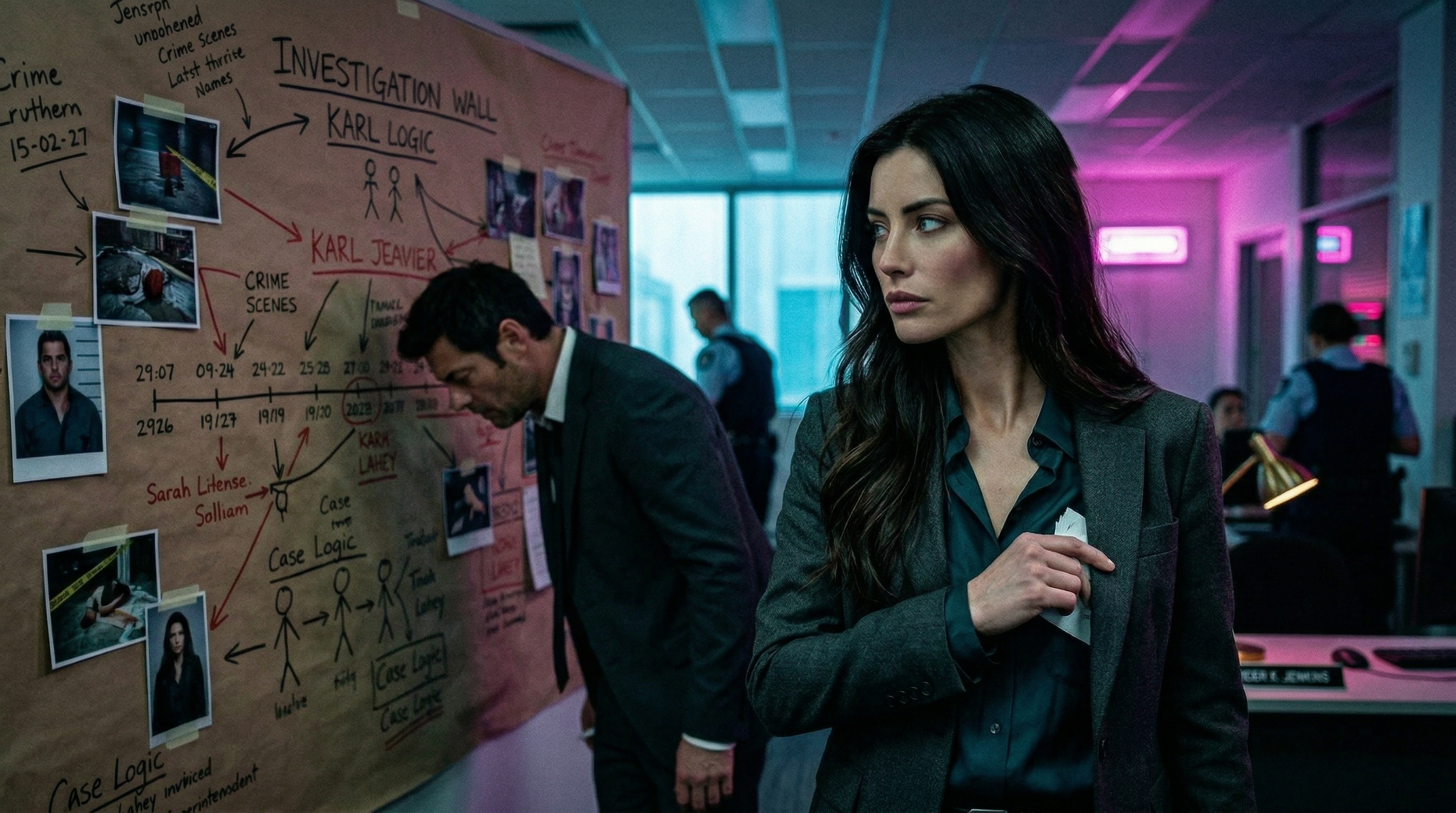
"You can hear a lie before it’s spoken. It sounds like interference — low, constant, and getting closer."
As I stepped back into the main office, the familiar hum of police activity wrapped around me like static. Phones rang with their persistent, mechanical urgency. Footsteps thudded rhythmically across linoleum worn smooth by decades of passage. Colleagues murmured over steaming mugs of weak instant coffee, their voices blending into an indistinct drone that somehow managed to be both comforting and grating.
It was the ordinary chaos of another Saturday in Hobart’s Southern Division — but inside my chest, everything still felt wired from what I’d just done.
My hand moved unconsciously to my pocket, feeling the outline of the folded paper through the fabric. The weight of it seemed disproportionate to its size, as though guilt had actual mass. I forced my hand away, forced my breathing to steady, forced myself to look normal.
Whatever normal meant anymore.
Karl was seated at his desk, shoulders hunched in deep concentration, his entire body language speaking of a mind engaged in architectural construction. His brow furrowed as he stared at something only he could see, completely lost in whatever mental framework he was building. His right leg bounced unconsciously beneath the desk — a sure sign his thoughts were firing at full speed, connections forming and reforming.
I knew that look. Had seen it countless times over the months we’d been partnered. It was Karl at his best and his most unreachable — brilliant and utterly isolated in his own head.
"Where do you want to start this investigation?" I asked, my voice slicing through his reverie.
He flinched slightly at the sound, blinking as he returned to the room, to the present, to me. For a moment his eyes held that slightly unfocused quality of someone being yanked back from a great distance. Then clarity returned, sharp and immediate.
Rising from his chair — an ageing relic whose flattened cushion bore the evidence of too many long nights and not enough ergonomic consideration — he stretched slightly, vertebrae popping in a cascade that I could hear from where I stood. Then he moved over to the far wall.
It had become his unofficial thinking space over the past few weeks, slowly accumulating layers of paper that clung like ivy to brick: notes, photos, scribbled names, timelines, post-its slowly curling at the edges from the heat and humidity of too many bodies in too small a space. A single sheet of butcher’s paper stood out amongst the chaos, pristine but vulnerable, like the first page of a story we didn’t yet understand.
The wall itself told its own story — a palimpsest of past investigations, half-removed tape marks, pin holes, the ghostly rectangles where photos had once been pinned. This wasn’t Karl’s first case to colonise this space, and it wouldn’t be his last.
"I've been putting a bit of a timeline together," Karl said, gesturing to the butcher’s paper. His voice was distant but not distracted — thoughtful, like he was walking me through something still unfinished in his own mind, still malleable, still subject to revision.
"On that?" I asked, tilting my head as I approached, unable to keep a touch of scepticism from colouring my voice as I surveyed the crude sketches and uneven handwriting that populated the page.
It looked less like a case board and more like a primary school art project on missing persons. Stick figures populated the timeline with varying degrees of anatomical accuracy, some with arms, some without, all rendered in Karl’s distinctive scrawl that managed to be both precise and childlike simultaneously.
He gave a sheepish shrug. There was no pretence in it, no defensiveness — just honest acknowledgment of his limitations as a visual artist. "What? I wanted to get my thoughts out before they disappeared."
A small smile tugged at the corner of my mouth despite everything — despite the paper hidden in my pocket, despite the lingering unease from Claiborne’s office, despite the secrets I was now carrying. This was classic Karl: brilliant but self-deprecating, capable of seeing patterns no one else could whilst simultaneously convinced his methods were inadequate.
"Oh, come on, Senior Detective," I teased gently, falling into the easy cadence we shared, the familiar rhythm of our partnership. "Give yourself a little more credit."
He exhaled through his nose — almost a laugh, but not quite, more like the acknowledgment of a joke he’d heard before but still found mildly amusing. Then he gestured again to the wall, his hand sweeping across the butcher’s paper with something approaching pride despite his earlier self-deprecation.
The stick figures were skeletal, crude, but oddly effective in their simplicity. Karl had always been more intuitive than he liked to admit, more comfortable working with visual metaphors than complex databases. He didn’t need fancy tools or sophisticated software — just the space to think, to see, to arrange information in ways that made sense to his particular brand of logic.
"So... what have you timelined then?" I asked, genuinely curious now, my earlier scepticism giving way to interest. Even if part of me was still recovering from the adrenaline crash of stealing from a superior officer, I couldn’t help but be drawn into Karl’s process.
His eyes scanned the sheet, and I watched them move — left to right, then back again, checking, verifying, ensuring he hadn’t missed anything in his translation from thought to paper.
"Not a lot," Karl admitted, the usual edge of frustration creeping into his voice like an unwelcome guest. He hated having incomplete pictures, hated the gaps that kept him from seeing the full story. "We know from this—" he pointed to the first stick figure, a comically skinny one without arms, "—was the last time Louise heard from her brother. This second figure—" he gestured further along the timeline, to a slightly more elaborate stick person "—is when she sent Kain to check on them."
I studied the figures, trying to see what Karl saw, to understand his logic for representing them this way. The armless first figure — was that deliberate? A symbol of helplessness, perhaps? Or just Karl’s impatience with details he deemed unnecessary?
"And the third one?" I asked, smirking despite myself as I pointed to an even more elaborate stick figure that seemed to have actual hair.
"That's Louise coming to visit us today," he said, his tone tightening as he refocused, the brief moment of levity passing as quickly as it had arrived.
"Of course," I said, scrunching my nose and giving a slight nod. I should have guessed. As rough as the sketches were, the way Karl spoke about them was anything but careless. His mind worked in patterns, in visual representations that transcended artistic skill. He needed to see the gaps, to identify the spaces between known events where mystery lurked.
And for all his flaws — God knew there were many, and I was becoming increasingly aware of them — his instincts were almost always dead on. That intuitive leap from scattered data to coherent narrative was his gift, the thing that made him a brilliant detective despite his tendency towards crude stick-figure timelines.
He stood there for a moment longer, squinting at the paper like it might shift and reveal something he’d missed, some pattern still hidden in the spaces between his marks. I could practically see his mind working, turning over possibilities, testing theories against the sparse facts we had.
Then he turned to me, decision crystallising in his expression.
"We should start by checking their bank accounts," he said with quiet finality.
And just like that, he snapped into motion — spinning on his heels with the kind of fluid precision that came from years of practice, grabbing for a notepad that sat on the corner of his desk, already halfway back to his workspace before I’d fully processed the transition. That was Karl to a tee: once he had a direction, everything else fell away. No hesitation, no second-guessing, just forward momentum.
I followed, matching his pace, my mind now tracking forward in time alongside his. Whatever lay in those bank records — transactions, gaps, anomalies, the digital breadcrumbs people left behind in their financial lives — it would begin to tell us the real story.
And I had a sinking feeling it wouldn’t be anything like the one we’d just heard from Louise Jeffries.
Having secured access to both Jamie and Kain’s financial records — despite the distinctly uncooperative bank manager who’d made us feel like we were asking for state secrets rather than routine information for a missing persons investigation — Karl and I settled into the painfully mundane task of combing through the accounts.
The process had taken over an hour of phone calls, warrant verifications, and bureaucratic rigmarole that seemed designed specifically to waste police time. The bank manager, a thin man with a perpetually pinched expression, had questioned every line of our authority, demanded additional documentation, and generally behaved as though we were attempting to hack into Fort Knox rather than review the financial records of two missing people whose family had consented to the search.
By the time we’d finally received the printouts — delivered via a courier who looked equally suspicious of us — my patience had worn tissue-thin.
Karl took Kain’s records, and I focused on Jamie’s. We sat opposite one another in one of the station’s smaller interview rooms, now temporarily converted into a makeshift data analysis centre. The lighting was too harsh, throwing everything into stark relief and creating shadows that seemed darker by contrast. The chairs were too stiff, institutional furniture designed for discomfort rather than extended use. And the smell of stale instant coffee clung stubbornly to the air, mixed with something else — old carpet, cleaning solution, the accumulated scent of anxiety from countless interviews conducted in this space.
The walls were blank except for a single motivational poster someone had hung years ago — something about teamwork making the dream work, the lettering now faded to near-illegibility.
I flipped through page after page of Jamie’s statements, my eyes beginning to blur from the monotony of petty purchases and routine expenses. Bank statements were always like this — simultaneously revealing and obscure, a record of life reduced to numerical transactions that told you what someone bought but not why, where they spent money but not what they were thinking.
There was a numbing regularity to Jamie’s spending habits. Petrol at the same station every week. Groceries from the same supermarket on roughly the same days. Occasional online orders from mainstream retailers — Amazon, eBay, nothing unusual. A gym membership that charged monthly. Subscription services: Netflix, Spotify, a couple of others I didn’t recognise.
No major withdrawals. No flight bookings. No hotel reservations. Nothing out of place. Nothing useful.
The portrait that emerged was of someone living a perfectly ordinary life — working, eating, occasionally treating themselves, paying their bills on time. It was almost aggressively normal, which was somehow more frustrating than finding obvious anomalies would have been.
I found myself checking the dates obsessively, cross-referencing them with the timeline Karl had sketched, looking for gaps or changes in pattern. But there was nothing. Right up until three days ago, Jamie had been living his usual life, making his usual purchases, following his usual routines.
And then... silence.
"Well, that was a fruitless exercise," Karl sighed eventually, breaking the silence that had settled over us for the past forty minutes. His voice was threaded with frustration, the kind that came from expecting answers and finding only more questions.
I didn’t respond straight away, my eyes still scanning the final lines of Jamie’s last statement, as though staring at them hard enough might make new information materialise. The numbers no longer felt like leads — they were just... numbers. Meaningless digits in columns, signifying nothing beyond themselves.
But even so, I couldn’t let go of the feeling that something had to be there. Some clue hidden in plain sight, some pattern I wasn’t seeing.
Karl pressed on, clearly thinking aloud now, working through his analysis in real-time. "Unless Kain has additional investments and finances secretly stashed elsewhere, which I highly doubt given how generous his parents seem to be, he has very simple spending habits, and, frankly, not much money. There's no indication that he purchased plane tickets or jumped on the ferry to Melbourne. But..."
My head snapped up at the trailing word, attention immediately sharpening.
"But?" I echoed, sitting straighter in my chair, the stiffness forgotten.
It wasn’t like Karl to trail off mid-thought. Not unless it mattered. Not unless he was weighing how to phrase something, or deciding whether something was significant enough to mention.
He gave a faint shrug, rubbing the back of his neck in that gesture he always made when he was uncertain. "Looks like Kain is a fan of the game Candy Crush. There are a few small transactions from the game at around 11:00 p.m. on the night before he visited Jamie, but I don't see how that's going to help us determine what happened after he saw Jamie. If he ever did see him, that is."
The casualness of the observation belied its potential significance. Game purchases at 11 p.m. — which meant Kain had been alive, had been using his phone, had been engaged in normal activity the night before he’d supposedly gone to check on his uncle.
I narrowed my eyes, studying Karl’s expression, trying to understand what he was thinking. "You don't think he did?"
His shoulders lifted in a vague shrug, his face carefully neutral in that way that suggested he was already three steps ahead but didn’t want to commit to a theory yet. "I'm not sure yet."
That was the thing with Karl — he didn’t guess. He didn’t run ahead of the evidence, didn’t let intuition override facts. He waited for information to stack itself up into something solid, something that could support the weight of a conclusion.
Me? I was already drawing connections in my head like red string on a conspiracy theorist’s corkboard. Already seeing patterns, possibilities, narratives that might explain the gaps.
"Well, I might have something," I announced, unable to keep the spark of excitement from my voice.
I rifled quickly through Jamie’s pages until I found the one I was looking for — the final statement, the last record of his financial activity. My hands moved with sudden urgency, paper rustling as I located the specific line.
I shoved the statement across the table towards Karl with enough force that it slid further than intended, nearly sliding off the opposite edge before he caught it.
"There, look at the last transaction," I said, tapping the line with firm insistence, my finger pressing hard enough to leave a slight indent in the paper.
Karl took the statement, his eyes scanning the entry with that methodical thoroughness he brought to everything. Seconds ticked by.
"Possibly," Karl muttered after a moment, his tone maddeningly cautious. That small nod of his, that measured look — it wasn’t enough. Not nearly enough for what I thought I was seeing.
"Possibly?" I stared at him, incredulous, feeling the frustration bubble up hot and immediate. "Only possibly? This is huge!"
My heart had started to race, that familiar rush I knew too well. It was the feeling I lived for — the sense that something was happening, that we were no longer just shuffling paper but actually moving forward, actually getting somewhere. This wasn’t just admin anymore. It was movement. Clarity. The lead we desperately needed.
"But it doesn't prove anything, nor give us any real information to go on," Karl replied, already grounding me with that steady pragmatism he always wielded like a shield against speculation.
His voice was calm, reasonable, infuriatingly logical. The voice of someone who’d seen too many promising leads evaporate under scrutiny to get excited prematurely.
"He practically drained his bank account in a single transaction three days ago!" I countered, my voice rising with everything I believed this could mean, the implications cascading through my mind faster than I could articulate them.
The transaction was there in black and white: a withdrawal of essentially every dollar Jamie Greyson possessed, transferred out in a single movement. Three days ago. Right before he’d gone silent.
"Louise is clearly justified in suspecting some sort of foul play," I continued, the words tumbling out now, my brain racing ahead to conclusions. I paused, took a breath, trying to organise my thoughts into something coherent. "I reckon that Luke Smith killed Jamie, then Kain caught him covering up the body, so Luke killed him too."
There it was. A theory, fully formed, presented complete. It fell out of my mouth faster than my brain could finish stitching together all the supporting evidence, but I could feel it — that intuitive certainty that sometimes came before facts, that sense of rightness that preceded proof.
It made sense. It explained the drained account, the disappearances, the timing. Luke kills Jamie, takes the money, and when Kain arrives unexpectedly, he has to eliminate a witness.
"Sarah!" Karl snapped.
The sound of my name, delivered with such sharp force, cut through the air like a whip crack. I flinched involuntarily, my enthusiasm gone in an instant.
He was glaring at me — jaw clenched, brow drawn into sharp lines, frustration simmering behind his eyes like something volcanic preparing to erupt. The temperature in the room seemed to drop by five degrees.
I went quiet, the thrill draining from my body like blood from an open vein, leaving me hollow and suddenly cold. I looked away, breaking eye contact, suddenly unsure. Stung by the vehemence of his reaction.
Karl’s temper was... well-known. Sometimes quick, always sharp when it flared. It appeared and vanished with equal rapidity, leaving no trace except the memory of its intensity. But in that moment, I felt something different behind it. Something more than just professional impatience with speculative leaps.
There was a flicker of something else in his expression — fear? Guilt? Something I couldn’t yet name but which sent a chill through me that had nothing to do with the cold room.
As much as I was falling for him — and I was, undeniably, maddeningly, against my better judgment — this was the side of Karl I struggled with. The moments when warmth gave way to steel without warning. When his walls shot up — unscalable, impenetrable, topped with razor wire and posted with no-trespassing signs.
There was passion in him, yes. I’d seen it, felt it, revelled in it during our secret encounters. But there was something else too. Something older, coiled tight beneath the surface like a spring under constant compression. Something dangerous that occasionally pressed against the constraints he’d built around it.
The silence sat between us, thick and uncomfortable. I kept my gaze fixed on the bank statements in front of me, not really seeing them anymore, just using them as a focal point to avoid looking at Karl, to avoid seeing whatever was happening in his expression.
He stood motionless now, one hand resting absently on the back of his chair, the other hanging limp by his side. His gaze was fixed on the timeline across the wall, but I knew he wasn’t really seeing it. He was elsewhere — deep in that private maze of logic and instinct he never invited me into, navigating corridors I couldn’t follow.
I watched him carefully from my peripheral vision, trying to time my next move. With Karl, you had to pick your moment carefully. Interrupt him too soon, and you risked shattering whatever fragile thread of thought he was holding onto, whatever connection he was trying to make. But wait too long, and the moment would pass, the insight would slip away before he could catch it.
Somewhere a chair scraped. Someone walked past in the corridor outside, their footsteps muffled but audible. The fluorescent lights hummed their persistent fifty-cycle song.
Then—"Aha!"
The word burst out of him, sharp and spontaneous, a flash of electricity breaking the static that had filled the room. His entire posture changed in an instant, tension releasing as whatever he’d been grasping for suddenly crystallised.
"What?" I asked, leaning forward immediately, seizing the moment before whatever insight he’d achieved could slip away unshared.
But Karl didn’t answer straight away. He stayed locked in thought, his eyes narrowing as he followed some invisible trail only he could see, connecting dots that existed only in his mind. His lips moved slightly, as though he was talking himself through the logic, verifying the connections.
I waited, watching him with a mixture of patience and urgency, the silence now prickling with anticipation rather than discomfort. This was different from before — this was Karl in breakthrough mode, Karl seeing something the rest of us had missed.
Finally, after what felt like an eternity but was probably only ten or fifteen seconds, he snapped back to the present. His focus zeroed in on me, his earlier anger completely forgotten or at least set aside.
"Sarah," he said, his voice calm now, clipped and deliberate, each word carefully chosen. "If we can find Kain, he'll lead us straight to Jamie."
I blinked, caught off-guard by the certainty in his voice. "Are you sure?"
His conviction had blindsided me. As ever, I was playing catch-up, trying to keep pace with deductions he hadn’t yet explained out loud, following a logical path he’d already completed while I was still at the starting point.
Karl rarely shared his full reasoning process. Sometimes I wondered if he assumed I could read his mind — or maybe he just forgot that other people couldn’t see the connections as quickly as he could, couldn’t make the intuitive leaps that seemed obvious to him but remained invisible to everyone else.
If only I had mutant powers or some second-sight, I thought ruefully, life as a detective would be far easier. As it was, I had to settle for being merely competent while Karl operated on some other level entirely.
"Jamie has all the skills to go off the grid if he wants to," Karl said, his voice steady now, almost clinical in its assessment. "That'll make him hard to pin down on our own. We need Kain. He's the one who can lead us to Jamie."
Go off the grid? The phrase lingered ominously in the air, carrying implications I didn’t fully understand. What skills did Jamie possess that made him capable of disappearing so completely? What did Karl know about Jamie Greyson that I didn’t?
I wanted to ask, wanted to demand clarification, wanted to understand the full picture Karl was seeing. But I could see his mind had already leapt ahead, already moved past explanation into planning, assembling the next phase of action with that rapid-fire decisiveness he brought to everything once his mind was made up.
That was his gift, really. His ability to spin threads into theory, to glimpse the shape of a truth still hidden to everyone else. Sometimes I envied it — the clarity, the certainty, the way he could cut through confusion to find the signal in the noise.
Sometimes I feared it — the way it isolated him, the way it made him impatient with those of us still struggling to catch up, the way it occasionally led him to conclusions that seemed to come from nowhere, unsupported by any evidence the rest of us could see.
"I don't think you're going to find anything," Karl continued, already issuing instructions, already assigning tasks with the authority of someone who’d mapped out the entire strategy while the rest of us were still reading the terrain.
His words landed with a certainty that brooked no argument.
"But if Jamie has that much cash, he could've purchased plane tickets without leaving an online record. I want you to follow up with both the Hobart and Launceston airports to check whether either Jamie or Kain have boarded any flights in the last five days."
"Okay," I said, blinking through the sharp pivot in pace, the sudden shift from theory to action. There was always a moment of disorientation when Karl changed gears so fast, when his mind moved from analysis to execution with such fluidity that everyone else was left scrambling to keep up.
"And what are you going to do?" I added, unsure why I even asked — maybe just to ground myself, to establish my own bearings in this suddenly accelerated timeline.
Karl didn’t answer right away. His eyes were distant again, focused inward on whatever plan was forming. Then, delivered with quiet finality: "I'm going to visit Luke Smith."
That caught me completely off-guard, stopped my thoughts mid-track.
"But—" I started, instinctively ready to object. We never split up at this stage of an investigation. Not when we were this close to something that could escalate quickly, not when there were still so many unknowns. Partnership meant staying together, providing backup, being there if things went sideways.
"Time is of the essence here, Sarah," he said, his voice final, cutting off my protest before it could fully form. "If my hunch is wrong and you're closer to the mark, then Jamie and Kain are in danger, and we have to divide and conquer."
The logic was sound. I hated it, but I couldn’t fault it. If Karl was right and this was about Jamie going off-grid voluntarily, we needed different approaches. If I was right and Luke Smith had killed both men, every second counted.
But it still felt wrong. It felt rushed, premature, like we were acting before we had enough information to act safely.
"Fine," I said, masking the disappointment in my chest with a flat professionalism that came more easily than it should have. If Karl heard the undercurrent of hurt beneath the word, he didn’t show it. Or maybe he did hear it and simply chose not to acknowledge it, filed it away as a problem for later, after the case was solved and emotions could be safely addressed.
I ran my hands down my trouser legs, trying to refocus, trying to shift from feeling sidelined to feeling purposeful. As I did, my fingertips brushed the folded scrap of paper still hidden in my pocket.
It was warm from my body heat, and suddenly heavier than I remembered. A physical reminder of secrets kept, of lines crossed, of trust broken.
Anyway, you've got your own investigating to do, I reminded myself firmly, pushing away the sting of being benched and the deeper sting of being shut out from Karl’s plans. There was work to be done. People were missing. Whatever personal drama was unfolding between Karl and me could wait.
And now, maybe, I had a mystery of my own to crack wide open. Two mysteries, in fact — the official one involving Jamie and Kain, and the unofficial one burning a hole in my pocket.
