4338.205 · July 24, 2018 AD
The Silence That Follows
Tensions in Clivilius fracture beyond repair as Paul’s faith collapses and Jamie’s fury hardens into dismissal. Left with only guilt and the weight of choices he cannot undo, Luke returns through the Portal to face the silence of a world that suddenly feels smaller, emptier, and far less forgiving.
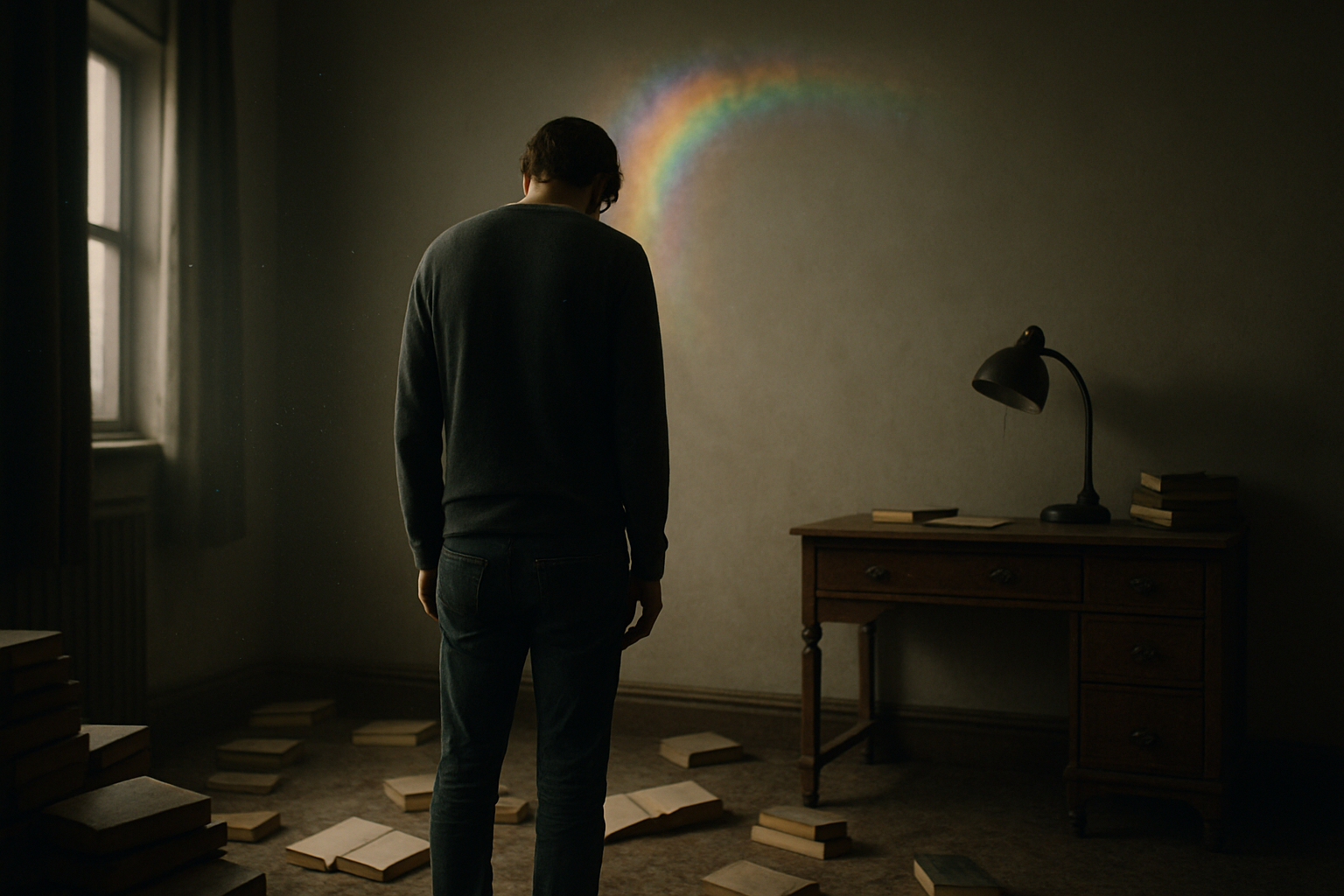
“The worst sound isn’t anger or accusation—it’s the silence that settles when love gives up on you.”
As I stepped back into Clivilius, the shift was brutal in its indifference.
The kaleidoscope of the Portal collapsed behind me, but instead of wonder or awe, I was met with an atmosphere dense as lead. The very air seemed to pulse with unspoken tension, pressing against my chest, heavy with the raw edges of fear and resentment. Where the study had held silence, here silence was alive—watchful, waiting, thick enough to choke on.
Paul's eyes found mine the instant I emerged.
There was no fire in them. No storm of rage. But something far sharper. His look cut clean through the thin veil of composure I tried to hold, slicing past every defence I might have assembled. Confusion sat there, yes, but laced with an accusation that needed no words. It was the gaze of someone who feels the ground has shifted beneath him and blames you for pulling it away.
"Did you know?"
His voice was quieter than I expected—subdued almost—but the sadness within it carried more force than any shout. It struck harder than anger, burrowed deeper, because it wasn't fury I was facing. It was betrayal. The sound of it cracked the fragile armour of excitement I had built around myself, and for the first time the reality of his predicament—their predicament—loomed over me like something I couldn't outrun.
"Know what?" The words tumbled out on reflex, sharp with defensiveness. My shoulders lifted in a shrug, feigning ignorance, but inside my thoughts ran wild. What did Clivilius know? What had it withheld? What had I ignored in my eagerness to believe? Its cryptic whispers had guided me here, but the same vagueness that had once thrilled me now felt like a blade with two edges—one that revealed, and one that concealed.
"That we wouldn't be able to get back." Paul's voice cracked slightly on the last word, but the weight of the statement landed heavy, irrevocable.
"How would I have known?" I shot back, frustration coiling in my throat. "I've been the only one here until now, and I've been able to come and go as I please." Even to my own ears, the words carried the ring of excuses rather than explanation.
"So, this is it then," Jamie spat, his voice serrated with fury. Each word carried the bite of despair, hurled like weapons into the dust. "This is our fate. To die in this god-forsaken dust."
"Not fate. Destiny," I countered, the word lifting from me almost before I had chosen it.
Something within me surged—a fierce ember of conviction that refused to be extinguished by their doubts. My voice was steadier than I felt, carrying the weight of belief, the insistence that this wasn't an ending but a beginning. I clung to the vision that had sustained me: Paul and Jamie not as prisoners of circumstance but as pioneers. The first immigrants of a civilisation waiting to be born. In my mind, I saw the dust transform beneath our hands into roads, shelters, a living world. The thought alone sparked a flicker of exhilaration, fragile yet bright against the bleakness surrounding us.
But their faces told a different story.
Paul and Jamie stood unmoved, their eyes flat, their silence louder than any protest. Blank stares met my conviction, and in them was nothing of belief—only distance. The gap between us yawned wider with every word I spoke, a chasm I had carved with my own enthusiasm and now couldn't bridge.
"You're so full of shit sometimes." Paul's voice cut clean through the silence, brutal in its directness. It wasn't shouted, wasn't even heated—just flat, exhausted, and sharp enough to draw blood.
The quiet that followed was suffocating.
Jamie's rants I expected; they were part of his rhythm, harsh but familiar. But Paul—Paul rarely wielded words like this. His blunt dismissal rattled me more than Jamie's fury ever could. It was uncharacteristic, a break in the calm solidity I had always relied upon in him. My older brother, who had covered for my childhood disasters, who had always been the steady one while I spun through phases of obsession and doubt—that Paul would never have spoken to me this way.
And it hurt. The accusation lodged itself inside me, a barbed reminder of how fragile everything had become. In that silence, I felt the fracture: not just of trust, but of us. And I feared it might not be easily mended.
As Paul's question broke free, it cleaved through the silence like something physical.
"What about my children? Am I ever going to see them again?"
The rawness in his tone made me flinch. This wasn't the Paul I knew—the one whose warmth and quiet humour had always anchored me, whose eyes carried that steady glow of kindness even in harder times. That light was gone now, smothered. What replaced it was a sharp, metallic glint, the kind that comes only when a man has been pushed too close to despair. His voice, once rich with vitality, sounded hollow, stripped bare.
And then, before I could stop myself, the words slipped out. Rash. Ill-formed.
"I can arrange to have them come here?"
My voice rushed, the offer tumbling from me in a clumsy cascade, more reflex than thought. It was desperation speaking—the urge to hand him something, anything, that might resemble hope, no matter how misguided.
Paul's reply came swift and merciless.
"Are you fucking kidding me?" His incredulity hit like a slap. Scorn carved itself into every syllable, his voice sharpened by disbelief and fury. "I know you don't have the first clue about parenting, Luke, but here's the number one, golden rule for how to be a dad. You ready?" He paused only to draw breath, his gaze scorching into mine. "Don't, under any circumstances, bring your children through a one-way inter-dimensional Portal to an alien wasteland where there is literally nothing but dust and a tent."
The words were brutal, each one hammering home the truth of my reckless suggestion.
His anger didn't just reject the idea—it exposed the gulf between us, laid bare how little I understood of the responsibilities he carried. I had no children. The weight of fatherhood was something I observed from a distance, acknowledged in theory but never felt in my bones. And standing there in the dry expanse, with dust swirling at our feet and the unopened tent boxes looming like mute judges, the truth of it stung deeper than I wanted to admit.
I didn't understand. I couldn't understand. And my attempt to help had only proven how vast the distance was between his world and mine.
Before I could shape even the barest defence, Jamie's voice detonated in the fragile air between us.
"I can't believe you've gotten us stuck in this bloody place!" His words were jagged, launched with the force of accusation, and they landed squarely, tearing through the thin fabric of composure I still clung to. His eyes bored into me, wild with frustration. "How long have you known about this?"
Desperation forced my tongue into motion. I spilled the story clumsily, piecing together the chain of strange events that had carried me here, hoping to stitch some kind of rationale from the chaos. I spoke of discovery, of my first steps into Clivilius, and finally of the device itself—the Portal Key. What once had felt like a marvel, a talisman of wonder, now seemed equally a curse. The source of our confinement as much as the key to its promise.
"Portal Key?" Paul's voice cut in, laced with disbelief so sharp it nearly whistled. His tone was thick with derision, his brow furrowed as though he could scowl the very concept into dust. "You're aware that you are not, in fact, living in a sci-fi novel, right?"
"Well, that's what it is, isn't it? The key to open the Portal?" I shot back, sarcasm curling around my words, my attempt at levity brittle and half-hearted.
"Yeah, but… Portal?" Paul repeated, his mouth twisting around the word as if it were something foul. The disdain dripped from it, each syllable spat like an offence against reason itself.
"What else would you call it?" I snapped, spinning toward the undulating wall of colours. The Portal shimmered in defiance, its surface alive with impossible light, a constant reminder of the precipice on which we now teetered. Its beauty, once mesmerising, now felt mocking—a luminous veil disguising a cage.
"A piece of shit," Jamie interjected flatly. His voice carried none of Paul's rhetorical flourish—just blunt, exhausted contempt. "One giant piece of shit."
An abrupt, unexpected snort of laughter shattered the thick air.
Sharp and almost grotesque in its timing, it slipped from Paul's tightly clamped lips, escaping against his will. Both Jamie and I spun toward him instinctively, our heads snapping in unison, expressions caught somewhere between bewilderment and the faintest flicker of relief. For the briefest instant, the suffocating tension that had held us all seemed to crack, releasing something lighter—though jagged at the edges.
"Sorry," Paul gasped, his hand flying to his mouth, fingers pressing so firmly against his lips that the knuckles blanched white. He tried, with all the force of restraint, to pin the laughter down, to force it back where it came from.
But it was hopeless.
Another burst erupted, louder this time, a snort so forceful it reverberated across the endless Clivilian desert, bouncing absurdly into the emptiness as though mocking us all.
I seized upon the fissure he had opened, desperate to slip some practicality into the chaos.
"I guess I'd better start bringing you some supplies," I ventured. The words felt heavy with necessity yet absurd in equal measure—the kind of banal suggestion that didn't belong in the middle of an alien wasteland. Still, the moment demanded something, and that was what came.
Paul gave no reply. None was needed. I had known him long enough to recognise this for what it was: his own strange brand of pressure release. Laughter where there should be tears. Humour when the weight became unbearable.
But here, in this stark landscape of dust and silence, the familiar quirk took on a far darker edge.
Paul turned away from us, his whole body convulsing now, laughter spilling out in relentless waves. His frame hunched over, shoulders jerking, his voice fractured into grotesque bursts of mirth that echoed far too loudly against the barren stillness. There was something unsettling about it, as if the desert itself were amplifying his madness, twisting the sound until it resembled the unhinged giggle of something broken.
A chill coiled low in my stomach as I watched him.
This wasn't the laughter of relief. It was something rawer, more fragile, teetering on the precipice of collapse. His laughter felt less like a reprieve and more like a warning—an omen of the struggles waiting just beyond the horizon, still unseen but drawing closer with every passing moment.
"Is there really no going back?" Jamie's voice cleaved the silence, brittle and unsteady, yet piercing straight through the fog of my spiralling thoughts. The question hung between us, trembling with despair but carrying the faintest thread of hope—as though he were daring me to contradict what he already feared was true.
"I guess not," I admitted, my reply little more than a whisper. The words scraped out of me, each syllable weighted with defeat. It took every ounce of strength to lift my eyes to his, to face the anguish that shimmered in them. His pain was raw, unshielded, and it mirrored back to me the cost of everything I had done.
"I'm sorry, Jamie."
The apology felt hollow, feeble against the enormity of what I had taken from him. It was like trying to mend a shattered window with nothing but good intentions.
Jamie's response was wordless at first, but devastating all the same.
His eyelids fluttered shut, only for a moment, but it was enough. That tiny gesture carried the full weight of his suffering—an unbearable admission that even the sight of me had become too much. When he finally spoke, it was not with fury, but with something far worse.
"Just go."
His voice was low, stripped of heat, laced instead with a weary resignation that cut deeper than any rage could. It was a dismissal, yes, but also a surrender—a quiet acknowledgment that trust and love had been eroded past repair. There was nothing left to fight about. Nothing left to say.
Just go.
Two words. And they hollowed me out more completely than any tirade ever could.
A boulder of guilt settled hard in my gut, so heavy it felt as though it might drag me to my knees. Every breath was thick with regret, each heartbeat echoing the truth of what I had done. With leaden steps, I turned away from them both.
I didn't dare grant myself the mercy of a final glance. I knew that if I saw their faces—etched with betrayal, sorrow, and the remnants of hope I had crushed—my resolve would crumble to dust.
And so, with my heart pounding a hollow rhythm, I stepped through the Portal once more, carrying the unbearable weight of what I had left behind.
I found myself once more in the study, its familiar light pressing in like the closing of a curtain.
The air was still, heavy with the faint musk of paper and dust, but it was dominated now by the fading glow of the Clivilian gateway. The colours flared in their last moments, writhing across the wall in one final, mesmerising display. Their vibrancy—rich, fluid, alive—stood in brutal contrast to the drab reality of the room: scattered books, worn carpet, the mundane clutter of ordinary life.
It was jarring. As though two universes had collided and then recoiled from one another, leaving me stranded between them.
My chest tightened.
With a bowed head and a heart leaden with grief, I willed the Portal closed. The act felt ritualistic—like severing something vital with my own mind, cutting away the fragile tether that bound me to a world that had, despite its dangers, begun to carve itself into me.
In a single instant, the colours died.
Snuffed out like the flame of a candle, the glow was swallowed by shadow, leaving only the unyielding wall in its place. Flat. Impassive. Merciless in its banality. It stood as a barrier now, indifferent to the lives cleaved apart by its closing.
Paul and Jamie—my brother, my partner—were gone to me. Not by distance alone, but by a gulf more final, more devastating. They were cut adrift in a place that defied reason, wrenched from the world they had known, from the lives they had built, from the futures they should have had.
And all of it—every loss, every fracture—was because of me.
The weight of that truth pressed down with suffocating force, and I stood there, alone, in a room that no longer felt like mine.
