4338.204 · July 23, 2018 AD
The Silence Between Words
Luke’s fragile hope for connection with Jamie falters under the weight of short answers and unspoken distance. Left in the silence of a call ended too soon, he clings to symbols of protection while wrestling with the question of whether his greatest truth might heal—or shatter—the bond he fears is slipping away.
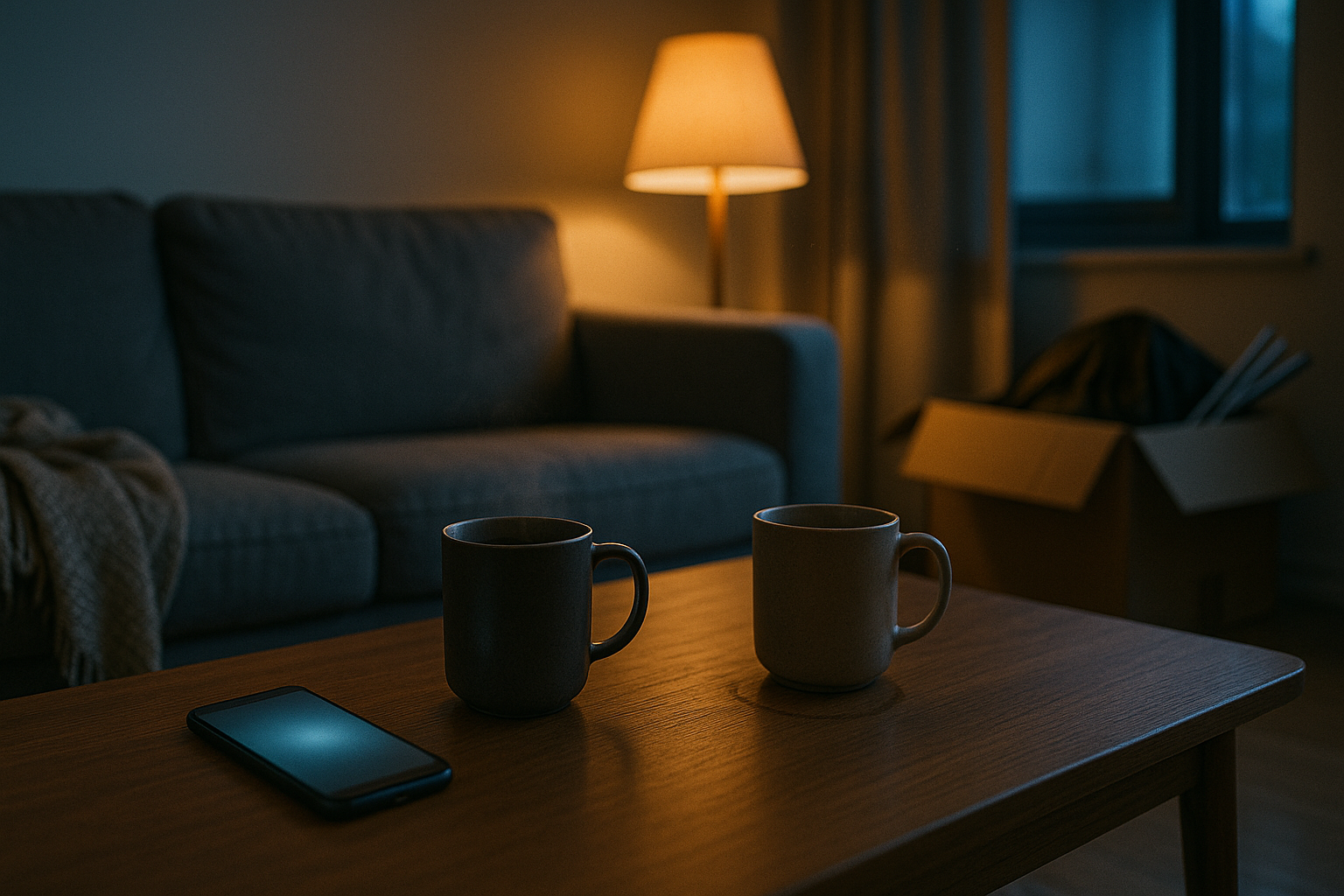
“It’s not the things we say that undo me—it’s the pauses, the hesitations, the echoes of what isn’t spoken.”
The phone sat in my hand like a question I wasn't sure I wanted answered.
I'd been staring at Jamie's contact photo for longer than made sense—that picture I'd taken two summers ago, during the drive down to Port Arthur when the light caught his profile just right and he'd laughed at something I'd said, his face open in a way it rarely was anymore. The man in that photograph seemed like someone from a story I'd read once, familiar but somehow fictional. The man I lived with now smiled less, laughed rarely, came home late from shifts and went to bed without much conversation in between.
The missed call from earlier still haunted the edge of my screen. He'd tried to reach me while I was... where? Bleeding on alien sand? Listening to a voice speak directly into my consciousness? Buying a two-thousand-dollar tent to shelter the people I loved in a world that shouldn't exist?
The unreturned call felt like a small crime I'd committed against our relationship, one more brick in the wall we'd been building between us without ever discussing the architecture.
I pressed the button before my courage could desert me.
The rings sounded too loud in the stillness of the study, each one a hammer strike against glass I was already afraid was cracking. One. Two. Three. The pauses between stretched into spaces large enough to lose myself in, each silence asking questions I didn't know how to answer. What would I say if he didn't pick up? What would I say if he did?
The line connected, and relief crashed through me with such force I felt it in my teeth.
"Hey," Jamie's voice came through, and the relief curdled almost immediately.
It was him. Unmistakably him—the same voice that had whispered secrets in our bed, that had laughed at my terrible jokes during late-night takeaway dinners, that had said my name in the dark with something like wonder during those early months when everything between us felt new and necessary. But the warmth I'd learned to associate with that voice was absent now, stripped away like paint revealing the bare wood underneath. What remained was functional. Present but not there.
"Hi. Sorry I missed your call before," I said quickly, the words tumbling out in that particular rush of someone trying to bridge a gap before it can widen further.
"That's okay."
Two words. That's all I got. Two syllables that landed with the weight of everything they didn't contain—no where were you, no I was worried, no curiosity about what had kept me from answering. Just acceptance that I hadn't been available, delivered with the mild unconcern of someone who'd stopped expecting availability a long time ago.
The words fell into me like coins into a deep well, the splash too far below to hear.
"What did you want? Will you be home soon?" I pressed on, keeping my voice careful, hopeful, shaped around the possibility that if I asked gently enough we might stumble back into the familiar grooves of who we'd been. Ten years of shared meals and shared space and shared dogs. That had to count for something. That had to mean we could still find our way back to each other when the distance between us grew too large to ignore.
But the hesitation that followed told me more than any words could have.
"Ahh..."
Jamie drew the sound out, and in that extended vowel I heard the shape of something he wasn't saying. Not a word, not even an attempt at one—just that stretched hesitation that spoke louder than refusal, louder than explanation. It was the sound of plans rearranging themselves without consulting me, of another evening deferred, of yet another night I'd spend waiting in a house that had stopped feeling like home months ago and now felt even stranger after everything that had happened since morning.
Something cold moved through me. That ahh was the pause of someone preparing to deliver news they know will disappoint, crafting their words to minimise the impact of what's already been decided. I recognised it because I'd heard it before—in phone calls from Mum during her dark periods, in the breath people take before they let you down gently.
My brow creased as the silence stretched too long. I tightened my grip on the phone as if I could hold onto him through the pressure of my fingers against the screen.
"Jamie? You still there?"
"Mr Gangley has had another fall. I'm going to be home late tonight."
The explanation landed with the weight of inevitability. Bob Gangley—I'd heard enough about him over the years to recognise the name. Gruff. Stubborn. The kind of elderly man who refused to use his walking frame because he'd decided it made him look weak, and consequently kept ending up on the floor with bruises that took weeks to heal. Jamie talked about him with a mixture of exasperation and fondness that suggested real affection beneath the professional concern.
I understood, in my head, that this was legitimate. That Jamie's job involved caring for vulnerable people, that falls happened, that he couldn't simply leave work because his partner wanted him home. The understanding sat in my skull like a fact I'd memorised for an exam.
But my heart registered something else entirely.
"Okay. Any idea what time?" I asked, clinging to the possibility of a concrete answer—a number I could hold onto, a promise I could count down toward. Something that would make the waiting feel finite rather than open-ended.
"No. It's one of those annoying semi-bad but not bad enough to call an ambulance incidents. Don't wait up for me."
The words were practical. I could hear the calm in his voice, that particular cadence Jamie adopted when dealing with crises that weren't quite emergencies—professional, competent, appropriate to the situation at hand. He was good at his job. I'd always admired that about him.
But don't wait up for me landed differently. It wasn't just practical advice about sleep schedules. It felt like permission I hadn't asked for, release from an obligation Jamie had already decided I wouldn't fulfil anyway. A small push away—not just from his return, but from the idea that his return mattered to me enough to structure my evening around.
The tent, I thought. I'd just spent two thousand dollars on a tent because I was planning to take him to another world. I was sitting in a study where, hours ago, a portal had opened in the wall and shown me a desert under a sun in the bluest sky I had ever seen. I'd nearly died today. I'd heard a voice speak my name with the intimacy of someone who'd known me longer than I'd been alive. I'd called my brother and manipulated him into flying across the country.
And now I was asking my partner when he'd be home, and the answer was don't wait up for me.
"Alright, I won't. Love you," I said softly.
The words came out almost automatically, the reflex of years of habit. But they weren't only habit—they were true, still true, stubbornly true despite everything. I loved Jamie. I'd loved him since we were children sharing secrets in Elizabeth playgrounds, and I'd loved him again when we'd found each other in Tasmania and built this life together out of second chances and cautious hope. The love had changed shape over the years, grown complicated with silences and distances that neither of us seemed to know how to address, but it was still there. Still real. Still weighted with meaning I needed him to hear.
"Okay. Gotta run. Bye."
And then the line went dead.
I sat there for a long moment, phone still pressed to my ear, listening to the absence where his voice had been. The dial tone didn't come—modern phones don't work that way—but the silence that replaced him felt just as hollow, just as final.
Okay. Gotta run. Bye.
No love you too. No see you later. No acknowledgement of what I'd offered or any indication that my words had registered as anything more than conversational punctuation. Just the practical announcement of departure and the click of disconnection.
The lack of reciprocation echoed in the quiet room, louder somehow than the words he'd actually spoken, reverberating through the space where warmth should have been until it felt like a different kind of fall—one I had no idea how to catch.
I lowered the phone slowly, looking at the screen until it went dark, until Jamie's face disappeared into blackness and all I could see was my own reflection in the glass—a man who looked older than thirty-four, who looked like someone who'd just been told something important without any actual words being spoken.
The stillness of the study pressed against me like a physical weight. This room had seen so much today—the portal, the desert, the voice, the bloody fingerprint in my journal. But somehow Jamie's brief, distracted call felt heavier than all of it. The portal was impossible, terrifying, vast beyond comprehension. But it was also new. It hadn't accumulated years of small disappointments and gradual withdrawals.
Jamie's distance was different. Jamie's distance was familiar.
I understood, with a clarity that felt cruel in its precision, that what I'd just experienced was a symptom of something larger. The gulf between us hadn't appeared today, hadn't been caused by my discovery of the portal or my decision to keep secrets. It had been growing for months, maybe years, widening in increments so small I could pretend not to notice each individual expansion. But the aggregate effect was undeniable now. The distance between us had become a chasm, broad and unforgiving, and I wasn't sure either of us knew how to build a bridge across it anymore.
My gaze drifted to the confirmation email still glowing on my computer screen—the tent I'd purchased in a frenzy of desperate hope barely an hour ago. Two thousand dollars on fabric and poles and the conviction that I could create shelter where there was none. It had felt meaningful when I'd clicked the purchase button, almost sacred in its absurdity. A symbol of my intention to provide for the people I loved, to bring them into Clivilius and protect them there.
But now, sitting in the aftermath of Jamie's okay, gotta run, bye, the tent felt different. It felt like the desperate gesture of a man who'd run out of other ways to say I still care.
Because that's what it was, wasn't it? The tent wasn't really about practical shelter. It was about creating a space where Jamie and I might exist together differently, where the strangeness of another world might somehow dissolve the accumulated strangeness that had grown between us on this one. It was an offering, a prayer, a ridiculous two-thousand-dollar declaration that I believed we could still shelter together if only we had somewhere new to try.
To an outsider, it would seem insane. To me, sitting in the fading afternoon light of a study that had witnessed impossible things, it felt like the only tangible way I knew to say: Please. Let's find our way back to each other. Let's start again in a place where neither of us knows the rules.
But even as I clung to that thought, another rose unbidden—darker, more complicated, harder to dismiss.
Clivilius.
I turned the idea of telling Jamie over in my mind, examining it from different angles like a gem whose flaws only become visible under certain lights. Could I tell him? Should I tell him?
The timing felt treacherous. Once, our relationship had been the bedrock of my life—the stable ground from which I could leap into the unknown without fear of falling forever. Jamie had been my anchor, my home, the person I trusted to still be there when I returned from whatever strange territories my dreams led me through. I could have told him anything during those early years, and he would have listened, would have believed me even if he couldn't understand.
But now? With cracks spreading unseen beneath the surface of what we'd built? With okay, gotta run, bye still echoing in my ears?
I wondered if sharing this impossible truth would save us—or break us entirely.
The possibilities branched in my mind, forking paths I could see but couldn't choose between. In one version of the future, I brought Jamie to Clivilius and the shared wonder of it rebuilt what had eroded between us. We stood together under that strange sky, saw the same impossible landscape, felt the same awe and terror, and it reminded us why we'd chosen each other in the first place. The distance dissolved because we were facing something so large that our small accumulated grievances couldn't survive in its presence.
In another version, I told Jamie the truth and watched his face close like a door. He looked at me the way he might look at a stranger on the bus who'd started talking about government mind control or alien abductions—with that particular mixture of discomfort and pity that said this person has lost their grip on reality. He took the dogs and left. He called my family. He suggested, gently, that I might benefit from professional help.
The second version felt more likely, somehow. More consistent with who we'd become.
Jamie was tired. I could hear it in every brief response, every deferred homecoming, every don't wait up for me. He was tired of work that demanded everything and offered exhaustion in return. He was tired of coming home to a partner who'd been growing increasingly abstracted over the past months, consumed by dreams he couldn't share and secrets he couldn't explain. He was tired in ways that made weird news about portals and other dimensions feel like one more burden he didn't have the capacity to carry.
And I was afraid. That was the truth of it. I was afraid not of Clivilius—or not only of Clivilius—but of the possibility that the person I loved most might not walk into it with me.
What if I told him everything and he chose not to come? What if the revelation that pushed us back together in my hopeful imaginings instead became the final weight that collapsed whatever fragile structure remained? What if okay, gotta run, bye was the beginning of an ending I couldn't stop, and my truth was the thing that finished it?
The questions circled without resolution, vultures over carrion I wasn't ready to admit was dead.
I set the phone down on the desk beside my keyboard, watching the screen stay dark, and let myself feel the fullness of what had just happened.
Tomorrow, everything would change. I knew that with the same conviction I'd felt when I purchased the tent—an understanding that bypassed reasoning and arrived fully formed, truth disguised as intuition. Paul would see the portal. I would have to decide what to tell him, how much to reveal, whether the truth was something that could survive the journey from my mind to his.
And Jamie... Jamie would come home late tonight, exhausted from dealing with Mr Gangley's fall and whatever other demands his shift had placed on him. He would slip into bed quietly, careful not to wake me if I'd followed his advice and not waited up. We would exist in the same house, the same bed, and feel as distant from each other as if we were already in different worlds.
Maybe that was the cruelest irony of all. I had discovered a doorway to another dimension, a literal pathway to a place where nothing worked the way it did here—and I still couldn't find a way to cross the distance to the man sleeping beside me.
I sat in the study as the afternoon light began its slow surrender to evening, thinking about portals and silences and the terrible mathematics of love reduced to its sparest equations. Okay, gotta run, bye. Four words where three would have changed everything.
The tent would arrive tomorrow. Paul would arrive tomorrow. Something would have to give, some decision would have to be made, some truth would have to be spoken or buried or transformed into action.
But tonight, I would sit in the silence between words and try not to count what I was losing.
