4338.210 · July 29, 2018 AD
The Shape of Help
Haunted by the morning’s trespass, Karl Jenkins returns to the station wearing the mask of professionalism — and the evidence of guilt beneath his sleeve. When a distraught woman arrives, pleading for help the system won’t give, Karl recognises the same pattern he’s been chasing in silence. Against better judgement and every procedural rule, he steps forward — one act of compassion that might pull him further into the dark.
“You don’t stop being a cop when you cross a line. You just start wondering which side of it you’re really standing on.”
As I trudged towards the police station, my body moved on instinct, operating on autopilot whilst my mind remained a battlefield—yesterday’s discoveries colliding with this morning’s transgressions in a violent, ceaseless crash of guilt and justification. Each step felt disconnected from conscious thought, as if I were piloting my own body from a great distance.
The shower had been scalding, rushed, and necessary—less for hygiene than for the symbolism of cleansing, for the desperate hope that hot water and soap could somehow wash away the stain of what I’d done. I’d stood under the spray until my skin turned red, until the water ran cold, scrubbing at my hands as if I could erase the memory of glass shattering, of deliberate destruction, of the precise moment I’d crossed from detective to criminal.
It hadn’t worked. The guilt clung to me, invisible but pervasive, a weight I couldn’t shake no matter how much I scrubbed.
The light bandage on my wrist pulsed beneath the sleeve of my second-best suit—my best suit still at the dry cleaners, waiting to be collected, another small domestic failure in a week full of larger ones. A subtle reminder that whilst I could dress the part of Senior Detective, I no longer entirely felt like one. The fabric felt wrong against my skin, too tight at the collar, too loose at the waist. Or perhaps it was simply that I no longer fit properly into the role I’d spent twenty-three years building.
The leather glove on my right hand felt snugger than usual, the hidden plaster sticking uncomfortably against skin still tender from the minor glass cuts that peppered my forearm. Each movement of my fingers sent small sparks of discomfort shooting up my arm—not pain, exactly, but sensation enough to keep the morning’s events constantly present in my awareness.
A month ago, I’d claimed eczema to avoid Sarah’s curiosity when I’d started wearing the gloves. The eczema excuse had become a convenient cover for something far more serious, a foundation of deception I was now building upon with each passing hour.
My injury wasn’t dramatic—a few shallow cuts, some bruising that would yellow and fade over the next week. But it was too telling. Any junior constable with a decent eye and basic forensic awareness would spot the shape and placement and draw the line from glass to skin. Fresh cuts in a linear pattern, precisely where they’d appear if someone had driven their elbow through a window and caught glass shards on the withdrawal. And from skin to window. And from window to the crime scene at Luke Smith’s residence. And from there to questions I couldn’t answer without destroying everything I’d worked to build.
The digital clock on the dash had mocked me during the drive in—late again. The glowing numbers had counted down my tardiness, each minute a small accusation. That detail, so small and ordinary in the grand scheme of things, now held sharp consequences that I couldn’t afford to ignore.
Tardiness might be forgiven once, perhaps even twice. A traffic incident. A personal emergency. Equipment failure. All plausible excuses for the occasional delay. But patterns of it, especially following erratic behaviour—especially following the kind of erratic behaviour I’d been exhibiting for the past few days—would raise flags I couldn’t afford. Flags that would invite scrutiny, questions, investigations into my recent activities and mental state.
The promotion still sat awkwardly on my shoulders, more decoration than armour, a title that felt increasingly hollow with each rule I bent or broke. Senior Detective. The words should have carried weight, authority, respect. Instead, they felt like a costume I was wearing, ill-fitting and increasingly transparent.
The station loomed as I approached, the concrete facade dull in the diffused light of early morning, grey against a grey sky that promised rain without quite delivering it. I saw it now less as home base—less as the sanctuary it had been for most of my career—and more as citadel. Its brutalist geometry wasn’t simply functional but somehow judging, each angular surface reflecting back my failures, my compromises, my slow descent into the very behaviour I was meant to investigate and prevent.
Would the incident log already contain a report of a suspected break-in at Luke’s address? The question had been circling my mind since I’d left Berriedale. If a call had come in—perhaps from Terry, perhaps from another neighbour disturbed by the sound of breaking glass—it could be sitting in the system already, waiting to be reviewed, waiting to be assigned, waiting for someone to connect the dots.
Waiting for a name to be linked to it.
Waiting for mine.
The thought made my stomach clench, acid rising in my throat. I could see it playing out with horrible clarity: a report filed, an officer dispatched to take a statement, photographs of the damage, forensic examination of the scene. And then someone—Sarah, perhaps, or Claiborne, or any of a dozen competent detectives—making the connection. Noticing that I’d been watching that house. Noting my obsession with the case. Observing my deteriorating mental state and erratic behaviour.
The dominoes would fall with terrible inevitability, each one triggering the next in an unstoppable cascade of revelation and consequence.
I pushed those thoughts down with physical force, mentally shoving them into the same compartment where I kept Queensland and Jamie and all the other things I couldn’t afford to examine too closely. Pushed them down and locked the door and tried not to hear them scratching to get out.
I approached through the front entrance, attempting confidence, manufacturing the appearance of normality through sheer force of will. No point slinking in through the rear entrance like a thief, like someone with something to hide. Let them see me walk tall—clean suit, steady step, professional face fixed firmly in place. Let no one guess how completely I was unravelling inside, how the edges of my carefully constructed persona were fraying with each passing hour.
The automatic doors parted with their familiar pneumatic hiss, and I descended the slight ramp into the reception area, the transition from outside to inside marked by that subtle change in air pressure and temperature that every building possessed. The familiar scent of the station wrapped around me like a scratchy old blanket—industrial-strength cleaning fluid that never quite eliminated the underlying odours, burnt coffee from the pot that had been sitting on the warming plate too long, toner from the never-quite-working photocopier that someone kept meaning to call for service.
It was oddly reassuring, this institutional perfume, this olfactory signature of a place I’d inhabited. It reminded me who I was supposed to be, even as I felt that identity slipping further from my grasp. It grounded me in the routine and rhythm of police work, in the mundane details that constituted most of actual detective work rather than the dramatic confrontations and revelations that civilians imagined.
Then I heard her voice.
"I don’t understand."
The words cut through the ambient noise of the station—sharp, distressed, female. The kind of tone that always made me pause, if only out of habit cultivated over more than two decades of responding to people in crisis. A voice that carried the particular quality of someone who’d reached the end of their rope but was still clinging to it with bleeding hands.
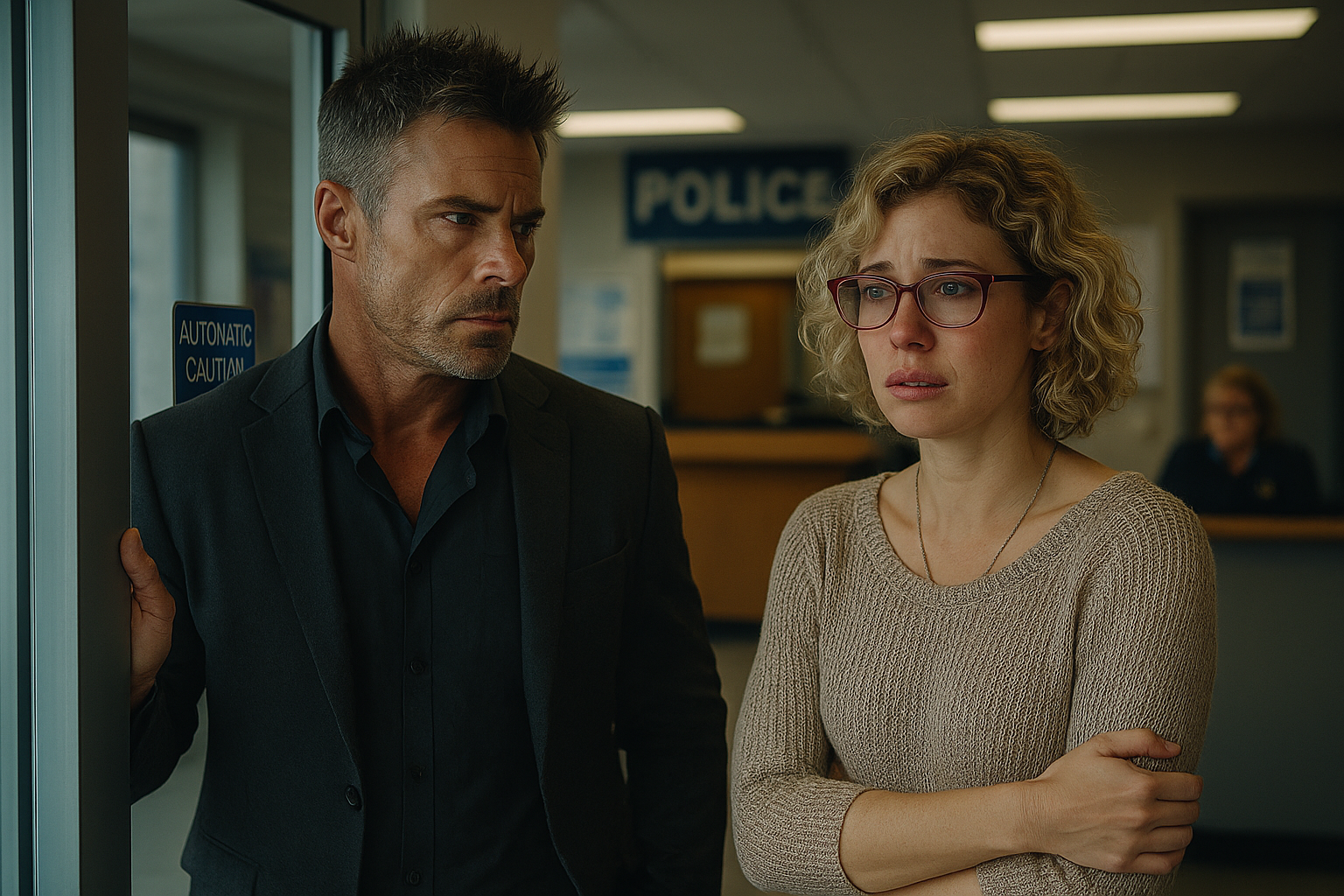
She stood at the reception desk, back turned towards me, hands clenched into fists at her sides—knuckles white with tension visible even from behind. Something about the posture—rigid yet folded inwards, spine straight but shoulders hunched, the contradiction of someone trying to maintain dignity whilst collapsing internally—told me she’d already been through rounds of explaining herself, and wasn’t being heard.
The body language was unmistakable to anyone who’d spent years reading it: frustration meeting bureaucracy, desperation encountering procedure, human need colliding with institutional inertia.
I stopped before swiping my security card, angling my body so the sleeve of my coat continued to hide the bandage on my wrist, positioning myself behind a support pillar that provided partial concealment. No one had clocked my arrival yet. No questions, no glances, no colleagues calling out morning greetings or asking where I’d been. Perfect cover for observation.
I pretended to busy myself with my phone—the universal gesture of someone occupied with important business, not eavesdropping on conversations at the front desk. Pulled it from my pocket, unlocked the screen, stared at it with apparent focus whilst directing all my attention to the conversation unfolding five metres away.
"I haven’t seen or heard from my husband since yesterday. How can that not qualify for me to make a missing persons report?"
Her voice cracked as she spoke, the fissure running through the words like a fault line through stone, but it wasn’t hysteria. It was barely restrained frustration, the tone you get from being reasonable for too long, from explaining yourself over and over to people who aren’t listening, from maintaining composure when everything inside you is screaming.
A voice I’d heard too many times. The voice of someone who knows something is catastrophically wrong but can’t make anyone else see it. The voice of someone drowning whilst everyone on shore tells them they’re fine, they’re standing in shallow water, they just need to put their feet down.
Then came the reply—flat, procedural, tired. Recited rather than spoken.
"I’m sorry, Mrs Triffett, but you said you received a text message from him last night. That counts as a form of direct contact. Jenny, your husband just isn’t missing."
Linda Hodgman. Of course it was Linda. I recognised the voice before my brain consciously processed the identification—that particular blend of weariness and rigid adherence to protocol that characterised her interactions with the public. The old guard. Her voice bore the weight of decades spent repeating policy, each repetition shaving away another layer of empathy like water wearing down stone, until nothing remained but the bare structure of rules and procedures.
She’d once been warm—I’d heard stories from officers who’d worked with her in the nineties. Community-centred, engaged, the kind of receptionist who knew everyone’s names and asked about their children. But time and exposure to human suffering without adequate support or acknowledgement had eroded her to a skeletal script of protocols and flowcharts. She spoke now like someone reading from the inside of a filing cabinet, reciting policies rather than engaging with human beings.
It wasn’t entirely her fault. The system ground people down, wore away their compassion through sheer volume of trauma and bureaucratic restrictions on their ability to help. But understanding the mechanism didn’t make the result any less damaging to people like Mrs Triffett, who needed help and received only obstacles.
Mrs Triffett didn’t cry—not properly, not with the theatrical sobbing that some people deployed in police stations to elicit sympathy or manipulate responses. Her eyes welled, yes, and her voice broke with the strain of holding herself together, but she held her posture, maintained her composure even as it cost her visible effort. The restraint somehow made it worse, more affecting than open weeping would have been.
"But that just isn’t like my husband!" she said, the words emerging with the force of conviction, of absolute certainty born from years of intimate knowledge. "He would never just leave like that, especially without saying goodbye to little Sammy. And the dog has gone missing too!"
That cut through me like a scalpel, clean and precise, slicing through the protective numbness I’d been cultivating.
Jamie. Kain. Luke. Now another man—and his dog.
All gone under circumstances that felt wrong to those left behind, that violated the known patterns and behaviours of the missing, but just plausible enough to skirt official concern. Just plausible enough that text messages and ambiguous explanations could be deployed to dismiss the reports, to categorise them as non-emergencies, to file them away in the vast bureaucratic machinery that processed thousands of complaints and concerns and kept the truly urgent separated from the merely worried.
A chill settled into my gut, colder even than the one that had crept through me crouched beside Luke’s garden in the pre-dawn hours. This was different. This was recognition. Pattern recognition, that fundamental skill that separated competent detectives from merely adequate ones.
A pattern was forming—or the ghost of one. Too many disappearances in too short a time frame. Too many families parroting the same desperate line: "This isn’t like him." All while the system—the one I had once believed in, had dedicated my adult life to serving—responded with blinkered indifference and red tape, dismissing legitimate concerns because they didn’t fit neatly into the categories and criteria that determined official action.
"Jenny, you know there’s nothing I can do for you. The system doesn’t have the resources—" Linda began, her tone flat, bureaucratic, already moving to close down the conversation before it could continue.
"Screw the system!" Jenny’s voice sliced through the room like broken glass, sharp edges catching light. She slammed her fist onto the countertop with enough force that the sound echoed through the reception area, loud enough to turn heads, to draw attention from officers and civilians alike. "You know me, Linda. You know my husband! Hell, you had dinner with us just last week. You know Nial would never do this to us!"
Her voice cracked with the strain of holding it together, with the effort of maintaining composure whilst simultaneously demanding to be heard, to be taken seriously, to be treated like a human being rather than a case number that didn’t meet the criteria for official action. And I felt the blow of it in my chest, a physical impact that had nothing to do with the volume and everything to do with the raw human plea bleeding through the rigid lines of procedure.
You know me. You know him. You know this is wrong.
The plea beneath the words, the subtext that screamed louder than the actual content: Please. See me. Hear me. Help me.
My own conscience twisted, winding tighter with each breath. I thought of the morning—my unauthorised surveillance that had become trespassing, the staged break-in that was actually just breaking and entering, the lies half-formed and sitting heavy in my pocket alongside that damn leather glove. Every ethical misstep I’d taken today pulsed beneath my ribs like a second heartbeat, a rhythm of guilt and rationalisation that I couldn’t silence.
But this... this was why I became a detective in the first place. Not for promotion or protocol, not for the salary or the respect or the authority. But for this: the chance to help someone when the world refused to. To stand between the system’s indifference and human suffering. To be the person who listened when everyone else had stopped listening, who cared when everyone else had filed the concern away under "Not Our Problem."
The idealism that had driven me into police work two decades ago—naive, perhaps, but genuine—still existed somewhere beneath the accumulated cynicism and compromises. I could feel it stirring, responding to Jenny Triffett’s desperation with something that felt almost like purpose.
Without fully deciding to do so, without conscious deliberation or weighing of consequences, I stepped forward. My feet moved before my brain caught up with the decision, carrying me towards the reception desk and the woman who needed help that the system wouldn’t provide.
"Mrs Triffett, was it?" I kept my voice low and steady, modulating it with deliberate softness, projecting calm authority without the edge that might make her defensive.
She turned to look at me, confusion etched into her features alongside the grief and frustration. Her eyes were red-rimmed but dry, tear-stained cheeks speaking of earlier breakdowns that she’d managed to contain. Dual-toned glasses—pink and black, stylish but not ostentatious—framed eyes that were searching mine for some indication of whether I represented help or just another obstacle.
"Yes." Her voice wavered, guarded now, the edges of her grief pulling back into herself like a wounded animal retreating into protective caution. The defensive posture of someone who’d been disappointed too many times already, who couldn’t afford to hope that this interaction might be different. "Do I know you?"
Something flickered in my brain—recognition, or perhaps projection. A face glimpsed at a supermarket, a passing moment at a neighbourhood event, one of those fleeting encounters that happens constantly in a city the size of Hobart where everyone is somehow connected to everyone else through no more than two degrees of separation? I couldn’t place it, couldn’t pin down whether I actually remembered her or simply recognised the type—the desperate family member, the person seeking help for something the system had deemed insufficient.
"No, I’m Detective Karl Jenkins," I said gently, letting the title do some of the work of establishing authority and legitimacy. "Why don’t you come with me and you can tell me what’s going on?"
Linda glanced at me, eyebrows raised in an expression that managed to convey both surprise and mild reproach, but said nothing. She didn’t need to. The receptionist’s role was to uphold policy, to be the gatekeeper who filtered out the non-urgent cases and prevented detectives from being overwhelmed by every concern that walked through the door. Mine was to know when to bend it, to recognise when the criteria were failing to identify genuine emergencies, when human judgement needed to override algorithmic decision-making.
We’d had this silent argument before, Linda and I. She thought I was too soft, too willing to take on cases that didn’t meet the thresholds. I thought she’d become too rigid, too committed to procedure over people. Neither of us was entirely wrong.
Jenny hesitated. A flicker of calculation passed across her face—distrust of systems, of uniforms, of false hope that would only make the disappointment worse when it inevitably came. The wariness of someone who’d already been let down by the institution she’d come to for help, who’d already been told her concerns weren’t valid, weren’t urgent, weren’t sufficient.
But desperation won out, as it usually did. She gave a small nod, chin trembling slightly with the effort of maintaining composure. Her movements were tight, rigid with tension, each gesture carefully controlled as if she feared that relaxing for even a moment would cause everything to come spilling out in a flood she couldn’t contain.
I swiped my card. The door buzzed and opened with a hollow click.
"After you, ma’am," I offered, standing aside and gesturing towards the corridor that led deeper into the station. My tone was courteous, almost too formal—a disguise for the unease gnawing in my chest, for the awareness that I was taking on more than a missing persons report, that I was walking into complications I couldn’t yet see but could sense hovering just beyond my perception.
But what else could I do? Let her walk away, let Nial Triffett become another disappeared husband, another missing person who didn’t quite meet the criteria for official concern? Let the pattern continue to grow whilst I stood by and did nothing because helping would be inconvenient, would complicate my already compromised situation?
No. Whatever I’d become this morning at Luke’s house, whatever lines I’d crossed and rules I’d broken, I was still a detective. That still meant something. It had to.
