4338.209 · July 28, 2018 AD
The Shape of an Absence
Detectives Karl Jenkins and Sarah Lahey reviewed the bank records of both missing men and found their answer not in what the transactions revealed but in what they did not. Kain Jeffries's spending ceased overnight. Jamie Greyson drained his account in a single withdrawal three days before anyone reported him missing. The financial data split the investigation in two — and the detectives with it.
Bank statements are confessions written in a language that requires no interpreter. They do not equivocate. They do not offer context or motive or the particular human texture of explanation that interviews provide and that detectives learn, over time, to distrust. They present what was spent, where, when, and in what amount, and they leave the question of why to the people reading them — which is precisely what makes them both invaluable and insufficient, a skeleton without the flesh that would tell you how the body moved when it was alive.
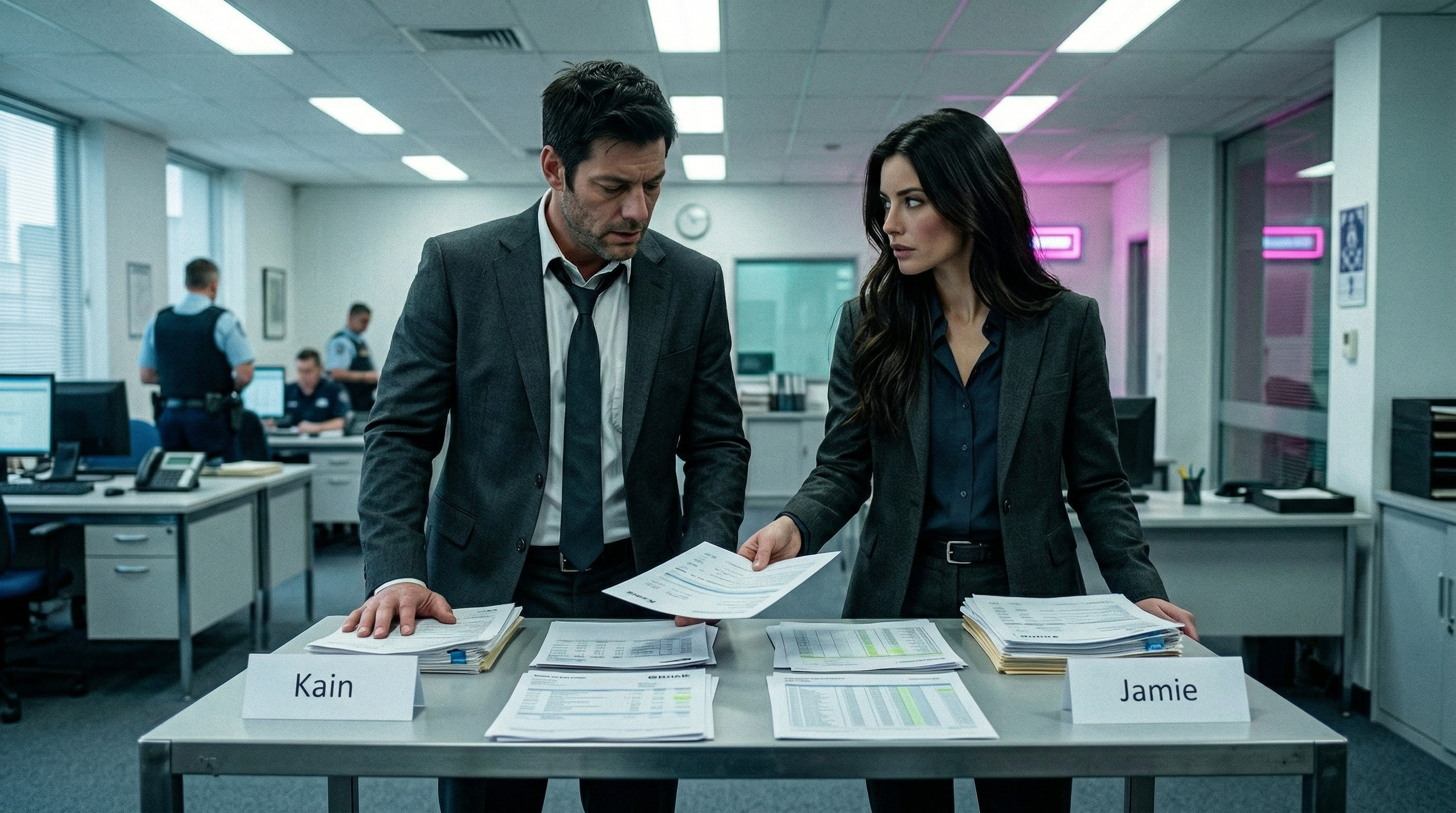
The records for Kain Jeffries and Jamie Greyson lay spread across a desk in the open-plan office of Hobart's Southern Division like the financial anatomy of two lives that had recently stopped generating data. Karl Jenkins had taken Kain's statements. Sarah Lahey had taken Jamie's. The division was wordless, habitual, the kind of operational shorthand that partners develop when they have spent enough time reading evidence side by side to no longer require discussion about who takes which pile. The fluorescent lights above them performed their usual flattening of everything beneath into clinical sharpness — ink rendered too black, paper rendered too white, the shadows beneath Karl's eyes rendered in a shade that suggested the hangover had retreated but not departed.
Kain's financial life told the story of a young man whose existence operated within modest parameters. Regular fuel purchases on the same day each week. Food transactions that clustered in the late evening hours with the consistency of someone whose appetite followed a nocturnal rhythm. Small gaming charges — the particular micro-transactions of a man who spent his downtime in digital worlds where progress could be purchased for less than the price of a coffee. No debts of consequence. No investments. No travel bookings, no ferry charges, no evidence of a life that extended beyond the geography of southern Tasmania. The portrait was one of routine so entrenched that its interruption carried the force of a detonation.
The interruption arrived as an absence. Not a tapering, not a gradual diminishment, but a complete cessation — the financial equivalent of a light being switched off. The final entry was a gaming charge of less than two dollars, timestamped at three minutes past eleven on the night before Kain had left his mother's house to check on his uncle. After that: nothing. No morning coffee. No fuel. No movement of any kind through the infrastructure of transactions that constituted proof of continued existence in a world that tracked its citizens through their spending.
Jamie Greyson's records told a different story, and the difference was what mattered. His spending followed its own unremarkable pattern — groceries, fuel, subscriptions, the quiet metabolism of an ordinary life — until three days before Louise Jeffries walked into the station. On that day, Jamie had emptied his account. Every dollar. A single transaction that swept the balance to zero with the finality of someone who had decided, for reasons the statement could not supply, that whatever came next would not require the services of a bank.
Sarah found it. The discovery arrived with the particular electricity of a lead surfacing from the numbing repetition of financial data — the moment when rows of meaningless numbers suddenly produce a figure that reshapes everything. She pushed the page across the desk with the urgency of someone who understood that the withdrawal did not explain the disappearance but could not possibly be unrelated to it. Karl received the information with the measured restraint of a man who had learned, through experience Sarah did not yet possess, that compelling evidence and conclusive evidence occupied different territories entirely.
The disagreement that followed was brief and public and more revealing than either of them intended. Sarah's instinct assembled a narrative from the available pieces — the drained account, the missing men, Luke Smith's inconsistent story — and arrived at a conclusion that Karl could not permit to stand unchallenged. Not because the conclusion was necessarily wrong, but because the speed of its assembly bypassed the discipline that separated investigation from speculation, and because Karl's proximity to the case made every premature conclusion dangerous in ways Sarah could not see and he could not explain. His correction landed harder than he meant it to — his name for her cracking through the open-plan office with a sharpness that silenced keyboards and stilled conversations, the sound of a man whose authority had been deployed before his judgement could modulate its force.
The office absorbed the moment and returned to its rhythms. Sarah absorbed it differently. The reprimand settled into the space between them with the particular weight of a boundary being drawn by someone who had previously operated as an equal, the first exercise of a rank that had existed on paper since his promotion but had not, until this moment, been wielded in the field. Something recalibrated in the architecture of their partnership — not broken, not yet, but shifted, the load-bearing walls no longer quite where they had been.
Karl's mind was already running past the disagreement, following a thread that connected Jamie's drained account to Kain's missing ute to a piece of knowledge he should not have possessed and could not explain having without exposing the history he had spent fifteen years sealing behind professional distance. Jamie had the skills to disappear. Karl knew this not from any file or database or intelligence report but from a period in Brisbane that predated Tasmania and the badge and the carefully constructed identity that both now threatened to compromise. The knowledge surfaced in his voice before his judgement could intercept it — a sentence about Jamie's capabilities that emerged from memory rather than deduction, and that Sarah registered with the quiet attentiveness of a detective who had begun to catalogue the gaps between what her partner knew and what he was willing to account for.
The investigation split along the line that the financial records had drawn. Sarah would check the airports and the ferry operators — the conventional exits from an island state, the routes a missing person would take if their disappearance involved movement rather than concealment. Karl would visit Luke Smith alone. The decision was framed as efficiency, as the operational logic of a case where time was compressing and two lines of enquiry required simultaneous pursuit. It was not untrue. But beneath the procedural justification lay a need that Karl could not afford to articulate: the need to sit across from the man who shared Jamie Greyson's life and read his account without a second pair of eyes monitoring the reaction — without Sarah watching Karl's face for the fractures that Jamie's name still produced in the surface he had spent the morning rebuilding.
They separated. Sarah gathered her files with movements that communicated efficiency and something tighter beneath it — the particular restraint of someone who understood she was being excluded from something and had chosen, for now, to permit the exclusion rather than force the confrontation that challenging it would require. Karl pulled on his coat and moved toward the exit, carrying the weight of a day that had begun with a hangover and a used condom and had arrived, by late morning, at a missing persons investigation that was rapidly becoming indistinguishable from an excavation of his own buried past.
On the desk behind them, the bank statements remained in their ordered piles — Kain's on one side, Jamie's on the other — the numbers unchanged, the absences they documented growing wider with each hour that passed without explanation. The butcher's paper timeline Karl had assembled earlier still clung to the far wall, its stick figures watching the empty office with the patient incomprehension of witnesses who had seen everything and understood nothing.

