4338.214 · August 2, 2018 AD
The Sanctity of Contamination
Haunted by the truth and hunted by consequence, Sarah brings Gladys—and the impossible device she carries—into the one place meant to be untouchable: her home. But as reality fractures around a portal that shouldn’t exist, Sarah must decide whether love is enough to justify what comes next.
"You don't realise what a home really is until you desecrate it yourself."
The headlights of my car illuminated the familiar contours of my driveway as I pulled in, the beams cutting through darkness that had settled like a suffocating blanket. The sense of unease that had been building throughout the drive home now grew with exponential intensity, metastasising from discomfort into full-blown dread.
My house. My sanctuary. The place where I was supposed to feel safe, supposed to be able to drop the mask, supposed to exist without pretence. And I was about to contaminate it utterly by bringing Gladys Cramer — witness, suspect, woman with impossible technology and even more impossible promises — across the threshold.
"Are you sure they can be trusted?" Gladys asked from the passenger seat, her voice tinged with anxiety that mirrored my own internal turmoil but pointed in a different direction, concerned with different variables in this equation of madness.
I replied with a forced steadiness that felt like performance, like acting in a play where I didn't know my lines but had to pretend confidence anyway. "It's my house," I said, as if property ownership somehow guaranteed security, as if the walls I'd painted and the mortgage I paid somehow created an impenetrable bubble of safety.
I opened the car door and stepped out into the cool night air that carried the salt tang of the Derwent mixing with the smell of neighbours' dinners — normal smells, ordinary smells, the olfactory landscape of a life I'd once had and would never have again. "Get out."
The command came out harsher than intended, but I was beyond moderating my tone, beyond caring about social niceties when my entire world was collapsing around me like a building with compromised foundations.
As Gladys followed suit, extracting herself from the passenger seat with the careful movements of someone who'd drunk too much wine and was trying not to advertise their impairment, a part of me screamed in silent protest. What the hell am I doing? The question gnawed at the edges of my consciousness, a nagging reminder of the absurdity and danger of the situation, of how far I'd strayed from every protocol, every ethical guideline, every principle I'd once claimed to hold sacred.
I shouldn't have brought Gladys here. The thought flashed through my mind like a warning sign on a dark road, like those reflective markers that tell you you're about to drive off a cliff. But it was too late for second-guessing now. The car was in the driveway. Gladys was climbing out. My neighbours' windows showed light and life and normality that excluded me absolutely.
I'd made my choices — through action if not conscious decision, through momentum if not deliberate selection — and now I had to live with them, had to see them through to whatever conclusion awaited in the private darkness of my home.
Standing next to Gladys in the small, dimly lit living room of my house moments later, the weight of my decisions pressed down on me like gravity had increased specifically within these walls.
The familiarity of the surroundings — the couch I'd picked out at a second-hand shop, the bookshelf my brother Oscar had built for me, the photograph of my grandparents on the mantle — clashed violently with the surreal nature of our clandestine meeting, creating cognitive dissonance so profound it left me disoriented and on edge.
Everything looked the same but nothing was the same. The room had been contaminated by what I'd brought into it, by the decisions I'd made, by the technology Gladys carried and the promises she'd made and the knowledge she possessed of things that shouldn't exist.
"Show me again," I demanded, my voice carrying an authority I didn't feel, a firmness that masked the terror beneath. I needed to see it again, needed to confirm I hadn't hallucinated what happened in the car, needed proof that reality was as broken as I'd witnessed or that I was simply having a complete psychological breakdown.
Gladys raised the device — the Portal Key, though I didn't know to call it that yet — and activated it with a gesture I couldn't quite follow, her fingers moving in patterns that seemed both deliberate and intuitive, like someone playing an instrument they'd mastered.
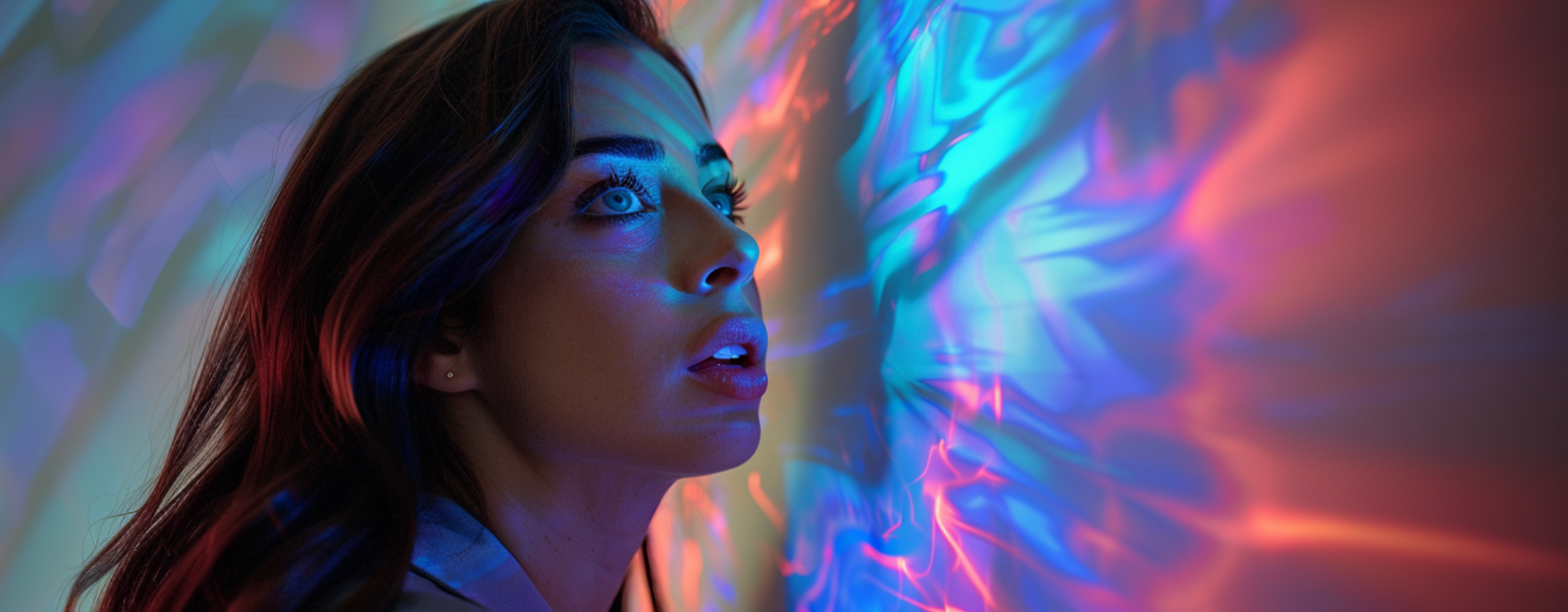
The grey wall before me transformed into a canvas of vivid, pulsating energy that defied every understanding of physics, of light, of matter itself. I watched, mouth agape like a child witnessing magic, as swirling hues of light collided and danced across the plaster surface, creating a spectacle that defied all logic.
The colours were wrong — not wrong like badly coordinated but wrong like they shouldn't exist, like my eyes were perceiving wavelengths they weren't designed to detect, like reality was showing me its undergarments and they were made of something that had no name in human language.
The scene from Luke Smith's house the night Cody was killed suddenly illuminated in bursts of ethereal light, playing out on my living room wall like a ghostly echo of the past, like footage from a security camera that filmed in dimensions I couldn't comprehend. I saw Karl — unmistakably Karl — saw the struggle, saw the moment of Cody's death rendered in swirls of colour that somehow conveyed movement and violence and finality.
It was all too much, too surreal, too impossible. My brain rejected it whilst my eyes insisted on its reality, creating a schism in my consciousness that threatened to split me completely.
An old newspaper article fluttered into view next, materialising from the colours like a photograph developing in solution, detailing someone named Rita's encounters with the unknown. The text was visible, readable, three-dimensional in ways that text shouldn't be, floating in space that existed somehow between the wall and the room.
Was this the very phenomenon Rita had witnessed? My mind raced to connect the dots, drawing lines between the unbelievable and the undeniable, trying to construct a framework that would allow me to process what I was seeing without losing my grip on sanity entirely.
"I need to take Cody," Gladys broke the silence, her voice quivering with emotion that was raw, unfiltered, desperately sincere. Her tears glistened as they trailed down her face, reflecting the kaleidoscope of colours from the wall in miniature, turning her cheeks into prisms. "His children want him back."
The statement landed with impossible weight. Children. Cody had children. In another world. Through that impossible doorway of light and colour. Children who wanted their father's body returned for... what? Burial? Ritual? Some custom I couldn't begin to fathom?
"Through that?" I gestured toward the mesmerising display with a shaky hand, my finger trembling as it pointed at impossibility, disbelief wrestling with the evidence of my own eyes, losing badly but refusing to surrender completely.
"Yes," Gladys sniffled, wiping her tears with the back of her hand in a gesture so human, so ordinary, that it created a jarring contrast with the supernatural display behind her.
"What... where is it?" My voice was barely a whisper, my eyes fixated on the whirling spectacle before us, unable to look away even though some primitive part of my brain was screaming that looking too long might change me, might damage something essential, might show me truths that humans weren't meant to perceive.
Suddenly, a soft, almost inaudible voice whispered in my mind — not through my ears but directly into my consciousness, bypassing normal sensory channels entirely: Clivilius.
The word arrived complete, fully formed, carrying with it implications and meanings I couldn't articulate but somehow understood on a level beneath language. It wasn't English, wasn't any tongue I recognised, yet I comprehended it perfectly, knew its pronunciation, felt its significance.
I jerked my head towards Gladys, seeking confirmation, needing to know if I was experiencing a hallucination or if the voice had been real, had been shared, had been something outside my own deteriorating psyche. Did she hear it too?
"Clivilius," Gladys echoed, speaking the word aloud, confirming its reality, giving it sound and weight in our shared reality.
I eyed her, a mix of suspicion and awe colouring my gaze, trying to read her expression for signs of deception, of madness, of shared delusion. "Is that where Karl is, too?" I needed to know, needed to understand the incomprehensible connection between all these fragmented pieces — Karl's disappearance, Luke's involvement, Cody's death, this impossible technology, this other world that apparently existed alongside ours.
Gladys nodded solemnly, her expression grave, knowing the magnitude of what she was confirming. "Yes."
The word hit me like a physical blow. Karl was there. In Clivilius. In another world. Not dead. Not in hiding somewhere in Tasmania's wilderness. But somewhere else entirely, somewhere so far beyond my reach that it might as well be another galaxy, another dimension, another reality altogether.
Driven by a reckless urgency that bypassed thought entirely, operating on pure instinct and desperate need, I darted toward the mesmerising display of buzzing electrical colours, my heart pounding in my ears with such force I could hear my own pulse, feel it in my fingertips, taste it in my mouth.
I was going through. Going to find Karl. Going to step through impossibility into whatever waited on the other side because staying here meant losing him forever, meant accepting his absence, meant surrendering to the unbearable.
But reality crashed into me with a heavy, unforgiving thud as my body collided with the dark, solid wall. The impact drove the air from my lungs, sent shock waves through my shoulder and arm, scraped skin from my palm as I tried to break my fall.
Stumbling back, blinking in disbelief, I realised the vibrant colours had vanished whilst I'd been moving toward them, had closed like a door I'd been too slow to reach. There was nothing but a cold, bare surface now — just my grey wall with a new scuff mark where I'd hit it, physical evidence of my attempt to reach the unreachable.
"Gladys!" I cried out, my voice laced with growing frustration and confusion that threatened to tip over into rage, into violence, into the kind of breakdown that ends with destroyed furniture and police intervention.
In a flurry of emotion I couldn't contain, couldn't moderate, couldn't channel into anything productive, I grabbed Gladys by the shoulders, my fingers digging into her flesh hard enough to bruise, shaking her violently. "What the fuck did you do that for!?" The words erupted from me, raw and unfiltered, revealing the depths of my desperation, my hope so briefly kindled and just as brutally extinguished.
Gladys's eyes were wide with fear as she screeched, "He's not there! He's not there!" Her voice cracked with desperation as she struggled to push me away, her hands scrabbling at my wrists, trying to break my grip without success.
"You just said he was!" I countered, my anger boiling over into something beyond reason, beyond control. I released Gladys and slammed my clenched fist into the wall beside where the portal had been, the impact drawing blood from my knuckle immediately — bright red against pale skin — and sending small chunks of plaster debris cascading to the floor like snow, like ash, like my disintegrating control.
The pain was sharp, clarifying, grounding. It cut through the chaos in my mind, providing one clean point of focus: the torn skin, the throbbing knuckles, the warm blood beginning to drip down my fingers onto the floor.
Gladys, regaining some composure now that I'd released her, spoke with a tremor in her voice that suggested she was trying very hard to remain calm, to explain, to make me understand complexities I hadn't begun to grasp. "Karl is in Clivilius, but it is a different location."
I stopped, the frustration momentarily giving way to confusion that was almost welcome after the rage, after the violence, after the raw emotion that had threatened to consume me entirely. "I don't understand." I began to pace anxiously, my damaged hand leaving small drops of blood in my wake, marking my path across the living room like breadcrumbs, like evidence, like the trail of someone coming completely apart.
"Portal Keys," Gladys started, her voice steadier now, taking on the tone of someone explaining complex concepts to a child or a very stupid adult. She held up the small, rectangular device with reverence, with respect, with the care you'd use handling something precious and dangerous simultaneously. Its significance suddenly became immense in my eyes — this was the key to everything, the technology that made impossibility possible, the bridge between worlds.
"They open different locations in Clivilius. They can be opened from anywhere on Earth but are tied to a single place in Clivilius. Mine... and Cody's," she paused, the name catching in her throat, emotion threatening to derail her explanation. She drew a deep, shaky breath before continuing. "Ours opens in Belkeep..."
I cut her off mid-sentence, unable to contain myself, the urgency in my voice unmistakable. "And Karl isn't in Belkeep?" Each word was punctuated with a mixture of hope and desperation, with the need to know where he was, how to reach him, how to bridge the impossible distance between us.
Gladys, her expression a portrait of sorrow that seemed to contain centuries of grief compressed into a single moment, slowly shook her head. "No. Luke took him to Bixbus."
My pacing came to an abrupt halt, like a ship suddenly anchoring in turbulent seas, arrested by certainty, by decision, by the clarity that sometimes comes when all alternatives have been eliminated. "Then I want to go to Bixbus," I declared, the determination in my voice belying the chaos churning within me, the fear and confusion and desperate need that drove every decision now.
"You need Luke for that," Gladys responded, her voice a blend of helplessness and resolve, stating a simple fact that complicated everything, that made my desire an impossibility without cooperation from the man at the centre of this entire nightmare.
My frustration mounting again, threatening to spill over into violence or tears or both, I pressed further. "Then take me to Luke. You must know how I can find him." There was a pleading edge to my demand, a tacit acknowledgment of our mutual dependence, of how neither of us could achieve our goals without the other, of how we were bound together now by shared criminality and shared desperation.
A wild, desperate flame flickered behind Gladys's eyes as they glistened with tears that caught the ambient light from my living room lamps — ordinary light, normal light, not the impossible colours from the portal but mundane illumination that somehow made her expression more heartbreaking, more human.
"Help me get Cody's body. If I take him to Belkeep, nobody on Earth will ever know what you did, Sarah. The evidence will be gone forever." Her voice trembled, betraying the gravity of her request, the magnitude of what she was asking, the price she was offering to pay and the price she was demanding I pay in return.
Gone forever. My blood at the scene. My fingerprints. The forensic evidence that would connect me to a death scene, that would destroy my career, that would send me to prison. All of it erased, vanished, made never-to-have-been through technology that shouldn't exist, through portals to worlds that couldn't be real, through mechanisms I didn't understand but desperately wanted to believe in.
Unyielding despite the temptation, despite the seductive promise of escape, I demanded, "I want Luke Smith." My words cut through the tension, sharp and unwavering, establishing the non-negotiable term of any bargain we might strike.
Gladys responded immediately, her voice laced with a bartering tone that suggested she'd expected this, had prepared for it, knew this was how negotiations would proceed. "Help me get Cody's body, and I will get you Luke."
A suffocating silence enveloped us for what felt like hours but was probably only minutes — time becoming elastic again, stretching and compressing, losing coherent measurement. I wrestled internally with the gravity of her proposal, feeling it from every angle, examining it for flaws, for alternatives, for any path that didn't require me to cross this final line.
I longed to be reunited with Karl, to feel his presence again, to confirm he was alive and retrieve him from whatever impossible place he'd been taken. But at what cost? What would I become if I did this? What had I already become that made this choice even possible to contemplate?
My thoughts swirled in turmoil, building arguments and counterarguments, justifications and condemnations, all whilst Gladys waited with the patience of someone who knew desperation when she saw it, who recognised I would eventually capitulate because I had no real alternative.
Finally, the pressure of the silence too much to bear, I blurted out, "How the hell am I supposed to get Cody's body?" The question echoed in the room, reflecting the practical impossibility of what she was asking even before considering the moral impossibility.
Cody's body was evidence in a death investigation. It would be under police custody, in the morgue, guarded by protocol and security and the entire apparatus of law enforcement. Accessing it would require... what? Breaking into the morgue? Falsifying records? Committing crimes so blatant, so undeniable, that there would be no talking my way out, no plausible deniability, no grey area to hide in?
Gladys's gaze met mine, unwavering, determined, her jaw set with the certainty of someone who'd thought this through, who had a plan, who knew exactly how impossible things could be accomplished. "You're going to cremate him."
Her suggestion hit me hard, driving what little air remained in my lungs out in a gasp. "Gladys, you're insane."
Cremate him. Destroy the evidence through legitimate means. Use my position, my authority, my badge to authorise disposition of remains. Transform evidence destruction into procedural compliance. It was brilliant. It was monstrous. It was exactly the kind of audacious criminality that might actually work because it was so brazen no one would suspect it.
In a voice soft yet unwavering, carrying the weight of absolute conviction, Gladys replied, "I'm in love."
Her words, whether intentional or not, struck a chord within me that resonated at frequencies I'd been trying to ignore, trying to suppress, trying to deny. My eyes began to sting, the emotional turmoil of the moment blurring the lines between right and wrong until they ceased to exist as distinct categories, collapsing into a single grey expanse where all that mattered was loyalty, love, the people we couldn't abandon even when abandoning them was the right thing to do.
I realised the depth of our entanglement, the lengths to which we were both willing to go for those we loved, the prices we'd pay, the crimes we'd commit, the souls we'd compromise. We were the same, Gladys and I — two women who'd chosen love over law, who'd decided that the people we loved mattered more than justice, more than careers, more than our own salvation.
The decision crystallised in that moment, becoming inevitable, becoming the only possible choice in a situation where all choices were impossible.
"Fine. You've got yourself a deal," I conceded, the words heavy with a mixture of resolve and resignation, with acceptance of consequences I couldn't yet foresee, with surrender to the momentum of events I could no longer control.
The words left my mouth and couldn't be recalled, couldn't be unsaid, couldn't be taken back. They hung in the air of my living room — my contaminated sanctuary, my ruined refuge — like a contract signed in blood, like a bargain struck with forces beyond my comprehension.
Gladys nodded once, sharply, sealing our agreement, binding us together in conspiracy, in criminality, in the kind of partnership that ends in prison or graves or worse.
I'd just agreed to cremate a murder victim, to destroy evidence, to facilitate the removal of a body to another world through technology that shouldn't exist. I'd crossed every line, burned every bridge, destroyed every principle I'd once claimed to hold.
And I'd done it for Karl. For love. For the desperate hope that somehow, impossibly, I could retrieve him from Clivilius — whatever the hell that was — and salvage something from the wreckage of everything I'd destroyed.
The portal had closed. The wall was just a wall again. But the door to my own damnation had opened wide, and I'd walked through it willingly, with eyes open, with full knowledge of what I was choosing.
There was no going back. Only forward — into crimes that would define me, into conspiracies that would consume me, into the darkness I'd chosen over the light.
The deal was struck.
And Detective Sarah Lahey — who'd once believed in truth and justice and the rule of law — ceased to exist in any meaningful sense.
What remained was something else entirely.
Something broken.
Something criminal.
Something beyond redemption.
And somewhere in another world, Karl waited, unknowing, whilst I prepared to commit sins that would damn us both.

