4338.212 · July 31, 2018 AD
The Pafistis Interview
Trapped in Karl's car in suffocating silence that acknowledges nothing about last night, Sarah drives to Battery Point to interview Sharon Pafistis about her missing husband. When Sarah's phone buzzes with urgent emails during the interview, phone records and security footage suddenly connect multiple disappearances in ways not entirely unexpected.
"Nothing like investigating missing persons with the man who used you last night. Pretend it never happened, maintain professionalism, solve crimes. Easy."
We sat in the car, enveloped in a heavy silence that pressed down on both of us like atmospheric pressure before a storm. The tension was palpable, an unspoken barrier that had formed since Karl had abandoned me the night before — pushed open my door, driven away, left me standing alone in that car park whilst my body was still warm from his touch and my heart was still foolishly hoping for something more than dismissal.
The silence wasn't the comfortable quiet of partners who understood each other. It was thick and awkward and suffocating, loaded with everything neither of us was saying. Every breath felt deliberate. Every small movement — Karl's hands on the steering wheel, my fingers fidgeting with the strap of my bag — seemed magnified by the absence of conversation.
I found myself staring out the window, deliberately avoiding any conversation with Karl, any eye contact, any acknowledgment that we were two people who'd had desperate, urgent sex less than twenty-four hours ago. The familiar landscape of Hobart blurred past as we headed towards Battery Point to investigate another disappearance — because apparently the universe had decided that our case load wasn't complicated enough without adding fresh mysteries on top of existing ones.
My mind was elsewhere, still trapped in the loop of last night's events. Still trying to reconcile the Karl who'd cried whilst I touched him, who'd kissed me with such desperation, who'd looked at me like I mattered — with the Karl who'd then immediately reverted to cold professional mode and literally pushed me out of his car.
How does someone do that? The question had circled endlessly through my head during the few fitful hours of sleep I'd managed. How do you be that vulnerable with someone and then just... nothing?
I'd barely slept. Had lain awake most of the night staring at my ceiling, replaying every moment, trying to find the point where I'd misread signals, where I'd projected meaning onto actions that apparently carried none. My eyes felt gritty and sore from crying, my body ached in ways that were both pleasant reminders and painful proof of my complete misjudgment.
And now here we were, driving to interview another missing person's spouse, pretending last night hadn't happened. Pretending we were just professional partners with no history beyond case files and operational procedures.
The professional mask I'd spent years perfecting felt paper-thin this morning, barely holding together under the strain of everything I wasn't saying. Every breath required conscious effort to keep steady, to not let the hurt and confusion show, to maintain the facade that I was fine, we were fine, everything was absolutely bloody fine.
Karl hadn't said a word since picking me up from my house twenty minutes ago. Hadn't apologised, hadn't explained, hadn't even acknowledged that anything had happened between us. Just arrived at my door with his usual professional demeanour, waited whilst I locked up, opened the car door with mechanical courtesy, and then driven in complete silence.
The silence felt like punishment. Or maybe avoidance. Probably both.
I'd considered calling in sick this morning — making up flu or food poisoning or some other convenient excuse that would let me hide at home and lick my wounds in private. But that felt too much like admitting defeat, like letting what happened affect my professional life. I was a detective. I could compartmentalise. I could separate personal feelings from operational duty.
Except I apparently couldn't, because here I was, seething with hurt and confusion whilst trying to prepare mentally for interviewing someone about their missing husband.
Focus, I told myself firmly. There's someone out there who needs help. Someone whose husband is actually missing, not just emotionally unavailable. Do your fucking job.
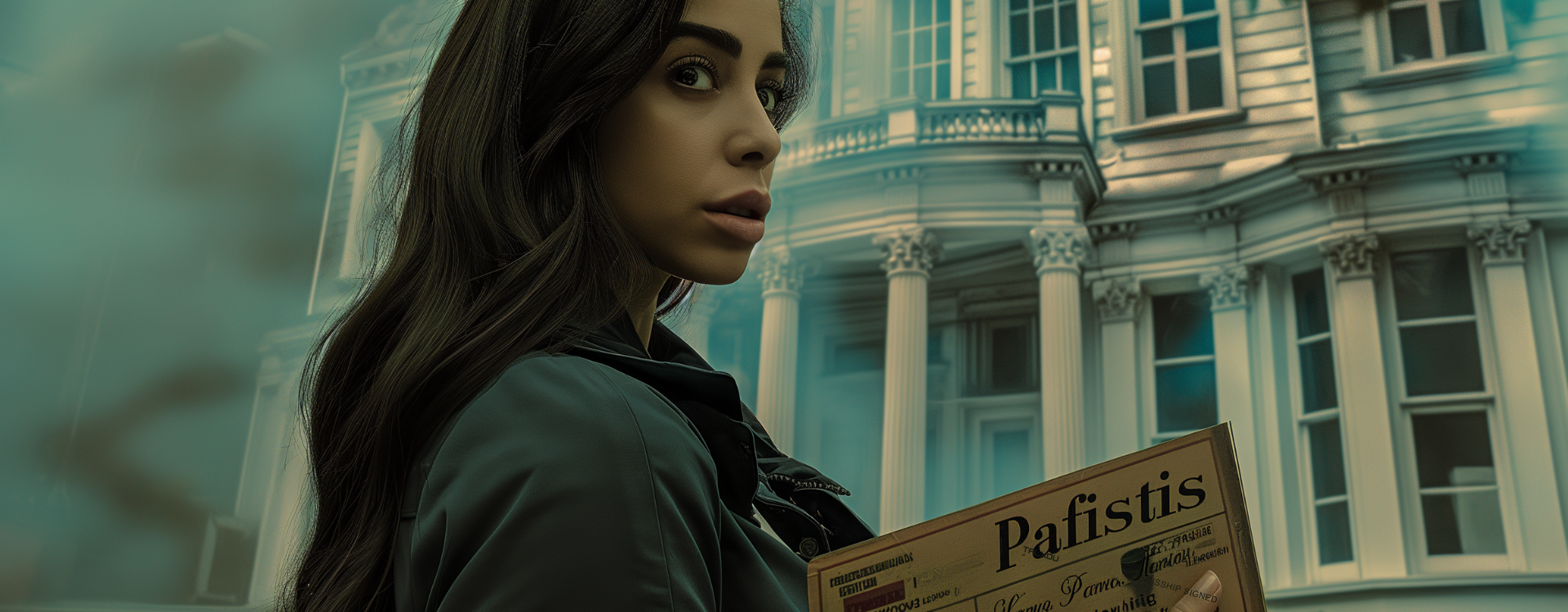
As we pulled up to our destination, my attention was momentarily drawn away from the turmoil churning in my chest. The house was immediately impressive — a large colonial structure that spoke of wealth and taste in equal measure, the sort that turned up in architecture magazines rather than police case files.
My eyes were drawn to the four columns that supported the large balcony overhead. Their Renaissance-inspired design was striking — classical proportions rendered in what looked like sandstone or rendered concrete, each column fluted with traditional detailing that lent an air of elegance and timelessness to the building. The columns flowed harmoniously into the spacious entrance below, creating an inviting yet imposing facade.
The house sat on a generous plot, landscaped gardens stretching around it with the kind of careful maintenance that required either significant time investment or hired help. Probably the latter, given the scale. Everything about the property spoke of established wealth — not new money trying too hard, but the sort that knew how to present itself quietly.
Karl pulled into the circular driveway, parking beside what looked like a late-model Mercedes. He cut the engine, and the sudden absence of road noise made the silence between us even more pronounced.
For a moment neither of us moved, both staring at the house ahead as though it might provide escape from the awkwardness of the car's interior.
Then Karl reached for his door handle, and the spell broke.
"This way please, detectives." Mrs Pafistis's voice broke through my thoughts as we approached the entrance. She appeared at the ample doorway before we'd even reached it — clearly she'd been watching for our arrival. Her presence was commanding yet welcoming, the practised hospitality of someone accustomed to receiving guests in her home.
She was perhaps early forties, elegantly dressed in casual clothes that probably cost more than my monthly salary. Blonde hair pulled back in a neat chignon, minimal makeup applied with expert precision, jewellery that looked expensive without being ostentatious. She had that particular polish that came from having both money and the breeding to know how to wear it.
As we followed her into the home, I couldn't help but admire the interior. The entrance hall alone was larger than my living room, with soaring ceilings and an impressive staircase that curved upward to the second floor. Everything spoke of careful design and expensive taste — the kind of home that turned up in lifestyle features on "Tasmania's finest residences."
We walked across large, square marble tiles that felt smooth and cool underfoot even through my boots. The tiles were a soft cream colour veined with grey, probably imported Italian marble if the house's other appointments were any indication. The path led us past a kitchen worthy of a high-end design magazine — the kind of space where professional chefs would feel at home.
Stone benchtops in what looked like grey granite paired with commercial-grade stainless steel appliances gave the kitchen a modern, luxurious feel whilst maintaining warmth through the wooden cabinetry and thoughtful lighting. A massive island dominated the centre, probably six metres long, with bar stools tucked beneath it suggesting this was a family that actually used their impressive kitchen rather than just displaying it.
Every detail had been considered, from the placement of pendant lights to the careful selection of drawer pulls that matched the overall aesthetic whilst remaining functional.
As we continued into the main living area, the sheer scale of the house became even more apparent. The room was spacious — easily large enough to host parties for fifty people without feeling crowded — with high ceilings that had to be at least four metres tall, and large floor-to-ceiling windows that allowed natural light to flood the space whilst offering views of the manicured gardens beyond.
The decor was tasteful, a perfect blend of comfort and style that suggested professional interior design rather than just expensive furniture randomly assembled. Pieces that looked like genuine antiques mixed with contemporary art in ways that shouldn't have worked but somehow did, creating a space that felt both timeless and current.
It all stood in stark contrast to the grim reason for our visit — and an even starker contrast to my own small weatherboard cottage with its second-hand furniture and DIY attempts at decoration.
"Your house is exquisite," the words tumbled out of my mouth almost involuntarily as I entered the room, a genuine reaction to the opulence that surrounded us. I couldn't help it — the grandeur was overwhelming, and some part of me that wasn't consumed by personal misery could still appreciate beautiful spaces.
The compliment also served a professional purpose. People liked having their taste acknowledged, their homes admired. It built rapport, created connection, made them more likely to open up during questioning. Though in this case, the admiration was entirely genuine rather than tactical.
"Thank you," Mrs Pafistis responded, her voice tinged with a hint of pride that suggested she'd heard this compliment before but never tired of receiving it. "Much of this is my husband's handiwork."
Her words added another layer to my impression of the house and the man we were here to discuss. It wasn't just a display of wealth purchased wholesale from expensive designers; it was also a testament to personal effort and creativity. Adrian Pafistis had apparently been involved in creating this space, contributing his own skills to the home's transformation.
"Impressive," I replied, finding it easy to appreciate the craftsmanship that had gone into creating such a space. It was impressive — genuinely so, regardless of how I felt about wealth disparity or my own current emotional state.
Karl, who had been quietly observant beside me, nodded in agreement. It was the first gesture he'd made that acknowledged I'd spoken, the first tiny crack in the wall of silence he'd erected between us.
Mrs Pafistis then gestured towards a gargantuan Italian leather sofa that dominated one side of the living room. The piece was gorgeous — probably custom-made given its size, upholstered in butter-soft leather the colour of caramel, with clean modern lines that complemented rather than competed with the room's other furnishings.
"Please, sit," she invited, and we followed her direction, sinking into cushions that managed to be both supportive and luxurious. It felt somewhat surreal to be sitting on such an expensive piece of furniture given the usual spartan nature of our fieldwork — most of our interviews took place in station interrogation rooms with uncomfortable plastic chairs specifically designed to make suspects want to confess just to escape the seating.
She took a seat of her own on a matching chair across from us, maintaining a poised and elegant demeanour even as she prepared to discuss her missing husband. Her back was straight, hands folded in her lap, expression controlled — the bearing of someone who'd learned how to hold herself together under pressure.
As she settled in, I couldn't help but take in the entire scene with my detective's eye. The room was tastefully decorated with artwork that I suspected was as expensive as it was beautiful. Original pieces, not prints — I could see the texture of paint on canvas, the signatures in bottom corners. The art leaned towards contemporary Australian work, landscapes and abstracts that complemented the room's colour palette whilst adding visual interest.
Books filled built-in shelving along one wall — real books that looked read rather than decorative props, their spines showing wear that suggested regular handling. Family photographs were interspersed among the volumes, capturing moments of happiness and celebration in expensive frames.
The contrast between the high-end surroundings and the gritty reality of our detective work was striking. It was a reminder of the diverse worlds our job often brought us into contact with — from crack houses to mansions, from desperate poverty to obscene wealth, all united by the common thread of human tragedy and mystery.
As Karl leaned forward, his demeanour shifted into professional mode — a subtle but unmistakable transformation I'd witnessed countless times over our partnership. His shoulders straightened, his expression became neutral and attentive, his entire presence projecting competent authority. It was like watching someone put on armour, piece by piece.
"Your full name for the record, please," he requested, his voice carrying the official tone of inquiry. In his hands, he held a small notebook and pen — tools of our trade that seemed almost quaint in the luxurious setting, ballpoint and paper rendered somehow archaic by the surrounding technology and wealth.
"Sharon Louise Pafistis," she answered, her voice calm and even. There was composure about her that spoke of someone accustomed to handling difficult situations with grace — though whether it would hold as the interview progressed remained to be seen.
Whilst Karl continued with his preliminary questions, diligently scribbling notes in his book, I took the opportunity to observe Sharon more closely. It was part of my process — reading people through their physical presentation, their micro-expressions, the thousand tiny signals that bodies gave whether their owners intended them or not.
She presented a picture of both fragility and refinement. Her frame was thin — almost delicate — yet there was a cultivated quality about her bearing, the result of years of careful self-presentation rather than natural grace.
My eyes were drawn to her face, which was a study in delicate features arranged with almost mathematical precision. Her nose was pointed yet well-shaped, creating symmetry and balance that suggested either exceptional genes or subtle surgical intervention — though I suspected the former. It was framed perfectly by large green eyes that held a depth genuinely captivating, the kind of eyes that could convey volumes without words.
Those eyes were her most striking feature, I decided. Not just their colour — though the green was remarkable, almost emerald in certain light — but their expressiveness. Even whilst maintaining surface composure, her eyes betrayed hints of the turmoil beneath: worry, fear, maybe something else I couldn't quite identify… yet.
Beneath those eyes, her mouth was full and wide, lips coated in finely applied flesh-coloured lipstick that added sophistication to her overall appearance without calling attention to itself. The makeup was expertly done — so natural it almost looked like no makeup at all, which paradoxically required significant skill and expensive products to achieve.
As I continued to observe her, I couldn't help but feel a certain admiration for the way she held herself despite the gravity of our visit. Her facial expressions and body language were carefully controlled, yet there was underlying strength that became more apparent with each passing moment.
Her presence in the room was like a piece of art in itself, fitting seamlessly into the elegant surroundings of her home. But beneath that refined exterior, I wondered what stories she held, what truths lay behind those expressive eyes.
In our line of work, appearances often concealed more than they revealed. The most composed witnesses sometimes harboured the darkest secrets. The most elegant homes sometimes contained the ugliest truths. And as the questioning continued, I knew that our job was to uncover the reality behind whatever had been constructed, no matter how well-crafted it might be.
"And you say your husband has gone missing?" Karl's voice was steady.
"Yes," Sharon confirmed with a small nod, her voice carrying a mixture of concern and disbelief — the tone of someone still processing an impossible situation. "Adrian."
"When was the last time you had any contact with him?" Karl continued.
"I last saw him yesterday morning. He said he was going out to meet with a client about a new potential job," Sharon explained, her words deliberate, as though she was trying to recall every last detail of their last interaction with photographic accuracy. Her gaze had gone slightly distant, looking past us rather than at us, reliving the moment internally.
"What time was that?"
"I'm not entirely sure. It would have been before nine," Sharon replied, a note of apology in her voice for the imprecision. Most people couldn't recall exact times unless something particular had drawn their attention to a clock.
As the questioning continued, I found myself standing up from the luxurious sofa and slowly making my way around the room. This wasn't just restlessness or discomfort with sitting — it was part of my process, my way of engaging with environments to get a better sense of the people we were speaking to.
Karl didn't approve of this method. He'd told me multiple times that I should remain seated during interviews, that moving around was distracting and could make witnesses uncomfortable. But I'd found that movement often revealed things that static questioning missed — details in the environment, reactions that wouldn't surface if I remained properly seated and non-threatening.
Each step I took was measured, my eyes scanning the room whilst my ears remained attuned to the conversation.
The expensive decor became more apparent the closer I examined it. Sculptures that looked like they'd been acquired from galleries rather than furniture stores. Books on art and architecture that suggested genuine interest rather than decorative filler. Personal touches that turned this house into a home — if an extraordinarily expensive one.
"Have you heard from him since? Any phone calls or text messages?" My question cut through the ongoing exchange, direct and focused on practical matters. I paused near one particularly striking piece of Aboriginal art, glancing back at Sharon whilst I waited for her response.
"No, nothing at all," Sharon's reply came, and I could hear the strain in her voice even as she tried to maintain composure. The facade of control was beginning to show cracks, small fissures appearing in the elegant presentation as the weight of her husband's disappearance started taking its toll.
Observing her, I noticed the subtle changes in demeanour — a slight tremor in her hand that she tried to still by pressing her palms together, the way her eyes momentarily lost focus as though overcome by emotion or lost in worried speculation. Her breathing had become slightly more rapid, barely perceptible but there if you knew what to look for.
It was clear that the reality of her situation was beginning to sink in properly now, the initial shock giving way to the human reality of fear and uncertainty that came with having a loved one simply vanish without explanation.
"Did you know the person he was going to meet with?" Karl asked, his tone remaining professionally neutral whilst he maintained eye contact with Sharon.
"No. I've never met them before," Sharon replied, her voice steady but with a hint of uncertainty.
"But you've heard of them?" Karl pressed on, his tone shifting slightly to a more optimistic note. He looked up from his notebook, catching Sharon's gaze with his own, encouraging her to think deeper, to access memories that might prove relevant.
"Yes. I think Adrian had done a few renovation quotes for him before," Sharon said, and I noticed her choice of pronoun — him — suggesting the client was male, though she hadn't explicitly stated this.
The mention of renovation quotes aligned with what we knew about Adrian Pafistis — he was the owner of Pafistis Construction, which explained his contribution to this house's transformation. But even the most innocent professional relationships could lead to unexpected revelations in cases like this. Clients could become obsessed. Business disputes could turn violent. Financial disagreements could escalate into something darker.
I observed Sharon closely whilst she spoke, watching for any flicker of recognition or hidden concern that might suggest there was more to her story. The way she held herself, the slight pause before answering, her gaze that sometimes seemed to drift off into the distance — all these subtleties were crucial in understanding the situation we were delving into.
As I listened, I continued to move slowly around the room, letting my eyes absorb every detail whilst my mind catalogued and cross-referenced. The elegant furnishings and tasteful art hinted at a life of comfort and cultivation, but they also raised questions. How much of this wealth came from Adrian's construction business? Did they have other income sources? Were there financial pressures hidden behind the beautiful facade?
"Is this your husband?" I interrupted, my curiosity getting the better of me as I picked up a small photo frame from a side table near the window. The frame held a single photograph of a smiling couple captured in a moment of joy on a beautiful beach — turquoise water, white sand, both of them in casual vacation clothing looking genuinely happy.
The image was picturesque, almost idyllic, the kind of photograph that spoke volumes about the people in it. Adrian was handsome in a rugged sort of way — dark hair greying slightly at the temples, strong features, genuine smile that crinkled the corners of his eyes. Sharon looked radiant beside him, her arm around his waist, both of them squinting slightly in bright sunlight but clearly delighted to be exactly where they were.
As I held the frame, turning it slightly to catch better light, I was acutely aware of Karl's glare directed at me from across the room. He'd warned me on several occasions about the etiquette of not touching belongings in someone's home during interviews, especially personal items like photographs. It was unprofessional, he'd said. It crossed boundaries. It made witnesses uncomfortable.
However, this morning there was a part of me that didn't mind pushing his buttons at all. Perhaps it was lingering resentment from last night. Perhaps it was passive-aggressive retaliation for being abandoned in a car park. Perhaps I just needed some small reassertion of autonomy in a situation where I felt increasingly powerless.
Besides, I rationalised, it wouldn't hurt for us to hear a little bit more about the couple's relationship. In cases like this, subtleties in how someone spoke about their partner could often reveal more than direct questioning. The tone of voice, the fleeting expressions that crossed their face, the words they chose and didn't choose — all of it contributed to understanding the truth beneath surface presentations.
"Yes. That was taken last year. We were on holiday in Bali. We managed to escape for a week without the kids," Sharon answered, her voice taking on a nostalgic tone as she looked at the photograph.
The detail about escaping "without the kids" suggested they valued couple time, that they made effort to maintain their relationship separate from parenting responsibilities. That was often a good sign — couples who prioritised their partnership alongside their family duties tended to have stronger marriages.
"You both look very happy," I commented, making it a point to glance over at Karl, ensuring he was paying attention to this exchange. It was a subtle reminder that sometimes my methods, however unconventional, yielded useful insights. The photograph told us something — whether Sharon's current distress was genuine worry about a happy marriage disrupted, or performance concealing something darker.
"Yes. We were," Sharon replied, and I caught the past tense immediately.
She must have heard it too, because she quickly corrected: "I mean we are," she amended, a touch of defensiveness creeping into her tone. "We've always had a happy marriage."
Her correction was telling. The slip from past to present tense, followed by the emphatic reassertion of marital happiness — both suggested discomfort with the topic, some complexity beneath the surface presentation of domestic bliss. It could mean nothing, just awkward phrasing under stress. Or it could mean everything.
The emphasis on "always" particularly caught my attention. When people insisted too strongly on something — always happy, never argue, completely honest — it often suggested the opposite. Absolute statements rarely reflected complex human realities.
As Sharon spoke of their supposedly happy marriage, I kept my gaze fixed on her, searching for subtle cues, any flicker of emotion that might betray the true nature of their relationship. Her eyes had gone slightly guarded, her shoulders tensed almost imperceptibly, her hands clasped together more tightly than before.
Meanwhile, I was acutely aware of Karl's growing frustration with my approach. Even without looking directly at him, I could feel his irritation radiating across the room. He was sending clear signals for me to back off, to let him handle the interrogation.
But I couldn't shake the feeling that there was more to be uncovered here, and sometimes that meant straying from the conventional path. Sometimes it meant picking up photographs and asking seemingly innocent questions that revealed cracks in carefully constructed narratives.
"You have children, then?" I asked, deliberately steering the conversation towards her family life. It was a question that might seem innocuous on the surface, but it served multiple purposes — gathering basic information, yes, but also observing how Sharon's demeanour shifted when discussing different topics.
"We have two daughters, Sarah and Brooke," Sharon replied, and for the first time since we'd arrived, her face lit up with genuine, uncomplicated pride.
The transformation was striking — her eyes brightened, her posture relaxed slightly, even her voice took on a warmer quality. This was real affection without the complicated undercurrents that had characterised her discussion of Adrian.
I noted the daughters' names mentally — Sarah and Brooke. One of them shared my name, which created a tiny thread of connection, however meaningless. "Are they home?" I continued, following this new avenue of conversation.
"No. They're at my sister's. I didn't want them to be here whilst I spoke with you," Sharon explained. Her decision to keep her daughters away during our visit was understandable from a parental perspective — protecting them from the stress and questions that would accompany police presence.
But it also opened another avenue for our investigation. Children often noticed things adults missed. They were present for conversations adults thought they weren't attending to. They could provide perspectives on family dynamics that parents couldn't or wouldn't articulate.
"We may need to speak with them too," I said, planting the seed that our inquiry might extend beyond this initial conversation. It was important to prepare her for the possibility that we would need more information, that this single interview wouldn't necessarily be sufficient.
Just then, my phone began vibrating in my pocket, the sensation pulling me out of the focused attention I'd been directing at Sharon. The timing was awkward, interrupting the flow we'd been building, but I couldn't ignore it — not when we were dealing with an active investigation that might generate time-sensitive information.
"Excuse me a moment," I said, removing myself from the conversation. I walked quickly into the adjoining room — what looked like a formal dining room with a massive table that could easily seat twelve — seeking privacy for whatever the call or message might contain.
Behind me, I heard Karl continue with his methodical questioning, his voice muffled slightly by the distance and the house's solid construction. I pulled my phone from my pocket, checking the screen, and felt my stomach drop as I registered what I was seeing.
Two text messages — both notifications that emails had arrived. Important emails, given they'd triggered text alerts. I quickly navigated to my email app, and opened the first message.
Then the second.
And felt my professional focus sharpen immediately even as my personal exhaustion threatened to overwhelm the surge of investigative adrenaline.
"Shit!" The word escaped my lips louder than I'd intended.
This was significant. Potentially case-breaking. The kind of development that changed everything.
I quickly composed myself — or tried to, though my face probably still broadcast exactly how important this information was — and walked back into the living room where Karl and Sharon were still seated, his notebook still open, her posture still carefully controlled.
"Karl," I called out, my voice carrying a concern that was impossible to mask.
Karl, sensing the urgency in my tone, turned to look at Sharon. "Excuse me a moment," he said, his tone polite but firm.
As he joined me in the adjoining room, I could see questions in his eyes, his mind already shifting gears to assess whatever situation I was about to present.
"I've just received Nial Triffett's phone records," I said quickly, the words rushing out as I handed my phone to Karl. Nial Triffett — one of our other missing persons, the fence contractor who'd vanished days ago leaving behind a confused wife and a life that had seemingly provided no warning of impending disappearance.
"And?" Karl's expression shifted to focused attention, whatever irritation he'd felt about my interview methods temporarily shelved in favour of investigative priority.
"Ignoring all the missed calls from his wife, check out the one near the end," I urged, watching his face as his eyes scanned the screen, following the list of numbers and timestamps that told the story of Nial's last known communications.
Karl squinted slightly as he read the small font. Then he reached the entry that had made me swear. His eyes widened slightly, and I watched realisation dawn across his features.
"There's a call from Luke Smith," he said, and the name hung in the air between us, carrying implications that extended far beyond simple phone records.
Luke Smith. The name that kept appearing in our investigation like a ghost haunting the edges of multiple cases. Luke Smith, who'd been mentioned in other contexts, who seemed to orbit our missing persons without ever quite coming into clear focus.
"I know," I said, my voice carrying the weight of what this connection meant. We'd suspected Luke might be involved, but phone records provided concrete evidence of contact, of relationship, of connection that transformed speculation into investigable fact.
"Fuck, this is bad," Karl murmured, the profanity slipping out.
"Yeah," I agreed, feeling anxiety tighten in my stomach. This changed everything. Multiple missing persons, all with connections to Luke Smith. That wasn't coincidence. That was a pattern. That was predation or conspiracy or something equally dark that required immediate action.
"But that—" I started to say, ready to tell him about the second email, the even more damning piece of evidence I'd received.
Karl cut me off abruptly, his focus still on the phone records, still processing implications: "Sharon was just telling me that she's pretty sure the client her husband went to see yesterday morning was Luke Smith."
The pieces were clicking into place with clarity that was as shocking as it was revealing.
Luke Smith had been in contact with Nial Triffett before his disappearance.
Adrian Pafistis had gone to meet with Luke Smith and hadn't returned.
This wasn't coincidence. This couldn't be coincidence. We had a suspect — not just a person of interest, but an actual suspect with concrete connections to multiple victims.
Glaring at Karl with determination that probably bordered on aggressive, I felt a surge of need to make sure he understood we weren't done — there was more, and it was worse. "But that's not all," I said firmly, shoving my phone back at him, navigating to the second email, making sure he saw the image attached.
"What's this?" Karl's tone shifted to curiosity as he examined what I'd brought up on the screen, his eyes narrowing as he tried to make sense of what he was seeing.
"It's the security footage from the ATM where the withdrawals from Jamie's account took place," I explained, watching his reaction closely, seeing understanding dawn in real-time.
Jamie Greyson. His bank account had shown activity after his disappearance, withdrawals that suggested either he was alive and accessing his funds, or someone else was using his card. We'd requested security footage to determine which.
"Are you sure?" Karl questioned, bringing the image closer to his face, squinting at the grainy ATM camera footage. "But that doesn't look like Jamie."
"It's not," I confirmed, my voice steady even as my heart pounded with the significance of what we'd discovered. "It's Luke Smith."
In that moment, standing in Sharon Pafistis's elegant dining room with Karl, surrounded by the material evidence of wealth and taste, I felt the familiar rush of a case breaking open. The pieces were falling into place. The pattern was emerging. We had a suspect and evidence and connections that transformed what had seemed like separate tragedies into something coordinated, deliberate, investigable.
"You take over Sharon's interview. I'll come and get you when we've got permission to obtain a warrant for Luke's arrest," Karl promised, his voice carrying urgency and decisiveness.
He was already moving towards the door, already mentally three steps ahead, already planning how to present this evidence to Sergeant Claiborne and secure the warrants we'd need to actually act on what we'd discovered.
"Karl, wait!" I called after him, feeling a sudden pang of unease at the thought of being left alone to handle Sharon's interview whilst he pursued the warrant. It wasn't that I couldn't handle it — I was a perfectly competent detective capable of conducting interviews independently. But something about being left here whilst he drove away triggered echoes of last night, of being abandoned, of being deemed expendable to whatever Karl considered more important.
But Karl didn't stop. He was already out the door, already heading to the car, already gone before I'd finished forming the protest I wanted to voice.
I stood there in the entrance hall, watching through the open door as he backed out of the driveway, the expensive gravel crunching under his tyres as he manoeuvred the car. Within seconds he'd disappeared down the tree-lined road, leaving me standing alone in this opulent house with a distressed woman whose husband was almost certainly another victim of whatever Luke Smith was doing.
"I'll put a pot of tea on," Sharon's voice called out from somewhere deeper in the house, bringing me back to the task at hand with jarring domesticity. Her offer was a small gesture of hospitality in a situation that was anything but ordinary.
The incongruity of it struck me — we'd just potentially identified the person responsible for her husband's disappearance, and she was offering tea like this was a social visit rather than a missing persons investigation. Though perhaps that made perfect sense. When facing unbearable stress, humans often retreated to familiar rituals and social conventions. Tea was comfort. Tea was normal. Tea was something she could control when everything else was spiralling beyond her influence.
Slowly, I closed the front door, the soft click echoing slightly in the high-ceilinged entrance hall. I turned and walked back towards the kitchen, my mind already shifting gears from the adrenaline rush of discovery to the focused attention required for continuing Sharon's interview alone.
"Thank you, Mrs Pafistis," I replied, my voice carrying genuine gratitude. Despite the tumultuous undercurrents of our visit — the missing husband, the emerging suspect, the evidence connecting her family's tragedy to a larger pattern — her offer of tea was a welcome gesture of normality.
