4338.211 · July 30, 2018 AD
The Lumberjack and the Huntsman
A routine delivery spirals into a showdown with an eight-legged invader, a flirtation that veers into farce, and an encounter with a man who may not be what he seems. As Gladys battles panic, innuendo, and the uneasy chill of something off-script, she’s left wondering: is this still just bad timing—or has the real game already begun?
"You can prepare for enemies, for disasters, for heartbreak. But you’ll never be ready for a spider on your Shiraz."
I let out a heavy, impatient sigh, the warmth of my breath misting the windscreen, momentarily obscuring the view of the frost-dusted paddocks beyond. The early morning chill crept into the car’s interior despite the heater’s half-hearted efforts, and the cabin felt close—too close. The kind of stillness that sharpened every thought into a blade.
I glanced to my left at the lone bottle of Shiraz nestled upright in the passenger seat, buckled in like a particularly well-behaved companion. Its dark glass glinted faintly in the muted light, and I found myself speaking to it as though it were capable of understanding the absurdity of our circumstances.
"I'm going to have to leave you soon," I said, my voice a mix of mock solemnity and genuine resignation. It was a ridiculous thing to admit aloud, and yet, it felt like a betrayal. The bottle had been my confidante, my shield, and, frankly, the most dependable company I’d had over the past twenty-four hours.
The silence that followed was heavy, punctuated only by the distant squawk of birds and the occasional creak of the car’s cooling engine. My thoughts drifted back to the events of the day before. Police snooping about where they didn’t belong. Watching. Waiting. Hovering like flies on something that had started to rot.
Snooping? I questioned my own inner monologue, brows furrowing. That word was far too quaint.
"Stalking more like it," I muttered darkly, bitterness bleeding into every syllable. I leaned back into the seat, feeling its chill through my coat, and closed my eyes for a moment, letting the tension knot tighter in my chest.
It had been Luke’s decision. Of course it had. Late yesterday afternoon, as the sun dipped below the hills and painted the lounge room in amber shadows, he’d dropped it as casually as one might mention a change in the weather. A new directive, handed down like gospel from on high.
"All major deliveries should be sent to the Owens' property," he’d said. Calm. Commanding. Like this was all part of some logistical exercise and not a rapidly spiralling mess of vanishing people, broken trust, and the ever-tightening grip of law enforcement.
"Owens?" I’d echoed, blinking. The name was unfamiliar, and nothing about the plan sounded remotely secure.
"They have a sheltered property in Collinsvale. They're both in Clivilius now," he'd added, and then came the grin. That grin. Infuriatingly charming. Completely inappropriate. Like he was enjoying himself in the middle of a house fire.
I’d wanted to scream. Instead, I’d held the bottle in my hand—this very bottle—and stared at it so hard I was sure I could hear the wine shifting inside, aching to be uncorked. The frustration had risen in me like a tide, thick and hot. Didn’t he see it? The pattern? One more missing person, and the Owens' property would go from 'sheltered' to 'evidence locker' faster than he could disappear through a portal.
But he'd left before I could argue, slipping away like he always did, and now here I was—me and the Shiraz—parked beneath a grey sky, waiting for a truckload of bloody firewood.
Not even metaphorical firewood. Just literal, chopped wood. Kindling for a cover story.
I let my head rest against the window and stared out at the Owens' place. Its rustic charm—weatherboard siding, a stubbornly crooked fence, the faint hum of nothingness—should have felt peaceful. But I’d grown wary of peace. It never lasted.
A branch snapped somewhere in the distance. My hand instinctively reached for the bottle, as if it might offer reassurance. Comfort in Cabernet. Answers in acidity.
This wasn’t a sanctuary. It was just another chessboard, and we were already mid-game.
I watched a magpie hop along the fencepost and tried to push down the sense of dread that had begun to rise in me. The Owens’ property might be our temporary haven, but I knew better than to believe in hiding places. Not anymore. Not with everything closing in.
And certainly not with Sarah Lahey watching.
The loud churning of the small truck’s engine tore through the delicate hush of morning, shattering the brittle peace like a crowbar through glass. I jolted upright, spine snapping straight as I craned to peer through the misting windscreen. The battered ute was inching its way along the pothole-riddled driveway, its suspension creaking beneath the weight of firewood stacked haphazardly in the tray. The sound of the load shifting, heavy logs clunking like bones, was a reminder of why I was here in the first place.
Relieved to see the delivery finally arrive, I leaned over the centre console, fingers numbly reaching for the glovebox. The air inside the car was still chilled, and my breath fogged faintly on the plastic as I fumbled with the latch. The metallic click was oddly loud. Everything was oddly loud lately.
As I gripped the envelope of cash we’d pre-prepared, a sudden, slithering sensation bloomed across the skin of my palm—light, feathery, wrong. A prickling chill surged up my arm. Instinct took over. My hand jerked back violently, the envelope slipping from my grip. Several folded notes burst into the air, flapping madly around the cabin like startled birds.
Then—thud.
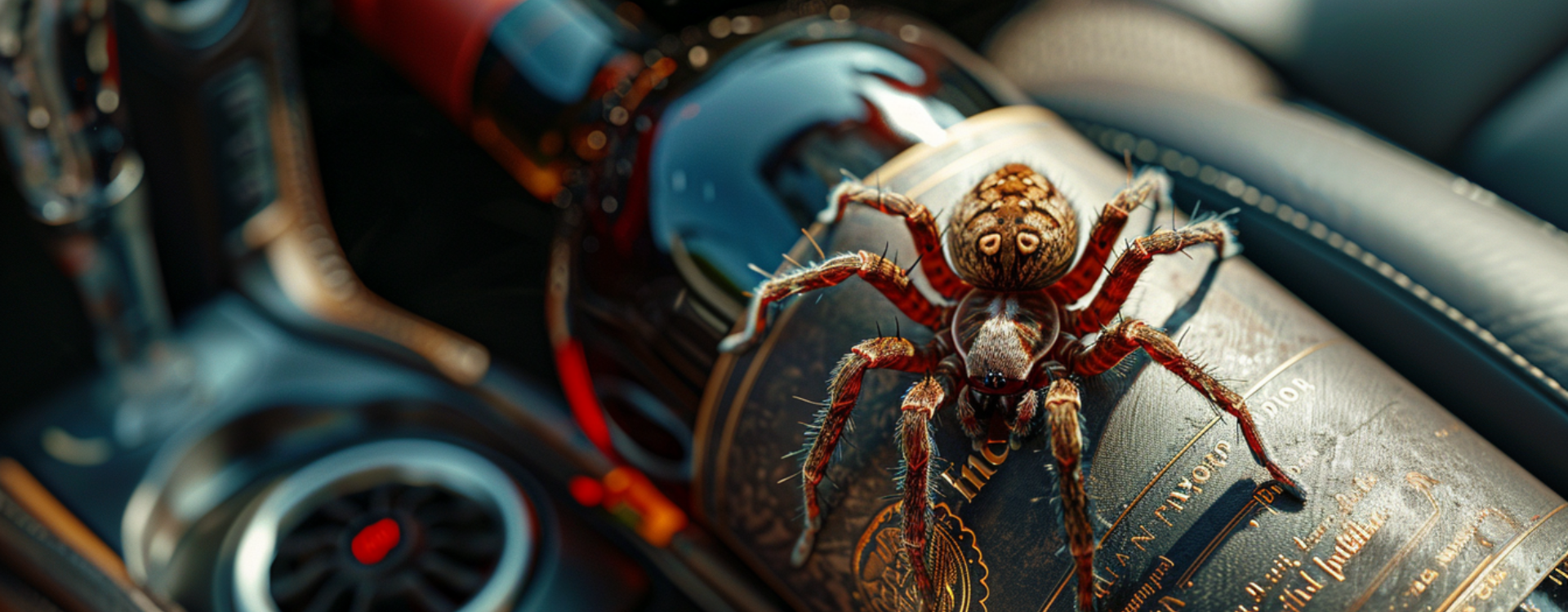
A squat, dark shape dropped out with them, landing squarely on the wine bottle’s label like some grotesque punctuation mark.
Time stalled. I stared. It stared back.
Eight glossy, bulbous eyes. A body the size of a flattened golf ball, covered in sinister grey fuzz. Thick legs arched into an unmistakably predatory stance. My breath caught mid-inhale, seizing in my throat like a swallowed stone.
It was a huntsman. A bastardly, God-forsaken huntsman spider.
My back slammed into the seat, knees knocking into the steering wheel, as I recoiled like a sprung trap. "Fuck off!" I barked, voice breaking on the upstroke, part fury, part raw, twitching panic. The spider didn’t move—just perched there on the Shiraz like it had every right to be judging me.
The bottle sat serenely in the seat, and somehow its calm made everything worse. As if the wine had accepted the spider’s presence before I had.
Then one of its front legs lifted, ever so slightly, as though it were testing the air. It twitched.
I twitched harder.
A shiver surged down my spine, involuntary and electric. My hands had frozen uselessly mid-air, palms splayed like I might fend it off with jazz hands. My mind was useless too—tied in knots, flipping through options that all ended with me accidentally touching it.
The truck’s engine rumbled outside, now idling. Someone would be stepping out soon. But in here, inside my small, boxed-in purgatory, I was trapped in a silent standoff with something that had no conscience and far too many legs.
My pulse pounded in my ears. Somewhere behind the terror, I had the surreal awareness that this—this—was what finally tipped me into madness. Not the detectives, not the missing people, not Luke’s increasingly cryptic orders.
A bloody spider.
"No, wait," I found myself whispering to it, absurdly, as though pleading with a guest not to leave before dessert. My voice was tight and breathless, the edges of hysteria sharpening it to a blade. "Don't go… just… just stay where I can see you."
The idea of it disappearing—into the glovebox, into the dark guts of the car, into my handbag—was far more horrific than staring it down. A known enemy was at least observable. Predictable. Disgusting, but observable.
The spider, apparently unmoved by my diplomacy, shifted slightly on the label. The elegant lettering of the vineyard’s name now curved beneath its twitching underbelly like the title of some horror novel I’d accidentally wandered into.
Another chill ran down my shoulders as I imagined its next move. I fought the instinct to abandon the car entirely, to hurl myself into the frostbitten paddock and just start a new life somewhere far away—somewhere spiderless, wined, and unburdened.
Instead, I sat paralysed, a single bead of sweat sliding down my temple as I stared down the literal embodiment of everything that was wrong with my life right now.
The spider twitched again.
I reached, very, very slowly, for the door handle.
Every movement felt like it existed outside time, as though the world had thinned to a single, brittle thread—the distance between my trembling fingers and the escape hatch to freedom. My palm slid along the upholstery behind my back, sticky with sweat, each inch an effort not to disturb the delicate, horrifying balance inside the car.
My hand finally found the handle.
For a fleeting second, I paused, heart thudding like a drumline. I could almost hear it echoing inside the car. "Yes," I whispered under my breath, barely moving my lips, afraid even a breath too bold might provoke the beast.
The plan was locked in my mind with surgical clarity: open the driver’s door, slip out quietly, circle the front of the car, then—ideally in one smooth, courageous motion—open the passenger side, grab the wine, and flick the spider into the void. A flawless plan in theory, assuming the spider didn’t vanish or leap directly into my face mid-execution.
With a breath I hadn’t realised I was holding, I gently cracked open the door.
The hinge groaned—of course it did—a metallic squeal like a rusty shriek that cleaved through the quiet morning. I winced and paused, frozen, half in and half out of the vehicle, awaiting an attack. None came. Miraculously, the spider remained precisely where it had landed—perched like some kind of smug, fuzzy gargoyle atop the wine label, unmoved and still.
Good. Stay there, you demonic little squatter.
I stepped out gingerly, the leaf litter crunching underfoot with sharp, dry snaps. The cool air hit my cheeks, and it struck me how clammy I’d become, my skin buzzing with residual adrenaline. The morning birdsong had long retreated into silence. Even the breeze felt like it was watching.
Eyes glued to the spider, I crept around the bonnet like a cat burglar with a vendetta. My every step deliberate, cautious. This was war. A battle of nerve. A standoff between one slightly hungover woman and the eight-legged embodiment of all her current life choices.
Then—slam.
The sound cracked through the air like a gunshot. My heart leapt into my throat. I whirled around, eyes wide and feral, instinctively expecting the spider to have launched at my face in the chaos.
But it hadn’t. It was still there.
Still.
Thank God.
From the corner of my vision, I saw the source of the commotion—a man in his early thirties stepping down from the truck cab, black boots thudding against the gravel with the weight of someone whose mornings were always loud. His hi-vis vest was slightly too bright for my taste, but there was a dependable sort of roughness about him.
"You order the wood?" he asked, his voice flat, half-yawned, as if he’d delivered firewood to more suspicious properties than he cared to count.
"Yeah," I replied quickly, still partially focused on my wine-hostage situation. My voice was tight, too clipped, but he didn’t seem to notice—or care.
I jerked my thumb in the vague direction of the shed. "Just dump it over there, somewhere."
"Righto," he muttered, trundling off.
His footsteps crunched off toward the garden shed, mercifully uninterested in asking questions about who I was or why I looked like I’d been in a car with a ghost. Or worse, a spider.
With the interruption fading behind me, I turned back to the car. The passenger side door loomed like a final test. My hand hovered over the handle. The metal was cool, reassuringly solid. This was it. My moment of triumph. I could almost taste the smug satisfaction of slamming that door shut after reclaiming my sacred bottle and banishing its foul guardian.
I leaned closer—
And froze.
"Shit. You bastard!" I snapped, loud and ragged, my voice sharp enough to startle the magpies. My gaze locked on the bottle, still nestled innocently in the passenger seat, its label slightly smudged where the spider had perched.
But now—no spider.
Gone.
Vanished.
There wasn’t a single grotesque leg in sight. Not even the faintest tuft of fur.
I backed away from the door, eyes wide, scanning furiously. My heart pounded with renewed urgency, the panic in me rising not just from fear but from the maddening uncertainty. Where the hell had it gone? Had it scuttled beneath the seat? Crawled into the air vents? Was it on me?
No.
No no no.
The absence of the spider was somehow worse than its presence. Because now, it could be anywhere. Watching. Waiting. Plotting.
My breath came shallow and fast as I pressed my face to the passenger side window, my cheek squeaking softly against the glass. I moved from one pane to the next, scanning frantically through the fogged interior like a madwoman searching for a ghost. Every crease in the upholstery, every shadow caught between sunbeams, seemed suddenly suspicious. The spider could be crawling under the seat. Behind the pedals. Inside the damned air conditioning vents. The idea of it re-emerging mid-drive, perhaps from beneath the headrest or between my legs, sent a fresh wave of horror through my system.
A low growl of frustration escaped me as I furrowed my brow, eyes squinting in desperation. The constant clatter of the wood outside wasn’t helping. Heavy logs slammed into the truck bed like someone hurling insults through a megaphone. I winced with each metallic bang. It was the auditory equivalent of static—grating, ceaseless, distracting. I just wanted five seconds of silence. Just five.
I rubbed hard at my temple, the beginnings of a dull headache blooming behind my eyes. It reminded me of driving through unfamiliar streets with the stereo blasting and realising, absurdly, that you need to turn down the volume to think. My own mind now felt like it had the volume stuck on full blast.
I needed a new strategy. This silent standoff, this jittery pacing around the car like a contestant on some twisted reality game show, was achieving nothing. I had to face it. Take control. Even if the very idea made my skin crawl.
Steeling myself, I reached for the passenger door, its handle cold and unwelcoming in my sweaty palm. The click of the lock felt louder than it should have—like I’d just disarmed a bomb—and I opened it slowly, cautiously, every muscle coiled in case of a sudden leap from the eight-legged monster within.
The door creaked open. And there it was.
The bottle of shiraz. Just sitting there.
Innocent. Immaculate.
Mocking.
No spider. No twitching legs. No satanic eyes. Just the bottle, basking in the sunshine like it had never hosted the spawn of Satan on its label.
I stood there, frozen in a moment that stretched beyond reason. My brain refused to compute. How could something so mundane feel so ominous? I couldn’t even move to retrieve it. I just stared, shoulders locked, mouth slightly ajar, caught in a fog of dread and absurdity.
"Everything okay?"
The voice came from right beside my ear.
I jumped so violently I knocked my knee against the open car door. "Shit!" I yelped, my hand flying to my chest as my heart performed an Olympic-level somersault.
The lumberjack stood beside me, tall and quiet in his own heavy-footed way, arms crossed, his curiosity barely masked by the weathered expression on his face.
"No," I snapped, the word biting and brittle. All pretence of politeness gone. My nerves were frayed, my patience stretched so thin it was practically transparent.
He cocked his head slightly, eyes narrowing, as if assessing whether I was unhinged or just hungover. He said nothing, giving me space to fill the silence.
I exhaled sharply, frustration practically steaming from my pores. "There’s a bloody huntsman in my car."
Recognition dawned in his expression, followed almost instantly by amusement. A wide grin crept across his stubbled face. "Well, you must’ve got him pretty good if he’s all bloodied."
He chuckled—a deep, belly laugh, the kind that usually belonged in a pub after three beers, not outside a haunted car with a neurotic woman beside it.
My lips curled into a sharp, humourless smile. "Oh, fuck off," I muttered, pursing my mouth like a sulking child. My tone didn’t even try to soften the words. I wasn’t in the mood for comedy.
To his credit, the grin didn’t leave his face. He merely turned away with a light shake of his head, about to walk off—until, abruptly, he spun back, all joviality gone.
"I need to get paid for the delivery first," he said, his voice now clipped with a tradesman's no-nonsense practicality.
Of course he did. Because why wouldn’t everything today come at a cost?
I closed my eyes briefly, inhaled through my nose, and turned back toward the car seat, the envelope of cash lying where I’d last seen it—betrayingly close to the wine bottle’s base. My hand reached forward, hesitant and twitching, each movement weighed down by the visceral memory of fur brushing against skin.
I gathered the notes one by one, fingers trembling, eyes darting across every corner of the car’s interior, alert for a twitch, a flicker—anything. The envelope felt damp now, probably from my own palms, as I carefully slid the crumpled bills back inside.
Somewhere, deep in the pit of my stomach, I knew this ridiculous spider incident meant something. I just wasn’t quite sure what yet.
"How much was it again?" I asked, taking a deliberate step away from my car, as if putting physical distance between myself and the spider-infested interior could somehow cleanse the invisible contamination it had left behind. I shivered. The vehicle now felt like a crime scene—one I had narrowly escaped.
"Cash?" the lumberjack queried, his tone light, almost incredulous.
"Obviously," I snapped, more sharply than I intended. A flicker of guilt pricked at me, but I didn’t soften it. My nerves were raw, every muscle in my body taut like stretched wire. I rustled inside the envelope, my fingers brushing over the crisp stack of notes, trying to ground myself with the solid texture of certainty.
"One-twenty will do," he said casually, as though we were discussing tomatoes at a farmers’ market and not playing financial footsie outside a spider-haunted car.
I lowered my gaze to the envelope, focusing hard. Concentration gave me a task, and tasks gave me purpose. I thumbed through the notes, the mechanical count soothing in its familiarity. Seventy. Ninety. One-ten. One-twenty. I held the counted bills together tightly in my fingers and extended my hand towards him.
But the moment our hands brushed—his calloused fingertips grazing mine—it was like static shocked through me. A reflex, sharp and involuntary. I recoiled. And with it, the delicate fan of notes fluttered skyward in a whirlwind of embarrassment.
His chuckle was a warm, unbothered sound, the kind people use when they’re trying to be kind about your obvious unravelling. He bent down, casually collecting the notes from the grass and gravel as if this was an everyday occurrence.
I stood frozen in place, watching helplessly, cheeks prickling with heat. My whole body radiated discomfort. "Sorry," I muttered, the word barely escaping my lips. I hated how small my voice sounded.
"It’s fine," he said, his tone reassuring. He glanced up briefly, our eyes meeting. His were steady, unjudging—an anchor in the whirlwind I seemed to be creating around myself.
I couldn’t hold the gaze. I looked away, ashamed not just of the money mishap, but of everything: the spider panic, the jittery nerves, the strange web of lies I was navigating daily. The Huntsman wasn’t even the real problem, not really—it was just the last straw. A symbol of everything creeping, crawling, and unseen.
Once he’d gathered the notes, he stood and offered his now empty hand. "I'm Jim, by the way," he said, with a rough nod.
I hesitated. Just for a beat. The memory of our earlier contact still buzzed faintly across my palm. But I couldn’t ignore the gesture, not without making it weirder. So I reached out and returned the handshake, letting his large, worn hand close around mine.
His grip was firm, grounded—one of those handshakes that communicated solidity without pretence. I found it oddly reassuring, though I quickly withdrew my hand the moment it was polite to do so, shifting my weight awkwardly onto the other foot.
"Do you need a hand finding your spider?" he asked, gesturing toward my car with a cheeky tilt of his head. His voice carried a lilt of humour, amused by the notion of hunting a rogue arachnid like it was a game.
"It's fine," I said, too quickly, and with a forced casualness I didn’t feel. I crossed my arms tightly across my chest to hide the tension in my shoulders. "It's just a spider." The words came out wooden, even to my ears.
Jim raised a brow slightly but didn’t comment.
"I'm sure if I leave the doors open for a while, it'll find its own way back out," I added, trying to convince myself as much as him. I glanced at the car warily. The open doors gaped like an invitation—to the spider, or to something worse. My palms were clammy again, and I wiped them down the front of my jeans, the denim quickly soaking up the moisture.
"Or just invite another one in," Jim quipped, chuckling, his face flushing with a hint of red under his stubble.
I forced a smile, but inside, the joke curdled in my stomach. Now that's more realistic, I thought grimly, as the sour taste of dread crept into the back of my throat. If one spider could find its way in, what was to stop another? Or ten?
The chill of the morning air no longer felt crisp and refreshing. It was oppressive now, filled with too many unknowns—eight-legged and otherwise.
Jim sucked in a deep breath, the kind that announced the end of a moment. "Well, I better get going then," he said, the air rushing out of him like a deflating tyre. His voice had returned to something more businesslike, stripped of the warm teasing from earlier. The spell was breaking.
I nodded, a slow, reluctant motion. Oddly, I didn’t want him to go—not yet. He’d been a distraction, a wall between me and the spiralling mess of my day. A brief, solid interruption from my own thoughts, which lately had the consistency of a tangled clothesline in a storm.
"It was nice meeting you..." Jim trailed off, and I could see the moment his brain fumbled for the detail he hadn’t yet been given.
"Gladys," I offered, my name falling from my lips with an unexpected softness. A smile tugged at the corners of my mouth—small, a little sheepish, but real.
"Gladys," he echoed, his eyes flicking down for a second before returning to mine. His face pinked slightly, whether from exertion or the awkward politeness of the moment, I couldn’t be sure. Either way, the red sat oddly beneath the dust and stubble on his sun-warmed skin.
He turned to leave, and that should have been the end of it.
But I couldn’t let it be.
"Hey, Jim," I called out, the words escaping before I knew what I was even going to say. He paused, turned, and just like that—my brain failed me spectacularly.
"Can I get a load of your wood?"
Time stopped.
A gust of wind might’ve passed by, but I couldn’t feel it. All I felt was the cold, horrified flush rising up my neck like a brushfire. The second the words left my mouth, I wanted to gather them back with both hands and stuff them down my throat. My face was on fire. Dear God, Gladys.
Jim’s whole posture shifted. The air between us thickened. His casual friendliness dropped away like a curtain, and he walked towards me with a steadiness that had weight behind it. Each footstep crunched on gravel and dead leaves, and each one seemed to echo louder than the last.
When he stopped, barely a foot away, I had to crane my neck to look up at him. He towered over me, the space between us charged, electric. His expression was unreadable, all seriousness and something else I couldn’t quite name. It made my stomach drop and flutter all at once.
I begged myself not to gawk at his face—weather-beaten, ruddy, lined with hard work and something else that wasn’t unkind. But my eyes refused to obey. I was stuck, glued to his presence, to the intensity of being looked at like that.
Then his hand—rough and dry like sun-split timber—lifted slowly, almost hesitantly, and came to rest against my cheek. My breath caught.
"That all depends on what type of wood you’re after," he said, and his voice was barely audible, a teasing whisper just above the wind. I could see the twitch of a grin starting to emerge at the corner of his mouth, like he was trying not to laugh at his own innuendo.
I swallowed, or tried to. A thick knot had taken up residence in my throat. "The uh… you know…" My tongue was useless, sticky and clumsy.
"Yeah," Jim murmured, his voice dipped in husk and honey. He leaned in, closing the distance. My pulse raced. His lips hovered so close, the warmth of his breath brushing against mine.
"The uh… your firewood," I blurted out at the last second, my voice breaking like a dropped plate. Somewhere in the distance, a bird screeched.
Jim paused. And then, without missing a beat, he whispered, "Yeah, my wood’s on fire." His tone was light, teasing—but there was something about it that sent a dart of nervous energy through me. It should’ve felt like a joke, something silly and forgettable.
Instead, his lips brushed mine. Soft. Hesitant, at first.
And yet I didn’t melt. I didn’t disappear into the kiss the way I was supposed to.
Because Cody’s face popped into my mind—unexpected and unwelcome, yet firm. A memory of something gentler, quieter. Something... unfinished.
I stepped back. My instincts took over, a small withdrawal that said more than words ever could. Jim didn’t question it. Didn’t try to close the space again. He just cleared his throat, rough and loud.
Then, in one abrupt motion, he turned and spat a thick wad of phlegm into the weeds beside us. The sound—wet and final—snapped the moment like a twig underfoot.
Just like that, whatever strange thing had passed between us crumpled into something awkward and ordinary. My stomach churned, unsure if it was from embarrassment, regret, or something far more complicated.
"So, uh, how much do you want?" he asked, turning back to face me.
My face twisted, the expression automatic and unfiltered—a visceral response to the wet, rattling memory of him hawking into the grass like a street-side smoker. The moment of tension, of strange magnetism, was well and truly dead. "None, thanks," I replied, my tone clipped, still reeling from how fast the atmosphere had shifted from charged to revolting.
"I meant firewood," said Jim, and there it was again—that disarming, crooked grin. The rough-edged flirtation dropped away as easily as it had come, replaced by the affable lumberjack I’d first encountered. He scratched at the back of his neck, almost sheepish.
I let out a breath I hadn’t meant to hold, but it didn’t bring relief. Instead, it stirred a swirling mess inside me—embarrassment, confusion, a reluctant trace of attraction... and then, like a bucket of cold water, the jarring thud of reality.
The sudden crunch of tyres over loose gravel snapped my attention away. The distinct rhythm of spinning wheels down the dirt driveway sliced through our awkward reprieve. I turned sharply, squinting against the light of the morning sun. The dust pluming up from the road framed the shape of a dark-coloured ute, its outline unfamiliar. The driver wasn’t anyone I recognised either.
An uneasy current zipped through my spine. We were in the middle of nowhere, and this place was meant to be off the radar. That someone was arriving—unannounced, unknown—felt like an alarm bell.
I reacted before I could even finish the thought. My hand dived into my coat pocket and pulled out the second envelope of cash. I shoved it against Jim’s chest. "Just bring however much this will buy," I said quickly, urgency sharpening the edge of my words.
His brow arched as he caught the envelope, clearly reading the change in my demeanour. But he didn’t ask questions. Good man.
I stayed rooted where I was, eyes trained on the approaching vehicle. The ute rolled confidently into the yard, crunching to a halt beside Jim’s now-empty truck. The driver killed the engine, but didn't step out. He lingered, visible through the windscreen, fiddling with something on the dash.
My mind raced as I tried to place him. His face didn’t trigger anything familiar—no connection to Luke, not one of the Guardians I could remember. So what the hell was he doing here? My stomach coiled tighter, nerves knotting like a rope being pulled from both ends.
"Might take a few days to deliver this much. You okay with that?" Jim’s voice broke through, calm and oblivious to my growing concern.
"Sure," I said distractedly, barely registering the words as I continued to observe the ute. "If I'm not here you can just dump it wherever it fits." My tone was detached, the automatic words of someone whose mind was already far ahead of the present moment.
Jim hesitated, and I noticed it—just for a second—a flicker across his face. Disappointment. Or maybe just curiosity at the way I’d withdrawn so suddenly. "Not a problem," he said finally, his voice neutral but not without a shadow of something unspoken.
He turned and walked towards his truck, and as he did, the ute’s driver finally leaned out the window and called, "Morning Jim."
"Hey, Adrian," Jim answered, his voice lifting with casual recognition. "You doing some work out here?"
Adrian. I locked the name in my mind like a file marked urgent.
Jim’s next words blurred into the background, his voice swallowed up by the growing hum of my worry. He was now close enough to Adrian’s window that they might as well have been whispering.
I edged forward, slow and deliberate. My footsteps felt clumsy, like I’d forgotten how to move naturally. I tried to appear indifferent, as though I were just stretching my legs or admiring the weather, but every inch closer was fuelled by frantic inner calculation.
Their voices dipped right at the point where I was close enough to hear a word or two. Frustration prickled at my temples.
Who the hell is Adrian, and why is he here?
I tried to reconstruct every word Luke had spoken to me about the Owens, about deliveries, about this place. Not once had Adrian been mentioned. Not once.
Was this one of Luke’s contacts? Had he sent him without telling me?
Or worse—was Adrian here on his own terms? Connected to the Owens in some other, more dangerous way?
The worst question pressed itself to the front of my mind with a sickening weight: If Luke isn't involved, how the hell am I going to explain to Adrian why I'm on the Owens’ property, alone?
And perhaps more troubling still—how much longer could I keep improvising before the web of lies caught me too?
Lost in my spiralling thoughts, I barely registered the end of Jim and Adrian's conversation. My eyes were still fixed on them, but the words passed me like mist—drifting, intangible. I had been too absorbed in my own anxious calculations, my questions twisting into knots that grew tighter with every moment. By the time I snapped back to the present, Jim’s truck was already rolling down the driveway, its taillights disappearing behind a curtain of dust.
He was gone. Just like that. And I hadn’t caught a single word of their exchange.
A low, frustrated sigh escaped me, followed by the tightening pinch of tension behind my eyes. Annoyance simmered beneath my skin, knotted tightly with apprehension. My body felt heavy, as if each movement had to push through layers of invisible resistance. I turned slowly back to face my car, the scene of my earlier humiliation and irrational dread.
Then I saw it—lying near the front tyre, half-buried in dry leaves. A large stick. Not just a twig, but a proper tool. A weapon. It felt like an invitation from the universe. Or maybe from the spider gods themselves. Either way, it would do.
With a quick, determined movement, I scooped it up, its dry bark rough beneath my fingers. Gripping it tightly, I leaned into the open passenger side of the car. My eyes locked onto the wine bottle like a hawk. And there it was—my tormentor—perched once again near the neck of the bottle as if it had never left.
"Bloody bastard," I muttered.
Without hesitation, I jabbed the stick forward and gave a swift, forceful flick. The spider launched through the air like a grotesque, hairy missile, hurtling across the interior and out the open driver's side door with a satisfying thud against the gravel outside.
Victory.
I stood frozen for a beat, my pulse still racing, a sheen of sweat on my upper lip. Then I dropped the stick with a soft clatter and slammed the car door shut with finality. The sound echoed across the property, the sharp crack like punctuation at the end of a sentence I’d been writing all morning.
A strange sensation crept through me—a mingling of relief and empowerment. It was absurd, really, to feel triumphant over an arachnid. But it wasn’t just the spider. It was everything. It was control. It was doing something, taking action, however small, when the rest of my life felt like a freefall.
But the moment was fleeting.
I stood there in the silence, hands slightly shaking, my chest rising and falling with shallow breaths. The stick lay forgotten at my feet, and the car once again appeared calm and harmless. But the mysteries of the morning clung to me like mist—unseen, inescapable.
Who the hell was Adrian?
What had he and Jim talked about?
Was I just a pawn in someone else's scheme, or had I wandered too far into a game I no longer understood?
A cold breeze rustled through the tall gums bordering the property, and I suddenly felt very alone. Not just physically, but spiritually—adrift in a narrative whose ending I couldn’t begin to guess.
The spider was gone. But the real problems? They were only just beginning.
