4338.209 · July 28, 2018 AD
The Journey
As Karl forces himself upright and outward toward the station, the weight of promotion, guilt, and the unknown gather like the winter mist swallowing Hobart’s streets. Haunted by a chance encounter and the echo of a promise he may not be ready to fulfil, Karl’s path to his first big case begins with survival, not certainty.
“Some mornings you don’t get dressed—you armour up. And if you’re lucky, no one notices the cracks.”
Dressing felt like an endurance trial designed by a particularly vindictive god. Every movement set off fresh waves of nausea, rising from the pit of my stomach with all the grace of sewage backing up through a blocked drain. My muscles ached with resentment, my coordination shot to hell. I fumbled my way through the wardrobe, fingertips numb and uncooperative as they pawed at hangers, seeking some approximation of presentability.
This wasn’t just any day. The first day as Senior Detective in Major Crimes came with expectations—none of which involved arriving looking like I'd crawled out from under the bar at The Whaler. I needed to project authority, composure, competence. Or at the very least, the illusion of them.
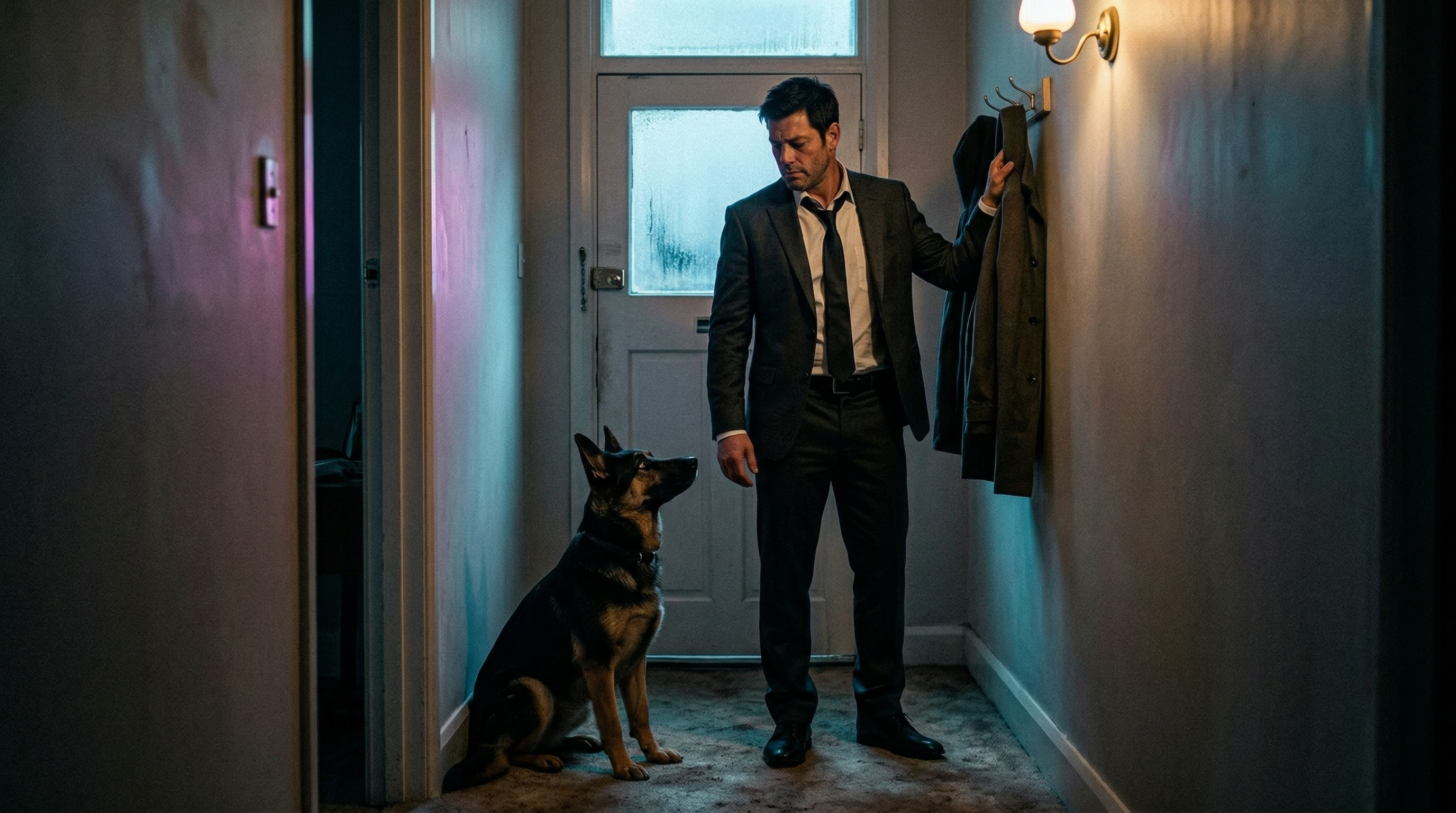
I settled on a charcoal suit. Conservative, tailored just enough to command respect without inviting attention. The dark colour would hide any residual shaking, blood loss, or moral decay I might still be exuding. The crisp white shirt scratched at my oversensitised skin like sandpaper—each button an act of warfare between cloth and coordination. The tie, navy blue with a fine crimson diagonal—a holdover from a previous life where I still gave a shit about colour theory—hung slack around my neck. I couldn’t bring myself to knot it fully. My throat felt as though it had swollen shut overnight.
"How do I look?" I asked, turning to Jargus.
He regarded me from the end of the bed, unmoving, amber eyes steady on mine.
He tilted his head, ever so slightly. Judgement, in canine form.
"That good, eh?" I muttered, catching a glimpse of myself in the mirror.
The reflection offered no mercy.
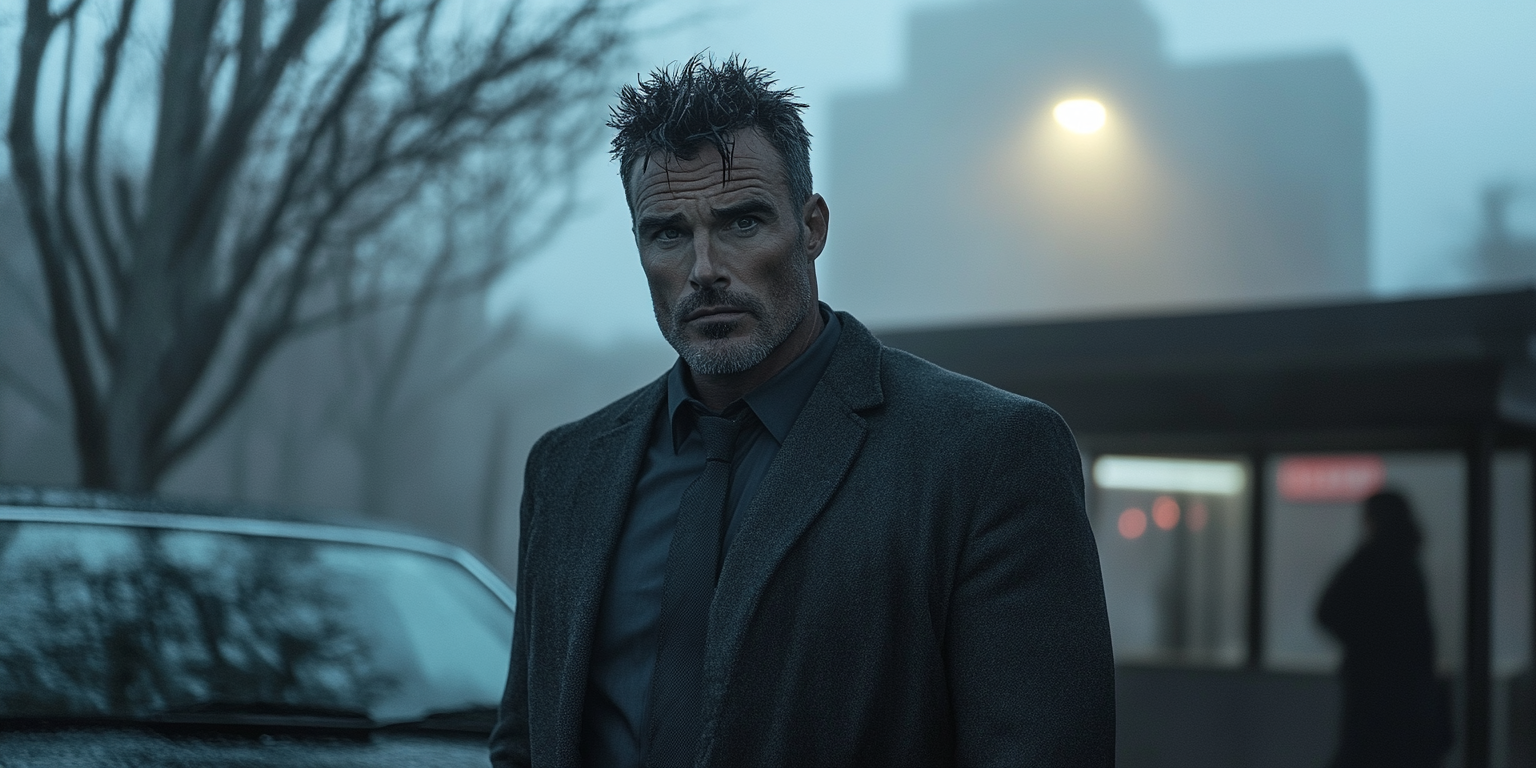
I looked like hell on leave. Bloodshot eyes sunk into purplish craters. Skin waxy and colourless, as if Hobart’s winter had started peeling me from the inside out. Stubble shadowed my jaw, but not in the rugged, television-detective way—this was scruff, uneven and accidental. My expression was slack, vacant, with just enough self-loathing around the edges to make the whole image feel uncomfortably honest.
I turned away.
In the bathroom, I rooted through the medicine cabinet with all the delicacy of a possum in a bin. Bottles, tubes, boxes—most half-empty, most expired. My fingers finally closed around a blister pack of paracetamol. No water. I didn’t care. I downed three tablets dry, wincing as they scraped their way down my raw throat like gravel through a funnel.
Desperation had long since overtaken common sense.
The kitchen offered little in the way of salvation, but I scavenged a half-drained bottle of Gatorade from the fridge. Electric blue. Artificial, cloying. But it was liquid, and it was cold. I drank deeply—three gulps, maybe four—before the aftertaste caught up with me. Still better than nothing. The sugar hit sparked a fleeting clarity, just enough to remind me how far gone I was.
I turned to Jargus again, who remained unmoved, his presence a stoic anchor in the morning chaos.
"Stay," I said.
Not that he needed telling. He hadn’t so much as twitched.
But still—something in his expression gave me pause. That eerie, knowing stillness. The suggestion that he’d scented something I hadn’t—that whatever was coming, he’d caught its trail first.
Or maybe I was just projecting. Guilt, stress, and a hangover will do that. Still, I hesitated at the door.
The cold hit me like a blunt instrument. Tasmanian winter didn’t announce itself with snowdrifts or blizzards—it seeped into you, invasive and wet, a dampness that took root beneath your skin and refused to leave. The street was blanketed in mist, turning the familiar into shadows, shapes distorted at the edges. My breath curled into the air like cigarette smoke, vanishing into the grey.
My car sat at the kerb, a black Holden Commodore dulled by condensation. I’d bought it to be taken seriously without looking like I was trying. Powerful, restrained. On days like this, I valued it mostly for being close by.
The key trembled slightly in my hand as I approached. Not from cold. Not entirely.
Sarah’s words echoed in my head.
This could be your big case.
I slid into the driver’s seat, the leather frigid even through the layers of fabric I wore. The chill spread across my back like a warning. I turned the key in the ignition. The engine roared, loyal and immediate, grounding me with its low, familiar rumble. I reached for the heater dial and twisted it to max, already aching for warmth. For comfort. For any reminder that I still lived in my body.
The radio blared to life. Some club track I didn’t recognise from the night before. Bass-heavy, synthetic, obnoxious. It hit my temples like a mallet. I slammed the power button, silencing the assault with a little more force than necessary.
Merciful quiet.
The car idled around me. A mobile coffin on wheels. A capsule containing everything I’d managed to salvage of myself.
Today would define me. That much was clear. I could already feel the line being drawn—the before and after.
I gripped the wheel.
Time to go.
Hobart’s early morning streets unspooled ahead of me, quiet and damp, still caught between sleep and obligation. South Hobart had slipped past without ceremony—brick duplexes and silent gardens giving way to the slow geometry of the city grid. The capital hadn’t fully woken. It breathed in low, uneven rhythms, reluctant to face whatever the day intended to bring.
Mount Wellington loomed in the rear-view mirror, half-swallowed by its own weather. Low cloud hung heavy around the upper slopes, obscuring the peak entirely. The whole mountain looked like a body tucked beneath a sheet—unmoving, but not at peace.
To my right, just visible between warehouse rooftops and crumbling stone walls, the Derwent River shimmered under a gauze of mist. Not gleaming—more like tarnished silver, dulled and restless. Wind pressed light ripples across the surface, blurring the reflection into something half-formed.
Traffic was mercifully thin. The usual cast of early risers moved like clockwork: tradies in utes with peeling signage, bakery vans running warmth into the veins of the city, taxi drivers ending long shifts with thousand-yard stares. This hour belonged to people suspended between endpoints—those who hadn’t yet stopped, and those who hadn’t quite started.
People like me.
The Commodore hummed beneath me, a muted growl of purpose I didn’t yet feel. My grip on the wheel was firm, too firm. I glanced at the rear-view mirror and winced.
The man staring back looked like a waxwork left too close to a radiator—the same wreck the bathroom mirror had served up, just lit worse. The suit helped, marginally; it held shape where I could not. But no amount of tailoring could fix the hollowness behind my eyes.
A traffic light flipped to red with mechanical indifference. I braked too sharply, sending a fresh tremor of queasiness through my gut. Fingers drummed the steering wheel in a weak attempt at rhythm, trying to outpace the nausea.
It was then I saw her.
Across the intersection, hunched in the sterile glow of a bus shelter, sat a young woman. Not a girl—there was a certain gravity to her that belied youth. Her posture snagged my attention. It wasn’t just the cold. She was folding in on herself, curling tight like something afraid of being seen. Her dark hair hung forward, a curtain shielding her from the world. Arms wrapped tight across her body—not for warmth, but protection. A defensive posture. I’d seen it before. Victims. Witnesses. People who’d had something stolen from them—safety, certainty, control.
Something about her stillness stayed with me longer than it should have. No case, no file, no reason to look twice. I looked twice anyway.
The light changed. A horn sounded behind me, shrill and impatient. I blinked, startled back into motion. The Commodore surged forward, and I watched her shrink in my mirror—reduced to a silhouette, then a blur, then swallowed by mist.
Gone.
The police station emerged ahead like a monolith in the fog. All sharp lines and uncompromising concrete, it stood as a monument to outdated ideas of order. Brutalist architecture, they called it. It had the charm of a bunker and the soul of a bureaucrat. Today, it looked like a place where decisions were made that didn’t come with second chances.
I pulled into my designated space and killed the engine. The silence that followed was heavier than it had any right to be. I sat there for a few seconds, letting the quiet stretch, searching myself for something solid. Some fragment of composure. I needed to be him again. Senior Detective Karl Jenkins. Newly promoted. Newly visible. The one who walked into rooms with answers, not apologies.
I glanced at my watch. Twenty-eight minutes since Sarah’s call. Two minutes to spare. Just enough time to rehearse being someone I wasn’t sure I still was.
I exhaled slowly and opened the door.
The cold bit at me instantly, sliding beneath my clothes like a blade. I adjusted my tie, squared my shoulders, and moved deliberately, consciously—managing the illusion of calm, of clarity.
I didn’t take the main entrance. Too exposed. Too many eyes that would clock the aftermath clinging to me—colleagues who’d seen me raise a glass last night and would now see the cost of that toast carved into every line on my face.
Instead, I circled to the rear of the building. The entrance favoured by those ferrying in suspects or returning from scenes too grim to walk past reception. It offered no ceremony, just discretion. And this morning, that was all I wanted.
I’d left Jargus at home. No callout, no fieldwork scheduled—just case briefings and Sarah’s half-baked theories. He’d be better off on the couch than pacing in a crate beneath the station lights. At least, that’s what I told myself.
I swiped my warrant card at the security panel. The reader chirped, obliging. The lock disengaged with a pneumatic sigh that almost echoed mine.
Inside, the corridor ran east—towards the loading dock and the back stairwell. I followed it, past the evidence lockers and half-lit break alcove, until I reached the stairwell door. Down one flight, turn left.
The showers sat tucked between the vehicle bay and K9 holding, as if even the building wanted to hide them.
I moved like a man navigating tripwires. Shoulders low. Footfalls light. My phone buzzed in my pocket. Sarah again. I ignored it.
Whatever urgency had pushed her to call could wait another five minutes. I needed those five minutes.
I needed to wash this off.
I needed to rinse last night from my skin and reclaim some fragment of myself before facing whatever waited upstairs.
If Sarah was right—if this was my big case—I couldn’t meet it like this. Not sodden with guilt and Gatorade, not trembling behind a charcoal suit.
I stepped into the showers and turned the tap until the water threatened to scald. Steam climbed the tiles, and I walked into it willingly.
This was no comfort. No indulgence. It was ritual.
A baptism by boiling water and borrowed time.
