4338.209 · July 28, 2018 AD
The Interview
Karl is pulled into an interview that cracks open the past. When a familiar face walks into the station with news of two missing men—her son and her brother—Karl must navigate a case as personal as it is dangerous, while trying to hold together the version of himself he’s spent years constructing.
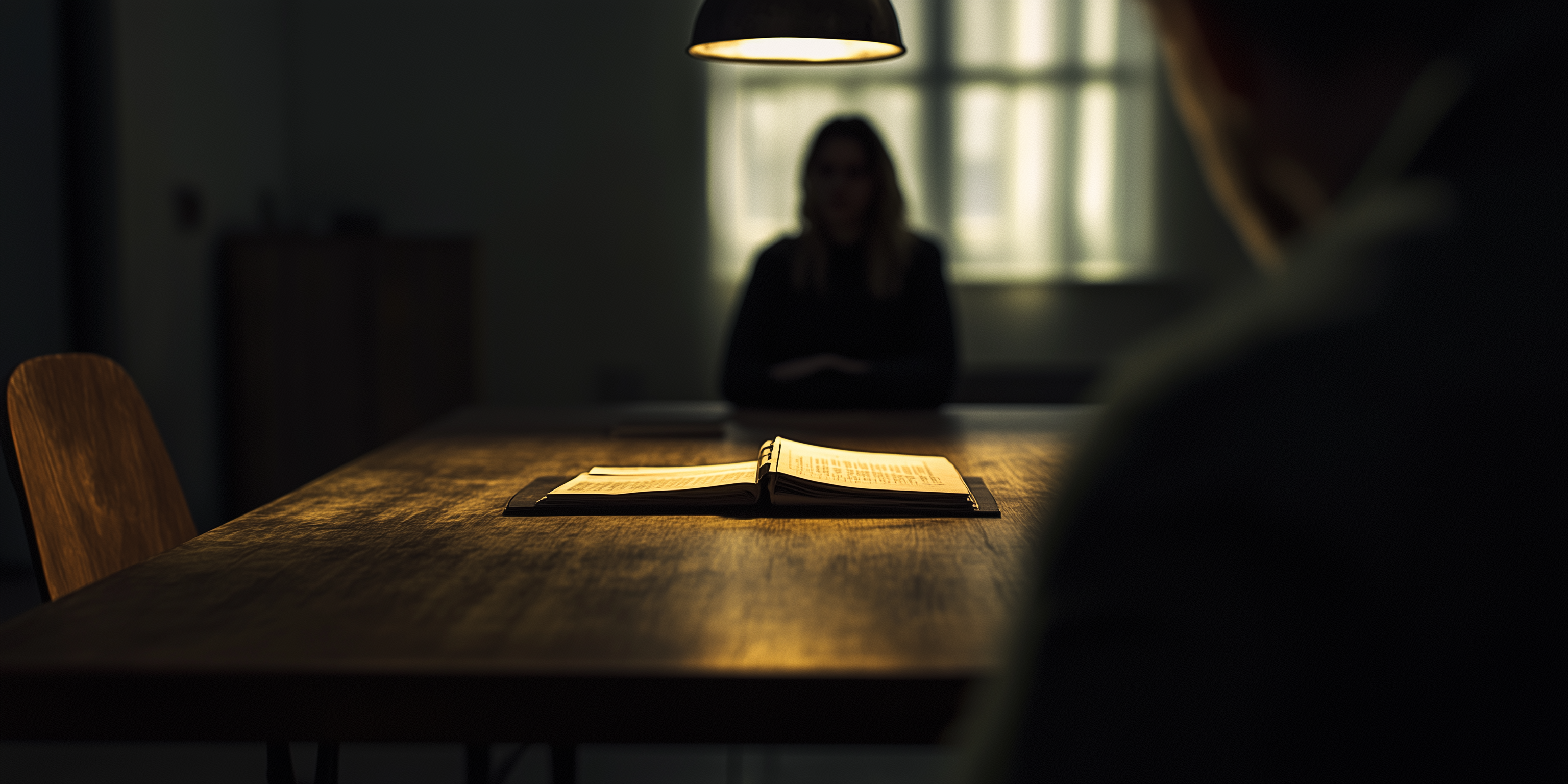
“There’s a moment—right before a case begins—when you feel it shift. Not in the facts. In your gut. That’s how you know it’s going to matter.”
Each step down the corridor felt heavier than the last, like my boots were filling with cement. The sterile overhead lights cast a clinical pall over the walls, exaggerating the institutional coldness of the station. That familiar buzz—the ever-present hum of law enforcement life—seemed distant now, as if filtered through gauze. Telephones ringing. Fingers clacking at keyboards. Indistinct murmurs. Normal sounds, routine even, but today they drifted aimlessly toward me, warped by the fog in my mind.
My hangover had lessened its grip, retreating to a dull, throbbing ache nestled behind my eyes, but the cognitive drag remained. Thoughts moved sluggishly, as if wading through treacle. The corridor itself felt wrong somehow—longer, narrower. Like one of those dreams where you walk and walk, but the door never gets any closer.
I passed familiar faces without registering them. No nods, no small talk. Just tunnel vision. The stark reality of my position—as the newly minted Senior Detective still marinating in last night’s sins—began to crystallise into something sharper than shame. Dread.
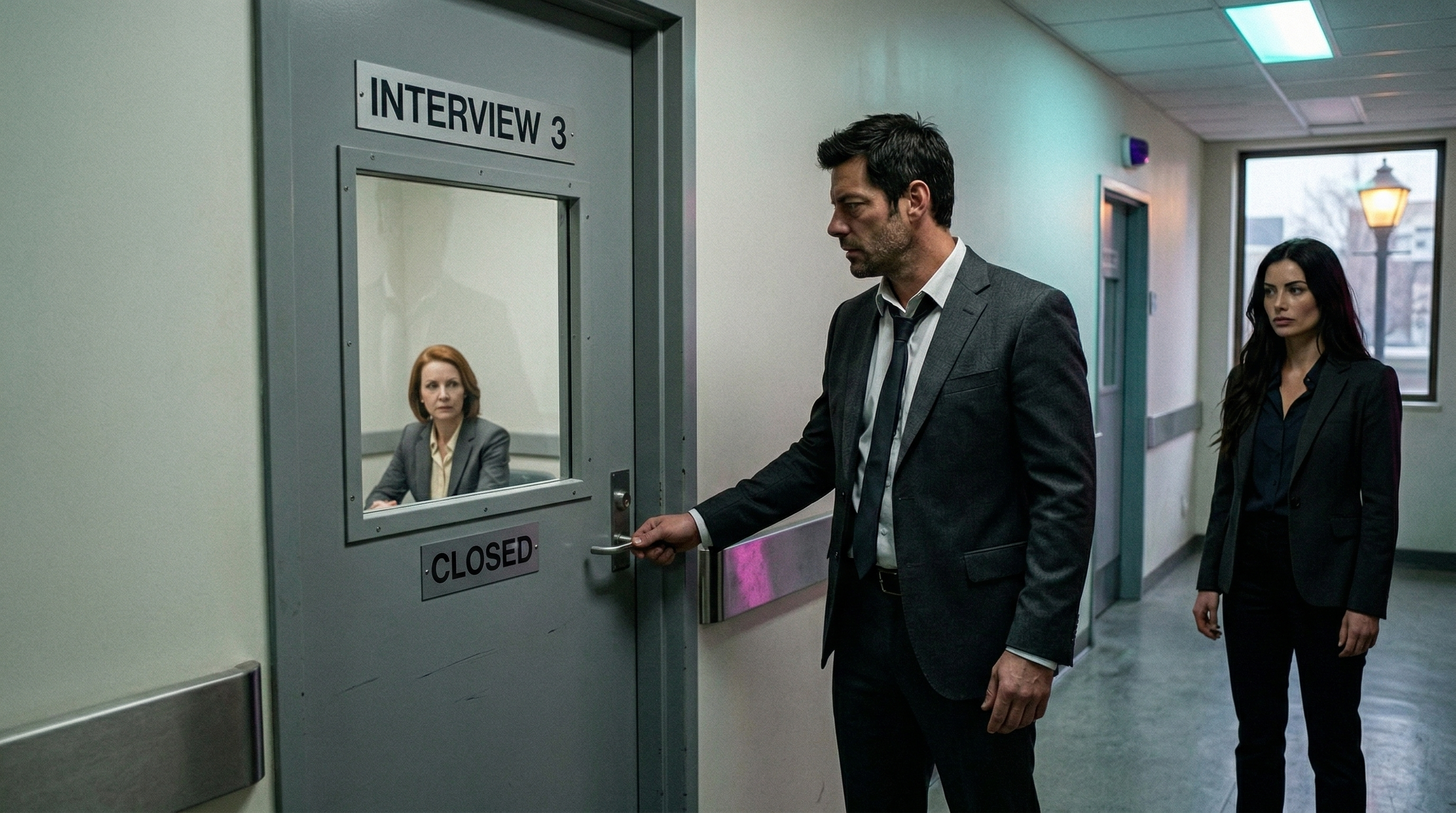
Interview Room 3.
Sergeant Claiborne stood posted like a sentry beside the door, his uniform creased to regulation perfection, arms crossed over his chest. He didn't so much as blink as I approached. To his left, Sarah was pacing—a slow, taut rhythm of contained energy. She tapped her pen against a notepad in a harsh, repetitive beat. Tap, tap, tap. Not hurried. Not random. Controlled. Measured. Each tap a countdown, each second a rebuke for every minute I’d squandered on last night’s oblivion.
"She’s in there," Sarah said, without turning. Her tone was clipped, business-like, stripped of anything personal.
This was Detective Lahey, not Sarah. The distinction was unmistakable. The warmth I was used to—the quiet humour, the subtle give-and-take—was gone. Replaced with a steel-edged resolve. She wasn’t angry. She was focused. Laser-locked on whatever was happening in that room. It pulled me into her gravity.
She stepped toward me, placing a hand lightly on my arm—firm, guiding, not comforting. The contact sent a jolt through me. Intimate, but not soft. A reminder of who I had to be in this moment.
"You ready for this?"
The question was layered. Not rhetorical. Not perfunctory. A quiet challenge. A test. And beneath that, something almost fragile—Are you still him? Can I still count on you?
I nodded, the gesture mechanical. My throat rasped dryly, and the words I should have said—I’m not sure, I’m trying, Give me a minute—stayed locked behind my teeth. I didn’t dare let them out.
I took a step toward the door, trying to form an opening line in my head—something composed, confident. I didn’t make it.
Claiborne’s hand shot out, hitting me square in the chest.
Not gently.
It stopped me dead. The air left my lungs in a surprised oof, and for a second, I froze. His palm lingered, flat and unyielding against my sternum. The suddenness of the gesture electrified every nerve in my overstimulated body.
His gaze locked with mine—cold, calculating. His eyes, the colour of clouded steel, scanned my face like a lie detector looking for faults.
"I’d normally tell you to go home," he said, voice pitched low enough to exclude the rest of the corridor. "But she has a unique story to tell. And she’s determined to tell it to you, specifically."
That penultimate word hit me harder than his hand had. You. Not someone from Major Crimes, not just any detective. You.
My skin prickled.
It wasn’t uncommon for victims or witnesses to request specific officers—gender preferences, someone with a certain tone, a familiar face from a previous interaction. But there was something in Claiborne’s phrasing, the measured way he said determined, that hinted at something else. Something heavier.
Something personal.
He removed his hand, but the sensation lingered. A pressure that had transferred from skin to bone.
"Now, don’t screw it up."
Five words. Calm, flat, devastating. Not a threat. Just the truth.
I swallowed hard, the aftertaste of stomach acid and adrenaline rising in my throat. This wasn’t just about the woman in the room. This was about the room itself. About what it represented. My first test in Major Crimes. A misstep here wouldn’t just be a blip—it would be a bloodstain on my personnel file. Permanent. Visible.
Claiborne leaned in slightly.
"I’ll be watching you closely."
His earlier warmth—the shared glance over Glen’s antics, the flicker of humour—was gone. The man before me now was all authority, all weight. His expression was unforgiving. Not because he didn’t think I was capable—but because he needed me to be. This wasn’t about personal redemption. It was about institutional trust.
I took a breath. A long, slow inhale that scraped its way through lungs still raw from alcohol and regret. I adjusted my tie, more for ritual than necessity. Straightened my jacket. Tilted my chin just slightly—posture compensating for the tremble in my gut.
Behind me, I could feel Sarah’s eyes on my back. Watching. Waiting.
I turned the handle.
Whatever—or whoever—waited inside had asked for me. And regardless of the ghost of last night still clinging to my skin, I had no choice but to step into that room as the man the badge said I was.
I’d spent the last half hour rebuilding him—Senior, authoritative, unbreakable. Whether he’d hold once that door closed behind me was another question.
And I was about to find out why I was the one she wanted to talk to.
Detective Lahey opened the door to Interview Room 3, and we filed in with the solemnity of mourners. The air inside hit with familiar weight: a stale cocktail of industrial disinfectant, overbrewed coffee, and institutional anxiety. These rooms never changed—no matter the precinct, no matter the city. The same steel table, bolted to the linoleum as if any attempt at escape might begin with dragging it to the exit. Four chairs—rigid, uncomfortable, deliberately impersonal. The recording equipment stood sentinel in the corner, red light blinking its silent warning: everything you say can and will be held against you.
I stepped inside with calculated composure, my stride measured, my expression carefully neutral. Claiborne’s gaze pressed into the back of my head like a sniper’s crosshair. I didn’t have the luxury of faltering. Not here. Not now. This wasn’t just another statement. This was the moment—my professional debut in Major Crimes. My chance to turn a promotion into permanence.
But the façade I’d spent the last thirty minutes rebuilding cracked the instant my eyes found her.
"Louise Jeffries?"
Her name left my mouth before I could stop it—four syllables shaped by muscle memory and years of silence. She stood there, not as a relic of nostalgia, but as a fact: present, real, and unmistakably her.
Time had left its mark—lines that hadn't been there before, a tension in her shoulders that spoke of long-haul resilience. But the core of her was unchanged. Those hazel eyes—clear, steady, sharper now—still held the weight of someone who’d learned how to endure without surrendering entirely.
She looked older. So did I. That was the price of persistence.
But I saw it. Not the past, exactly—just the shape of who she'd been before all this. The woman whose voice had once calmed the worst parts of me. The woman I’d admired from a distance I never dared cross.
The door clicked shut behind us, and for a moment, it was like the years compressed. Not gone, not undone—just pressed together into the silence that filled the room.
"Oh my God! It is you," I said, quietly. Not a revelation—just a fact wrapped in disbelief.
Memories rose like old photographs—her quick wit over coffee, the sharp turn of her head when she was about to challenge someone, the conversation we never finished after I let things go unsaid for too long.
She nodded once. No smile. No surprise.
We both knew this moment had always been waiting.
"You two know each other?"
Sarah’s voice cut through the quiet, sharper than necessary. Not just surprise—something colder. Alertness, maybe. Territory, maybe. The kind of tone a person uses when the room shifts without their permission.
"You could say that," I said, keeping my eyes on Louise. The words came out thin, loaded. A world of context buried in a single breath.
There was no version of this I could explain. Not here. Not now. Louise wasn’t a former colleague or a passing acquaintance. She was a fixed point in a timeline that had bent me in ways no one else quite had. A constant I hadn’t spoken to in years, and still thought of more often than I’d ever admit.
And I couldn’t reduce that to a soundbite for Sarah or Claiborne.
"How have you been?"
It was a stupid question. Reflexive. Shallow. The kind of thing you ask at a café counter, not in a police interview room under fluorescent lights. But I couldn’t stop it leaving my mouth. Emotional muscle memory, faster than thought.
Louise didn’t flinch, but I caught it: the fractional delay in her breath, the tension along her jaw. Composed, but not untouched. She’d always been precise. Even now, she held herself like someone who’d learned exactly what it costs to fall apart—and decided never to pay it again.
"Please, Karl. Sit."
Her voice hadn’t changed. Calm. Even. Perfectly enunciated. But the familiarity of it hit like a tuning fork to the chest—something that reverberated in the spaces I usually kept locked.
And with it came that old, cold instinct. Not emotion. Not guilt. Warning.
Not because I was seeing her again after all this time. But because if Louise Jeffries was sitting in this room, asking for me by name—Something was already very wrong.
I sat opposite her. The chair groaned under my weight. The cold metal bled through the fabric of my trousers, anchoring me in the here and now. I folded my hands on the table and resisted the urge to fidget. The air con clicked on above us, sweeping a draught across the back of my neck. Goosebumps prickled along my forearms. It felt like the room itself was bracing.
"I’ve already told most of this to your colleague here," Louise said, nodding toward Sarah with a curt professionalism. "But I wanted to tell you directly."
That emphasis again—not the department, not the police. Me.
Sarah said nothing, but I could feel the shift in her stance beside me. I didn’t need to look to know her eyes were narrowing. She was assembling a mental file, trying to piece together what this meant, what kind of storm had just entered the room.
I leaned forward slightly, schooling my expression, resisting the reflex to react emotionally. I had to find the line—present, engaged, but professionally detached. I couldn’t let the years between us colour this moment. And yet, every fibre of my being wanted to reach across the table and ask why now?
But I didn’t.
"I’m listening," I said.
Simple. Neutral. But my eyes locked on hers, holding that contact. I’m here. That was what I needed her to know. Whatever this is, I’m here now.
Her face didn’t change. But something in her gaze shifted—just slightly.
That subtle flicker in Louise’s eyes, barely perceptible, was all the signal I needed. It wasn’t nerves. It wasn’t indecision. It was the moment before impact—the final breath before a truth that couldn’t be unsaid.
She held my gaze with an intensity that rooted me to the chair, her composure like fine porcelain—flawless from a distance, but straining under invisible pressure. A sigh escaped her, quiet and controlled, the sound of someone preparing to lift a weight they knew would crush them if not handled with care.
"My son, Kain, is missing."
The words dropped into the clinical stillness of the room and struck something I hadn't realised was unguarded.
Kain. The name hit harder than it should have.
Not because I’d forgotten him—but because I hadn’t expected the memory to surface so fast, or so sharp. In my mind, he was still sixteen, standing half-defiant in a youth interview room, shoulders squared, gaze level. Eyes like his mother’s—hard when challenged.
Back then, it had been nothing serious. A public drinking caution. A mother trying not to panic. A favour called in. No charge. No paperwork. Just a quiet conversation, a closed file, and a boy I hoped would walk the line from then on.
That had been six years ago.
Now Louise was here, using the word missing.
And I knew immediately—this wasn’t overreaction. If Louise had come to me, it meant the situation was already past routine. Past questions. Past doubt. She’d waited until she was certain. And if Kain was truly missing, then whatever this was... it had already moved out of her control.
There was no panic in her voice. No theatrics. Just that precise, deliberate calm I remembered—the kind that always meant something serious was happening underneath.
I felt the shift in the room before anyone spoke. Sarah’s posture had stiffened. The air wasn’t hostile, but it was watching.
And then I registered something else—a silence. An omission.
She hadn’t told them. Not about me. Not about us.
My relief was immediate, but silent. She hadn’t brought our shared history into this. Not in front of Sarah. Not in front of Claiborne. Whatever had once existed between us—whatever we’d carefully never named—she’d left it where it belonged. Tucked away. Buried in subtext. Shielded by years and restraint. For now.
"And so is my brother," she added, her voice low. Flat. Final.
Another name. Another weight.
My stomach tensed. "Jamie?" The word caught in my throat, heavy with dust. I hadn’t spoken it in years. Not aloud.
Jamie Greyson. Once a constant presence in my life—intense, volatile, brilliant in the way storms are brilliant. He hadn’t grown up with me, but it had felt that way, for a while. We'd collided in Brisbane, young and restless, both of us pretending not to need anyone. But in the space between conversation and confession, we'd found something that resembled loyalty. Maybe even trust.
And then—it all shattered to pieces.
There’d been a line crossed—one we never spoke of. And after that, only distance. Almost fifteen years of silence, interrupted only by accidental sightings—across streets, across time. Neither of us ever spoke. Neither of us ever waved.
We passed like strangers. But I never once forgot the last thing I said to him. Or what came after.
"Yes," she said, the confirmation quiet and absolute.
I straightened slightly, instinctively retreating into procedural posture, even as something cold began tightening behind my ribs.
"Are you sure?"
My tone remained calm, but the air between us was charged now. This wasn’t a coincidence. Two disappearances in the same family. This wasn’t just a missing persons case—it was personal. For her. For me.
"I haven’t been able to contact him for several days now," Louise said, voice trembling despite her best efforts. "He hasn’t answered any of my calls or responded to any of my texts. I’ve driven past his house a few times and his car is still in the driveway."
That last detail landed heavily. The car still parked up outside. Not a good sign. I could already see the scene in my mind: mail building up at the door, curtains drawn, a silence that felt more ominous than peaceful.
"Have you knocked on the door?" I asked, frowning slightly. The question felt redundant, but her previous answers had left gaps—gaps I needed to fill.
She hesitated. "I didn’t at first."
Her voice cracked, just a hairline fracture—but enough. "Maybe if I had, Kain would still be around."
Regret bloomed in her eyes, followed swiftly by anger—directed squarely at herself. She wiped at her face with the back of her hand, not a gesture of helplessness, but one of frustration. Louise had always loathed feeling vulnerable. It was painful to watch her wear it now.
"I’m confused, Louise," I said, leaning forward, trying to keep my voice steady. "You said you didn’t knock on his door at first. But you have now?"
Timelines. Details. I needed them to make sense. My head was already spinning out theories, scenarios, possible triggers—but they were only noise without structure.
She nodded slowly. "Yes. But he didn’t answer. I only spoke to Luke."
"Who is Luke?" I asked. The name jarred. Not part of the picture I’d kept—however outdated it might be.
"Luke Smith," she said, pausing just long enough to signal significance. "Jamie’s partner."
A beat passed. Then another.
"Oh. I didn’t realise," I admitted, my voice quieter now.
It shouldn’t have caught me off-guard, but it did. Not that Jamie was gay—that never would have mattered to me—but that I didn’t know. That he’d lived an entire private life beyond my reach. That I’d been gone for all of it.
The man who once knew the shape of Jamie’s thoughts, who could anticipate his movements in a room, now sat across from his sister, learning facts that should have been part of a shared life. The distance between us suddenly felt immense.
"It’s okay," Louise said, softening. There was no judgement in her tone—just understanding. She could see what the admission had stirred in me.
I drew in a breath. Slow. Steady.
The past would have to wait. Jamie’s relationship with Luke. Kain’s disappearance. My own guilt. None of it mattered unless I could function. Unless I could help.
I reached for my pen and notepad, the motion grounding me in procedure.
Professionalism was the only armour I had left. Because beneath it, the floodwaters of old wounds were rising fast.
"Louise," I began, my tone deliberate, measured, the cadence of a man trying to bring order to chaos. "I'm still quite confused. Please, start again from the beginning."
Her eyes widened slightly, alarm flitting across her face. "The beginning?"
"Just of the disappearance," I clarified quickly, hands raised in a reflexive gesture of reassurance. The last thing we needed was an accidental excavation of our shared past. That was a dig site better left untouched, at least while Sarah and Claiborne hovered like archivists, ready to catalogue any emotional artefact that fell loose.
Louise inhaled slowly, her chest lifting with the familiar rhythm of someone about to recount something difficult. I remembered that breath. It used to precede arguments, revelations, truths I wasn’t ready to hear. But now it preceded something worse—loss.
"It’s been four days since I’ve been able to get in touch with Jamie," she began, her voice more stable now, anchored by the need to tell it cleanly. "And it’s unusual that he doesn’t answer my calls."
The old Louise—methodical, rational, grounded in evidence—was emerging beneath the fear. I could see her shifting into that gear now, clinging to it like a lifeline. "I was already concerned about his relationship with Luke, so I sent Kain over to their house to check on him. But I haven’t heard from Kain since."
She paused, just for a moment, but in that pause her mask faltered. Her lower lip trembled almost imperceptibly, her jaw tightening with the effort of restraint. I knew those signs. The blink that was a second too long. The slight shift in posture as if bracing against a storm. The strength it took to remain composed in the face of growing dread.
"I'm really worried that something terrible might have happened to them," she continued, strain evident as she fought to maintain control. Unshed tears magnified her eyes, catching the harsh fluorescent light.
I leaned forward and, without overthinking it, placed my hand over hers where they trembled on the table. The gesture was both instinctive and intentional—a moment of contact that offered reassurance and quietly re-established connection. It was professional. Mostly. But also deeply human.
"When did you send Kain?" I asked, keeping my tone gentle but firm, coaxing detail rather than comfort.
"Two days ago. It was first thing in the morning," she replied, voice softening. "I’ve contacted Kain’s friends, but nobody has seen or heard from him since he left our house. Kain’s fiancée swears to me she hasn’t heard from him either."
That last part carried weight. Louise didn’t exaggerate. She didn’t cry wolf. If she’d consulted Kain’s friends and his fiancée before coming to the police, then this wasn’t panic—it was terror disguised as diligence.
I nodded, mentally building a timeline:
Four days since Jamie last answered his phone.
Two days since Kain went to check on him.
No contact from either since.
The silence was telling. Too clean. Too complete.
"So, after driving past Jamie’s house several times, I finally decided yesterday morning—" Her voice caught then, words momentarily strangled by emotion. I felt her hands tremble beneath mine. My grip tightened slightly, a wordless reminder: you’re not alone.
"I decided," she continued, once she'd wrangled her voice back under control, "that I’d go and knock on the door. I pulled into the driveway, but I didn’t get a chance to knock. Luke was already walking out the front door."
Her tone shifted again, back into the observational—the voice of someone replaying events in her head with forensic clarity. I followed her carefully, noting every beat. She wasn’t rushing. She wanted this told right.
"I asked him about Jamie, and he told me they were having relationship issues and Jamie had gone to Melbourne for a few weeks to think things over."
I leaned back slightly, the cold plastic of the chair creaking under me. That changed things—if true. A voluntary departure to Melbourne would shift this from high-priority missing person to domestic absence. But something in Louise’s voice told me she wasn’t buying it.
Neither was I.
"And do you believe him?" I asked, watching her closely.
"Well, he did seem to be pretty upset about it all," she admitted, her tone cautious, "but even if it were true and Jamie had gone to Melbourne, that doesn’t explain why he won’t respond to any of my calls or messages."
She was right. People need time. People take space. But Jamie had always stayed tethered to Louise—especially after what they’d been through as kids. A total blackout? It didn’t fit.
I drew a breath, noting the deepening sense of unease. Something isn’t right.
"And did Luke say anything about Kain?"
A critical question. We needed to close the gap in the timeline.
"Not really. He just said that Kain never made it around. He said he hadn’t seen him since last Christmas."
My brow furrowed. That didn’t make sense.
If Kain never arrived, then where had he gone?
And if he did arrive, why would Luke lie?
Two narratives now sat in direct contradiction. Louise had sent Kain to check on Jamie. Kain had vanished. Luke claimed not to have seen him. That divergence set off every warning bell I possessed.
I stared down at my notepad, where I’d been scribbling fragmented notes:
Jamie: missing 4+ days.
Kain: sent to check, missing 2 days.
Luke: says Jamie’s in Melbourne.
Luke: denies seeing Kain.
The shape of something darker was forming. Not a coincidence. Not a misunderstanding.
And Louise knew it too. I could see it in her eyes. Beneath the grief, beneath the fear—was certainty. A certainty that neither of them had simply walked away.
They’d disappeared into something much deeper.
And we were only beginning to trace the edges.
"None of this makes any sense at all," Detective Lahey interjected, flat and impatient.
I blinked, disoriented—not by her words, but by the reminder that she was still in the room. I’d been so locked onto Louise, so consumed by the layered meanings in her every breath and pause, that I’d temporarily forgotten the presence of anyone else. Sarah’s voice was clear, composed, yet tinged with restrained frustration. She wasn’t wrong. The timeline was fractured, the accounts contradictory, and the situation deeply irregular.
"No, it doesn’t," I agreed, my voice quieter than usual, already retreating into the procedural logic that offered temporary relief from emotion.
I stood, movement slow and deliberate, regaining control over the room the way a stage actor might reset the scene. Louise’s story had shaken more than my professional composure—it had rattled the scaffolding I’d built between who I had been and who I was now supposed to be.
"Thank you for coming in, Louise," I said, the professional tone clicking back into place. "Detective Lahey and I will write up our notes and open an investigation immediately. We'll keep you informed of our progress. I'm sure we'll be in touch very soon."
I kept my expression neutral, my posture authoritative, but my eyes betrayed me. They lingered on her a beat too long, caught in the storm of familiarity and pain.
"Thank you, Karl," she replied, her voice cracking slightly on the final syllable.
It hit me in the chest. Not the name—not even the tone. The history behind it. The echo of times when ‘thank you’ had meant something else entirely. I met her gaze and, for a moment, the world around us fell away. No interrogation room. No case. Just memory. Her face, still beautiful despite the weight she now carried, held mine with unguarded emotion—gratitude, fear, and something older. Something neither of us had ever spoken aloud.
My pulse surged. I reminded myself to breathe, to stay here. Stay present. Stay in control.
"Detective Lahey will take you to a more comfortable room where you can write up your formal statement," I said, each syllable placed carefully, like stones across a river I had to cross without falling in.
Louise turned to Sarah. I caught the flicker of emotion on her face—reluctance, perhaps annoyance. She didn’t want to repeat it all. Not to someone who hadn’t been there. Who hadn’t lived the chapters that had shaped this one. Her shoulders tensed slightly, her chin lifted in subtle defiance. But she said nothing. She would comply. Louise always had when it mattered.
I felt the guilt well again, sour and familiar. I placed a hand on her shoulder. Professional. Reassuring. But we both knew it was more than that. Her muscles were coiled beneath my touch—strained, clenched against the weight of everything she’d said, and everything she still hadn’t.
"Don’t worry," I told her, voice low and certain, though certainty was the one thing I didn’t feel. "We’ll find them. Both of them."
She nodded, once. The kind of nod that meant: I want to believe you. And then she let Sarah lead her out.
I didn’t sit. I couldn’t.
The door clicked shut behind them, and the silence that followed was suffocating. The room seemed to shrink, its grey walls closing in like a vice. The fluorescent lights buzzed overhead, static in the air. My gaze fell to the chair Louise had just vacated—still slightly angled towards me, as if her presence lingered there in ghostly outline.
For years I’d kept those parts of my life boxed away. Neatly filed, emotionally quarantined. And in under an hour, Louise had pulled the lid off everything. Jamie was missing. Kain was missing. And I had no choice but to step into that void.
The personal and the professional had collided in a single sentence: "I wanted to tell you directly."
I ran a hand across the back of my neck, fingers grazing skin still damp from the earlier shower. It felt like days ago. A different man entirely had stood in front of that mirror, trying to look the part of Senior Detective.
And now… now I was here.
Alone.
Responsible.
The echoes of Louise’s voice clung to the walls. The details of her account replayed in fragmented loops. Luke. Melbourne. The car in the driveway. The unanswered calls. Kain vanishing without a trace. Nothing about this felt accidental. The pit in my stomach twisted tighter.
This was the kind of story that pulled threads from the past until the entire fabric unravelled. The kind of case that buried you, not just in evidence, but in memory.
And it had landed in my lap on day one.
Senior Detective Karl Jenkins had officially arrived in Major Crimes.
And the first case? It was mine. Completely. Personally.
