4338.210 · July 29, 2018 AD
The House That Lost Its Silence
Inside Luke Smith’s immaculate home, Sarah and Karl find more questions than answers — until tension gives way to violence. Gladys lies, Karl breaks, and the house itself seems to breathe beneath their feet. In the aftermath of shattered glass and betrayal, Sarah is left bleeding and alone, her partner gone, the case unrecognisable, and the world suddenly colder.
"Some walls don't keep secrets — they just wait for you to add yours to the collection."
"Sarah!" Karl hissed sharply, his voice a low, urgent whisper that cut through the stillness of the house like a blade through silk. The sound snapped me back to the present with the force of cold water.
I glanced over my shoulder, catching his eye across the living room's expanse. He stood near the far end of the open-plan space, shoulders tense in a way that suggested coiled energy barely contained, his expression shadowed by something more than professional caution. Something darker, more visceral.
I froze mid-step, my fingers only inches away from a neatly arranged bowl of polished river stones on the shelf — smooth grey and white pebbles that looked like they'd been collected from some pristine beach and arranged with deliberate artistry. My hand hovered in the air, caught in the act of reaching for something I had no right to touch.
Karl mouthed the words clearly, exaggerating each syllable so there could be no misunderstanding: Don't touch.
His eyes were sweeping the room in slow, deliberate arcs, cataloguing details with that methodical sharpness he always brought when something didn't sit right. Reading the space like a text, looking for what didn't belong, what told stories the occupants hadn't meant to share.
I straightened immediately, guilt prickling at my skin as I stepped back from the display shelf with its carefully curated objects. He was right, of course. I knew better than to touch anything in someone else's home during an investigation — knew about fingerprints and evidence chains and the importance of maintaining scene integrity.
But waiting still never came easily to me. Patience had never been my strong suit, and standing idle whilst my mind raced with questions and theories felt like torture dressed as professionalism.
Gladys had insisted we remain in the living room — an airy, open-plan space that flowed seamlessly into a modern kitchen and dining area with the kind of moneyed polish that suggested significant investment. She'd gestured to the sleek leather sofa, to the designer armchairs positioned at aesthetically pleasing angles, suggesting we make ourselves comfortable whilst she supposedly went to find Jamie.
She'd said it so breezily, voice light and unconcerned, as if she were about to fetch him from the next room. Just popping her head around a corner to call him in from the study or bathroom, pulling him away from whatever mundane task he was engaged in.
But that had been more than several minutes ago now. Long enough that the wait had shifted from reasonable to suspicious, from polite to pointed.
And I'd barely lasted ten seconds before curiosity tugged at me like a child pulling insistently at a sleeve, demanding attention I shouldn't give but couldn't quite resist. I'd wandered the room slowly, absorbing every detail with the intense observation that came naturally after years of training and instinct.
The pristine benchtops in the kitchen — granite or marble, expensive either way — gleamed under recessed lighting without a single water mark or stain. Candles were arranged like stage dressing throughout the space — pillar candles in varying heights, votives clustered in decorative trays, all positioned with a deliberate casualness that suggested professional staging.
Everything felt too in place. Too perfect. Too curated.
As if someone had been trying to manufacture the illusion of home rather than actually live in one, to create the appearance of domestic comfort without the messy reality that came from genuine occupation.
"I don't see any dinner preparations," I whispered to Karl, lowering my voice but letting the scepticism bleed through anyway. The kitchen gleamed with surfaces so untouched they looked photographic — no pans on the stove, no groceries left out on counters, not even a cutting board in sight. No knife block showing signs of use. No tea towel hanging from the oven handle. Nothing that suggested anyone had cooked anything here recently, let alone was in the middle of preparing a meal.
"No," Karl replied, his eyes narrowing in the way that meant his mind was working through possibilities, assembling a picture from fragments. "And I don't think that's the only thing Gladys is being untruthful about, either."
The statement landed hard, transforming speculation into something closer to certainty.
That got my attention immediately, pulled my focus from the room's details to Karl's face.
"Oh?" I asked, eyebrows lifting with interest and invitation for him to elaborate. There was a note in his voice — something colder than usual, something calculated and sharp. When Karl got that particular look — eyes slightly narrowed, jaw set, posture radiating focused intensity — I knew we were standing on the edge of a reveal, approaching the moment when accumulated observations crystallised into understanding.
His gut didn't whisper gently with vague concerns. It warned with a clarity that came from pattern recognition honed through experience.
I turned back to the room, letting his suspicion sharpen my own instincts, refocusing my attention through the lens of his concern. What had he noticed that I'd missed? What details had assembled themselves into a picture I hadn't yet seen?
The air in the house had a strange quality to it — still, but not peaceful. Not the comfortable quiet of a lived-in home but something else. Expectant. Tense. Like the walls themselves were holding their breath, waiting for us to uncover something they'd been hiding, secrets pressed into plaster and paint.
I scanned the living room again, this time with a more critical eye, looking past surface aesthetics to what they revealed about the people who'd arranged them. The décor was undeniably stylish — contemporary without being trendy, expensive without being ostentatious. Clean lines, neutral colours punctuated with carefully chosen accent pieces. The kind of interior design you'd see featured in magazines about modern living.
But it was also impersonal in ways that went beyond minimalist aesthetics. No family photos on walls or shelves. No framed pictures capturing moments of joy or connection. No cluttered coffee table with the accumulated detritus of daily life — remote controls, half-drunk mugs, unopened mail, all the small evidences of actual habitation. No half-read books by the armchair with bookmarks protruding, no newspapers folded open to partially completed crosswords, no shoes kicked off near the door.
It felt like a showroom: polished, sterile, curated for impression rather than comfort.
It didn't feel like anyone lived here. Not really. Not in the way humans actually occupied space — messily, inconsistently, leaving traces of themselves in every room through simple existence.
The longer we stood in that stillness — surrounded by expensive furniture and carefully arranged decorative objects that meant nothing, revealed nothing — the more certain I became that Gladys wasn't just bending the truth slightly, shading facts to present a more favourable picture.
She was hiding something. Something significant.
And whatever it was, we were standing right in the middle of it, surrounded by evidence we couldn't yet interpret, clues waiting to be assembled into a coherent narrative.
"Jamie doesn't appear to be here," Gladys announced as she re-entered the living room. She sounded genuinely surprised — though with Gladys, I was rapidly learning that tone alone meant very little, that she could manufacture emotion as easily as she'd manufactured this display of domestic normality.
We'd listened whilst she'd called out for Jamie in various parts of the house, her voice rising and falling as she moved through rooms we couldn't see. "Jamie? Jamie, are you home?" The calls had bounced off walls that seemed to swallow the sound instead of returning it naturally, creating an acoustic deadness that spoke of empty space rather than occupied rooms.
"Does Jamie live alone?" Karl asked, his voice now light and conversational, shifting gears with ease. He played the part of the clueless visitor with uncanny skill — a mask I'd seen him wear many times, especially when he sensed something off about a situation but wanted to gather more information before revealing his suspicions.
The friendly cop, interested but not threatening, asking innocent questions that might reveal more than direct interrogation.
"Um, no," Gladys replied, and there it was again — that subtle pause before speaking, that thin waver in her voice that suggested she was weighing words before releasing them. "He has a partner."
"Oh," Karl said, drawing out the word with a hint of performative surprise, as though this information was news rather than something we'd already known from our investigation. "Is she about?"
At that seemingly innocent question, something flickered across Gladys's face — an expression too quick to fully capture but unmistakable in its intensity. Colour bloomed abruptly in her cheeks, spreading from her neck upward in a rush of blood that turned her complexion a blotchy crimson. It was a visceral reaction, involuntary and revealing, the kind of physical tell that couldn't be faked or controlled through conscious effort.
The suddenness of it caught my attention like a tripwire, made me lean forward slightly to study her face more carefully. What about Karl's assumption had provoked such a strong response? The misgendering? Something deeper?
"I'm sorry if I've embarrassed you," Karl added gently, lowering his tone with just enough warmth to smooth the sharp edge of the question whilst simultaneously acknowledging the reaction he'd provoked. He was extraordinarily good at this — reading the ripple beneath the surface, sensing emotional currents and adjusting his approach accordingly. Coaxing more information with kindness than pressure, making people want to explain themselves rather than feeling attacked.
Gladys offered a tight, slightly forced smile that didn't quite reach her eyes. "His name is Luke," she corrected, her voice more measured now, pulling itself back under control through visible effort. "But they've been having a few personal troubles lately, and Luke has gone to Melbourne for a few weeks to think things through."
The explanation came out smoothly, rehearsed-sounding, a story that had been told before and refined through repetition. A convenient narrative that explained Luke's absence whilst keeping things vague enough to discourage follow-up questions.
Karl gave a small nod, acknowledging her answer without pressing further — for now, at least. His expression remained neutral, accepting, giving no indication of whether he believed what she was telling him.
"Oh, I see," he said simply, voice carrying nothing but polite understanding.
Then, casually, as though it had just occurred to him: "May I use the bathroom, please?"
It was the sort of request you couldn't reasonably deny without seeming suspicious or rude, and Karl's tone made it sound like a simple physical need rather than a calculated tactical move designed to gain access to other parts of the house.
"Sure," Gladys said after only the briefest hesitation, glancing toward the hallway that led deeper into the house. "It's just down the end of the hallway on the left."
As Karl disappeared down the corridor — his footsteps barely audible on the plush carpet that ran throughout the house — I remained behind in the polished quiet of the living room, trying to ignore how loud the house felt in its silence. How the absence of normal domestic sounds — humming appliances, creaking floorboards, the ambient noise of habitation — created a vacuum that felt oppressive rather than peaceful.
I turned my attention back to Gladys, studying her with the focused observation usually reserved for suspects rather than cooperative witnesses. She was standing stiffly near the edge of the kitchen, body language projecting casual ease on the surface — weight shifted to one hip, arm resting on the counter — but betraying tension in subtler ways.
Her posture was relaxed only superficially. Beneath it, her hands told a different story: twitchy, overactive, unable to settle. One hand brushed her hair behind her ear repeatedly despite the strands already being secured, a nervous gesture repeated compulsively. The other hovered close to that brown paper bag she'd carried in from the car, fingers occasionally touching it as though confirming its presence, protecting it from proximity or inspection.
"So, what was it you said that Jamie was cooking again?" I asked, keeping my tone calm but purposeful, projecting mild curiosity rather than accusation. My gaze drifted deliberately to the kitchen benches, still conspicuously bare — no cutting board with vegetable scraps, no spice containers left out, no measuring cups or mixing bowls, no sign of a single burner having been switched on recently enough to retain heat.
"Would you like a glass of wine?" Gladys interjected suddenly, pivoting with almost theatrical speed that suggested practised evasion. Her voice was brighter now, artificially cheerful, rehearsed in the way service workers asked if you'd found everything alright. She turned away from me before I could respond, busying herself at a cupboard, as though the flush in her cheeks — still visible on her neck — hadn't just deepened noticeably.
The cupboard she reached for was positioned high above the counter — too high to be convenient for everyday use, requiring her to stretch on tiptoes to access the shelf. Yet the glass she retrieved from it was elaborate, ornate — cut crystal that caught the light and scattered it in prismatic patterns across her hand. Not one you'd use for a quick post-work pour or casual weeknight drinking. Not the kind stored in accessible locations for regular use.
It struck me as oddly performative, the whole sequence feeling choreographed rather than spontaneous.
I frowned, not bothering to hide my disapproval or scepticism. "No," I said curtly, the word clipped and final. I wasn't here to share drinks or participate in social rituals — I was here to understand what the hell was going on in this house that felt wrong in ways I couldn't yet articulate.
Gladys merely shrugged at my rejection — a gesture that tried for casual indifference but landed somewhere closer to defensive dismissal — and poured herself a generous glass anyway. The red wine sloshed into the etched crystal like stage blood, thick and rich, dark enough to be almost black in the overhead lighting. She raised it to her lips immediately, taking a substantial swallow before I could form my next question.
And for the first time, I noticed the faint tremor in her hand — barely perceptible unless you were watching closely, but unmistakable once spotted. The wine surface rippled slightly, disturbed by movement she couldn't quite control.
What an odd woman, I thought, watching her closely whilst trying to assemble her contradictions into coherent understanding. Her mannerisms were too controlled in some ways and yet too inconsistent in others. Like she was trying to hold in more than just the truth, trying to contain something that kept threatening to spill out despite her best efforts at composure.
"You still haven't answered my question," I said, my tone sharper now, no longer interested in polite edges or social niceties. I leaned slightly forward, shifting my weight, my gaze locking onto her with an intensity that said I wasn't going to be distracted or deflected again.
Gladys gave a soft, breathy laugh — almost nervous, almost smug, landing somewhere in the uncomfortable space between the two. "Oh, haven't I? I'm sorry. What was your question again?"
She took another large gulp of wine, throat working as she swallowed, as if fortifying herself against the weight of whatever answer she didn't want to give. Using alcohol as liquid courage or liquid evasion, impossible to tell which.
I stared at her, unimpressed by the performance, unmoved by the feigned confusion. We both knew she'd heard the question perfectly well, understood exactly what I was asking, and was choosing deliberate evasion over direct response.
"What is Jamie—" I began again, my voice low but unwavering, ready this time to demand a straight answer and refuse to be sidetracked by offers of wine or convenient memory lapses.
"Did you hear that?" Gladys suddenly interrupted, her head snapping to one side with startling speed, eyes widening as though she'd just caught a whisper from somewhere deep inside the house. A sound I apparently hadn't heard, that existed only for her.
She didn't wait for my reply, didn't pause to see if I'd confirm her hearing. Without a word of explanation, she bolted from the living room, footsteps moving with surprising speed across the carpeted floors despite the wine glass still clutched in her hand. She disappeared down the hallway Karl had taken minutes earlier, moving with an urgency that suggested genuine alarm or manufactured excuse — impossible to distinguish which.
I cursed under my breath, irritation flaring hot in my chest like struck flint. Her evasions were piling up, accumulating into a mountain of avoidance that was becoming impossible to ignore or excuse. And now this? A noise only she heard, perfectly timed to interrupt my question yet again?
Still, instinct overrode annoyance — years of training insisted I follow rather than stand idle whilst something potentially significant happened out of sight. I shot after her immediately, my boots thudding hard against the floor in sharp contrast to her softer tread, following the sound of her voice as it carried back towards me down the corridor.
"Hey! What the hell are you doing in there!" Gladys's voice ricocheted off the walls like a gunshot — loud, sharp, accusatory enough to make my pulse spike. The words echoed through the hallway with aggressive volume, bouncing between surfaces.
I rounded the corner at speed, heart hammering in my chest with sudden anxiety about what I'd find, every worst-case scenario flooding through my mind simultaneously.
Karl stood frozen outside one of the bedrooms like a child caught mid-theft, his hand still wrapped around the doorknob in an incriminating grip. The hallway light cast long, angular shadows across his face, catching every crease of tension in his expression, highlighting the guilt written clearly across his features.
His wide eyes gave him away completely — guilt plain and unapologetic and blazing with an intensity that said he knew exactly what he'd been caught doing and couldn't quite bring himself to care about the consequences.
What the hell, Karl? I thought, barely believing what I was seeing despite the evidence directly before me. We both knew the rules about private spaces, had discussed boundaries and legal limitations countless times. Bedrooms were sacred ground unless we had probable cause or a warrant explicitly granting access.
Had he really thought he could get away with poking around in someone's private bedroom during what was technically a voluntary visit rather than an official search? Or worse, had he not cared about the legal implications, about the consequences of violating someone's privacy without justification?
"I think you better leave," Gladys snarled, stepping up beside me with aggressive proximity, her cheeks flushed an angry crimson that spread down her neck in blotches. Her whole body vibrated with rage barely contained, her voice trembling just beneath the surface with emotion she was struggling to control. The tension was palpable enough to taste — metallic, sharp, dangerous.
Karl stepped back from the door, visibly jarred by her reaction — but only for a moment, only briefly before something else took over.
Then the lights above us flickered once — a brief interruption in power that made the shadows jump — then again, longer this time. Fluorescent tubes buzzed with electrical protest, casting long, stuttering shadows that jittered across the hallway like something alive, like fingers reaching across walls.
I blinked, disoriented for half a second by the visual disruption — and in that breath, Karl's radio crackled loudly to life on his belt. Static hissed into the charged silence, white noise breaking through with aggressive volume before cutting out again just as suddenly, leaving ringing silence in its wake.
A chill swept through the air without apparent source. Not just a draught from an open window but something deeper — cold down to the marrow, a temperature drop that had no rational explanation. The hairs on the back of my neck stood up, prickling with a sensation I couldn't explain rationally but couldn't ignore either. Primal warning systems activating without conscious permission.
"You bastard!" Karl suddenly roared, his voice exploding with a fury so raw and unexpected it sucked the breath from my lungs with its intensity.
The sound was visceral, animal, nothing like Karl's usual controlled tones. It reverberated through the hallway with physical force, made the air itself seem to vibrate with the violence contained in those two words.
Then — without hesitation, without any visible thought or consideration — he lunged forward. His shoulder smashed into the door with brutal force, body weight and momentum combining into a battering ram of human flesh against wood and hardware.
The door buckled immediately under the assault, swinging violently inward on its hinges with a protesting shriek of metal. It crashed into the wall behind with a deafening bang that echoed through the entire house, plaster cracking audibly from the impact, the doorknob punching a hole into the plasterboard.
"Karl!" I shouted, stunned into momentary paralysis by what I was witnessing. "What the hell are you doing!?"
My pulse pounded in my temples, my body bracing for a threat I couldn't yet identify. I moved after him automatically, nearly stumbling over the threshold as I reached for my weapon with muscle memory overriding conscious thought.
"He's here!" Karl shouted back without turning, his voice wild with emotion I'd never heard from him before — desperation mixed with fury mixed with something else I couldn't identify. "Luke is here!"
The declaration sent electricity through my nerves. Adrenaline surged through me in a wave that made my vision sharpen and my movements quicken. I drew my firearm in one smooth motion — years of training making the action automatic — stepping into the room with focused intensity, sweeping the space from corner to corner with both weapon and gaze.
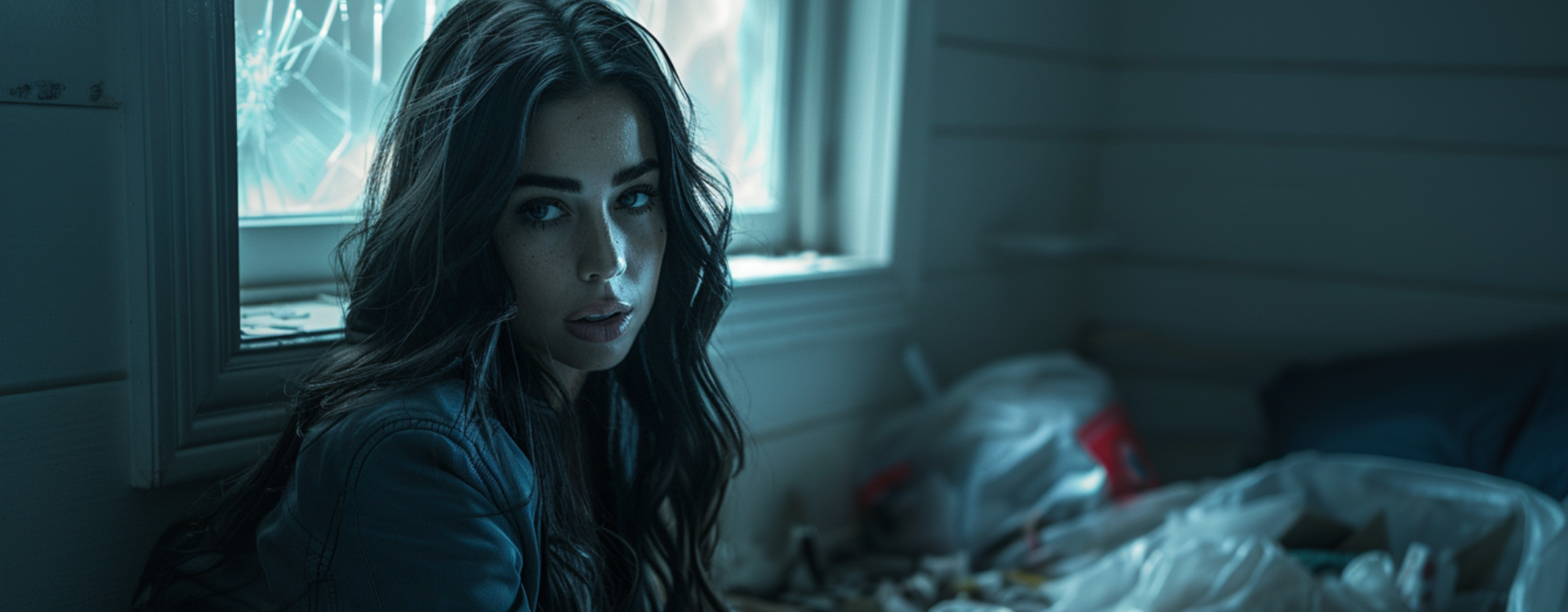
My back pressed instinctively to the wall beside the window as I entered, finding cover whilst maintaining sightlines — already broken, I registered distantly. The window was shattered, glass glittering like spilled diamonds across the carpet in the ambient light. The cool breeze slipping through the opening tugged at the edges of my shirt, carrying the scent of outside into the stale interior.
"Go, I've got you covered!" I called out to Karl, grounding myself in procedure and training, in the familiar protocols that made sense when nothing else did. My voice was steady despite the chaos swirling around us, despite my confusion about what was happening and why. Professional competence overriding personal bewilderment.
Karl stepped fully into the room, yanking the door closed behind him with a jarring thud that made the frame shake. Gladys's face flashed past the narrowing gap for just a moment — wide-eyed and livid, mouth open in protest or shock — before he shut her out completely, cutting her off from whatever was happening inside.
Then silence fell like a curtain, sudden and complete.
I turned slowly, weapon still raised, eyes sweeping the room, looking for movement, for threat, for Luke Smith allegedly present and dangerous.
There was no one.
No Luke Smith standing in corners or emerging from a wardrobe.
No person at all.
Just empty space, a blank wall with fresh damage where the door had struck it, and a gaping hole punched through plaster by a doorknob driven with excessive force.
Blood roared in my ears, loud enough to drown out everything else.
"What the—" I started, but my words died in my throat as I saw Karl — eyes wild with something beyond reason, body trembling with barely controlled energy — grab a nearby rubbish bag from a pile I hadn't initially noticed.
There were half a dozen of them stacked in the corner of the room, heavy-duty black plastic bulging with contents. They were unmarked, out of place in this otherwise pristine house, their presence alone strange enough to warrant attention.
But what happened next was stranger still, crossed from unusual into genuinely alarming territory.
With a guttural sound that came from deep in his chest — animal rage given voice — Karl tore into the first bag with both hands. Plastic ripped with a sharp sound, giving way under his assault to release a wave of rotting odour.
The smell was foul, organic, acrid — decomposing food waste mixed with something else, something chemical and wrong. It filled the room instantly, made my eyes water and my stomach lurch with nausea. Karl didn't flinch, didn't react to the stench at all, just stared into the bag's contents with manic intensity.
Unsatisfied with whatever he saw or didn't see, he moved immediately to the next bag. Tore it open with the same violent urgency, shredding plastic like it was tissue paper. Rubbish spilled out in wet, scattered heaps across the carpet — old food containers, shredded paper, something unidentifiable that looked disturbingly like hair or fur, dark and matted.
Then another bag ripped open. Then another. Each torn apart with increasing desperation, contents spreading across the floor in an expanding circle of filth and decay.
"Karl!" I cried, my voice climbing with panic and confusion, no longer maintaining professional calm because nothing about this situation warranted a calm response. My hand gripped my weapon tighter out of instinct rather than necessity, heart skidding in my chest like tyres on ice.
What the hell was he doing? What did he think he'd find in rubbish bags? What had broken inside him to produce this behaviour?
This wasn't searching with purpose. This wasn't methodical investigation.
This was panic. This was madness made manifest. This was someone completely losing control.
He tore at the last bag like a man possessed by forces beyond understanding or reason, hands moving with frantic speed that suggested he'd completely lost connection to rational thought.
"I know he's here!" Karl bellowed, his voice cracking under the strain of whatever emotion was driving him. Eyes burning with something I didn't recognise — fury, desperation, grief all tangled together into something toxic and overwhelming.
"Karl!" I screamed, crossing the room in three quick strides and grabbing his shoulder hard. My palm met the solid tension of muscle locked into rigidity, body coiled so tight it felt like touching stone. "Karl, stop!"
That's when it happened.
He turned — just slightly, barely rotating his upper body — and his arm lashed out with brutal force. Not a controlled defensive movement but something wild, unthinking. His hand caught me square in the chest, a blow delivered with enough power to suggest he'd forgotten his own strength, forgotten I was there at all.
The impact knocked the breath from my lungs in a harsh expulsion, ribs protesting under the sudden compression. I stumbled backward immediately, feet slipping over strewn rubbish — wet food waste and shredded plastic creating a treacherous surface that offered no stability. My arms flailed uselessly, reaching for balance that wasn't available, for purchase on empty air.
My head hit the wall with a dull, sickening crack that reverberated through my skull. The sound was internal and external simultaneously — felt and heard in the same moment.
Pain flared instantly, hot and sharp, spreading from the point of impact outward in waves that made my vision blur at the edges. White spots danced across my field of view like dying stars.
I dropped to the floor hard, the landing jarring through my entire body. Hip, shoulder, elbow — each point of contact protesting the sudden impact.
My firearm clattered from my grip — I hadn't even realised I'd lost hold of it — spinning once against the doorframe before coming to rest several feet away. Out of reach. Uselessly distant.
A gasp tore from my throat involuntarily as my left hand landed hard against something sharp. The sting registered before understanding, pain before recognition. Jagged glass — a shard from the broken window pressed into my palm with the full weight of my body behind it.
I winced, teeth clenching against the sensation of flesh parting, of glass embedding itself where it didn't belong. Blood welled fast around the intrusion, slick and bright, spreading across my palm in a warm rush that felt viscous and wrong.
I looked up at Karl through the haze of pain and shock, vision swimming slightly, trying to reconcile the man standing above me with my partner. Dazed. Breathless. Unable to process what had just happened.
Karl?
The question formed in my mind but couldn't make it past my lips, couldn't find breath enough to voice itself.
He turned toward me slowly, as though emerging from underwater, as though waking from a dream that still held him partially in its grip. His movements were sluggish, uncertain, nothing like his usual confident precision.
His face was a battlefield — emotions warring for dominance across features I thought I knew but suddenly didn't recognise. Rage still lingered in the set of his jaw, in the tension around his eyes. Confusion clouded his expression, making him look lost in ways I'd never seen. Guilt carved itself into the lines bracketing his mouth, pulling his features downward.
And something else beneath it all... horror. Recognition of what he'd just done, of the line he'd just crossed.
"I'm sorry," Karl whispered, the words barely audible even in the sudden silence.
They were inadequate — utterly insufficient for what had just transpired — but I could see them in his face before he spoke them. Could read the regret carved into every line, the shock at his own actions written clearly across features that had gone pale beneath their usual colour.
Regret wasn't enough. Sorry wasn't enough. But they were all he had to offer, and they fell between us like stones into deep water — making ripples but changing nothing.
And I couldn't move. Not yet.
Not because I physically couldn't — though my head throbbed with nauseating intensity and my hand screamed protest around embedded glass — but because I didn't know how to be in that moment. Didn't know what expression to arrange my face into, what words to summon, what reaction was appropriate when your partner struck you and then looked horrified by his own actions.
Hurt. Betrayed. Bewildered. Angry. Frightened. All of it swirled together into something too complex to untangle, too immediate to process.
I stared at him, my breath coming in ragged gasps that hurt my bruised ribs, heart cracked down the middle by the impossibility of what had just happened.
Karl's gaze dropped first, unable to hold eye contact with the evidence of what he'd done. He turned and left the room without another word, his steps fast and unsteady — fleeing rather than walking, escaping the scene of his own creation.
A second later, the front door slammed with enough force to rattle windows throughout the house. Hard. Final. The sound of someone leaving who had no intention of coming back anytime soon.
I stayed there on the floor, one hand pressed to my bleeding palm with my sleeve — applying pressure instinctively whilst my mind struggled to catch up with events. Surrounded by torn plastic and scattered rubbish and broken glass. Surrounded by the physical evidence of Karl's breakdown, whatever it had been.
My body hurt — head throbbing, chest aching, hand bleeding steadily through the fabric pressed against it. Multiple injuries from a single moment of violence that had come from nowhere and everywhere simultaneously.
But what hurt more — what ached in ways that had nothing to do with physical trauma — was the knowledge that something fundamental had broken between us. Some essential trust, some foundation I'd believed unshakeable, had fractured under pressure I hadn't seen coming.
Karl had hit me. Had shoved me hard enough to send me crashing into a wall. Had lost control so completely he'd forgotten I was human rather than obstacle.
And I didn't know how — or if — we'd ever put it back together. Didn't know if partnership could survive what had just transpired in this room, if trust once broken could be mended into something functional even if never quite whole.
The house was silent now. Even Gladys had stopped making noise — no footsteps, no voice, no presence I could detect. Perhaps she'd fled when Karl had. Perhaps she was hiding. Perhaps she was calling actual police to report two detectives who'd forced entry and destroyed property and assaulted each other.
I should move, I knew. Should get up, retrieve my weapon, assess the situation properly. Should call for backup, report the incident, begin the formal processes that came with officer-involved violence regardless of circumstances.
But for now, I just sat there amongst the wreckage, bleeding onto carpet that wasn't mine, trying to understand how a routine traffic stop had escalated into this nightmare. How a day that had started with paperwork and coffee had ended with me on the floor of a stranger's bedroom, injured by my own partner, surrounded by evidence of something I couldn't yet comprehend.
The shadows lengthened as minutes passed. The breeze through the broken window carried the afternoon chill, raising goosebumps on skin still clammy with shock-sweat.
And I sat there, alone, trying to piece together what the hell had just happened.
Trying to understand what I'd do next.
