4338.210 · July 29, 2018 AD
The House That Lied in Daylight
Karl and Sarah accompany Gladys to Luke Smith’s immaculate Berriedale home, where every detail feels too precise, too deliberate. As the door unlocks and the facade gives way to a silence that feels staged, Karl senses that the truth waiting inside isn’t hidden by darkness—it’s hiding in plain sight.
“It’s easy to spot the monsters at night. The real trick is noticing them when the lights are on.”
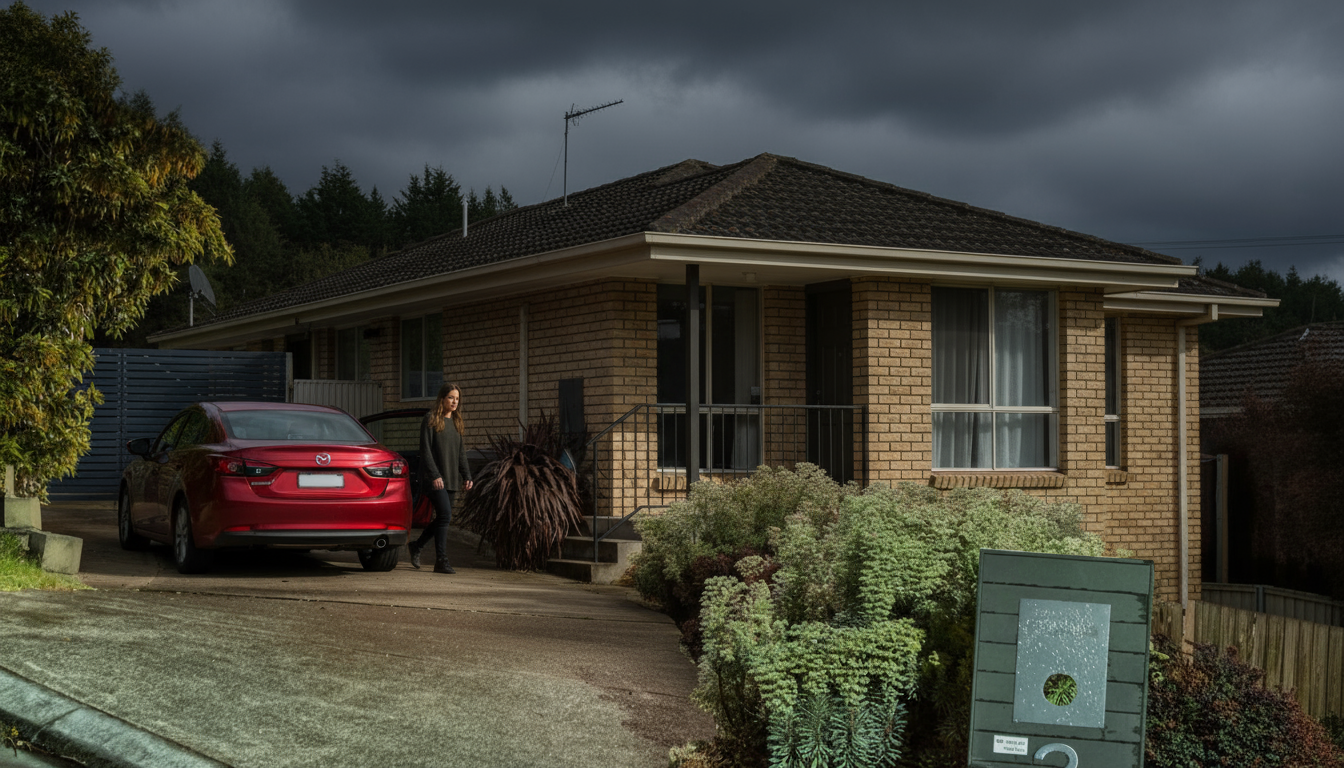
Parking across the road, we watched as Gladys pulled into Luke Smith’s driveway. The cream-coloured brick house sat in neat, suburban stillness beneath the pale afternoon sky. It looked different by daylight—less ominous than it had in the shadowy stillness of my previous visit. Back then, it had loomed with the quiet menace of unanswered questions. Now, with winter sun warming its roof tiles and illuminating the frost-burnt patches of lawn, it wore a facade of normality. Polished. Pretending.
Berriedale in late July had that particular quality of Tasmanian winter light—sharp and cold, the kind that made shadows look darker by contrast. The neighbouring houses sat quietly along the hill, their windows reflecting the pale blue of an afternoon that promised an early sunset.
But knowing what I knew, the ordinariness only sharpened the unease. And behind those windows, I had no doubt, the illusion was being curated.
I watched Gladys exit Jamie’s Mazda with an air of composed tension. Her movements were precise, almost too deliberate—the careful choreography of someone aware they’re being observed. She closed the door gently, cast a quick glance over her shoulder. That fleeting look—just a flick of the eyes in our direction—confirmed it. She’d made that call to Luke. She’d warned him. Whatever was waiting for us inside was no accident.
The afternoon air carried that mineral bite peculiar to Hobart’s northern suburbs—clean, cold, with an undertone of eucalyptus from the bushland reserve that backed onto these properties.
My wrist ached—a dull, nagging throb that pulsed in time with my memory of the act. The window. The broken glass. The manufactured evidence. I’d told myself it was necessary—an anticipatory act in the name of truth. Now, as I sat metres from the front door in broad daylight, that reckless moment felt like a ghost of someone else’s desperation. The house I had broken into now invited us in through the front.
The leather of the car seat creaked as I shifted position, my service belt catching slightly on the seatbelt. Small sounds, magnified by tension.
Beside me, Sarah hadn’t moved. Her fingers rested near the door handle, but she remained still, her eyes fixed on the house, jaw set. It was a look I recognised—a quiet freeze just before action, where instinct met hesitation. Not fear. Strategy. She was calculating, processing.
"I don’t think we’re going to be meeting Jamie Greyson," I told her, answering the unspoken question that had already settled between us.
She turned towards me, her brow furrowed. "Huh?" It was a short sound, clipped and uncertain—rare for Sarah.
"But with a bit of luck, we might be about to speak with Luke Smith," I said, letting the smallest grin rise. "He’s cooking for her."
The effect was immediate. Sarah’s eyes widened, the realisation landing in real time. Her head tilted, connecting the thread I’d just traced aloud—Gladys hadn’t been heading to Jamie. She’d been covering for Luke. The wine, the dinner story—it had all been constructed, just enough truth to mask the bigger lie.
And Luke, the man I’d suspected but never managed to corner, was now hopefully standing behind that cream brick facade, sautéing onions and waiting for the wine to arrive.
The casualness of the detail—he’s cooking—made it more damning. It rendered Gladys’s story absurd. Jamie wasn’t in that house. He wasn’t preparing food. If he was there at all, he wasn’t in any position to answer the door.
Sarah’s features lit up with a familiar intensity—eyes sharp, mouth set, that spark of energy I knew too well. It was the look of a detective about to lift the lid off something festering.
"Come on," I said, pushing my door open, the smile still playing faintly at my lips.
The cold hit immediately as I stepped out—that particular Tasmanian winter cold that found its way through jackets and settled into bones. The temperature had to be hovering around ten degrees, perhaps less in the shade. Our footsteps on the concrete footpath were the only sound breaking the suburban silence.
As Sarah and I approached the house, the scene was already unfolding before us. Gladys stood at the front door, her knuckles rapping against it in a rhythm that echoed oddly into the still afternoon air. Each knock seemed to carry further than it should, amplified by tension rather than acoustics. There was no ambient sound to soften it—no lawnmowers humming in the distance, no dogs barking, no children playing. The entire neighbourhood seemed to be holding its breath. Even the magpies had fallen silent in the nearby gum trees.
She turned to us as we stepped onto the porch. "Well, that’s a bit odd," she commented calmly. "There doesn’t seem to be anybody home. I wasn’t gone that long."
The tone was light, almost too light—carefully measured, deliberately casual. It rang false. Not because of the words themselves, but because they clashed with everything that had preceded them: her furtive glances, her defensive tone, her sudden phone call to Luke. Now, here she was, feigning mild surprise. A stage performance, and not a particularly convincing one. I caught the faint tremble in her left hand as she dropped it back to her side. Anxiety leaking through the cracks. Her breath came slightly faster than it should for someone standing still.
I turned my attention to the house itself, letting my eyes trace over what I’d missed during this morning’s illegal entry. The facade was pristine. Windows freshly cleaned, their reflective surfaces catching the angled light of late afternoon and throwing back distorted images of the street behind us. Blinds drawn at precise, uniform levels. Even the welcome mat was centred to perfection, its fibres still showing vacuum tracks. It was a display, not a dwelling. The kind of place kept in order not for comfort, but for appearance. The kind of presentation that spoke of someone with something to hide—or someone trying very hard to prove they didn’t.
Behind me, Sarah let out a huff—sharp and disappointed. I didn’t need to look to know the expression on her face. She’d been bracing for something more immediate—answers, confrontation, maybe even Jamie. The tension in her shoulders, the clipped exhale, told me all I needed to know.
My gaze flicked to the set of keys in Gladys’s hand, glinting in the sun. Jamie’s car keys—now hanging alongside others. House keys, presumably.
"But you have a key, don’t you, Gladys?" I asked, my tone pointed, deliberately shifting the moment.
Gladys let out a short, nervous laugh. "Oh, yeah," she said, lifting the keys with an exaggerated jingle. "How silly of me."
It was the kind of laugh people use when they’re trying to control a room, but can’t quite keep their footing. Too high. Too quick. The metallic jangle seemed to ring out across the entire street. She held up the keys like an actress delivering a punchline, as if the sound of metal alone might distract from the obvious question: Why pretend to knock when you could let yourself in?
I said nothing for a moment, allowing the silence to settle in around her. Silence was a tool. In interviews, in confrontation, in moments like this—people often filled it, exposed things in their effort to escape it. The seconds stretched.
Gladys’s eyes darted between Sarah and me, her weight shifting from one foot to the other. Her fingers closed hard around the keys, stilling their jingle.
"Well, aren’t you going to invite us in?" I asked, my voice low and steady.
Gladys hesitated. Only for a second—but enough. Her tongue darted out, moistening her lips. Her shoulders rose fractionally, a defensive posture she probably didn’t even realise she’d adopted.
"Wouldn’t it be a bit rude of us to enter Jamie’s house if he wasn’t home?" she said, her eyes locking on mine. There was a flicker there—not quite challenge, not quite plea. A shade of desperation. The kind of look that said she knew she was cornered but was still searching for an exit.
I smiled, small and slow. The kind of smile designed to reassure whilst disarming. "I’m pretty sure he wouldn’t have given you his keys if he didn’t want you being here," I said evenly.
From beside me came a sudden, stifled snort. Sarah, caught off guard, clapped a hand over her mouth, trying to recover her composure. Not ideal. But forgivable. Her eyes were watering slightly from the suppressed laugh.
Gladys glared at her briefly, then back at me. Her shoulders dropped a fraction. "I guess so," she said, the words floating on a resigned exhale.
The shrug she gave was meant to seem casual, but it was far too rigid. Her mouth was tight, her movements strained. Every part of her body betrayed the tension she was trying to bury.
I watched as she slid the key into the lock, her hand pausing just long enough to betray reluctance. The key turned with a soft scrape, metal against metal sounding louder than it had any right to. The mechanism was well-oiled, smooth—the door was used regularly, maintained carefully.
My heart picked up pace. Not from fear, but from that adrenal clarity that came before entering the unknown. The brass glinted in the sunlight, each rotation of the key a countdown. My hand moved instinctively to rest on my belt, near my radio. Old habits. Preparation for whatever waited beyond that threshold.
I held my breath as the lock disengaged with a click. Final. No turning back.
Finally. After days of circling, questioning, chasing shadows, the moment had arrived. We were no longer theorising—we were stepping into the truth. Or at least, we were stepping into Luke Smith’s carefully constructed version of it.
The door creaked open, inch by inch, revealing slivers of the house beyond. Polished tiles. A clean white wall, so freshly washed it seemed to glow in the afternoon light. The edge of what looked like modernist artwork in muted tones—greys and whites, abstract and deliberately inoffensive. Inside, the space was immaculate—every surface gleaming, every object positioned with a kind of sterile precision. The air that escaped carried a faint chemical scent—cleaning products, recent and thorough. Underneath it, something else. The absence of the smells a house should have. No cooking odours. No lived-in mustiness. No pets.
The hallway stretched back into shadow, doors closed on either side. Light fixtures spotless. Not a single picture frame crooked on the walls.
What lay beneath that polished veneer? What answers—or what lies—waited for us just out of sight?
Whether we were walking into a confession or another layer of misdirection, I followed Gladys across the threshold—into a house that had done all its lying in broad daylight.
