4338.209 · July 28, 2018 AD
The House That Forgot Itself
In the frozen quiet of a Tasmanian night, Detective Karl Jenkins returns alone to a house that refuses to speak. The official case says “missing persons,” but Karl’s instincts whisper something far darker. As he prowls the immaculate rooms and finds one imperfection—a faint, reddish smear on glass—he realises he’s not just investigating a disappearance. He’s trespassing on the edges of his own past.
“You can tell a lot about a person by what they leave behind. Some leave mess, some leave silence. The dangerous ones? They leave nothing at all.”
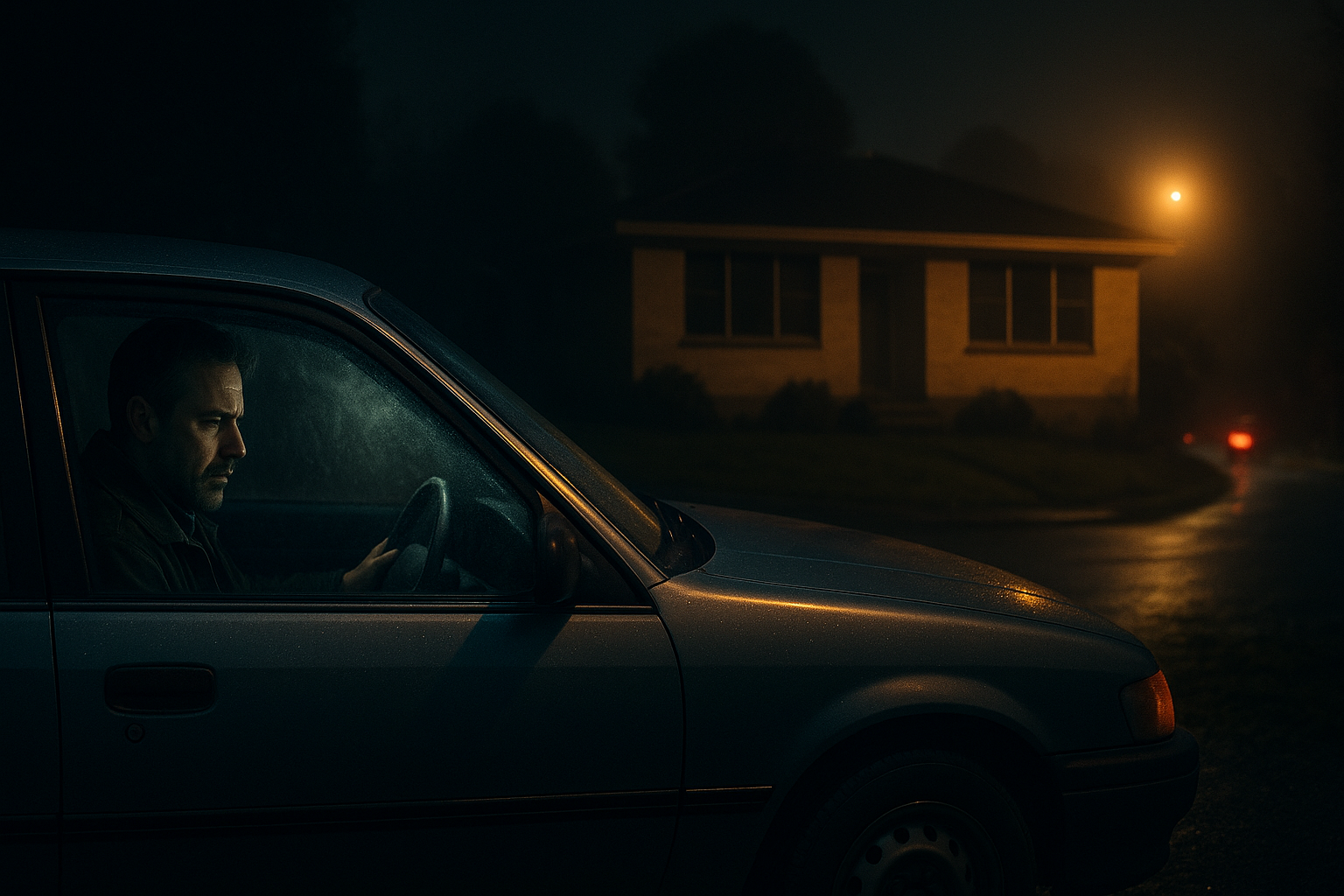
Sitting in my car outside Luke Smith's house, I switched off the engine and let the silence fold in around me.
The darkness was instant and absolute. No dashboard glow, no ambient music—just the ticking sound of cooling metal and the distant hiss of tyres over wet bitumen as some other car passed in the night, its red taillights flickering briefly in my side mirror before vanishing around the bend.
I had already been here once today. Officially, it was a knock-and-check—standard follow-up on a missing persons case. But I'd stayed longer than I needed to. Walked slower to the door. Watched the windows like they might blink first.
There was something else driving me. Not professional. Not entirely. Instinct, maybe. Or something older. Something still knotted up in the space where Jamie used to live.
Luke hadn't answered the door. In fact, no one had. The house had remained mute—shuttered, silent, stubborn in its refusal to engage. There had been no lights in the windows. No creak of floorboards. Not even the telltale flicker of a television behind blinds. Just... stillness. And it was that stillness, more than anything else, that had kept me thinking long after I'd returned to the station.
Now, hours later, I was back.
July's bitter Tasmanian winter clung to the windscreen, crawling in through every imperfect seal in the Holden's ageing frame. My breath fogged the cabin with ghostly persistence—each exhalation a faint spectre that hung briefly before dissolving into the cold. Outside, the temperature hovered somewhere just above freezing. Cold that didn't announce itself with dramatic gusts but settled in quietly, seeping through layers of clothing and finding the gaps between muscle and bone.
The house loomed ahead of me like something sentient. Jamie's house. Or rather, Jamie and Luke's. Cream brick, low set, nondescript. A place you'd drive past without a second glance in daylight—modest, unassuming, the architectural equivalent of a polite handshake. And yet tonight, under the sodium-orange cast of the streetlight, it had taken on an uncanny quality. Its windows looked like vacant eyes—opaque and unblinking. Watching.
I sat in the car longer than I meant to, the engine now quiet but the gears of my mind grinding noisily. There was a question there. A loose thread I hadn't pulled hard enough earlier.
My previous visit had been half professional, half personal—though I hadn't admitted the latter aloud, not even to myself. I'd approached the front door with textbook formality: crisp knock, badge ready, neutral posture. Nothing.
A second knock. Harder. Still nothing.
What followed had been decidedly less textbook. I'd circled the perimeter, eyes scanning for signs of life, disturbance, anything. Movement behind curtains. A recently watered plant. An unattended package on the porch. But the place was immaculate. Too immaculate.
There was no lived-in clutter. No dishes in the sink. No stray shoes by the door. The living room had been staged within an inch of its life—cushions arranged with geometric precision, a throw blanket folded so neatly it might've been ironed. The kitchen was gleaming, stainless steel and spotless surfaces, like something from a showroom. Like a display home waiting for prospective buyers who would never arrive.
It was... sterile.
Not the quiet mess of a house temporarily unoccupied, but the intentional absence of human trace. A curated emptiness. As if someone had gone out of their way to erase any sign of Jamie or Luke having ever lived there at all.
And that—that had stuck with me.
But what really lodged under my skin—what pulled me back here now—was the rubbish.
I hadn't clocked it at first. It was just a passing note—the bins out front filled to the brim. Standard.
But through the drawn blinds of what looked like a spare bedroom, I'd caught a glimpse. Black plastic bags. Four, maybe five. Lined up side by side like a row of corpses awaiting removal.
And nothing else.
No furniture. No lamp. No laundry basket or cardboard boxes or random clutter. Just the bags. Perfectly sealed. Perfectly spaced.
At the time, I'd filed it away with a mental shrug. People forget bin night. People hoard junk. People leave messes.
But then I'd gone home, heated up leftovers, stood at the sink scraping off cling film. And the image of those rubbish bags came back—sharp and insistent, impossible to scrape off.
If someone was going away—voluntarily, for an extended time—you didn't leave behind waste. Especially not that much.
You cleaned. You emptied the fridge. You left the bins out. You didn't tuck four bulging sacks into the corner of a bedroom like an afterthought.
Unless you were interrupted.
Or unless what was in those bags couldn't be placed in a bin on the kerb.
The thought had taken root, burrowing deep enough that I could no longer ignore it. It wasn't evidence. It wasn't even really a lead. It was just... wrong. The kind of wrong that tasted metallic at the back of your throat, that made your pulse quicken without reason, that whispered in the small hours when rational thought had surrendered to something more primal.
I turned off the stove in one motion, the hiss of cooling metal barely audible over the noise in my head. The steak—midway through searing—was wrapped quickly in cling film and returned to the fridge. A clumsy afterthought. The half-drunk beer beside it condemned to the same limbo.
"Sorry, Jargus," I said quietly.
He sat beside the bench, ears perked, tail wagging with that hopeful rhythm only dogs can maintain—one part optimism, two parts loyalty. I crouched, ran a hand over the back of his head. His fur was warm and familiar beneath my palm, the living pulse of a creature who knew me better than I often knew myself. My touch was meant as comfort, but it felt hollow. A gesture towards normality in a moment that had already slipped past it.
Jargus gave a soft whine, watching as I grabbed my coat and my keys. He always knew. Always. The shift in energy, the sudden drop in casualness. He'd seen it a hundred times before: the tension in my jaw, the way I moved with a sharpened edge. It meant we were back in the field. It meant something wasn't right.
But this time, I left him behind.
I couldn't articulate why. Maybe it was the lateness of the hour. Maybe it was the gnawing sense that what I was about to do sat somewhere between professional diligence and something far murkier. Or maybe it was simpler than that: I didn't want a witness to whatever line I was about to cross.
Now I sat alone outside Jamie and Luke's house, the engine of the Holden ticking down into silence. The temperature had dropped further still, a creeping cold that numbed your fingers before you realised it had set in. Each slow exhale reminded me that I was still here, still breathing, still capable of leaving if I chose to.
The house loomed in the same oppressive stillness as before. No lights. No movement. No sign of life.
Was I mad to come back?
Probably. Official procedure would laugh me out of the building for what I was contemplating. No warrant. No backup. No legal grounds beyond instinct. Just a gnawing certainty that whatever lay beyond those darkened windows was wrong.
The logic of the day no longer held weight under the cover of night. Everything seemed more honest in darkness—more dangerous, too. Shadows didn't lie the way daylight did. They revealed the shapes of things we preferred not to see.
My earlier visit had been constrained by formality. I'd knocked. Waited. Done the rounds like a polite trespasser. This time, I wasn't here as a uniform. I was here as me.
The bags. The blinds. The unnatural cleanliness.
Houses didn't look like that unless someone wanted them to. Life left smudges, fingerprints, mess. Real kitchens had half-drunk mugs on benches. Real bedrooms had laundry somewhere on the floor. That house didn't look lived in—it looked cleared out.
And yet, those bags. Four or five of them, stacked against the wall of the spare room like unsent apologies. Left behind as if forgotten, but nothing else had been.
Why leave the rubbish?
The question circled in my mind like a bird of prey, patient and relentless. Because if you were fleeing—if you were running from something or someone—you took only what mattered. You didn't stop to tidy. You didn't stage the living room or wipe down the kitchen benches. You grabbed essentials and you left.
But if you were hiding something...
Then you cleaned. Methodically. Obsessively. You removed every trace of what had happened. Every fingerprint, every stain, every scrap of evidence. You turned the house into a museum of absence, a monument to nothing.
Except you couldn't take the rubbish to the kerb. Because someone might notice. Someone might ask questions. Someone might look inside.
I gripped the torch in my pocket. The metal was cold against my palm, solid and reassuring.
It wasn't fear that clenched my stomach—it was the cold hum of adrenaline, the chemical certainty that something was about to shift. The line between instinct and evidence blurred dangerously in moments like this, and I knew it. I'd lectured junior officers about it. I was the officer they now turned to for examples of how to get it right.
But tonight, that line felt... bendable.
One more circuit. One more look.
Not an illegal search. Not technically. I wasn't entering the property. I wasn't opening doors. Just observation. Reconnaissance. A professional preliminary to justify a formal request.
At least, that's what I told myself.
Because the truth sat in my chest like a weight I couldn't quite name. This wasn't just about procedure. And it wasn't just about duty.
I wasn't here as a detective—not entirely.
I was here as Karl. As someone who once got too close to Jamie Greyson, and never figured out what that closeness meant until it was already gone. As someone who walked away from a fracture he never repaired.
And now, standing outside a house that had gone too quiet, I wasn't sure what I was hoping to find—answers, or proof that I was still too late.
The wind picked up slightly, sending a ripple through the trees along the fence line. The bushland rustled, distant and impenetrable, its shadows encroaching slowly into the suburbs like a rising tide. Tasmania had a way of doing that—reminding you how close the wilderness was. How quickly it could swallow the civilised world whole. Out here, on the fringe of Hobart, you were never more than a few minutes from the edge of something vast and indifferent.
Jamie had always understood that. The way he talked about hiking trails, about getting lost in the bush and finding your way back. About the comfort of solitude that wasn't loneliness. I'd never quite shared that perspective. For me, solitude was just... what was left when everyone else walked away.
I thought about Queensland. About the last time I'd seen Jamie before everything fractured. My 28th birthday. My party. The one he never came to.
Four days later, we'd met at Moggill Creek. The confrontation was supposed to clear the air. It was supposed to be... I don't know. Closure, maybe. Understanding.
Instead, I'd struck him.
Not hard. Not with intent to harm. But with frustration I couldn't contain, with questions I couldn't articulate, with the accumulated weight of every conversation we'd never had and every boundary neither of us knew how to navigate.
He'd fallen. Not far—just a stumble backwards off the footbridge into the rain-swollen creek below. The water was chest-deep, cold, brutal. He'd surfaced sputtering, eyes wide with shock more than fear.
And I'd stood there, frozen. Not reaching down to help. Not apologising. Just... standing. Watching the distance between us become literal.
He'd climbed out on his own. Said nothing. Walked away.
We never spoke of it. Never reported it. And when I transferred to Tasmania six months later, we both pretended it was for professional reasons.
But I knew the truth. I was running. From what I'd done. From what it meant. From the person I became when Jamie was close enough to make me feel things I didn't have language for.
And now he was missing. And I was back. Chasing him again. Still unable to articulate what it was I wanted. Still hoping that if I could just find him, if I could just solve this, then maybe...
Maybe what?
Maybe I could undo fifteen years of silence.
Maybe I could prove that the distance between us wasn't as insurmountable as it felt.
Maybe I could stop being the man who hurt people and started being the man who saved them.
Or maybe I was just a detective who couldn't let go. Who turned every case into a crusade because it was easier than examining why I needed the crusade in the first place.
I extricated myself from the car with deliberate care, easing the door closed with the barest click. The faint tick of the engine cooling echoed like a threat in the stillness. I'd parked discreetly across the road, in the small gravel recess at the intersection of Berriedale Road and Wallcrest—a position carefully chosen for line of sight and plausible deniability. From here, I could observe the rear of Jamie and Luke's house without broadcasting my presence to anyone inside it. Or, more pressingly, anyone watching from it.
The cold had sharpened since sunset, deep enough now to ache in the knuckles and the hinge of the jaw. Frost glinted across the leaf litter and low shrubs, silvering everything it touched. My breath misted in rhythmic pulses, each one dissipating too fast for comfort. The air smelled of eucalyptus and damp earth, that particular Tasmanian scent that managed to be both clean and slightly decayed at once.
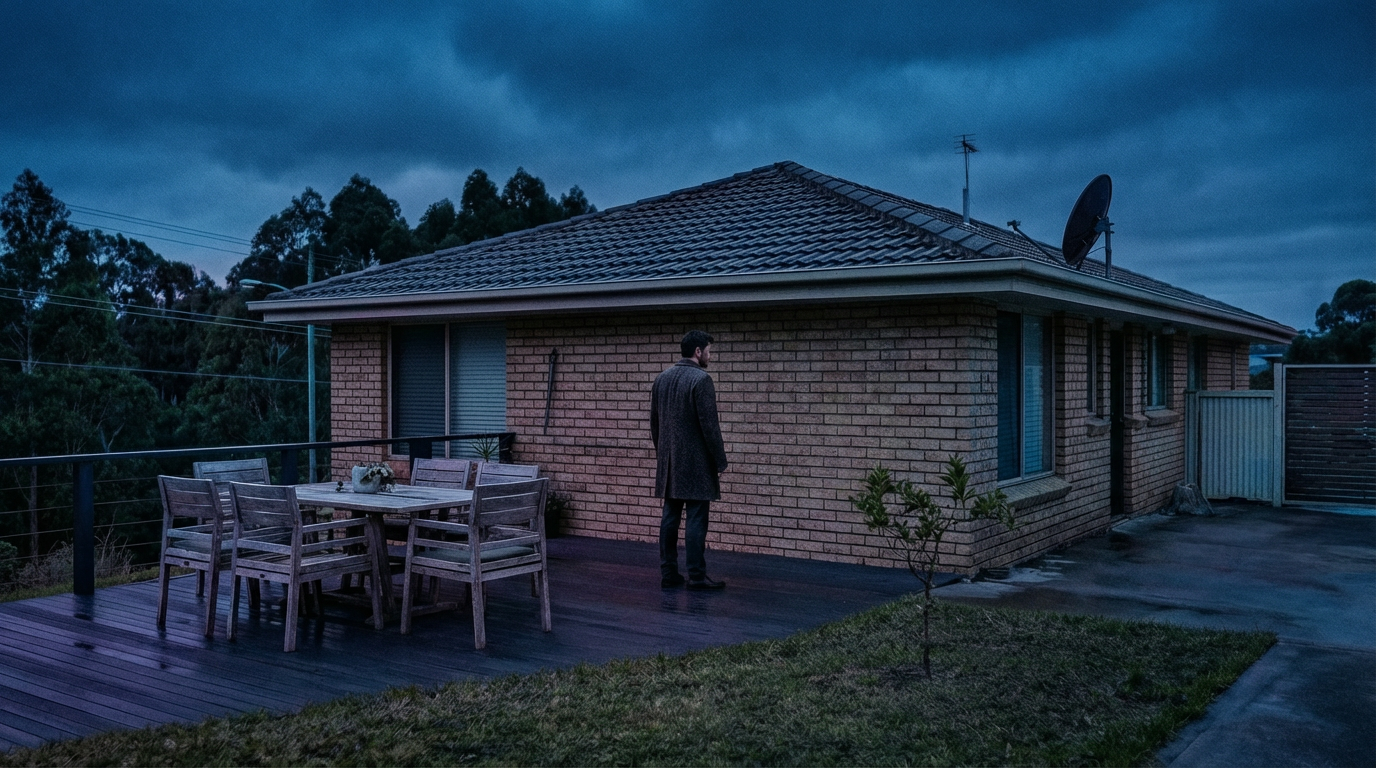
From my vantage point, the full span of the split-level property was visible—the lower storey sunken into the slope, taking advantage of the hillside to create the illusion of more space than the house actually possessed. The rear deck jutted into the darkness like a stage waiting for its scene to begin. The blinds across every window were drawn tight. The cream brick facade, commonplace in this stretch of mid-century Hobart suburbia, now seemed to drink in the available light. It made the house look like a husk—empty, silent, and sealed.
I circled wide, skirting the nature strip and cutting through the shadows of tall pittosporum shrubs that lined the eastern boundary. Their waxy leaves brushed against my sleeves as I moved, their nocturnal fragrance cloying in the cold air—sweet and slightly medicinal, like funeral flowers left too long in a closed room. I kept low, moving with deliberate slowness, pausing every few metres to listen.
No dogs barking. No footsteps. No voices.
Just the sound of wind in the trees and the occasional mechanical hum of distant traffic on the main road. The city felt far away. Out here, in the quiet pockets between streetlights, its hold on the land felt thin and provisional.
The side gate yielded soundlessly under my hand. Someone had oiled the hinges recently—an odd detail, but not unheard of. Still, I noted it. Fastidious upkeep of small things often hinted at deeper compulsions. Control manifested in strange ways. I'd seen it before in crime scenes that looked too clean, in suspects whose stories were too rehearsed. The human need to impose order on chaos, even when—especially when—that chaos was self-inflicted.
The passage down the side of the house was narrow, hemmed in by bricks on one side and an ageing timber paling fence on the other, its slats leaning slightly as though tired of standing. The wood was silvered with age and damp, soft enough that I could've pushed my thumb through it if I'd tried. I moved silently, keeping my footfalls light, testing each step before committing my weight. The security lights remained off—either disabled, faulty, or intentionally overridden.
Another detail that didn't sit right.
The windows on this flank of the house were shut tight and shaded. No opportunity for visual entry. As I crept towards the back garden, the air grew colder—thicker somehow. Moisture from the slope pooled here, trapped between the fence and the house, and the boards beneath my feet were slick with it. The fence leaned with fatigue, boards swollen from years of rain, some split along the grain. It was the kind of boundary that kept nothing out except the idea of boundaries.
The garden was starting to let go. Grass patchy and long in places, interspersed with bare dirt where nothing would grow. Weeds curling at the base of garden beds that had once been tended but now showed signs of surrender. Mulch scattered, brittle, breaking down into soil. Nothing wildly overgrown—but enough to suggest neglect. A place no longer being cared for with intention. A place that had slipped from someone's priorities or someone's ability to maintain.
It was disorder that didn't scream, but whispered. Nobody's home. Nobody's been home for a while.
I tested the back door. Locked. As expected. But the handle was new, and the lock too polished—like it had been replaced recently, the kind of upgrade someone makes not out of habit, but after something's gone wrong. After a break-in, maybe. Or after losing track of who had keys. The brass still had that showroom gleam, untarnished by weather or frequent use.
I rose slightly on the balls of my feet and leaned in to the kitchen window. The glass was cold against my forehead, shocking in its immediacy. Inside, the kitchen sat in low light—moonlight, mostly, and the distant halo of streetlamps diffused through vertical blinds.
What I saw made the hairs on my arms lift.
It wasn't just clean. It was curated.
Stainless steel appliances, no fingerprints. No smudges on the fridge handle, no grease splatter on the stovetop. Benches mostly bare. No dirty dishes, no mail torn open and left askew, no half-eaten toast forgotten on a plate. Just a chrome toaster, unplugged and aligned with the counter edge as if measured with a ruler.
People lived in kitchens. They left behind clutter, crumbs, conversations. This felt like someone had wiped the memory of their presence clean. Not just tidied—erased. It reminded me of show homes, those sterile spaces designed to let potential buyers project their own lives onto blank surfaces. Except this was supposed to be someone's actual home.
I moved on, each step deliberate, each window a new frame in a growing catalogue of wrongness.
Dining room: same. Table bare. Six chairs, perfectly spaced. No placemats. No coasters. No signs of pause or life. Not even a salt shaker or a decorative bowl. Just a table that might have been carved from the same silence that filled the house.
It didn't feel like someone had gone away. It felt like someone had started to vanish—deliberately, piece by piece. Like a magician's trick in reverse, where instead of making something appear, you made yourself disappear by erasing every trace that you'd ever existed.
Then came the bins.
Council issue—green lid for general waste, yellow for recycling. They sat tucked against the brick wall, just beneath the kitchen window, sheltered slightly by the eave. The lids didn't quite close—swollen from overflow, contents pressing up against the plastic with insistent pressure.
I lifted the yellow lid first, bracing myself. A sour waft hit me—plastic, fruit skin, faint chemical undertones. Not overpowering. Just unpleasant in the way all warm rubbish is, that particular mix of decomposition and human waste that triggers an instinctive recoil.
From the top layer alone, it was clear whoever filled it hadn't bothered with proper sorting. Milk cartons tossed in with greasy takeaway boxes, the cardboard already starting to disintegrate. Glass jars half-rinsed, labels peeling, their contents leaving sticky residue on the surrounding plastic. A bundle of shredded paper half-soaked with something that looked like old coffee, the ink bleeding into abstract patterns. An aluminium can crushed flat. A plastic container with remnants of something that might once have been food but was now just organic matter in transition.
I nudged one bag aside with the back of my hand, careful not to disturb too much, careful not to leave evidence of my presence. Nothing unusual. Just domestic waste. The archaeology of ordinary life—takeaway dinners, morning coffee, weekend newspapers.
The green bin was the same—more food wrappers, a smashed light globe carefully wrapped in newspaper, torn packaging from what looked like an electronics purchase, plastic cutlery still bundled with the elastic band from the takeaway, something that might have been a bone or a snapped coat hanger.
Normal rubbish. But messy. Rushed. Unthinking.
Not the kind of thing that proved anything. Not the kind of thing that would hold up in court or justify a warrant. Just the kind that left a taste in your mouth. The kind that whispered questions you couldn't quite formulate. Because if you were leaving for an extended period, if you were going away voluntarily, you didn't leave bins overflowing. You took them out. You didn't leave evidence of your life decomposing in the backyard.
Unless you left in a hurry. Unless you were interrupted. Unless you never intended to come back.
I let the lid drop softly back into place, then turned towards the deck.
I stepped lightly onto the back decking—old timber boards softened by weather and quiet disuse, their surface slightly spongey beneath my weight. The wood was silvered with age, the grain raised where years of rain and sun had worn away the softer fibres. Some boards creaked faintly as I tested them, their protests barely audible but enough to spike my adrenaline. The slope behind the house fell away into shadows, the ground dropping steeply towards the gully below where the bush began in earnest. But up here, everything felt strangely still. Too still.
No wind now. No distant traffic. Just the sound of my own breathing and the faint settling noises of the house itself—the small contractions and expansions old buildings make, wood and brick responding to temperature changes in ways that could sound almost alive if you listened hard enough.
I looked towards the master bedroom window. The vertical blinds were closed, drawn tightly across the glass. Not a single gap between them. A closure that was deliberate, that took effort to achieve. Not just pulled shut but adjusted, aligned, perfected. No glow of a bedside lamp. No movement. Just a flat wall of pale slats catching faint silver from the moonlight.
But there—on the outside of the glass—something caught the light. A mark.
A single smudge, low on the pane, roughly at chest height. Reddish-brown, irregular. Not fresh, but not aged out either. It had been wiped—hurriedly, by the look of it—but not thoroughly. Just enough to blur the worst of it, not to erase. The kind of half-hearted cleaning that suggests panic rather than planning.
Could've been rust from the window frame. Could've been paint transfer from someone's hand after DIY work. Could've been old juice from a dropped fruit.
Could've been something else.
I leaned in, breath held, squinting past the reflection of my own face in the glass. The angle, the grain of light—it gave me nothing definitive. Just suggestion. Just possibility. The mark was roughly the size of a palm, spread in a way that suggested contact rather than splatter. As if someone had braced themselves against the window, or been pushed against it.
My mind immediately began constructing scenarios. A struggle. Someone trying to escape through the window. Someone pressed against it from inside whilst someone else...
I forced myself to stop. This was how investigations went wrong. This was how you saw patterns that weren't there, how you built narratives from insufficient evidence, how you convinced yourself you'd found answers when all you'd found were questions.
But in a house so quiet, so ordered, so wiped of every personal trace, this smudge was the only imperfection I'd seen.
The only thing that didn't fit the pattern of deliberate erasure.
The only crack in the carefully constructed facade of normality.
I stepped back, heart ticking faster now. Not from certainty. But from the sense that I was standing too close to something I couldn't yet name. Standing at the threshold of understanding without having crossed it yet. The feeling was familiar—I'd had it before on cases that eventually broke wide open, where one small detail became the thread that unravelled everything.
But I'd also had it on cases that went nowhere, where the thread led only to more questions, where the answer was simply that there was no answer.
No broken locks. No forced entry. No clear evidence of anything illegal. No cause to force a door tonight, no justification I could offer to a magistrate or a superior officer. I wasn't here to push a boundary I couldn't professionally justify. Not yet, anyway. That line still existed, however faint it had become.
But something had happened inside that house.
It was too clean. Too cold. Too controlled.
The kind of control that suggested someone was trying very hard to hide something. Or the kind of control that suggested obsessive personality traits that had nothing to do with crime at all. Or the kind of control that was simply how some people lived, and I was projecting my own chaos onto their ordered existence.
I returned to the street, moving with the same slow care, my presence erased as quietly as it had arrived. No lights came on behind me. No movement stirred the curtains. The house remained exactly as I'd found it—silent, sealed, secretive.
But I couldn't shake the sensation that I was no longer alone. Not in the literal sense—there was no one watching from the windows, no figure in the shadows. But in the way that places sometimes feel inhabited even when they're empty. The way you can walk into a room and know someone was just there, even though you saw no one leave.
