4338.209 · July 28, 2018 AD
The Holden and the Dark
Karl Jenkins remains parked across the road from the Berriedale residence long after his reconnaissance has ended, unable to start the engine, unable to answer the phone pulsing with Sarah Lahey's increasingly urgent messages, unable to separate the detective watching an empty house from the man who struck Jamie Greyson at Moggill Creek fifteen years ago and has been running from the distance ever since.
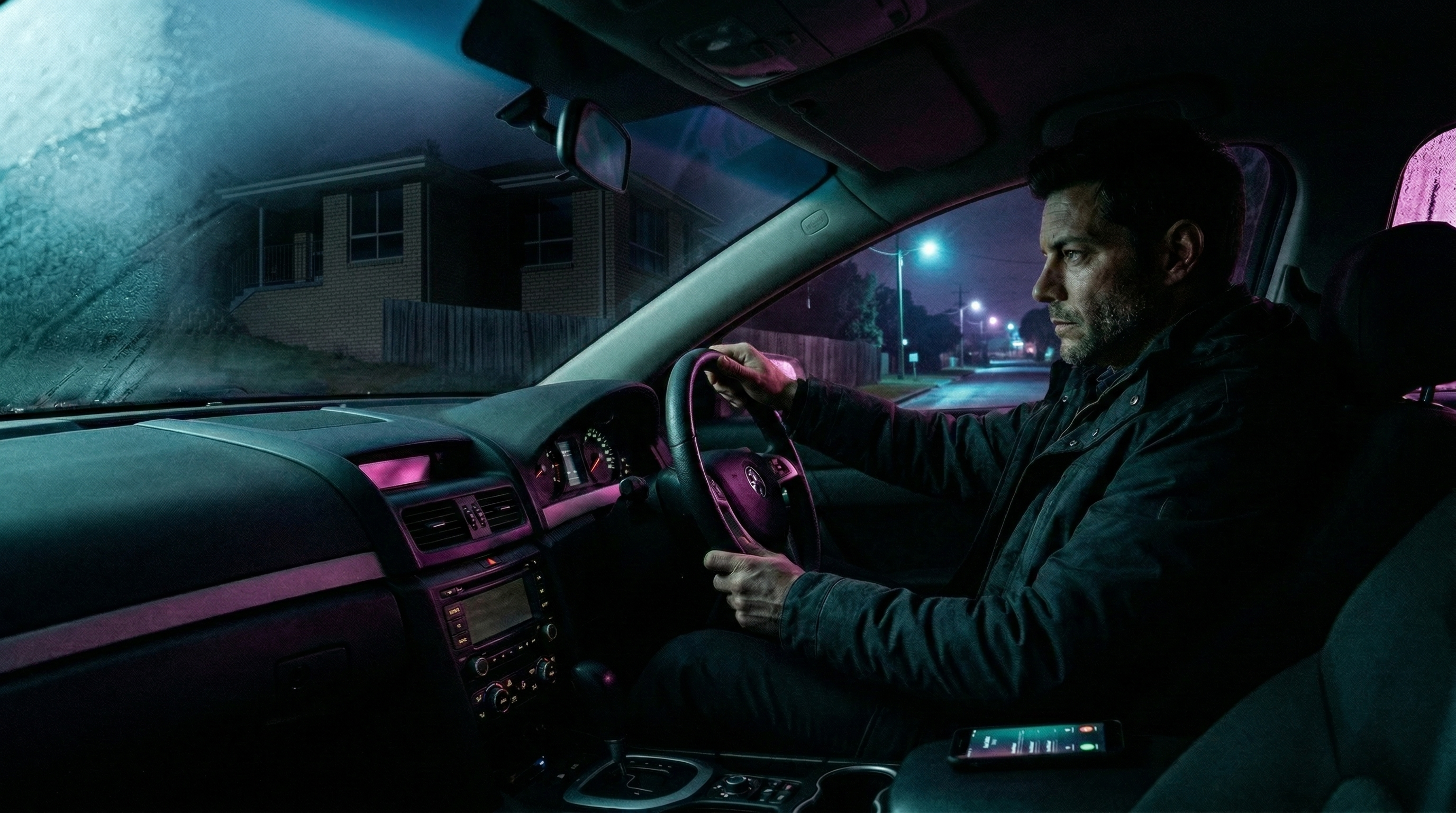
A vigil requires no justification to the person keeping it. It requires only the conviction that departure would constitute a greater failure than remaining — that the act of watching, however fruitless, however cold, however impossible to defend in any report or debrief or conversation with a partner whose calls are going unanswered, is itself a form of fidelity to something the watcher cannot yet name but refuses to abandon. Vigils do not operate on evidence. They operate on the particular stubbornness of a human being who has decided that the space between knowing and not knowing is a space worth occupying, even when occupation means sitting in a freezing car on a suburban street in southern Tasmania while frost builds on the windscreen from the inside and the dashboard clock measures the passing of time that the watcher has ceased to experience as passing at all.
Karl Jenkins had returned to the Holden after his circuit of the property and had not started the engine. The decision to remain was not a decision in any meaningful sense — it was the absence of the decision to leave, which amounted to the same thing in practice but felt different in the architecture of a mind that had spent the day constructing justifications for behaviour it could not justify. The house sat across the road in its practised silence, offering nothing it had not already offered: drawn blinds, dark windows, the particular stillness of a dwelling that had been emptied of the evidence of habitation and now existed as a container for whatever its emptiness was designed to conceal. The mark on the master bedroom glass was no longer visible from this distance. The overflowing bins were hidden by shadow. The sealed bags in the spare room existed only in Karl's memory, where they had taken up residence with the permanence of things that refused to be filed under routine.
The mobile phone pulsed on the passenger seat with the patient insistence of a conscience that had been externalised into a device. Three calls from Sarah Lahey, unanswered. Five messages, unread except for the final one, whose content Karl had absorbed through the glass of the screen without touching it — a threat to escalate to Claiborne that carried the particular weight of a promise made by someone who did not make promises she did not intend to keep. Sarah operated in a world of drawn lines and respected boundaries and professional accountability, a world where partners checked in and cases were pursued through channels and the distance between instinct and action was bridged by procedure rather than compulsion. Karl had lived in that world for most of his career. He had helped build it. He had trained junior officers to respect its architecture and had reprimanded those who did not.
Now he sat in a cold car ignoring his partner's calls because answering would require an explanation, and the only honest explanation available was one he could not deliver without dismantling the professional identity he had spent two decades constructing. He was not conducting surveillance. He was not following a lead. He was not doing anything that would survive the scrutiny of a supervisor or a disciplinary panel or even the gentle cross-examination of a colleague who cared about him and was growing frightened by his silence. He was watching an empty house because a man he had once known lived there, and that man was missing, and somewhere beneath the investigation and the promotion and the hangover that had started this day and the scrap of paper that Claiborne had produced from his jacket pocket, Karl could feel the specific gravity of a guilt that predated all of it — older than the case, older than Tasmania, older than the badge — pulling him toward this house with the persistence of something that had been waiting fifteen years for him to stop running long enough to feel its full weight.
Moggill Creek surfaced the way it always surfaced when Karl's defences were low enough to permit it. Not as narrative but as sensation — the particular humidity of a Queensland afternoon, the sound of water moving over stones, the kinetic memory of a fist connecting with a jawbone and the fraction of a second between contact and consequence when the world narrowed to the specific horror of watching a body fall backward from a footbridge into chest-deep water. Jamie surfacing with an expression that was not anger and was not fear but something worse — recognition. The recognition of a man who had understood, in the moment of being struck, something about Karl that Karl himself would spend the next fifteen years refusing to understand. The silence that followed. The walking away. The years of distance maintained with the deliberate care of a man tending a wound he had inflicted on someone else and somehow contracted himself.
Tasmania had been the prescription. A new state, a new station, a new identity built at sufficient distance from the original that the two need never occupy the same room. Karl had constructed the Tasmanian version of himself with the meticulous attention of someone who understood that reinvention was not about becoming different but about becoming unrecognisable — filing away the Queensland chapters, sealing the connections, maintaining the professional surface with a rigour that left no gap through which the past might seep. It had worked. For fifteen years, it had worked. And then Louise Jeffries had walked into Interview Room Three and spoken Jamie's name, and the distance Karl had built between himself and his own history had collapsed with the structural integrity of something that had never been as solid as it appeared.
The cold had found its way through his jacket and into the spaces between his ribs where warmth retreated last. His fingers had gone numb against the steering wheel. His breath continued its patient work of obscuring the windscreen from within, each exhalation adding another layer of frost to the glass until the house across the road existed only as a suggestion of shape beyond the condensation — dark geometry glimpsed through ice, less a building than an idea of a building, less a crime scene than a mirror reflecting back the specific quality of concealment that Karl recognised because he had been practising it himself for longer than Jamie had been missing.
He should leave. The thought arrived with the mechanical regularity of a clock striking an hour that the listener has no intention of responding to. He should start the engine and drive home to the flat where Jargus waited with the steady patience of a partner who did not require explanations, and sleep, and return in the morning with warrants and backup and the procedural framework that separated investigation from trespass. He should answer Sarah's messages. He should be the detective the department had promoted rather than the man the department did not know it had hired.
The phone pulsed again. The house held its silence. The frost thickened on the glass.
Karl Jenkins remained where he was — engine off, hands on the wheel, eyes fixed on a darkness that would not yield and could not be abandoned — keeping vigil over a silence he had spent fifteen years learning to maintain and one day learning he could no longer afford.
