4338.205 · July 24, 2018 AD
The Gap on the Shelf
After restoring order to the small rituals of his morning, Luke finds himself drawn once more to the device—and to the absence of a book that confirms his journey was no dream. With his dogs occupied outside and awe in his chest, he chooses again to step into Clivilius, unable to resist the call of a world that demands to be entered.
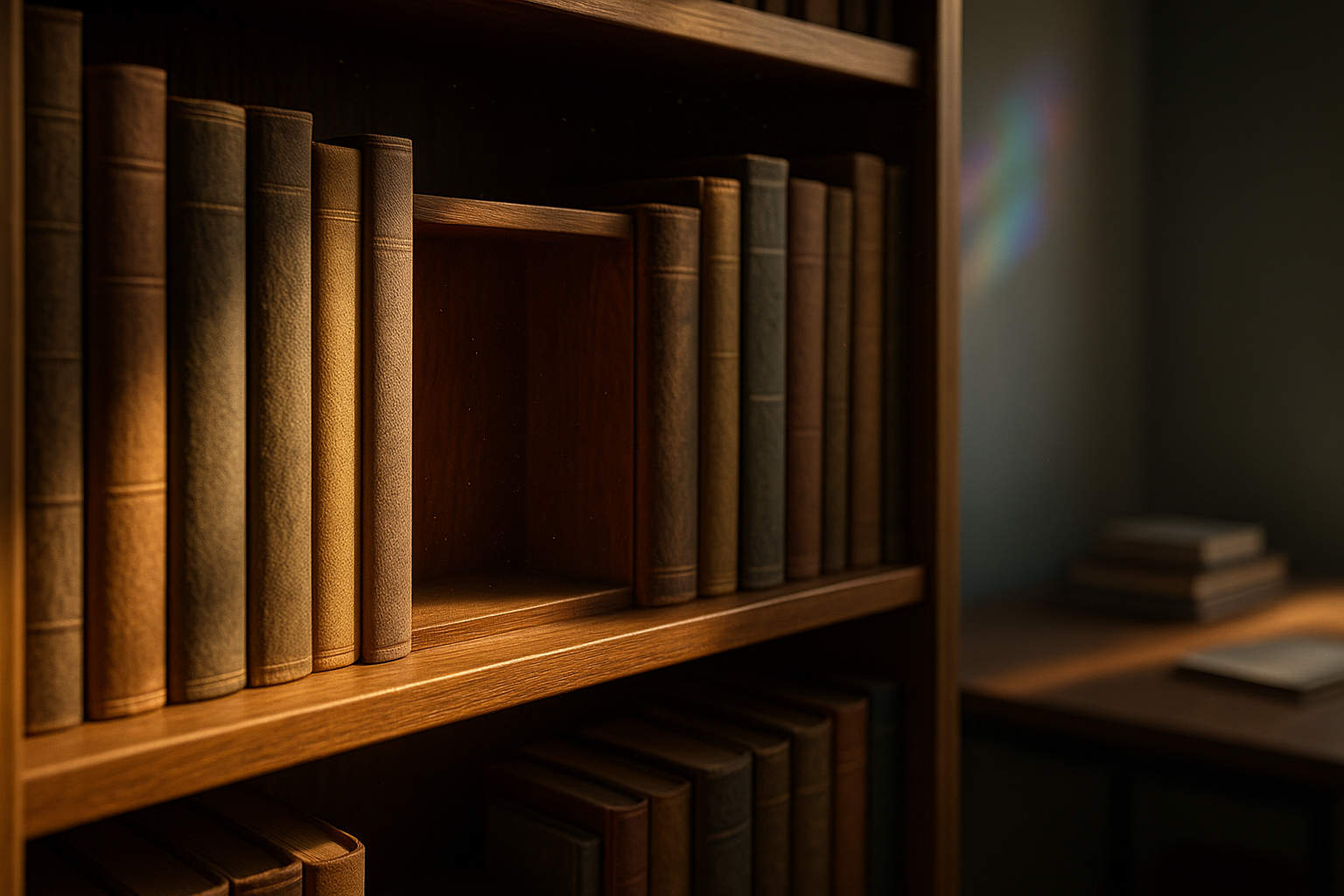
“It wasn’t the book I carried into Clivilius that haunted me—it was the empty space it left behind, proof that the impossible had followed me home.”
The last bite of toast went down like an apology I was making to myself.
I dragged the back of my hand across my stubbled chin, catching the streak of yolk that had escaped during my hurried eating. The bright smear clung to rough skin for a moment, resistant, before I wiped it clean with the corner of a napkin. Such a small thing—egg on my face, literally—but it felt like the morning's final commentary on how everything had gone sideways since I'd woken to the smell of bacon and the cold absence of Jamie beside me.
He was gone now, driving toward the airport with frustration riding shotgun. Paul would be landing soon, stepping off a plane he hadn't paid for, into a situation I'd manufactured from half-truths and emotional manipulation. And I was here, alone in a kitchen that still smelled of the breakfast Jamie had made for himself and himself alone, trying to decide what to do with the strange hours stretching out before my brother arrived.
The question hovered in my mind like something waiting to land: Clivilius, or dishes?
It should have been an absurd comparison. One option involved inter-dimensional travel, alien landscapes, and the complete restructuring of everything I'd believed about reality. The other involved soap and warm water. But the pull of the ordinary was stronger than I'd expected—not because dishes were compelling, but because habit had always been my armour against chaos. When the world tilted, you reached for the familiar. You imposed order where you could, even if the order was as small as clean countertops and properly stacked plates.
With a sigh that carried more weight than the decision deserved, I gathered the breakfast things and began the ritual of restoration.
The plates went into the dishwasher with that particular clatter of ceramic against metal. I arranged them with more care than strictly necessary, finding unexpected comfort in the geometry of proper placement. Each dish had its slot. Each piece of cutlery its designated compartment. There was something almost meditative about it, this imposition of structure onto chaos, this proof that some things still fit where they were supposed to fit.
The pans I left for the sink, filling the basin with warm water and watching the soap bloom into foam. Washing up had never felt like a chore to me—not since adolescence, anyway, when leaving a mess behind had guaranteed a lecture from Mum sharp enough to etch the lesson into permanent memory. The training had stuck, becoming less obligation and more rhythm over the years. A way to think without thinking. A way to let my hands stay busy while my mind wandered wherever it needed to go.
Today, though, I allowed myself a small rebellion. Instead of drying each item with the tea towel hanging from its hook, I left them to air-dry on the rack. Water beaded on stainless steel surfaces, each droplet a tiny glittering defiance against the perfection I usually demanded of myself. It felt good, somehow. A minor declaration of independence on a morning when so much else felt out of my control.
The bench still bore evidence of the morning's passage—coffee rings from mugs set down carelessly, a smear of butter from toast preparation, and most notably, the dried arc of vindaloo sauce from last night's dinner. The curry had seemed like a good idea at the time, a familiar comfort before everything had become unfamiliar. Now the sauce had hardened into a stubborn stain, reddish-brown against the pale stone, clinging to its claim on the countertop as if unwilling to acknowledge that circumstances had changed.
I wet the blue washcloth under the tap, wringing it until the fibres grew heavy with cool water. Droplets scattered across the stainless steel sink as I squeezed, tiny splashes that caught the morning light before vanishing. The cloth met the bench with a satisfying slap, and I began to work.
The vindaloo resisted. Of course it did. Nothing ever yielded easily when you needed it to. I scrubbed harder, watching the stain lighten by degrees, feeling muscles in my forearm engage with the effort. There was something almost personal about it—this battle against dried spice and congealed oil, this insistence that the evidence of yesterday could be erased if you just worked hard enough.
When the mark finally surrendered, fading until the stone gleamed clean beneath the winter light, I stood back and surveyed my work with quiet satisfaction. The kitchen looked like ours again. Like the kitchen of two people who had their lives together, who ate breakfast at the same table and kissed goodbye without arguments about brothers and money and broken promises.
The illusion wouldn't survive Jamie's return, probably. But for now, it was enough.
I hung the cloth to dry and turned toward the hallway.
My feet knew where they were taking me before my mind had fully committed to the destination. The study called with a gravity that had nothing to do with physics and everything to do with the device in my pocket, the gap I knew I'd find on the shelf, the confirmation waiting to either cement my sanity or shatter it entirely.
The study had always been my sanctuary. The room where I retreated when the world became too loud, too demanding, too full of other people's needs and expectations. Books lined the walls in no particular order that anyone else could discern, though I knew exactly where each one lived.
I stopped in the doorway, letting my eyes drift closed.
It had become a ritual over the past day—this deliberate pause before entering, this conscious transition from ordinary space to somewhere that now held extraordinary significance. I breathed in deeply, filling my lungs with the familiar perfume of the room: old paper, aging leather bindings, the faint mustiness of books that had been loved and handled and left to age on shelves. The smell of accumulated stories. The scent of other lives, other worlds, other possibilities.
My heart was beating faster than it should have been. I could feel it knocking against my ribs, insistent and slightly frantic, as if it knew something my conscious mind was still trying to process. I held the breath longer than was comfortable, trying to impose calm on the storm building in my chest. Then I released it in a ragged exhale, letting go of tension I hadn't realised I'd been holding.
When my eyes opened, they went straight to the bookshelf.
And there it was.
The gap.
It gaped at me from between familiar spines, a wound in the otherwise orderly arrangement of titles I'd known for years. Bare wood gleamed where there should have been an old uni textbook, polished surface visible with an almost accusatory clarity.
I'd known it would be there. I'd carried that book into Clivilius with my own hands, and left it standing in darkness as proof against future doubt. But knowing and seeing were different countries, and now that I stood at the border between them, the reality of the absence hit me with unexpected force.
The book was gone. Really gone. Not misplaced, not borrowed, not moved to another room during some forgotten reorganisation. It was sitting on sand that existed in another dimension, beneath a sky that had never known stars, marking the spot where I'd stood before fleeing back to everything I understood.
The gap was proof. Undeniable, physical, present.
It was real.
The certainty of it blazed through me, burning away the last wisps of doubt that had clung to my thoughts like smoke after a fire you're not quite sure you extinguished. Whatever else I didn't understand about the device, about the voice that had spoken my name, about the role I'd apparently been chosen to play in something far larger than my ordinary life—this much was no longer in question. The portal existed. Clivilius existed. And I had walked there twice and returned, leaving evidence that could not be argued away as dream or delusion or the desperate invention of a lonely mind.
Something stirred in my chest that might have been terror and might have been exhilaration and was probably some combustible mixture of both. The gap on the shelf seemed to pulse with significance, an absence that was somehow more present than the books surrounding it. It asked questions I couldn't answer and made promises I couldn't evaluate and challenged me to ignore it if I could.
I couldn't.
My hand was already moving toward my pocket, fingers closing around the device before I'd made any conscious decision to reach for it. The metal was cool against my palm, familiar now in a way that seemed impossible given how recently it had entered my life. I drew it out slowly, cradling it in the light from the window, studying its surface for the thousandth time as if this examination might reveal secrets the previous nine hundred and ninety-nine had missed.
The button waited. Small, unassuming, carrying none of the weight it should have carried given what it could do. I turned the device over in my hands, feeling its heft, remembering the first time I'd pressed that button and watched the wall dissolve into colours.
The wall in question stood before me now—plain cream paint, slightly scuffed near the bottom where I'd bumped the desk once, utterly ordinary in every way that could be measured by ordinary instruments. But I knew what it could become. I'd seen it tear itself open into something that shouldn't have been possible, watched colours pour through the breach like light through stained glass, stepped across the threshold into a world that had been waiting for me since before I was born.
"Here we go," I whispered, and the words hung in the quiet room like a prayer or a promise or maybe just the verbal equivalent of taking a deep breath before diving into water of unknown depth.
My finger found the button. The wall waited. The gap on the shelf testified to what I already knew.
The sharp clang of the doggy flap shattered the moment like a brick through a window.
My heart lurched, the sudden sound crashing through the silence with all the subtlety of a fire alarm at a funeral. For one wild instant I was caught between worlds—mind already halfway to Clivilius, body frozen in my study, the device raised and ready in my hand like some kind of technological wand about to cast an impossible spell.
Then the familiar sounds registered, and the tension broke into something almost like laughter.
Duke had gone through first—he always did, his thinner frame and superior agility making the flap look almost graceful. But the silence that followed his exit was brief, punctuated almost immediately by a series of grunts and scraping sounds that could only mean one thing.
Henri.
I didn't need to see him to picture the scene: his chubby body wedged in the flap at an awkward angle, stubby legs scrambling for purchase on the laundry floor, his expression carrying that particular blend of determination and indignation that made him simultaneously ridiculous and endearing. The flap had never been designed for a dog of Henri's generous proportions, but he'd never let that stop him. Where Duke went, Henri followed, even if the following involved significantly more effort and occasional whimpering.
A final grunt, a scraping sound, and then the flap clattered shut behind him. Both dogs were outside now, tumbling into the backyard for whatever adventures awaited them among the bushes and the fence line and the spots where interesting smells accumulated.
"Well, that's two of them," I murmured, shaking my head at the absurdity of the interruption.
The dogs' departure had broken something—not the intention, but the tension that had been coiling tighter with each moment of anticipation. I felt lighter now, oddly grateful for the intrusion of the ordinary into what had been becoming dangerously portentous. Here I was, standing in my study with an alien device in my hand, about to open a doorway to another dimension, and my dogs had just waddled outside to sniff at grass and bark at birds as if the universe hadn't recently revealed itself to be several orders of magnitude stranger than anyone had ever suspected.
The contrast was absurd. Beautiful, even. A reminder that life continued its small rhythms regardless of what cosmic revelations might be unfolding in the background. Duke and Henri didn't care about portals or impossible landscapes or voices that spoke across dimensional boundaries. They cared about possums and treats and the particular patch of sun that would warm the back deck in about an hour.
There was comfort in that. A grounding that I hadn't realised I needed.
But the comfort didn't diminish the pull. If anything, it clarified it.
The study had grown quiet again, the dogs' departure leaving behind a stillness that felt almost reverent. The kind of silence that sharpens the edges of thought, that makes room for decisions to be made without the background noise of ordinary life interfering. My hand still held the device. The wall still waited. And now, with no one in the house to hear or interrupt, the space between intention and action had narrowed to almost nothing.
I raised the device.
My finger hovered over the button for a moment that stretched longer than it should have—not hesitation, exactly, but acknowledgment. A recognition that I was about to step across a threshold again, to confirm that the first time hadn't been a fluke, to prove to myself that Clivilius would still be there waiting.
I pressed.
The button gave way with a softness that seemed almost tender. Above me, the ceiling light flickered—a momentary stutter in the mundane, as if reality itself was taking a breath before transforming. The air thickened around me, charged with something that made the hairs on my arms stand at attention.
And then the wall opened.
Colours erupted from the point of impact, the tiny sphere of light from the device striking the plain cream surface and detonating into something that my vocabulary still couldn't adequately describe. They unfurled and spiralled, weaving and folding over each other in patterns that seemed to follow rules I couldn't comprehend. The display was different from last night—brighter, perhaps, or maybe that was just the daylight streaming through the window casting everything in sharper relief—but no less overwhelming for its familiarity.
My breath caught somewhere between my throat and my lungs, stuck in that liminal space where wonder and fear become indistinguishable.
I pinched my arm. Hard.
The pain flared sharp and immediate, a bright sting that anchored me to my own body with undeniable certainty. This was real. I was real. The colours swirling before me, the portal taking shape in my study wall, the impossible made tangible—all of it was happening, not in dream or delusion but in the waking world where consequences had weight and choices had meaning.
The ritual had become necessary. Each time I activated the device, I needed this confirmation—this small violence against my own skin that proved I wasn't floating through some elaborate hallucination. Dr De Bruyn would probably have something to say about that, some professional observation about coping mechanisms and the need for physical grounding in the face of psychological overwhelm. But she wasn't here, and I was, and the pinch worked, so I kept doing it.
The portal finished forming.
Where moments ago there had been wall, there was now a doorway that seemed to breathe with colour and possibility. The swirling patterns had settled into something almost stable, a threshold that pulsed gently as if inviting me forward. Through it, I could see—or sense, or imagine—the shapes of another world waiting to receive me.
My eyes widened, and I felt the familiar bloom of awe expanding in my chest. It didn't matter that I'd seen this before. It didn't matter that I knew what lay beyond. The portal's beauty struck me fresh each time, an assault on the senses that never quite became routine. The study wall had become a canvas of miracles, and I was the only audience.
I stepped forward.
One pace, then another, each movement a surrender to something larger than doubt or fear. The colours pulled at me—not threatening, not demanding, but insistent in the way that water is insistent when it finds a path downhill. They wanted me to come through. Or maybe I wanted to come through, and the colours were simply showing me the way.
My heart hammered with something that wasn't quite hope and wasn't quite terror but contained generous portions of both. Questions circled in my mind like debris caught in a slow eddy—questions about what I'd find, what I'd learn, what all of this meant for the life I'd been living before the device had fallen into my hands and rearranged everything.
But the questions could wait. The portal couldn't.
I let go of hesitation.
I stepped through.
The transition hit me the way it always did—total, immediate, a complete exchange of one reality for another that happened in a moment too brief to measure and too profound to ignore. One instant I was standing in my study, surrounded by books and the morning light and the lingering smell of breakfast. The next I was elsewhere, wrapped in air that tasted different, standing on ground that belonged to no map anyone on Earth had ever drawn.
Clivilius received me without ceremony.
The colours of the portal still blazed behind me, casting their impossible light across the landscape in dancing patterns that seemed almost playful. But ahead, and to the sides, and stretching to every horizon I could see, the orange sands waited—patient, ancient, indifferent to my arrival in the way that truly vast things are indifferent to truly small ones.
I stood there for a moment, letting the reality of it settle into my bones. The silence here was different from the silence of the study—more complete, more deliberate, pressing against my ears like a physical presence.
Another chapter was beginning. Another story that was mine alone to tell.
And somewhere behind me, in a house in Berriedale that suddenly seemed impossibly far away, a gap on a bookshelf stood witness to the impossible becoming ordinary, one crossing at a time.
