4338.210 · July 29, 2018 AD
The Face at 6:47
After a sleepless night of watching an empty house, Karl Jenkins’ exhaustion is shattered by a flicker of movement — and a face. In a heartbeat, the case shifts from theory to certainty, and the observer becomes the observed. But as dawn exposes what the dark concealed, Karl realises he’s no longer looking for the missing — he’s being drawn toward them.
“Sometimes proof doesn’t arrive like revelation — it just blinks once through the blinds and dares you to admit you saw it.”
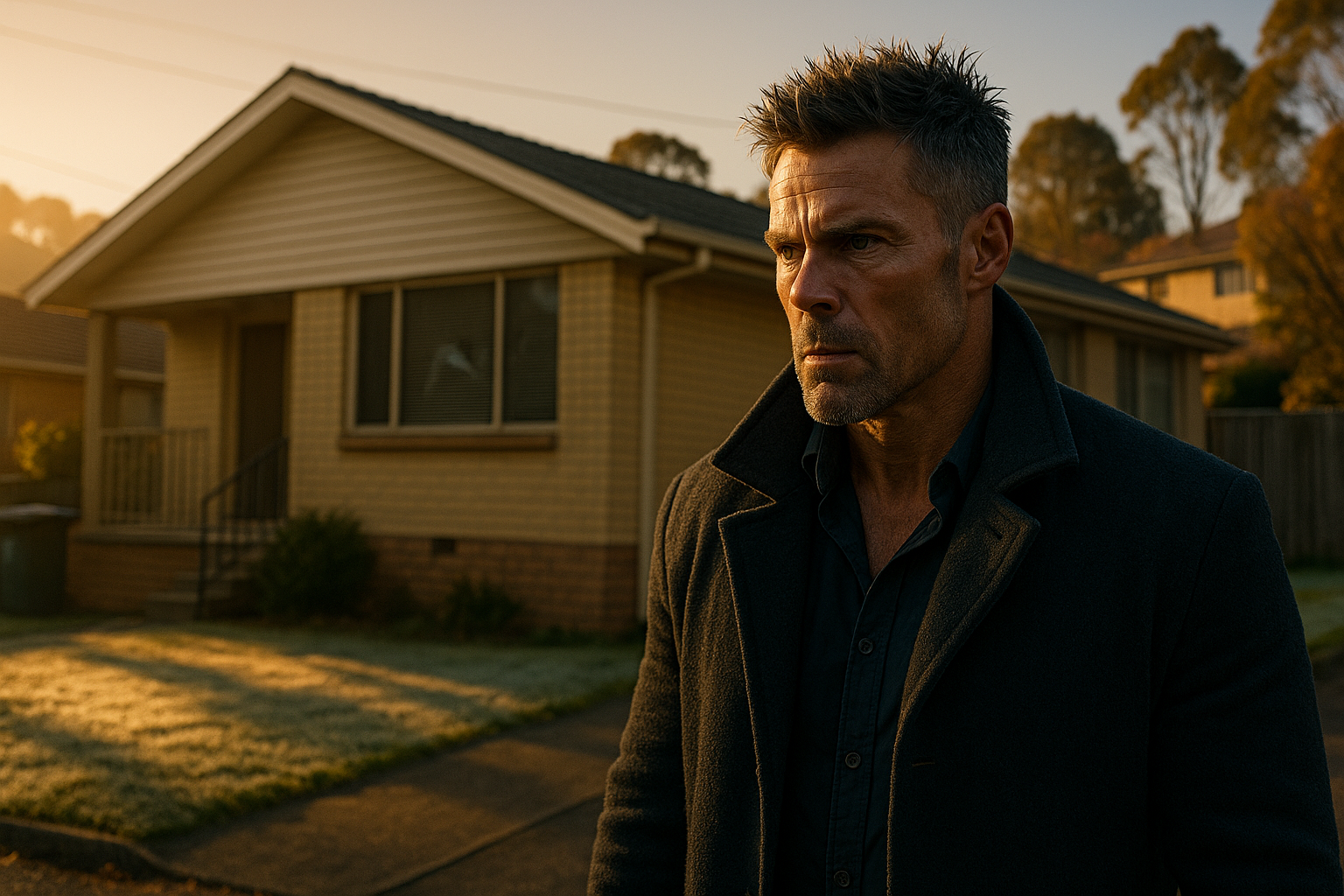
The first rays of dawn crept over the Berriedale hillside, brushing the landscape in quiet gold. It was a light that asked for nothing, slipping in through gum branches and between rooftops, stroking frost-covered lawns, arriving without ceremony. Light that promised nothing, that made no claims about the day ahead, that simply was.
My car, which had become a coffin of condensation and cramping joints, slowly began to illuminate from within. The transformation was gradual, almost reluctant—darkness yielding to grey, grey softening into amber. The condensation on the windows caught the growing light and turned it into something living, patterns of moisture that looked almost intentional, as if the car itself was trying to write messages I couldn't read.
Outside, the dark gave way to a milky grey that wasn't quite morning but wasn't night anymore either. That liminal space where the world held its breath. Shapes emerged from shadow—fences, bins, postboxes, flowerbeds rimmed with rime. Each object solidified as if being called into existence by the light itself. The eucalypts above the ridge stood black against a blush of amber sky, like watchmen outlined in watercolour.
I yawned involuntarily, my jaw cracking in protest. The sound was shockingly loud in the confined space, a percussion of bone and cartilage that echoed in my skull. The kind of yawn that comes from the marrow, not the lungs—soul-deep fatigue. The kind that signals the body's complete exhaustion, its stores depleted, its reserves drawn down to nothing.
I'd meant to last the night, and I had. That had been the goal, the line I'd drawn for myself hours ago when the concept of dawn had seemed abstract and distant. But now, even my thoughts were starting to stagger under the weight of exhaustion.
My body ached in ways I'd forgotten were possible. The driver's seat, which had seemed adequate at the start of the night, had revealed itself to be a medieval torture device cunningly disguised as automotive upholstery. Every vertebra announced its displeasure. My hips screamed. My shoulders had locked into positions that felt permanent. Even my scalp hurt, though I couldn't fathom why.
I told myself I'd stay just one more hour.
Just until full light. Just until the street woke properly. Just until I could be certain that what I'd seen—or thought I'd seen—during the night wasn't simply fatigue playing tricks with shadows.
And then sleep. Maybe two hours, tops. Enough to make it through whatever Claiborne was going to throw at me today. Enough to keep sharp. But not enough to dream. Never enough for dreams. Dreams brought back things I'd worked hard to keep buried, brought Queensland rushing back, brought Jamie's face before he fell, brought all the failures and fractures I'd accumulated over forty-two years.
My body ached as I stretched out in the driver's seat, attempting to reclaim some flexibility from joints that had seized during the long watch. Tendons popped with sounds like distant firecrackers. Joints cracked like ice breaking on the Derwent. The entire car echoed with the brittle percussion of cartilage realigning, a symphony of ageing and discomfort that reminded me I wasn't twenty-five anymore, wasn't thirty-five anymore, was dangerously close to an age where overnight surveillances in cars became something you paid for with days of recovery.
I pushed both hands forward to stretch my shoulders, trying to work out the knots that had formed between my shoulder blades, only to thump the steering wheel with the heel of my palm in a movement more forceful than intended.
Blaaarp.
The horn blared like a scream in a cathedral.
The sound was catastrophic. Obscene. It tore through the morning quiet with the subtlety of an air-raid siren, announcing my presence to every living creature within a hundred-metre radius. Birds exploded from trees. Somewhere down the street, a dog began barking with frantic insistence.
I flinched, startled by my own clumsiness, and smacked my head hard against the roof of the car in my haste to recoil.
Pain shot through my skull and across the bridge of my nose, white-hot and immediate. Stars burst behind my eyes. "Shit!" I hissed, clutching the crown of my head with both hands, the throbbing already beginning, and glancing around in mounting panic.
So much for surveillance.
Stillness.
No joggers materialising from around the bend. No curious neighbours emerging onto porches. No porch lights flickering on in response to the disturbance. Just the gradually settling echo of my stupidity bouncing off houses and fading into the awakening day.
I exhaled in relief, the warm breath clouding the windscreen again. My shoulders dropped. My pulse began to slow. The crisis, it seemed, had passed without consequence.
And then—
A movement.
Barely there. A whisper of motion so subtle it might have been imagined. Might have been a trick of the light, of fatigue, of a mind that had been staring too long at static scenes and had begun to invent motion where none existed.
The blinds.
Second-floor lounge. Left window. The one I'd been watching intermittently throughout the night, the one that had remained resolutely, absolutely still for hours.
They shifted.
Just slightly. Just enough. A displacement of vertical slats that suggested someone had touched them from behind, had created pressure that moved them fractionally out of alignment before releasing them back to their resting position.
I froze.
My breath caught in my throat. My hands, which had been rubbing my head, went still. Every muscle locked. In that instant, I became completely motionless, a predator that had spotted prey, or prey that had spotted a predator—I wasn't sure which.
And then—a face.
Just a sliver. Pale. Oval. A suggestion of features caught between the slats. The curve of a cheek. The shadow of an eye socket. The hint of hair. Not enough to identify, but enough to confirm: human. Alive. Watching.
Not a trick of the light. Not fatigue-induced hallucination. Not the pattern-seeking tendency of an exhausted brain imposing order on chaos.
A person. An actual human being, standing at that window, peering out through the gap they'd created in the blinds.
Watching me.
Then gone.
The face withdrew as quickly as it had appeared, perhaps faster. A magic trick performed in reverse—now you see it, now you don't. The blinds settled back into their precise, pristine arrangement.
But I'd seen it.
The certainty didn't build—it just arrived, absolute. This wasn't speculation anymore. This wasn't instinct or intuition or professional paranoia. This was fact.
Someone was in the house.
Not a hunch any more. Witnessed. Real. Verifiable by my own eyes, however briefly.
They'd been there.
Possibly watching me whilst I'd watched them. A Mexican stand-off conducted in silence and shadow, both parties aware of the other but neither acknowledging it. How long had they been standing there? Had they seen me arrive hours ago? Had they watched me move around the car, walk the perimeter, return to my position? Had they seen the horn incident and decided I was compromised, that my cover was blown?
Had I forced their hand? Or had I startled someone who wasn't meant to be seen at all?
The questions piled up faster than I could sort through them.
Adrenaline kicked my fatigue out of the car with violent efficiency and took its place at the controls. Every cell in my body came online simultaneously. Exhaustion vanished as if it had never existed. My vision sharpened. My hearing became acute. Even my sense of smell seemed heightened, picking up the stale coffee from hours ago, the metallic scent of cold metal, the faint trace of frost creeping through the car's inadequate seals.
My mind flicked through possibilities, too fast to land on any single one, cycling through options like a card dealer showing me hands I couldn't quite read.
Luke? Returning in the early hours from wherever he'd been, letting himself into his own house, disturbed by a car horn and checking to see what had caused it? Innocent behaviour, explainable, reasonable.
Jamie? Never having left at all, hiding in his own home whilst his sister reported him missing, whilst police conducted searches, whilst the investigation expanded? But why? What could possibly drive a man to fake his own disappearance so elaborately?
Kain? Hiding somewhere, biding time, waiting for something or someone? Another missing person, found but not ready to be found, adding layers of complexity to an already impossible situation.
Or someone else entirely—someone outside the official narrative, whose existence hadn't been accounted for in any of the statements or records or interviews. A fourth presence. A wildcard. Someone whose involvement changed the entire equation in ways I couldn't yet calculate.
I considered the implications, working through the logic with the methodical precision my training had drilled into me. If someone had been watching me... then they knew I was watching them. That changed everything. The rules of the game had shifted in that one second of eye contact, however indirect. The dynamic had altered fundamentally.
I was no longer just the observer, the detective conducting surveillance from a position of invisible authority. Now I was observed. Seen. Noted. Catalogued. My presence was known, my interest registered. Whatever advantage I'd thought I held through secrecy had evaporated with that movement behind the blinds.
Still, the breakthrough changed the trajectory of the entire case. The fundamental premise had shifted. A house long believed empty wasn't. A narrative centred on disappearance now invited the possibility of deception. People weren't missing—they were hiding. Or being hidden. The distinction mattered enormously.
Every instinct that had kept me here through the long night had just been earned out. Whatever else was true, the house was occupied—right now, this moment, someone breathing on the other side of those blinds.
I pulled out my notebook with hands still tingling from adrenaline, fingers clumsy with cold and excitement, and scribbled the time, the exact window, the position of the sun, the blind's movement—anything that might matter, every detail I could recall whilst the memory was still fresh. The pen moved across the page in my cramped handwriting, recording facts that might become evidence, observations that might become testimony.
6:47 AM. Second floor, left window (lounge). Blinds disturbed. Face visible approx 2-3 seconds. Pale, features indistinct. Withdrew quickly. Deliberate observation or startled response? Impossible to determine.
The words looked inadequate on the page, unable to capture the visceral impact of that moment, the way my heart had seized, the absolute certainty that flooded my system. But they were something. Documentation. Evidence of a sort.
I'd have forensics analyse those bins today. Push Claiborne for the warrant with new urgency, armed with this development. Leverage the face at the window into justification for a full interior search. This was no longer just instinct and suspicion—this was observed activity that suggested ongoing occupation of a residence connected to two missing persons cases.
Whatever was inside that house—whoever—they were running out of places to hide.
And I was out of reasons to wait.
The procedural path forward was clear. Document what I'd seen. Return to the station. File a report. Brief Claiborne. Request immediate warrant based on confirmed occupation. Assemble a proper team. Return with backup and legal authority. Do this by the book, the right way, the way that would hold up in court and keep my career intact.
But even as I thought it, I knew I wouldn't follow that path. Couldn't. Something deeper was driving me now, something that had nothing to do with procedure and everything to do with how far back this actually went.
