4338.211 · July 30, 2018 AD
The Doorstep
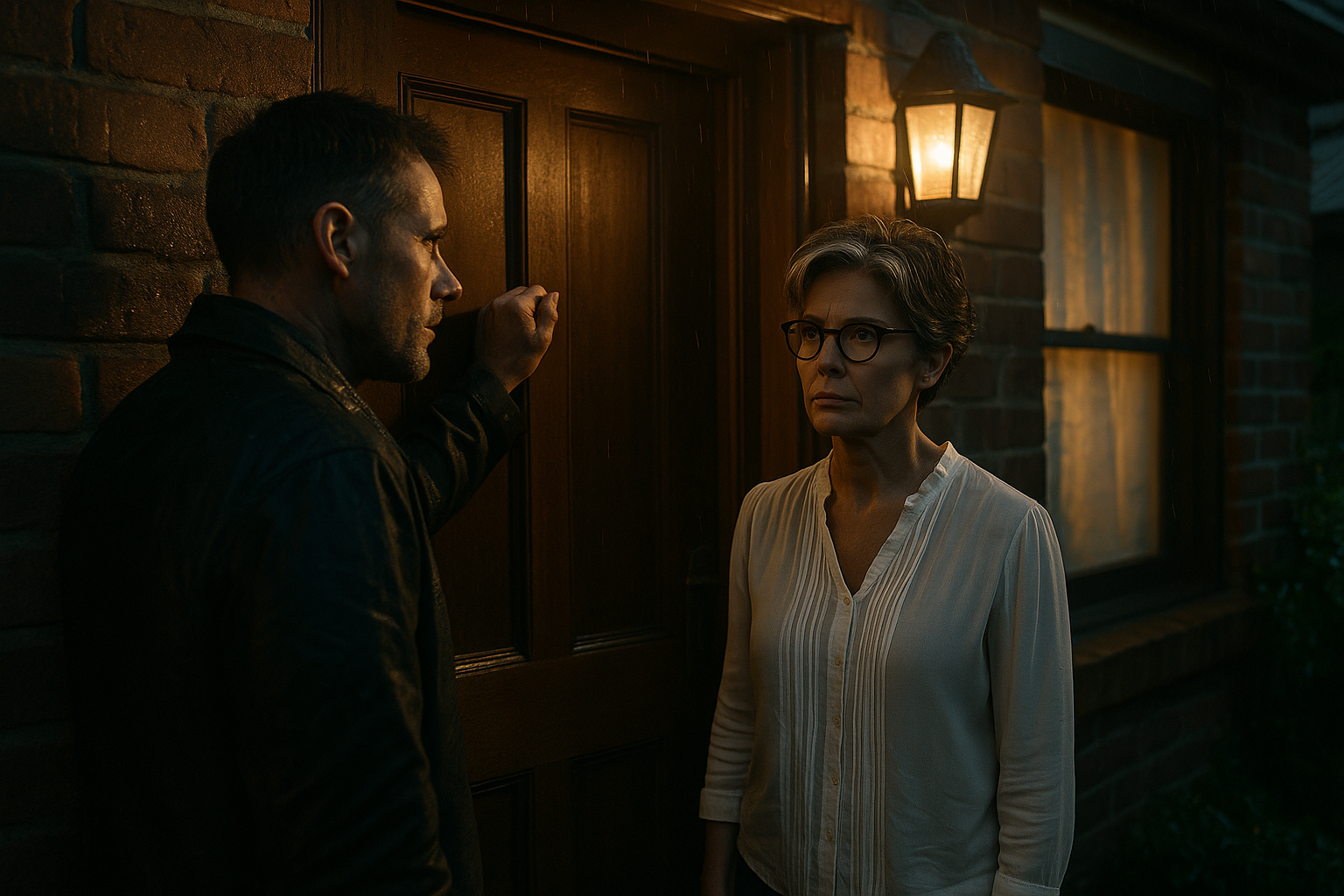
Drawn by an impulse he can’t explain, Karl returns to the Cramer residence after years of silence. What he finds isn’t cooperation but hostility — and a reminder of wounds that never healed. Turned away by Wendy Cramer, Karl’s last lead collapses into doubt. But as he turns back to his car, a shadow moves in the upstairs window — at least he thinks that's what he saw.
“Some doors don’t stay closed because of the locks. They stay closed because of what’s waiting behind them.”
As I pulled up outside the Cramer residence, a wave of anxiety washed over me, rising from my gut to my chest in a cold surge that made my breath catch. The sensation was almost nauseating—my stomach churning with acid and dread in equal measure, the combination creating a sick feeling that threatened to overwhelm me completely. My hands trembled slightly as I cut the engine, fingers fumbling with the key like I’d forgotten this simple mechanical task I’d performed thousands of times.
The street was quiet in that particular way residential areas become after dark—a few scattered porch lights casting pools of amber illumination on the wet road that reflected the light back like mirrors, doubling the glow and creating the illusion of more warmth than actually existed. A cat moved somewhere in the shadows between houses, visible only as a dark shape against darker background.
I should have felt relief at reaching my destination. Instead, I felt nothing but mounting dread.
The house itself stood like a preserved memory from another time—modest, unassuming in the way houses built in the seventies often were. A two-storey brick structure with a small, well-tended garden that glistened under the streetlights, every leaf heavy with accumulated rain that made them droop towards earth. The lawn was neatly trimmed despite the weather, edges sharp and precise in a way that spoke of habitual care. Garden gnomes stood in formation near the path, their painted faces cheerful in a way that felt almost mocking given my current state.
On any other night, from any other perspective, it might have looked inviting—the kind of home that promised warmth and welcome, where families gathered and life proceeded with comfortable predictability. The kind of home where you’d expect to find fresh biscuits and offered tea, where conversation flowed easily and visitors were smiled upon.
Tonight, approaching it felt like walking into the past. Into judgement. Into confrontation I was utterly unprepared for despite being the one who’d chosen to come here.
Nothing about its exterior suggested the emotional minefield it represented for me personally, yet the very sight of it was charged with the weight of my past interactions with Beatrix’s family. Interactions that had not gone well, to put it with grotesque understatement. The memory surfaced vivid and unwelcome despite my attempts to suppress it, rising like something dead that refused to stay buried.
The last time I had stood on this doorstep—three years ago—my words had been met with fury that had shocked me with its ferocity. My presence had been treated like an insult and a violation, like I’d brought contagion with me that threatened to infect their entire household. Brett’s face had been reddened with rage, jaw clenched so tightly I’d genuinely feared he might crack a molar, spittle flying as he’d shouted me down in this very driveway whilst neighbours watched from behind curtains and pretended not to hear.
"You’ve done enough damage! You’ve taken enough from this family! Get the fuck off my property before I call the police—oh wait, you ARE the fucking police, aren’t you? Well here’s something your badge can’t protect you from!"
I’d thought he might actually hit me. Part of me had wished he would—at least physical violence would have been straightforward, something I could respond to with procedure and protocol. But he’d just stood there, shaking with rage, whilst Wendy had positioned herself just behind him like a second line of defence. Her arms had been crossed defensively, expression carved from granite, every line of her body communicating refusal and condemnation.
Their message had been unambiguous, delivered plainly enough that there could be no misunderstanding: never come back.
Three years had passed since that confrontation. Time enough to heal wounds—or to bury them deeper where they could fester and rot and transform into something even more toxic than the original injury. I didn’t know which I’d find tonight. Didn’t know if the passage of time would have softened their anger or simply given it time to calcify into something harder and more permanent than rage.
Probably the latter, if I was being honest with myself. Some things didn’t heal with time. Some wounds were designed to stay open.
I sat in the car a moment longer, trying to summon the resolve that had carried me through countless interrogation rooms and crime scenes over the years. The professional detachment that let me walk into hostility and violence without flinching, that armoured me against the worst humanity had to offer. But I couldn’t find it. Couldn’t access that part of myself that knew how to compartmentalise and proceed despite discomfort.
All I could feel was exhaustion so profound it had moved beyond physical tiredness into something more existential. Like my soul was tired. Like I’d been running on empty for so long I’d forgotten what full felt like, and now the tank was completely dry and I was coasting on momentum alone.
My reflection in the rear-view mirror offered little encouragement. I looked like hell—worse than hell, actually. Hell at least had the excuse of being eternal damnation. I just looked like someone who’d been systematically destroying himself through poor decisions and lack of sleep. Shadowed eyes with darkness beneath them that spoke of more than just this one punishing day. Stubble that had crossed the line from fashionable to concerning. Hair that stuck up at odd angles from where Sarah’s hands had gripped it, from the fresh shirt I’d pulled on too hastily, from running my own fingers through it repeatedly during the drive here.
I looked like someone who’d come to deliver bad news, not ask a favour. Like someone who shouldn’t be trusted, who’d proven himself untrustworthy through actions that were written clearly across haggard features for anyone who cared to look.
Like someone who, less than an hour ago, had been inside his partner, and had then immediately pushed her out of his car into the night without explanation or kindness or even basic human decency.
The guilt that I’d been suppressing during the drive here rose up again, sharper now, combining with the anxiety to create a toxic cocktail that churned in my gut. Sarah’s face when I’d pushed open her door. The hurt in her eyes. The way she’d slammed the door hard enough to make the whole car shake. "You can be such a prick sometimes, Karl."
Sometimes? Try always. Try consistently. Try with such reliable frequency that it had become my defining characteristic.
But I had to do this. The compulsion was still there—had not diminished during the drive, had not been satisfied by arrival. If anything, it had intensified the closer I’d gotten to this address, pulling me forward despite reason and history and the very clear memory of being told never to return. It thrummed beneath my skin like a second heartbeat, insistent and undeniable.
Beatrix. I need to see Beatrix.
The need felt external, like it was being broadcast into my skull from somewhere outside myself. Which was insane. Which meant I was probably losing my mind. Which wouldn’t be surprising given the hallucinations and the exhaustion and the mounting evidence that my grip on reality had become dangerously tenuous.
But I couldn’t fight it. Could only follow where it led and hope I wasn’t walking into complete disaster.
With trepidation that made my movements slower and clumsier than they should be, I approached the front door, gravel crunching beneath my shoes with each step—small sounds that seemed far too loud in the residential quiet, announcing my presence to anyone listening. The porch light wasn’t on—perhaps deliberately so, perhaps just forgotten—forcing me to navigate by the spillover glow from neighbouring houses.
Each step felt like wading through water, resistance building the closer I got to the door. My legs felt heavy, muscles protesting movement after the day’s exertions. The forest chase. The desperate search for Gladys. The car park. Everything had taken its toll, and my body was presenting the bill with compound interest.
My knocks were almost timid when they finally came, hesitant in a way that was completely unlike me—three soft raps that barely disturbed the silence and which could easily be ignored if the occupants chose not to answer. Part of me hoped they wouldn’t answer. Part of me wanted to turn around and leave, to flee back to the car and drive away and forget this entire ill-conceived mission.
But I couldn’t. The pull wouldn’t let me. So I stood there, waiting, whilst my heart hammered and anxiety built to crushing levels.
I had barely finished the third tap when the door swung open with unexpected swiftness, as though someone had been waiting just on the other side—watching through the peephole, perhaps, preparing their response, gathering their anger in preparation for deployment. Light from the hallway spilled out in a rectangle, briefly blinding me after the relative darkness, making me squint and blink rapidly whilst my eyes struggled to adjust.
When my vision cleared enough to make out details, I found Wendy’s silhouette framed in the doorway. She was smaller than I remembered—more compact, as though age had compressed her somehow, drawing her inward. But what she lacked in physical stature she more than compensated for in the sheer hostility radiating from her frame.
Her face—visible now as my eyes adjusted to the light—was carved from displeasure and old resentment. Lips pressed into a thin line. Eyes narrowed with immediate recognition and equally immediate rejection. Every line of her body communicated one clear message: you are not welcome here.
"Fuck off, Karl," Wendy snapped, her voice harsh and utterly unwelcoming, the profanity shocking from a woman who’d always seemed prim in our previous interactions. Who’d always been proper and polite in that way older women often were, maintaining standards that younger generations had abandoned.
She moved to close the door almost as soon as she had opened it, the motion swift and decisive—not slamming it, but shutting it with firm purpose that left no room for negotiation.
"Wendy, wait!" I called out instinctively, my hand shooting out to stop the door just inches from closing completely in my face. My palm connected with the painted wood harder than intended, the impact sending a jolt up my arm that rattled my teeth and made my shoulder joint protest. Pain bloomed immediately—sharp and clarifying in a way that cut through some of the fog.
I pushed gently against the door, trying to keep it open whilst not being aggressive, not escalating what was already clearly hostile. But Wendy countered with firm resistance that was surprisingly effective given our size differential. Despite her age—she had to be in her sixties now, possibly older—there was real strength in her opposition, strength born of righteous anger and protective instinct and three years of accumulated resentment that had been waiting for an outlet.
The door became a contested space between us, both of us pushing in opposite directions, locked in a stalemate that was almost absurd in its physicality.
"You don’t get to call me Wendy," she retorted, her voice laced with bitterness that had clearly accumulated over years, that had been building since long before our confrontation three years ago. This wasn’t just about that one incident—this was deeper, older, more fundamental. "You lost that privilege. You lost any right to familiarity when you—" She cut herself off, jaw clenching, apparently deciding that finishing that sentence would give me more than I deserved.
"Mrs Cramer, please," I pleaded, abandoning any pretence of professional detachment, my voice desperate in ways I hadn’t intended and couldn’t prevent. "I need to speak with Beatrix. It’s urgent."
The word urgent carried weight I couldn’t fully articulate. Not just professionally urgent—though the investigation certainly qualified. But personally urgent. Existentially urgent. Like something fundamental depended on this conversation happening, like I couldn’t move forward until I’d seen her, spoken to her, confirmed that she was real and not another hallucination conjured by my deteriorating mental state.
There was a momentary pause in the physical struggle over the door—a slight easing of the pressure that gave me hope for approximately half a second. Something in my tone must have registered with Wendy, must have cut through her anger enough to create doubt. Perhaps the genuine desperation that couldn’t be faked, or maybe just the uncharacteristic humility of the plea. Maybe she heard something broken in my voice that made her pause, made her wonder if this really was urgent in ways that transcended our personal history.
For a heartbeat, I thought she might actually relent. Might remember some vestige of when we’d been on better terms, before everything had gone wrong, before I’d become persona non grata in this household.
"She’s not home," Wendy stated firmly, voice flat and final in a way that suggested this wasn’t negotiable, wasn’t open for discussion or persuasion. Her eyes narrowed with renewed suspicion, searching my face—looking for deception or ulterior motive, trying to determine whether I was telling the truth about urgency or simply manipulating her.
I couldn’t tell if she was lying about Beatrix’s whereabouts. Couldn’t read her well enough to know if this was truth or protective fiction designed to get rid of me. The uncertainty was maddening, especially given how far I’d come, how much I’d sacrificed to get here.
Sarah’s face flashed in my mind again. The hurt. The confusion. The way I’d literally pushed her away. All of it for this—for a closed door and a hostile reception and no answers whatsoever.
But then, catching me off guard despite the warning signs, despite the clear trajectory of this interaction heading towards outright refusal, Mrs Cramer gave the door a final, decisive shove that used her full body weight. She must have braced herself, must have planted her feet and pushed with every ounce of strength she possessed.
The edge of the door caught my shoulder—a solid blow that would definitely bloom into a spectacular bruise by morning. Pain exploded through the joint, sharp and immediate, making me gasp and stagger backwards. My hand fell away from the door automatically, self-preservation overriding determination, and the door slammed shut in front of me with finality.
The sound of the deadbolt sliding into place felt like a full stop to any hope of cooperation, of resolution, of answers. Metal sliding into metal with decisive click that said this conversation is over.
I stood there, stunned by the brutality of it, by the sheer physical dismissal I’d just experienced. Frustration and defeat rolled through me, hot and cold alternating, making me dizzy, making the world tilt slightly beneath my feet. My shoulder throbbed in time with my heartbeat, adding another layer of pain to the migraine that was building behind my eyes.
My lead—my only real lead, the urge that had driven me here so insistently—seemed to evaporate with that closed door like morning mist under sunlight. The conviction that had felt so strong, so undeniable during the drive here, suddenly seemed foolish and inexplicable now that I stood here rejected on a darkened porch with nothing to show for it but a bruised shoulder and accumulated humiliation.
What had I expected? A warm welcome after three years of silence? Forgiveness for past mistakes I could barely remember but which clearly loomed large in the Cramer family consciousness? Information freely given despite our obviously poisonous history?
Yes. Somehow, against all logic and evidence, some part of me had expected exactly that. Had expected the compulsion to mean something, to lead somewhere, to result in revelation rather than rejection. Because otherwise what had been the point? Why had I felt so certain this was necessary? Why had I abandoned Sarah—hurt her, used her, dismissed her—if it was all leading to this: standing alone on a porch whilst a door slammed in my face?
I took a moment, standing there in darkness on the Cramers’ doorstep like a complete fool, collecting my scattered thoughts and trying to reassemble them into something resembling coherence. The cold night air raised goosebumps on my arms beneath the fresh t-shirt I’d changed into, the thin cotton inadequate against the chill that followed rain. I should have grabbed my jacket from the car. Should have planned better. Should have done a lot of things differently.
Damp from earlier precipitation still clung to the ground and to the soles of my shoes, making each small shift of weight produce a squelching sound that seemed obscenely loud. The scent of wet earth rose around me, organic and immediate, smelling of decay and growth happening simultaneously, life and death mixed together in soil.
A dog barked in the distance, the sound echoing between the rows of quiet houses and reminding me of Jargus waiting at home. He’d be wondering where I was, when I was coming back, whether I’d abandoned him the way I seemed to abandon everyone eventually. The thought created another spike of guilt that I didn’t have room for, that couldn’t fit into the already-overfull container of emotions I was barely managing.
The pressure in my head, which had ebbed somewhat during the drive here, began to return—a low, pulsing throb at my temples that spoke of a building migraine. Not just building—actively arriving, claiming territory, establishing dominance. The pain radiated outward from a point just behind my right eye, spreading across my forehead in waves that made my vision blur slightly at the edges.
The image of the woman in the toilet block flared again in my mind, unbidden and intrusive, refusing to be dismissed no matter how I tried. The silver hair catching torchlight with unnatural brilliance. The crouched posture in that impossible space. The way she’d looked at me—through me, into me—with recognition I couldn’t understand. The way she’d simply vanished when I’d looked away for a second, disappearing as completely as if she’d never existed.
Had that been Beatrix? If so, why was she running from us? What was she running from? And if it wasn’t her—if it was hallucination or some other woman or something my exhausted brain had conjured—then who the hell had I seen? What did it mean that I was seeing things that weren’t there, that I couldn’t trust my own perceptions anymore?
My footsteps were heavy as I retreated down the garden path, each one taking me further from answers I hadn’t even managed to formulate proper questions for. The gravel crunched beneath my shoes with sounds that seemed like small accusations, like the earth itself was judging me for my failures.
The car waited like a faithful animal, indifferent metal and glass that asked nothing of me and offered nothing in return. Just transportation. Just machinery. Just a box to sit in whilst I tried to figure out what the hell came next.
As I reached for the door handle—fingers closing around cool metal that felt solid and real in a way nothing else did right now—I cast one last glance back at the Cramer house, unable to help myself. Some instinct made me look, some feeling that I was being observed, that I wasn’t as alone as I thought.
For a moment, I thought I saw a figure at the upstairs window—a silhouette taller than Wendy’s slight frame, standing motionless behind the curtains, observing my departure with what might have been curiosity or might have been satisfaction or might have been something else entirely. The shape was indistinct, backlit by dim light from within the room, but definitely present. Definitely real.
My breath caught in my throat, hope and dread mingling into something that tasted metallic and sharp. Beatrix. It had to be Beatrix. She was home, and Wendy had lied, and she was watching me leave, and—
But when I looked again, focusing properly, squinting against the darkness and trying to make out details, the curtains were drawn tight across the window with no gap for observation. The house once again presented only its impassive exterior to the world—brick and glass and paint, nothing more. No movement. No silhouette. No evidence that anyone had been watching at all.
Had I imagined it? Was exhaustion making me see things that weren’t there, hallucinations building on hallucinations until I couldn’t distinguish real from imagined?
Or had someone been there—someone who’d stepped back from the window the moment I’d noticed them, someone who was now standing just behind those curtains waiting for me to leave?
I couldn’t be sure of anything anymore. Couldn’t trust my own perceptions when they’d been proven unreliable so many times today. Couldn’t separate truth from exhaustion-fuelled delusion when the line between them had become so thoroughly blurred.
The only thing I knew for sure was that I was standing alone in the dark outside a house that didn’t want me, that had shut me out thoroughly, that offered no answers and no comfort and no resolution to the chaos spinning inside my skull.
I opened the car door and slid inside, pulling it closed with a sound that felt like sealing myself into a tomb. The interior still smelled faintly of Sarah—her perfume, her skin, the lingering evidence of what we’d done. The scent was a reproach, a reminder of what I’d sacrificed to come here, of what I’d destroyed for absolutely nothing.
I sat there for a long moment, hands on the steering wheel, staring at nothing, trying to summon the energy to start the engine and decide where to go next.
Home? The station? Somewhere else entirely?
I had no idea. Had no plan. Had nothing but exhaustion and confusion and the growing certainty that I was in way over my head, drowning in circumstances I couldn’t understand or control, losing my grip on everything including my own sanity.
The migraine pulsed in time with my heartbeat, and in the throbbing rhythm I thought I heard a whisper—soft and insistent and impossible to quite make out.
Beatrix.
Still calling. Still pulling. Still demanding something I couldn’t give and didn’t understand.
I closed my eyes, rested my forehead against the steering wheel, and tried very hard not to think about anything at all.
